
In this guide on the top NotebookLM alternatives in 2026, we look at the best tools that can replace or enhance your document analysis and note-taking workflow with powerful AI.
Short version first: if you are on a Mac and care about privacy, Elephas is the strongest pick because it works offline.
If you want a free option, Open NotebookLM and Bohrium are the ones to try. The rest of this guide breaks down all ten so you can match a tool to your own work.
Here's what we cover:
- What is the best NotebookLM alternative
- Detailed reviews of each NotebookLM alternative
- Pricing comparison and what each tool is best for
- Free vs paid options at a glance
By the end you will have a clear idea of which NotebookLM alternative fits your needs, budget, and workflow.
Quick answer
- The best NotebookLM alternative for Mac users who want privacy is Elephas, because it runs offline with built-in local LLM models and keeps your files on your device.
- The best free alternatives are Open NotebookLM (open-source PDF to podcast) and Bohrium (search across 160M+ research papers).
- For academic research with citations, Anara and Afforai are the strongest picks.
- Only Open NotebookLM matches NotebookLM's audio podcast output. Most alternatives focus on chat and writing instead.
- For confidential files, a private Mac alternative like Elephas keeps your data on your device. Pricing starts at $19 a month with a free trial.
Is Gemini Notebook the Same as NotebookLM?
Yes. Google renamed NotebookLM to Gemini Notebook on July 16, 2026. Same tool, same plans, same limits: only the name and the address changed, and old notebooklm.google.com links redirect to notebook.google.com automatically. Google's reason for the change is simple: it wants one Gemini brand across all of its AI products. This guide uses both names.
What is the best NotebookLM alternative?
Elephas is the best NotebookLM alternative for users who want privacy and offline control. It chats with your own documents through a knowledge base called Super Brain.
It can run fully on your Mac using built-in local LLM models, so your data does not leave the device. You can also bring your own key for cloud models like ChatGPT 5.5 or Claude Opus 4.7 when you want more power.
Its Mac integration, including Apple Notes sync, plus writing assistance and workflow automation, makes it a strong all-rounder.
The Super Brain feature builds a knowledge base that rivals NotebookLM while keeping your data on your own machine.
Which NotebookLM alternative is free?
Open NotebookLM, Bohrium, and Microsoft OneNote are free to use. Open NotebookLM turns PDFs into podcasts, Bohrium searches 160M+ research papers, and OneNote handles collaborative notes.
Elephas is the pick if you want privacy and offline processing rather than a free cloud tool. You can try Elephas for free too, with paid plans starting at $19 a month.
Top 10 best NotebookLM alternatives in 2026
| Alternative | Best feature | Free tier? | Pricing |
|---|---|---|---|
| Elephas | Offline functionality with built-in local LLM models and Mac integration | Free trial | From $19/month |
| Open NotebookLM | PDF to podcast conversion with multi-language support | Yes | Free |
| Afforai | All-in-one research workspace with 10,000+ citation styles | Limited | $16/month |
| The Drive AI | Multi-format file support with team collaboration | Limited | $19.99/month |
| Anara | Referenced AI chat with citations for academic research | Limited | $20/month |
| Bohrium | Literature search across 160M+ research papers | Yes | Free |
| Claude Projects | Custom workspaces with document knowledge base | Limited | $20/month |
| Microsoft OneNote | Real-time collaboration with handwriting support | Yes | Free |
| Notion AI | Smart writing assistant with document chat | Limited | $10/month |
| MyMind | Visual search with privacy-first design | No | $7.99/month |
Prices are accurate as of June 2026 and can change, so each tool's own pricing page is the live source.
1. Elephas, best for Mac privacy and offline use
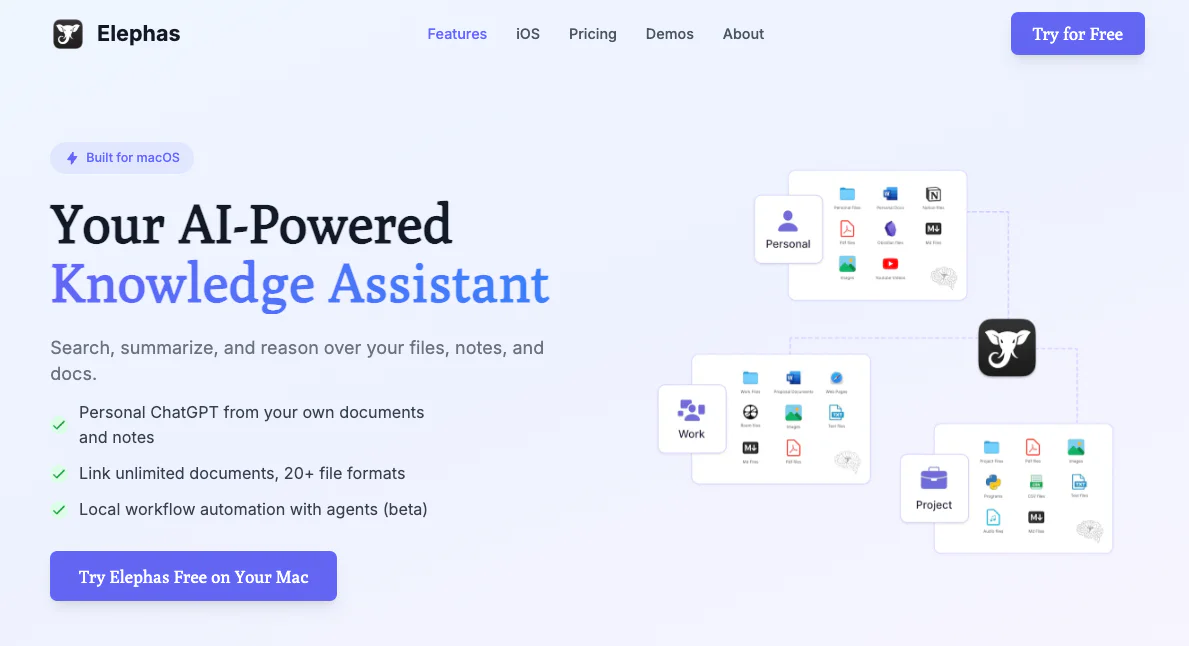
Elephas is a privacy-first AI knowledge assistant for Mac. It changes how you capture, organize, and access information on your device, and it can work fully offline so your data stays private.
The platform combines a personal knowledge base called Super Brain with writing features and workflow automation.
You can bring in your existing notes from Apple Notes, Obsidian, and other apps while choosing which AI model runs your work.
You can also run Elephas with cloud models like ChatGPT, Claude, or Gemini using your own key. When you do, Smart Redaction removes personal details before the text leaves your Mac, then restores them locally in the answer. It works on every plan, including Free.

Key features
- Offline functionality: Run AI features fully offline with built-in local LLM models to keep your data on your device
- Multiple AI providers: Bring your own key for ChatGPT 5.5, Claude Opus 4.7, Gemini, and others (sensitive details redacted before sending), or stay fully offline with the built-in local models
- Super Brain knowledge base: Build a personal repository from many sources with automatic organization
- Apple Notes integration: Sync your Apple Notes with Super Brain without copy and paste
- Agent Mode (beta): Automated workflows that decide the steps and run them for you
- Writing features: Grammar fixes, content rewrites, smart replies, and continue writing
- App integration: Works with Notion, Obsidian, DevonThink, and other note apps
- Smart Redaction: Cleans personal details out of your text before any cloud model sees it, on every plan including Free
Pros
- Works offline for maximum privacy
- Multiple AI providers and models to choose from
- Good Mac integration with Apple Notes and other apps
- Writing assistance with multiple rewrite modes
- Workflow automation with agent-based tasks
- Smart Redaction protects sensitive text sent to cloud models
- Supports many file formats including CSV and JSON
Cons
- Only available for Mac users
- No audio podcast generation
Why it's the best alternative to NotebookLM
Elephas stands out for offline privacy, multiple AI provider choices, and Mac integration including Apple Notes.
It does not have audio podcast generation, but it gives you writing assistance, workflow automation, and the option to keep your sensitive data on your own Mac.
Pricing
Elephas pricing starts at $19/month, with a free trial. Check the Elephas pricing page for the live list.
Customer reviews
I couldn't really be happier, it pretty much made my workflow faster. Made my project way easier and I finished 5 more in 1/3 the time it normally would have taken me. If you have a specialized knowledge base, Elephas's Brain makes it way better. Capterra
I like experimenting with what Elephas is capable of. It needs some setup, but it is so powerful that I like to see how it helps me be more productive. Capterra
2. Open NotebookLM, best free PDF-to-podcast tool

Open NotebookLM is a free, open-source project (not affiliated with Google) that turns your PDF documents into podcast-style audio.
It uses AI models to read your PDF files and create a natural conversation between two speakers.
The tool takes your uploaded PDF and converts it into a dialogue, then uses text-to-speech to create an MP3 that sounds like a podcast about your document.
Key features
- PDF to podcast: Upload a PDF and get a podcast-style audio file with two speakers
- Multi-language support: Create podcasts in 13 languages
- Open source: Built with open models for text and speech
- Simple interface: Easy web interface anyone can navigate
- Free access: Free to use with no subscription
Pros
- Completely free and open-source
- Easy to set up and use
- Creates engaging audio content
- Supports multiple languages
- Can be customized since it's open source
Cons
- Only works with PDF files
- Requires technical setup for local use
- Limited features compared to NotebookLM
- No collaborative features
Why it's a good alternative to NotebookLM
Open NotebookLM is great if you only want to create audio podcasts from your PDFs for free. You cannot chat with your documents or ask questions like you can with NotebookLM. It only makes audio. For a full walkthrough, read our Open NotebookLM review.
Pricing
Free to use.
3. Afforai, best for references and academic writing

Afforai is a complete workspace for research and writing that brings your tools together in one place.
It helps you manage references, annotate files, write papers, and research a topic without jumping between apps.
The platform combines document writing, reference management, file annotation, and AI research tools. You can upload sources, take notes, get citations, and write your final paper in the same workspace.
Key features
- Document writer: Write papers with automatic citation formatting and bibliography generation
- Reference manager: Store sources with support for PDFs, Word docs, web links, and 10,000+ citation styles
- File annotator: Highlight, comment, and add notes to PDFs with AI help
- AI research assistant: Search your library or a large academic paper database
- Collaboration tools: Share libraries and tag colleagues on projects
- Multi-format support: Import from other reference managers and work with EPUB, DOI, URL, PDF, and DOCX
Pros
- All-in-one research and writing workspace
- Strong citation system with 10,000+ styles
- Good collaboration features
- AI research through a large academic database
- Imports from existing reference managers
Cons
- Learning curve for new users
- No audio generation
- Focused on academic writing
- No mind mapping or timeline features
Why it's a good alternative to NotebookLM
Afforai is strong at full research workflows with reference management, collaborative writing, and academic database access. It focuses on traditional writing rather than NotebookLM's interactive chat and audio podcasts.
Pricing
$16/month.
Customer reviews
Good, from the informed welcome message to the use of features supported by info notes. It is a positive experience, still learning some features. Capterra
4. The Drive AI, best for multimedia team collaboration

The Drive AI is a smart workspace that combines file storage, AI chat, and team collaboration. You can upload videos, audio, images, PDFs, and YouTube links, then ask questions about your content and get instant answers.
It works like a smart file manager with built-in AI that reads and understands your documents. It also includes team chat and real-time writing tools.
Key features
- File intelligence: Chat with videos, audio, images, and PDFs for instant insights
- AI-powered analysis: Answers grounded to your sources with citations and timestamps
- Team collaboration: Chat channels per document and folder with real-time messaging
- AI writing assistant: Multi-model support with context-aware suggestions
- Real-time editing: Live cursors, track changes, and instant sync
- Smart organization: Automatic file categorization with AI
Pros
- Works with video and audio files
- Strong team collaboration features
- AI writing assistance with multiple models
- Real-time collaborative editing
- Smart file organization and search
Cons
- No audio podcast generation
- Limited study tools like mind maps
- No public sharing of notebooks
- No offline access to files
Why it's a good alternative to NotebookLM
The Drive AI is strong at team collaboration with chat, real-time editing, and multi-format file support including video and audio. It lacks NotebookLM's podcast generation and study tools like mind maps and timelines.
Pricing
$19.99/month.
Customer reviews
I've been using The Drive AI for a while, and the AI-powered smart storage has made finding and organizing files a breeze. Product Hunt
It is a snazzy little tool that lets you do a lot of things in a single place. Product Hunt
5. Anara, best for cited academic research

Anara is an AI tool built for researchers and academics. It helps you quickly understand research papers, books, audio recordings, and handwritten notes while keeping everything organized with clear citations.
The platform focuses on accuracy by only using sources you upload and linking every AI response back to the original document. That makes it easier to verify information and avoid citation mistakes.
Key features
- Referenced AI chat: Answers with clickable citations back to your sources
- Multi-format support: Upload PDFs, handwritten docs, audio/video, and images
- Group analysis: Organize papers into groups for cross-referencing
- AI writing assistant: Find citations, paraphrase, and autocomplete
- Collaborative research: Shared workspaces with real-time editing
- Multi-language support: Available in 90+ languages
Pros
- Strong citation system with direct source linking
- Built for academic research workflows
- Supports handwritten and poorly formatted documents
- Multiple AI models available, including Claude and Gemini
- Good collaboration features
- Works with audio and video content
Cons
- No audio podcast generation
- No mind mapping or timeline visualization
- No study guide creation
- Only works with uploaded sources (no web search)
Why it's a good alternative to NotebookLM
Anara is strong at academic research with citation control and cross-document analysis. It lacks NotebookLM's broader content support, audio podcasts, and study tools like mind maps.
Pricing
$20/month.
Customer reviews
Anara keeps things grounded, only using your uploaded sources and linking every claim to a citation. The group feature is useful for lit reviews and large reading lists. Effortless Academic
Strong on advertising but the features sit behind a paywall, with a low upload limit on the lower tier. Trustpilot
6. Bohrium, best for searching research papers

Bohrium is an AI academic research platform that helps researchers and students find, analyze, and organize scientific literature. It searches over 160 million research papers to help you build literature reviews and discover relevant studies.
It combines search with AI analysis to make academic research faster. You can chat with papers, create personal libraries, and get summaries of complex content.
Key features
- Advanced literature search: Search 160M+ research papers with natural language
- Interactive paper chat: Ask about methodologies, findings, and research gaps
- Personal library: Save and organize papers for ongoing projects
- Search filters: Filter by year, citation count, and journal impact
- Scholar profiles: Follow researchers and get updates on their work
- Interactive diagrams: Visual elements to help understand topics
Pros
- Massive database of 160M+ research papers
- Natural language search
- Interactive chat with individual papers
- Strong citation tracking
- AI summaries for quick paper understanding
Cons
- Limited to academic and scientific content
- No audio generation or podcast features
- No collaborative editing
- No support for non-academic document types
Why it's a good alternative to NotebookLM
Bohrium is strong at academic research with its paper database, paper chat, and scholarly filters. It lacks NotebookLM's broader document support, audio podcasts, and general study tools.
Pricing
Free to use.
Customer reviews
It is a good product. An AI that focuses on research is a great help to the community. Product Hunt
Finally, an AI tool that understands scientific research. It does not just search papers, it helps me think. Product Hunt
7. Claude Projects, best for custom AI workspaces

Claude Projects is a feature within Claude, the AI assistant from Anthropic. It lets you create custom workspaces by uploading documents and setting instructions for how Claude responds.
You upload multiple documents related to your work and chat with all of them together. You can set instructions for how Claude analyzes and responds, which makes it better suited to specific tasks than regular Claude chat.
Key features
- Custom workspaces: Dedicated project spaces with uploaded documents and instructions
- Document knowledge base: Upload and chat with multiple documents at once
- Custom instructions: Set guidelines for how Claude responds
- Collaboration: Work with team members in the same project
- Extended context: Handle more documents and longer conversations
- Persistent memory: Remembers documents across sessions in the project
Pros
- Better memory retention than regular Claude chat
- Custom instructions for consistent responses
- Upload multiple documents for analysis
- Collaboration features for teams
- Runs on Claude Opus 4.7
Cons
- Limited to text-based documents
- No audio generation
- Cannot share projects publicly like NotebookLM
Why it's a good alternative to NotebookLM
Claude Projects is strong at focused workspaces with custom instructions and document analysis. It lacks NotebookLM's audio podcast generation. For a deeper look at how it compares, read NotebookLM vs Claude.
Pricing
$20/month.
Customer reviews
Claude provides strong coding help. The interface is intuitive and flexible, letting you bring in your own documents and photos for a true multi-modal experience. Capterra
It sometimes contradicts itself on simple logic, which can be frustrating. Trustpilot
8. Microsoft OneNote, best for Microsoft ecosystem users

Microsoft OneNote is a digital note-taking app that gives you one place to keep your notes, research, plans, and information. It works like a digital notebook you can access from any device.
You create notebooks with sections and pages to organize content. You can type notes, draw, record audio, clip web pages, and work with others in real-time. You can also use Microsoft Copilot with OneNote to summarize documents and ask for citations.
Key features
- Digital notebooks: Organized notebooks with sections and pages
- Real-time collaboration: Work on the same notebook with instant syncing
- Web clipping: Save articles, images, and pages into notebooks
- Handwriting and drawing: Write by hand or sketch with a stylus
- Audio recording: Record meetings or lectures while taking notes
Pros
- Free with a Microsoft account
- Excellent collaboration features
- Works across all devices
- Great for handwriting and drawing
- Integrates with other Microsoft Office apps
- Strong search across all notes
Cons
- No built-in AI chat without Copilot
- No audio generation or podcasts
- No study guides or mind mapping
- Cannot process external PDFs on its own
Why it's a good alternative to NotebookLM
OneNote is strong at collaborative note-taking with organization, handwriting, and Office integration. It lacks NotebookLM's AI document analysis, chat, and study tools like audio generation and mind maps.
Pricing
Free to use.
Customer reviews
Versatility: this software gives you freedom to lay things out your way, and the sidebar and pages make it simple to organize thoughts and tasks. Capterra
I lost a day's notes to sync issues more than once, which made it hard to keep using. Trustpilot
9. Notion AI, best for existing Notion users

Notion AI is a writing assistant built into the Notion workspace. It helps you create, edit, and organize content using AI inside your existing Notion pages and databases.
It can write blog posts, summarize long documents, translate text, check grammar, and chat with your documents. It works inside your Notion workspace to make writing and project management faster.
Key features
- Smart writing assistant: Generate posts, emails, and outlines while fixing grammar
- Document chat: Ask questions about your Notion content
- Content summarization: Summarize long documents and notes
- Database automation: Auto-fill properties and generate action items
- Multi-language support: Translate and change tone
- Content enhancement: Expand, simplify, and find synonyms
Pros
- Integrated into your existing Notion workspace
- Chat with your documents for quick retrieval
- Strong writing and editing
- Database automation and analysis
- Good for team collaboration in Notion
- Multiple language translation
Cons
- No audio generation or podcasts
- Limited to text content
- No mind mapping or timelines
- Cannot process external PDFs on its own
Why it's a good alternative to NotebookLM
Notion AI is strong at workspace-integrated writing with document chat and database automation. It only works inside Notion and lacks NotebookLM's broader document support, audio podcasts, and dedicated study tools.
Pricing
$10/month.
Customer reviews
Once I learned the basics and started using Notion daily, I really enjoyed creating notes and database systems to organize my work and personal life. Capterra
Notion can get slow with a lot of data, and support is hard to reach. Capterra
10. MyMind, best for visual personal knowledge

MyMind is a personal knowledge management tool that stores your bookmarks, notes, images, and articles in one private place. It uses AI to organize everything automatically without folders.
It focuses on visual search and natural language to help you find things quickly. You save anything with one click and search by colors, keywords, brands, or dates.
Key features
- Smart bookmarking: Recognizes articles, products, books, and recipes
- Visual search: Search by color, keyword, brand, or date
- No folders needed: AI tags and categorizes content automatically
- Text recognition: Find text inside images and handwritten notes
- Smart spaces: Collections that sort what you save by your rules
- Privacy first: No social features, ads, or tracking
Pros
- Complete privacy with no tracking
- Beautiful visual interface
- Works across devices with sync
- Natural language search
- No complex folders to manage
- AI content recognition and tagging
Cons
- No collaborative features
- Limited to personal use
- No AI chat or question answering
- No study tools like mind maps
Why it's a good alternative to NotebookLM
MyMind is strong at personal knowledge management with visual organization and a privacy-first design. It lacks NotebookLM's chat, document analysis, and collaborative study tools, but it organizes saved content well.
Pricing
$7.99/month.
Customer reviews
Great experience for capturing images, infographics, and videos. Think of it as a smart pinboard rather than a heavy notes app. Product Hunt
I skipped switching to MyMind because of weak auto-tagging and limited import options. Review
What to look for in a NotebookLM alternative
Now that you have seen all ten, weigh each one against the few things that actually change your day-to-day work. These are the factors we used to compare the tools above, and a quick checklist to run your own shortlist through.
- Where your data goes. On-device or cloud. If your files are sensitive, an offline tool like Elephas keeps them on your Mac, while most cloud tools upload them to a server.
- Offline access. Whether the tool still works without internet. Only a few here run fully offline.
- File types. PDFs, web pages, YouTube, audio, images, and spreadsheets. Some tools only read PDFs.
- Citations. How well it links answers back to the exact source, which matters most for academic and research work.
- Audio and study tools. Podcasts, mind maps, flashcards, and quizzes. Only Open NotebookLM matches NotebookLM's podcast output.
- Collaboration. Shared workspaces and real-time editing for teams.
- Price and free tier. Whether there is a free plan or trial, and what the paid plan costs.
How we chose: we ran each tool through the same tasks, document upload, chat, citations, and summarizing, then scored them on privacy, features, ease of use, and value. The picks in this guide reflect what each one does best.
Which NotebookLM alternative should you pick?
It depends on what matters most to you. Here is a quick way to choose:
- Privacy and offline on a Mac: Elephas, because it runs built-in local LLM models on your device.
- Free audio podcasts: Open NotebookLM, the only pick here that turns sources into a podcast.
- Academic research with citations: Anara, Afforai, or Bohrium.
- Team collaboration: The Drive AI, OneNote, or Notion AI.
- Already in an ecosystem: OneNote for Microsoft, Notion AI for Notion, Claude Projects for Claude users.
If you want a head-to-head with NotebookLM itself, see NotebookLM vs Elephas, or start with what is NotebookLM if you are new to the tool. You can also compare it with NotebookLM vs ChatGPT.
Related NotebookLM Guides
- What is NotebookLM
- NotebookLM vs Elephas
- Open NotebookLM review
- NotebookLM vs Claude
- NotebookLM vs Perplexity
- NotebookLM vs ChatGPT
- NotebookLM vs private AI
The bottom line
Finding the right NotebookLM alternative depends on your needs, budget, and workflow. We've covered 10 alternatives, each with strengths for different use cases.
For free options, Open NotebookLM and Bohrium are strong picks for PDF-to-podcast and academic research. Microsoft OneNote is solid for Microsoft teams, and Notion AI fits existing Notion users.
If you're a Mac user who values privacy, offline functionality, and AI, Elephas is a clear winner.
It works offline with built-in local LLM models, lets you bring your own cloud model when you want one, and runs Smart Redaction in front of every cloud request so your sensitive details stay on your Mac.
Elephas pricing starts at $19/month with a free trial. For Mac users who want to keep their data secure, it is worth trying. Try Elephas free.