Can AI Tools Waive Attorney-Client Privilege? What Every Lawyer Must Know
Every time a lawyer pastes client information into ChatGPT, they may be creating a third-party disclosure that waives attorney-client privilege. Here's what the law says, what the ABA recommends, and how to use AI without putting privilege at risk.
The core risk in one sentence
Cloud-based AI tools transmit your data to third-party servers. Under privilege law, voluntary disclosure to a third party can waive the privilege entirely. This isn't a theoretical risk—courts have already ordered AI companies to produce user logs, and OpenAI's own CEO has acknowledged that ChatGPT offers no privilege protection.
How Attorney-Client Privilege Works: A Brief Primer
Attorney-client privilege is one of the oldest and most fundamental protections in the legal system. It protects confidential communications between a lawyer and their client made for the purpose of seeking or providing legal advice. The privilege belongs to the client, and once waived, it can be extremely difficult—or impossible—to reassert.
For the privilege to apply, three core elements must be met:
Confidential communication
The communication must be made in confidence, meaning neither party intends for it to be disclosed to third parties.
Between attorney and client
The communication must be between a lawyer (or their agent) and a client (or prospective client).
For the purpose of legal advice
The communication must relate to seeking, obtaining, or providing legal counsel.
The critical vulnerability is the first element: confidentiality. If a privileged communication is voluntarily disclosed to a third party who is not covered by the privilege, the privilege can be waived—not just for that specific communication, but potentially for the entire subject matter. This is where cloud-based AI tools create a serious problem.
Why Cloud AI Creates a Third-Party Disclosure Problem
When a lawyer pastes client information into ChatGPT, Claude.ai, Google Gemini, or any other cloud-based AI tool, a specific chain of events occurs:
- The text is transmitted over the internet to the AI provider's servers
- It is processed on third-party infrastructure (often including subcontractors like AWS or Azure)
- The input is logged and stored—sometimes for model improvement, sometimes for compliance, sometimes indefinitely
- The data may be accessible to the AI provider's employees, engineers, or trust and safety teams
- Courts can subpoena these logs, and have already done so
Each of these steps represents a potential third-party disclosure. The lawyer has voluntarily transmitted confidential client information to an entity that is not covered by the attorney-client relationship. Under traditional privilege doctrine, this voluntary disclosure to a third party can constitute a waiver.
This isn't merely a theoretical concern. Sam Altman, CEO of OpenAI, has publicly acknowledged that ChatGPT does not offer privilege protection. And courts have already ordered OpenAI to retain and produce user interaction logs in litigation—meaning your “private” AI conversations are discoverable.
“Even if you opt out of data training, your inputs are still transmitted to, processed on, and temporarily stored on third-party servers. Opting out of training doesn't eliminate the third-party disclosure—it just limits one use of that disclosure.”
ABA Formal Opinion 512: What It Means for AI and Confidentiality
In 2024, the American Bar Association issued Formal Opinion 512, which directly addresses lawyers' ethical obligations when using generative AI tools. The opinion doesn't ban AI use—but it establishes clear duties that make cloud-based AI problematic for privileged work.
Opinion 512 centers on four key duties:
Duty of Competence
Model Rule 1.1Lawyers must understand how AI tools work before using them. This includes understanding where data goes, how it's stored, and who can access it. Using an AI tool without understanding its data handling is itself an ethical violation.
Duty of Confidentiality
Model Rule 1.6Lawyers must not reveal information relating to the representation of a client unless the client gives informed consent. Transmitting client data to a cloud AI provider's servers is a disclosure that requires either client consent or a reasonable belief that the disclosure won't harm the client.
Duty of Communication
Model Rule 1.4Lawyers may need to inform clients about their use of AI tools, especially when client data is being processed by third-party services. Transparency about AI use is becoming a baseline expectation.
Duty Regarding Fees
Model Rule 1.5If AI reduces the time required for a task, lawyers must consider whether billing the full manual rate is ethical. AI-assisted work must be billed fairly and transparently.
The practical implication is clear: before using any AI tool with client information, lawyers must understand the tool's data flow and ensure it doesn't create unauthorized disclosures. For a deeper breakdown of all four duties and state-level compliance requirements, see our ABA Opinion 512 Practical Compliance Guide.
Real Cases: When AI and Legal Ethics Collide
Mata v. Avianca (2023): Hallucinated Case Law
Attorney Steven Schwartz used ChatGPT to research case law for a personal injury case against Avianca Airlines. ChatGPT generated multiple case citations that appeared legitimate—complete with volume numbers, page references, and judicial opinions. None of them existed.
The fabricated citations were submitted to the Southern District of New York. When opposing counsel couldn't locate the cases, the court investigated and discovered the AI-generated fabrications. Schwartz and his firm were sanctioned $5,000, and the case became a landmark warning about AI hallucinations in legal practice.
Lesson: Cloud AI tools generate responses from patterns, not verified legal databases. They can and do fabricate convincing but entirely fictional case law.
Court-Ordered AI Log Retention
In multiple cases, courts have ordered AI companies including OpenAI to preserve and produce user interaction logs as part of litigation discovery. This means conversations that lawyers assumed were private are not just stored—they're discoverable by opposing parties.
Lesson: Even if an AI provider promises data privacy, courts can compel disclosure. Your “private” AI conversations may end up as exhibits in litigation.
State-Level AI Disclosure Rules
Multiple states have begun requiring lawyers to disclose AI use in court filings. California, Florida, New York, Pennsylvania, and Oregon now have rules or guidelines requiring disclosure of AI-assisted legal work. Some courts require certification that AI-generated content has been verified by a human attorney.
Lesson: The regulatory environment is tightening. Understanding your AI tool's data flow isn't optional—it's becoming a compliance requirement.
Architectural Privacy vs. Policy Privacy: A Framework for Lawyers
Not all privacy protections are created equal. When evaluating AI tools for legal work, the distinction between architectural privacy and policy privacy is critical—and most lawyers aren't making this distinction.
Policy privacy is what most cloud AI providers offer. ChatGPT Enterprise, for example, promises not to train on your data and offers zero-data-retention agreements. These are meaningful protections—but they don't eliminate the third-party disclosure. Your data still travels to OpenAI's servers, is processed there, and could be subject to legal discovery.
Architectural privacy is fundamentally different. When an AI tool processes everything locally on your device, the data never leaves your machine. There's no third-party disclosure because there's no third party involved in the processing. The privacy isn't a promise—it's a structural property of the technology. For privilege preservation, this distinction is the difference between “we promise to protect your data” and “your data physically cannot leave your device.”
How Local-Processing AI Preserves Privilege by Design
Local-processing AI tools like Elephas take a fundamentally different approach to AI-assisted legal work. Instead of sending your data to the cloud, everything happens directly on your Mac.
No third-party disclosure
Documents are processed by AI models running locally on your Mac. No data is transmitted to external servers, so no third-party disclosure occurs. The first element of privilege—confidentiality—remains intact.
No data retention by AI providers
Because your data never reaches an AI provider's servers, there's nothing to retain, nothing to train on, and nothing for a court to subpoena from the provider. Your data exists only where you put it—on your device.
Matter isolation with Super Brain
Create separate knowledge bases for each client or matter. Documents in one Super Brain are completely isolated from another, preventing accidental cross-contamination between matters—a critical requirement for conflict management.
Offline capability for sensitive work
Disconnect from the internet entirely and still use AI for document analysis. This eliminates even the theoretical possibility of data transmission. Ideal for the most sensitive privileged work, courtroom preparation, or travel.
Source citations from your own documents
Unlike ChatGPT, which generates responses from internet patterns (and sometimes hallucinated citations), Elephas answers from your actual documents and cites specific sources. No fabricated case law.
For a comprehensive comparison of AI tools evaluated through a privacy lens, see our guide to the 7 best private AI tools for lawyers in 2026. You can also see how specific tools compare: Elephas vs Claude and Elephas vs NotebookLM. For discovery-specific workflows, see our guide to offline AI for legal discovery.
What Lawyers Should Do Right Now: An Actionable Checklist
Whether you're a solo practitioner or managing a firm-wide AI policy, here are the steps you should take immediately to protect attorney-client privilege in the age of AI.
Privilege Protection Checklist
Audit your current AI tool usage. Identify every AI tool you or your firm uses and map where client data goes when you use each tool.
Stop pasting privileged information into cloud AI tools immediately. If you're using ChatGPT, Claude.ai, or Gemini with client data, stop until you've assessed the privilege implications.
Adopt a local-processing AI tool for privileged work. Tools like Elephas process everything on your device, eliminating the third-party disclosure entirely.
Create separate knowledge bases per client and matter. Use Super Brain or equivalent features to maintain strict matter isolation.
Develop or update your firm's AI usage policy. Include data handling requirements, approved tools, and prohibited practices. See our ABA Opinion 512 compliance guide for a template framework.
Inform clients about AI use. Under the duty of communication, consider disclosing your AI practices to clients—especially if you're using cloud-based tools.
Review billing practices for AI-assisted work. Ensure you're billing fairly for work that AI has accelerated.
Stay current on state-level AI rules. California, Florida, New York, Pennsylvania, and Oregon all have specific AI requirements. More states will follow.
Train all attorneys and staff. Everyone who handles client information should understand the privilege implications of AI tools.
Document your AI compliance efforts. If privilege is ever challenged, documentation of your diligence will be critical.
For a comprehensive compliance framework covering all four ABA duties and state-specific requirements, see our ABA Formal Opinion 512 Compliance Guide.
Frequently Asked Questions
Can using ChatGPT actually waive attorney-client privilege?
Potentially, yes. When you paste privileged information into ChatGPT or similar cloud AI tools, that data is transmitted to and stored on third-party servers. Under privilege law, voluntary disclosure of privileged information to a third party can waive the privilege. While courts haven't definitively ruled on AI-specific privilege waiver yet, the third-party disclosure framework strongly suggests the risk is real. The safest approach is to use local-processing AI tools that never transmit data to external servers.
What does ABA Formal Opinion 512 say about AI and confidentiality?
ABA Formal Opinion 512 establishes that lawyers have duties of competence and confidentiality when using AI tools. Under the competence duty, lawyers must understand how the AI tool works, including where data goes and how it's stored. Under the confidentiality duty, lawyers must ensure client information isn't disclosed to unauthorized third parties—including AI providers. The opinion effectively requires lawyers to vet AI tools for data handling practices before using them with client information.
Is it safe to use AI for legal research if I don't paste client information?
Using AI for general legal research questions that don't involve client-specific information carries less privilege risk. However, there's always a risk of inadvertently including identifying details. Additionally, tools like ChatGPT can generate hallucinated case citations (as seen in Mata v. Avianca), creating a separate professional responsibility risk. Local-processing tools eliminate both risks: your queries stay on your device, and you can build verified knowledge bases from your own documents.
What is the difference between architectural privacy and policy privacy?
Policy privacy means an AI provider promises not to misuse your data through terms of service, privacy policies, and enterprise agreements. The data still leaves your device and is stored on third-party servers. Architectural privacy means the technology itself prevents data from leaving your device—there's no data to misuse because it never goes anywhere. For privilege preservation, architectural privacy is far stronger because it eliminates the third-party disclosure entirely rather than relying on contractual promises.
How does Elephas preserve attorney-client privilege?
Elephas preserves privilege through architectural privacy. When you use Elephas with local AI models, all document processing happens directly on your Mac. Your case files, client communications, and legal documents never leave your device—there's no cloud transmission, no third-party server storage, and no data shared with AI providers. This eliminates the third-party disclosure that creates privilege waiver risk with cloud-based AI tools.
What happened in the Mata v. Avianca case?
In Mata v. Avianca (2023), an attorney used ChatGPT to research case law and submitted a brief containing multiple case citations that were entirely fabricated by the AI. The cases didn't exist. The court sanctioned the attorney and his firm. The case became a landmark warning about AI hallucinations in legal practice and underscored the importance of using AI tools that provide verifiable citations from your own documents rather than generated internet responses.
Do enterprise AI agreements (like ChatGPT Enterprise) protect privilege?
Enterprise agreements provide stronger contractual protections than consumer plans, but they don't eliminate the fundamental third-party disclosure issue. Your data still travels to and is processed on the provider's servers. While enterprise agreements may include zero-data-retention clauses, the data transmission itself constitutes a third-party disclosure. For truly privilege-safe AI use, local processing that keeps data entirely on your device is the only approach that eliminates the disclosure issue entirely.

Related Resources
Explore all AI for Lawyers resourcesSiri vs ChatGPT for Confidential Work
15 min readarticleCan You Upload Contracts to AI? Privacy Risks, Vendor Workflow, and Safer Alternatives for AI Contract Management
11 min readarticleAI for Sensitive Data: A Complete Guide to Using AI Tools Without Exposing Sensitive Company Information (2026 Edition)
10 min readarticleIs ChatGPT Attorney-Client Privilege Protected? The Heppner Ruling and Generative AI in Litigation
11 min readPreserve Privilege by Architecture, Not by Policy
Elephas processes everything locally on your Mac. No cloud transmission, no third-party disclosure, no privilege risk. Starting at $19/month—a fraction of enterprise legal AI pricing.
Try Elephas Free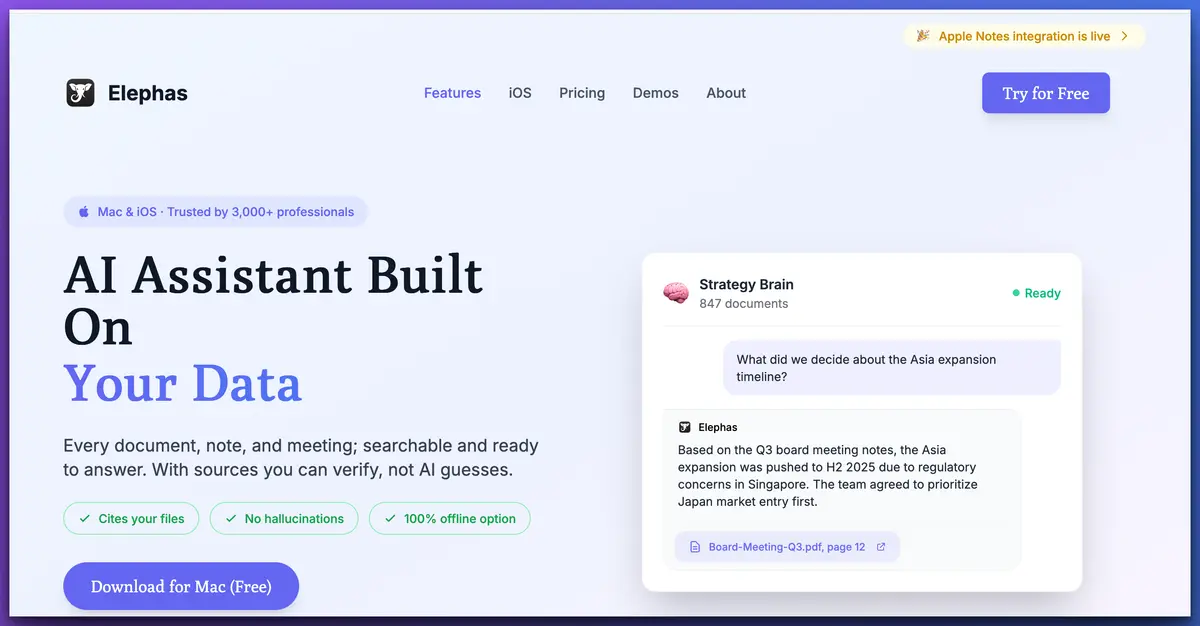
No credit card required. True offline AI included.