The True Story Behind the AI Cancer Vaccine That Shrunk a Dog's Tumor by 75%
When vets told Paul Conyngham that his rescue dog Rosie had months to live, he did not accept it. Conyngham, a Sydney-based machine learning engineer with no background in biology, turned to AI tools to find an alternative. Working with scientists at the University of New South Wales, he went from a ChatGPT conversation to a personalized mRNA cancer vaccine in a matter of months.
The story spread fast across social media, with major tech leaders calling it a sign of what AI can do for medicine. But the reality behind the headlines is more complicated than it first appears. Not everything worked, and not every claim holds up under closer inspection.
75%
Tumor shrinkage after first injection
120+
Active mRNA cancer vaccine trials globally
$3K
Genomic sequencing cost (AUD)
<2 mo
From formula to vaccine production
Executive Summary
- Paul Conyngham, a Sydney-based data analyst with no biology background, used AI tools to design a personalized mRNA cancer vaccine for his rescue dog Rosie after conventional treatments failed
- ChatGPT served as a research assistant for planning, AlphaFold modeled tumor protein structures, and Grok designed the final vaccine construct
- Scientists at the UNSW RNA Institute produced the vaccine in under two months using lipid nanoparticle delivery, the same technology behind COVID-19 vaccines
- Rosie's largest tumor shrank by about 75% after her first injection in December 2025, and her mobility improved significantly
- The vaccine was given alongside a checkpoint inhibitor, making it impossible to measure each treatment's individual effect
- UNSW confirmed Rosie still has incurable cancer, and at least one tumor did not respond
- Over 120 human clinical trials for mRNA cancer vaccines are already active globally, with Moderna and Merck leading Phase 3 trials for melanoma
- The real cost of the project likely exceeds hundreds of thousands of dollars, far beyond the $3,000 Conyngham paid for sequencing
Who Is Paul Conyngham and What Happened to His Dog Rosie
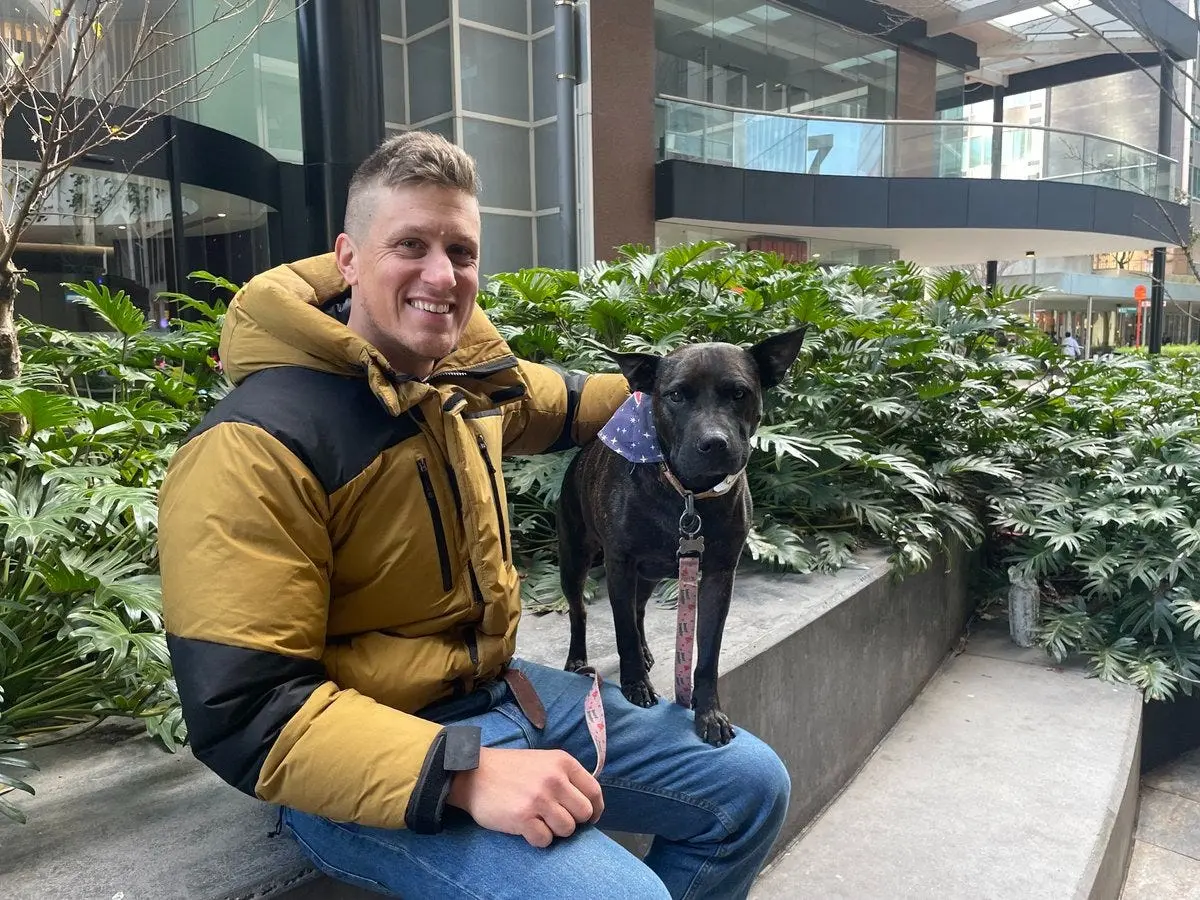
Paul Conyngham is a Sydney-based data analyst and machine learning engineer. He has worked in the field for 17 years. He co-founded Core Intelligence Technologies, a data consultancy in Sydney. He also served as a director of the Data Science and AI Association of Australia. He knows AI and data well, but he has no training in biology, medicine, or chemistry.
Conyngham adopted Rosie, a Staffordshire Bull Terrier-Shar Pei cross, from an animal shelter in 2019. In 2024, large tumors started growing on one of her back legs. Vets diagnosed her with mast cell cancer. This is the most common type of skin cancer found in dogs. These tumors release a chemical called histamine into the body, which causes swelling, pain, and other health problems.
Key Facts About Rosie's Condition and Early Treatment
- Conyngham spent tens of thousands of dollars on surgery and chemotherapy for Rosie
- Both treatments slowed the cancer but failed to shrink the tumors
- Vets estimated Rosie had between one and six months left to live
- The cancer had reached an advanced stage with limited treatment options remaining
Conyngham did not accept the diagnosis as final. Instead of giving up, he decided to look for an alternative path using the tools he knew best: AI and data analysis.
How ChatGPT, AlphaFold, and Grok Helped Design the Vaccine
Conyngham started with the tool he knew best. He opened ChatGPT and asked it to help him build a treatment plan for Rosie's cancer. The chatbot suggested immunotherapy as a possible direction. It also pointed him toward genomic sequencing, a process that reads the full DNA code of a living thing.
ChatGPT even recommended specific institutions, including the UNSW Ramaciotti Centre for Genomics in Sydney. Throughout the project, ChatGPT worked as a research assistant. It helped Conyngham read through scientific papers, understand medical terms, and plan each step of the process.
Conyngham then contacted the Ramaciotti Centre and paid $3,000 AUD (about $2,000 USD) to have two sets of Rosie's DNA sequenced. One came from her healthy cells. The other came from the tumor. Martin Smith, a computational biologist and director of the centre, was skeptical at first.
The request was unusual, and genomic data is difficult to work with. Conyngham compared the two DNA sets to find exactly where mutations had occurred. He described the process as comparing a brand new car engine to one that had driven 300,000 km. The differences between the two reveal where the damage sits.
Once Conyngham had the mutation data, he turned to AlphaFold. This is a protein structure prediction tool built by Google DeepMind. It won the Nobel Prize in Chemistry in 2024 for its ability to predict how proteins fold into 3D shapes.
Conyngham used it to model a protein called c-KIT, which plays a key role in driving mast cell cancer in dogs. From these models, he identified mutated proteins on the surface of the tumor cells. Scientists call these neoantigens. They are markers that the immune system can be trained to recognize and attack.
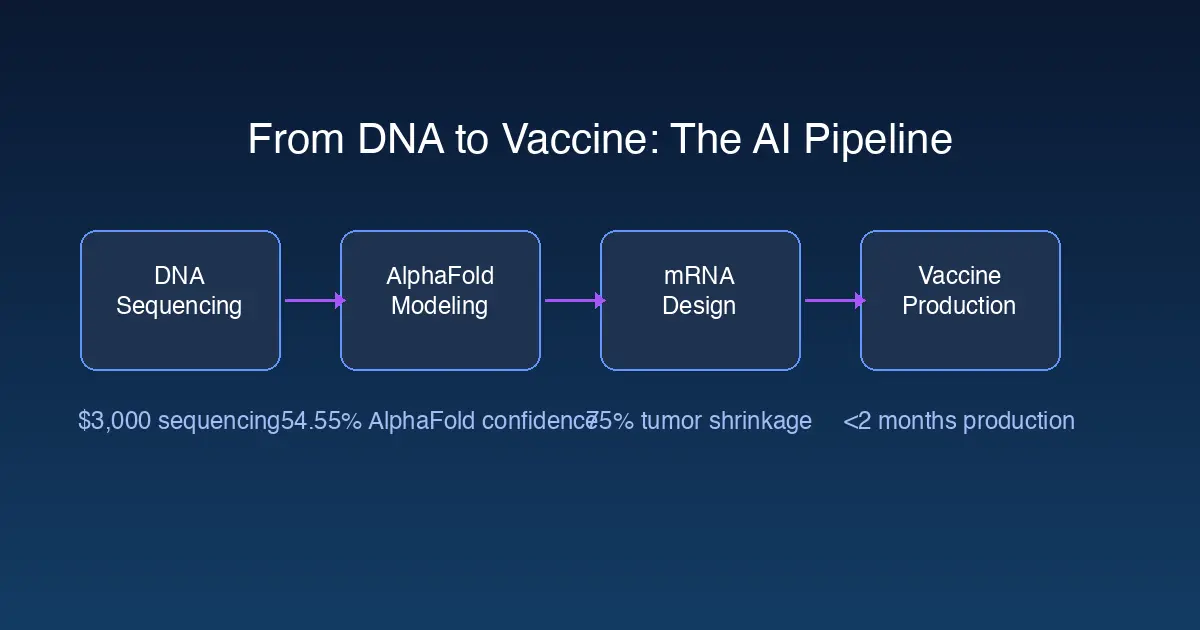
Each AI Tool's Actual Role in the Process
- ChatGPT served as a research planner and literature navigator, not a vaccine designer
- AlphaFold predicted 3D protein structures from the tumor's genetic data to find possible treatment targets
- Grok, built by Elon Musk's xAI, designed the final vaccine construct, as Conyngham later confirmed on X
- Gemini, built by Google, also handled a significant portion of the data analysis work
Conyngham later clarified an important detail that most early reports missed. The final mRNA vaccine sequence was not designed by ChatGPT. He revealed on X that Grok created the actual vaccine construct. He also noted that Gemini did a large share of the analytical work. ChatGPT's main contribution was in planning, research, and connecting Conyngham to the right people and papers. After months of analysis across multiple AI tools, the entire vaccine design was condensed into half a page of formulas.
How Scientists Turned AI Data Into a Real Vaccine
Conyngham took his half-page formula to Pall Thordarson, director of the UNSW RNA Institute. Thordarson is an expert in bio-mimetic chemistry and mRNA technology. His team had produced hundreds of different mRNA molecules for medical purposes over the years. But they had never made a cancer vaccine before. Thordarson was interested but skeptical. He assumed that by the time a vaccine could be ready, it would be too late for Rosie.
The production moved faster than anyone expected. Thordarson's team took the DNA template from Conyngham's formula and amplified it. They then converted it into mRNA, the set of instructions that tells cells what proteins to build. The final step was packaging the mRNA into lipid nanoparticles. These are tiny fat bubbles that protect the mRNA and carry it into the body's cells. This is the same delivery method used in the Pfizer and Moderna COVID-19 vaccines. The full production process took less than two months.
The Regulatory Process and Vaccine Administration
- Conyngham spent three months writing a 100-page ethics application, working two hours every night after his regular job
- A pharmaceutical company refused to supply an immunotherapy drug for compassionate use in a dog, which forced the team to pivot to the mRNA approach
- Mari Maeda, founder of the Seattle-based Canine Cancer Alliance, connected Conyngham to Rachel Allavena, a canine immunotherapy professor at the University of Queensland who already had ethics approval for experimental treatments
- Conyngham drove 10 hours from Sydney to Gatton, Queensland, for Rosie's first injection in December 2025
- Rosie received a booster shot in February 2026, with another booster planned
Getting permission to use the vaccine turned out to be harder than making it. Australia requires ethics approval before any experimental treatment can be given, even to an animal. Conyngham could not get the UNSW researchers to administer the vaccine directly. Allavena's existing approvals for experimental immunotherapies in dogs cleared the path. The entire process, from formula to injection, followed proper scientific and regulatory channels. This was not a backyard experiment.
Did the Vaccine Work? What Happened After Rosie's Treatment
The early results were encouraging. The tennis ball-sized tumor on Rosie's hind leg shrank by about 75%. In early December 2025, Rosie had very limited mobility. She was slowing down and losing energy. By the end of January 2026, she was jumping over fences at the dog park to chase rabbits. Rachel Allavena, the veterinary professor who administered the vaccine, noted that Rosie's coat looked glossier and she appeared much happier and healthier overall. Conyngham said the treatment has added significant lifespan and quality of life to Rosie.
But the results were not complete. Not all of Rosie's tumors responded to the treatment. At least one large tumor did not shrink at all. The team is now studying whether the non-responding tumors have different mutations that require a separate approach. Conyngham is already working on a second vaccine to target that remaining tumor.
Important Context About the Treatment Results
- The vaccine was not given alone. Rosie also received a checkpoint inhibitor, an immunotherapy drug that helps the immune system recognize and attack cancer cells. Because both treatments were given together, it is impossible to tell which one caused the improvement
- UNSW published a blog post on March 17, 2026, stating clearly that Rosie still has cancer and it is still incurable
- Conyngham does not claim this is a cure. He has said it bought Rosie more time and a better quality of life
- The team is designing a second vaccine for the tumor that did not respond to the first treatment
The results are promising but incomplete. A single case with no control group cannot prove how well the vaccine works on its own. The combination with a checkpoint inhibitor makes it even harder to measure the vaccine's individual effect. Still, Rosie's improvement over a short period is something the scientists involved did not expect.
Can This Approach Work for Humans? The State of mRNA Cancer Vaccines
The technology behind Rosie's vaccine is not new. Scientists have been working on personalized mRNA cancer vaccines for humans for over a decade. Several of these treatments are now in late-stage clinical trials, and the results so far are strong.
Moderna and Merck are leading the field with mRNA-4157, also known as V940. This is a personalized vaccine designed for melanoma patients. In their Phase 2b trial, the vaccine combined with Keytruda, an immunotherapy drug, reduced the risk of cancer coming back by 44% compared to Keytruda alone.
Five-year follow-up data released in January 2026 showed an even stronger result. The risk of cancer recurrence or death dropped by 49%. The FDA has granted this vaccine Breakthrough Therapy designation, and Phase 3 trials are now enrolling patients globally. Regulatory submissions could come as early as 2026.
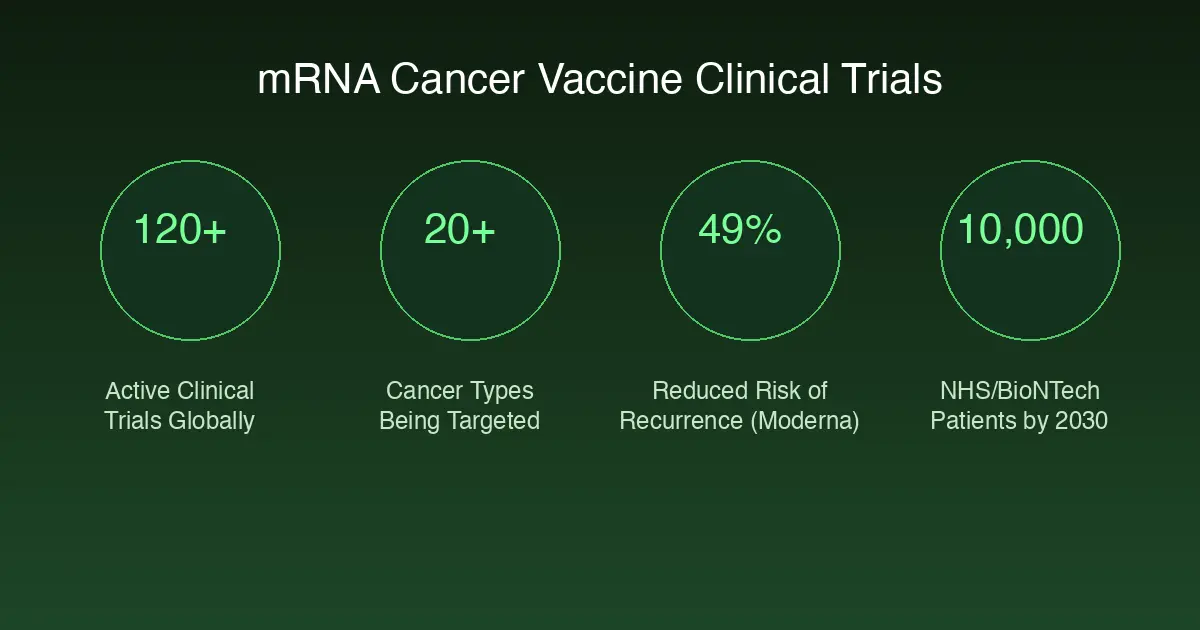
The scale of research goes well beyond a single vaccine. There are over 120 active clinical trials for mRNA cancer vaccines around the world right now. These trials cover more than 20 types of cancer, including melanoma, lung cancer, pancreatic cancer, and brain tumors. The UK's National Health Service has partnered with BioNTech to deliver personalized cancer vaccines to up to 10,000 patients by 2030. In one study published in Nature, pancreatic cancer patients treated with advanced cell model research and mRNA vaccines achieved long-term remission.
Current Challenges in Bringing Personalized mRNA Vaccines to More Patients
- Each personalized vaccine costs between $100,000 and $300,000 per patient at current production rates
- Manufacturing improvements have cut production time from nine weeks to under four weeks, but the process is still slow for widespread use
- Steven Lin, a radiation oncologist at MD Anderson Cancer Center, said the main bottleneck is the speed of generating these vaccines
- Thordarson said making personalized medicine accessible requires rethinking how governments handle both reimbursement and regulation
- AI tools are accelerating scientific discovery, helping scientists identify the best cancer targets faster, but the lab work still takes time and specialist resources
Rosie's case sits within this larger picture. The same basic pipeline used for her treatment, sequencing the tumor, modeling the mutations, and designing a targeted mRNA vaccine, is already being tested in human trials by major pharmaceutical companies. What Rosie's story shows is that this pipeline can be compressed from years into months with the help of AI tools.
Thordarson called it proof that personalized medicine can be done in a decentralized way, without relying on a single large pharmaceutical company to control every step. But Rosie's case was simpler than human medicine. Veterinary treatments face lighter regulatory requirements, and the safety standards for a single animal are far lower than what human patients need.
What the Headlines Get Wrong About This Story
Rosie's story went viral within days. OpenAI president Greg Brockman and Elon Musk both shared it on social media to millions of followers. Many headlines credited ChatGPT with curing a dog's cancer. The full picture is more complicated than those headlines suggest.
ChatGPT did not create or cure anything. It worked as a research assistant. It helped Conyngham find scientific papers, identify institutions, and plan his approach. The final vaccine construct was designed by Grok, as Conyngham himself confirmed on X. Gemini also handled a significant share of the data analysis. The actual lab work, genomic sequencing, mRNA production, and vaccine packaging, was done by human scientists at UNSW using specialized equipment over several months. David Ascher, Professor of Biotechnology at the University of Queensland, noted that the process required university laboratories, expert labor, and thousands of dollars in resources. It was not just a chatbot and a few prompts.
Key Scientific and Practical Limitations
- The vaccine was given alongside a checkpoint inhibitor, so there is no way to measure how much of the improvement came from the vaccine alone
- This is a single case with one animal and no control group. A single result cannot prove how well any treatment works
- Some of Rosie's tumors did not respond to the treatment at all
- AlphaFold's confidence score on the protein model it produced was 54.55 out of 100, which Kate Michie, a structural biologist at UNSW, described as low
- Veterinary experimental treatments face lighter regulatory requirements than treatments for human patients
The cost picture also needs context. Conyngham paid $3,000 for the genomic sequencing. But the full cost of producing the vaccine was absorbed by UNSW's research institute and was not charged to him. The real cost of the project likely exceeds hundreds of thousands of dollars. A vaccine made to human-grade standards would need to meet much higher safety and purity requirements, pushing costs even higher.
On a more positive note, Element Biosciences, a San Diego-based company, plans to offer whole genome sequencing for $100 in the near future. That kind of drop in sequencing cost could make the first step of this process far more accessible over time. As AI agents become more capable, the research and analysis phases of projects like this could become faster and more accessible to scientists without specialized AI training.
Sources
- The Scientist: Transitioning to 3D Cell Models for Better Insights
- UNSW RNA Institute Blog Post, March 17, 2026
- Paul Conyngham's posts on X (formerly Twitter), 2025-2026
- Moderna/Merck mRNA-4157 (V940) Phase 2b/3 Clinical Trial Data, January 2026