AI Privacy Risks: What Most Users Don't Realize
In April 2026, Check Point Research disclosed ChatGPT vulnerabilities that silently exfiltrated user input, uploaded PDFs, and attached medical records to attacker-controlled servers. The user saw nothing in the UI. Cyberhaven Labs telemetry from 1.6 million knowledge workers found that 11% of all data pasted into ChatGPT is confidential.
Think about your last 24 hours. A draft you pasted into Claude. A spreadsheet you dropped into Gemini. A board paper you asked ChatGPT to summarise. Your iPhone scanned your face at airport security. Each one hands a copy of your personal information to a different AI system, and most of those copies outlive the conversation.
If those pastes are not private for the millions doing them right now, why would yours be private next quarter? This guide covers the AI privacy risks most users miss in the age of artificial intelligence, what current privacy law actually says about today's concerns, and the architectural fix.
11%
of data employees paste into ChatGPT is confidential (Cyberhaven Labs, 1.6M workers)
20M
ChatGPT logs ordered preserved in 2025, including chats users had already deleted
5 years
how long Anthropic now retains your chats when training is on
30 sec
of recorded voice is enough to clone a CFO, a lawyer, or a parent
Quick Summary
- The AI privacy risks most users worry about (a hacker steals my prompt, a server gets breached) are real but smaller than the lawful, default behaviour of the tools themselves: training-data ingestion, prompt history retained for years, biometric logging.
- “Deleted” is not deleted. Reviewed conversations can be retained for years, and litigation-hold orders can resurface millions of prompts users believed were gone.
- The age of AI has outrun the privacy law book. GDPR, the EU AI Act, the California Consumer Privacy Act, and the AI Bill of Rights each solve a different slice. None solve the whole problem.
- Agentic AI moves the perimeter inward, from “what you typed” to “what your assistant saw on its way to do the task.” Three apps, three new disclosure surfaces.
- Elephas is a privacy-friendly AI knowledge assistant for Mac with built-in local LLM models. Documents stay on your Mac by default; Smart Redaction (beta) strips identifiers before any cloud call leaves the machine.
Inside Artificial Intelligence's Hidden Data Pipeline
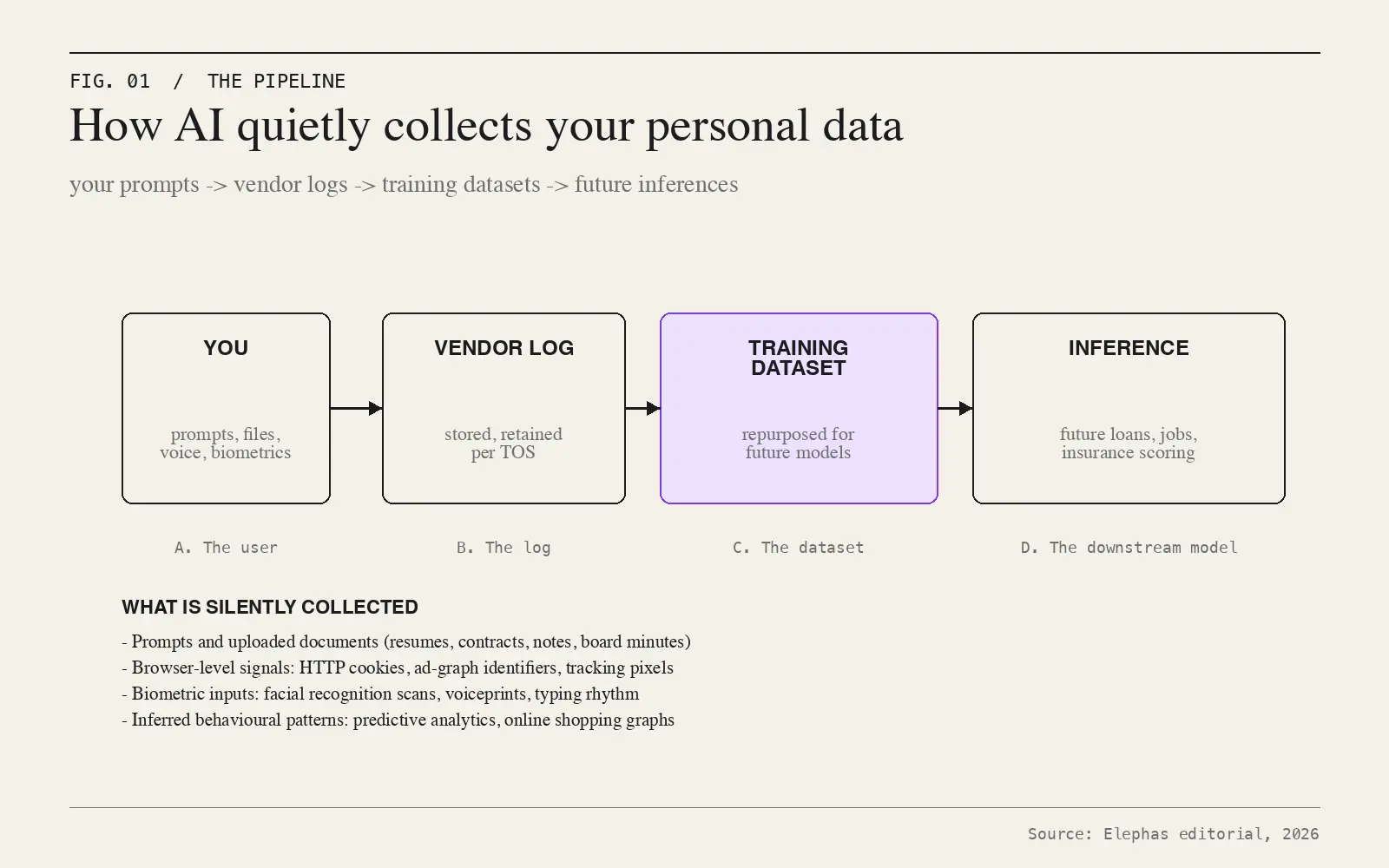
Every prompt you write is data. Every file, every voice note, every browsing trail, every facial scan at airport check-in is data. The functionality of AI depends on huge amounts of data, and most of it comes from you, every day, in ways you do not see.
Three things happen when you type into a generative AI tool:
- The tool stores your input in a log.
- The input may be repurposed for training AI systems on your patterns, your phrasing, and your private notes, accelerating the collection of training data.
- Without an enterprise contract, the input is treated as ordinary user content the vendor can read, retain, and disclose under its terms of service.
That is the same pipeline whether you are using ChatGPT, a smaller vendor's chat tool, or a generic assistant baked into your browser. What gets silently collected by typical generative AI services and modern AI applications:
- Prompts and uploaded documents (resumes, contracts, medical notes, board minutes), the data that can teach a future ranking system how to score you
- Account and device metadata: iPhone or iOS version, IP address, locale, language
- Browser-level signals: HTTP cookie chains, ad-graph identifiers across Safari, Chrome, Microsoft Edge, Firefox, Brave
- Biometric inputs: facial recognition system scans, voiceprints, typing rhythm
- Inferred behavioural signals: predictive analytics, online shopping graphs, and other forms of AI-driven inference
That is constant background harvesting. The same data collection that trains a chatbot today can train tomorrow's loan-decisioning, hiring, and insurance models. The harm extends to behaviour you never typed but that an algorithm now infers about you.
This is structural data exposure: not an accident, the design.
The Real Risks of AI You're Underestimating
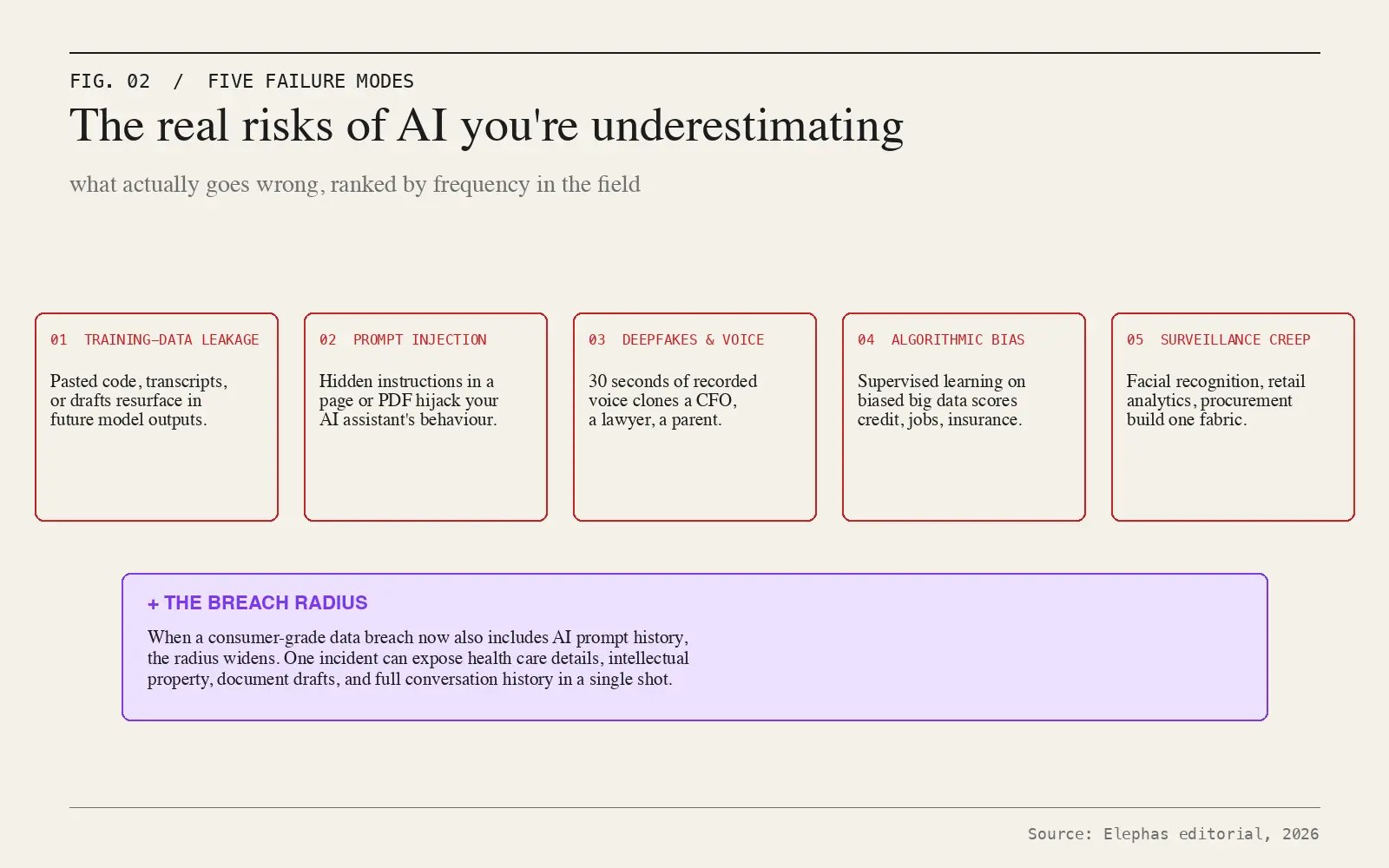
The headline AI threats are leakage and misuse, but reality is layered. Stanford University's HAI privacy track and academic groups in Texas and California have catalogued how data and AI interact at the conversation level, and the picture is harder than the news cycle suggests.
Five concrete failure modes that AI uses produce in practice today:
- Training-data leakage. A 2023 Samsung incident showed engineers pasting source code and meeting transcripts into ChatGPT. Once a fragment is ingested, it can resurface. A separate write-up on contract uploads to AI traces the same mode through a Delaware ruling.
- Prompt injection. Hidden instructions inside a webpage, PDF, or email can hijack the AI agents acting on your behalf. Computer security teams now treat prompt injection as a top-tier threat to data security.
- Deepfakes and voice clones. Thirty seconds of a board call is enough to generate a convincing deepfake or telephone-grade voice clone. Reputation, fraud, and identity theft compound into one risk.
- Algorithmic bias and predictive analytics. Supervised learning on biased big data denies credit, healthcare claims, or interviews from a property record or shopping history the system was never told to use. Algorithmic bias is structural data privacy harm with a friendly UI.
- Surveillance creep. Facial recognition system rollouts in retail and law enforcement, IBM-style enterprise analytics, biometrics at borders, and intelligence-agency procurement create a surveillance fabric no single law fully governs.
A second layer is the consumer-grade data breach. Typical leaks come through a misconfigured server, a compromised supply chain, or a phishing-driven theft. When that breach now also includes AI prompt history, the radius widens. Health care details, intellectual property, document drafts, and conversation history can be exposed in a single shot.
Misinformation and disinformation are the public face of these risks. The private face is quieter: the slow, lawful drift of personal data into systems built to pattern-match on it.
Why Individual Privacy Has Quietly Eroded
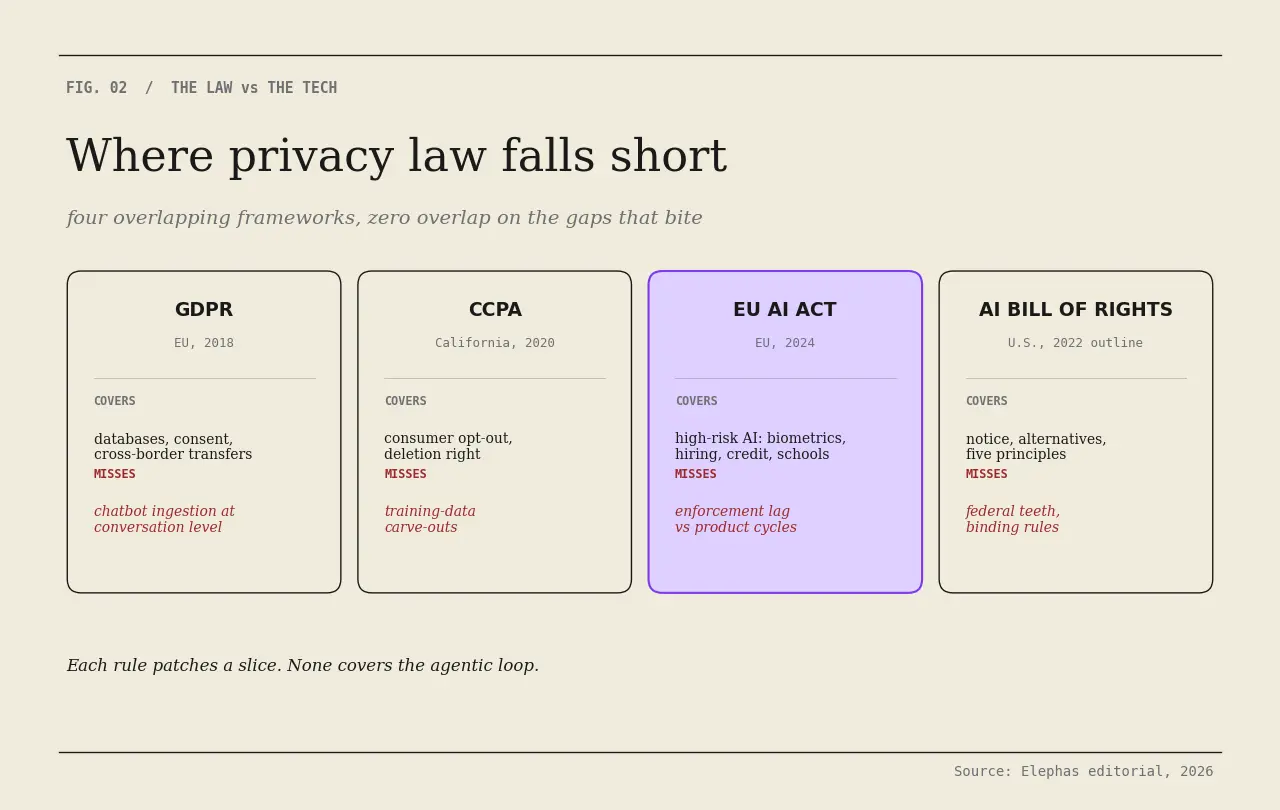
The age of AI has outrun the privacy law book. The General Data Protection Regulation was written for databases and CRMs, not for a world where a chatbot absorbs a paragraph of confidential information in two seconds and re-emits a fragment of it to another user a month later.
The California Consumer Privacy Act, the EU AI Act, and the United States policy framework are the three reference points professionals should know. A federal ruling on whether ChatGPT preserves attorney-client privilege shows how quickly courts have moved on the same question.
The newer European law layers a risk-based framework on top, classifying high-risk AI systems (biometrics, education, employment, credit, public services) for stricter duties. In the United States, the AI Bill of Rights sketches five protections, including data privacy protection, notice, and human alternatives.
Four regulatory gaps still bite the privacy of individuals hard:
- Consent loopholes. Most consent UX is built to be skipped, not understood. Do Not Track failed at fixing that. The privacy of an ordinary user in 2026 still depends on a one-click checkbox.
- Training-data carve-outs. Vendors reserve the right to use your inputs for product improvement unless you opt out, even though privacy has shifted in policy text.
- Cross-border transfers. Data sharing across jurisdictions remains the weakest link, especially for SaaS-shaped products that touch personal information in multiple regions.
- Enforcement lag. Investigations take years; product iterations take months. Governing AI at speed is the central challenge of the modern artificial intelligence and privacy debate.
Agentic AI and the Next Wave of Privacy Risk
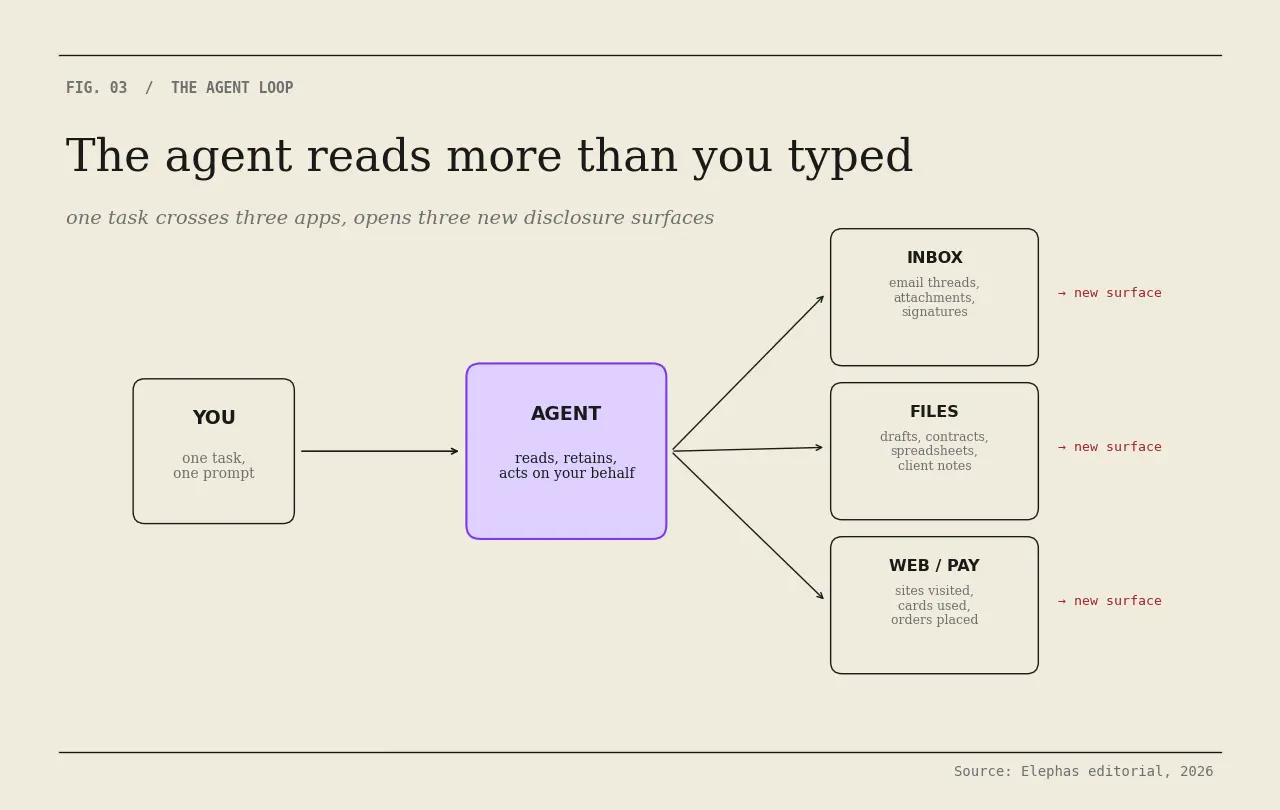
The next twelve to twenty-four months belong to a new class of assistant: software that reads your inbox, files your expenses, browses the web on your behalf, and places an order on your card. That shift moves the risk perimeter inward, from “what you typed” to “what your assistant saw on its way to the task.”
Stanford research, IBM pilots, and Microsoft Copilot rollouts show the same pattern: as assistants move from suggestion to action, they read more, retain more, and act with broader scope. The spread of AI assistants is faster than any previous consumer feature.
Four risks worth flagging now across AI today:
- Chained data leakage. An assistant that reads three apps to complete one task creates three disclosure surfaces, and a single compromise spans them all.
- Decision delegation. Decisions about your data are increasingly made by software, not the user. Autonomy quietly transfers from human to machine.
- Audit blindness. There is no standard audit log for the use of AI at the agent layer. Companies often cannot reconstruct what the system saw and where it sent it.
- Existential framing. Nick Bostrom's superintelligence work and broader philosophy of artificial intelligence essays warn about value alignment. Today's assistant is not Turing-test famous, but it is already authorised over your calendar.
Privacy Protection That Actually Works
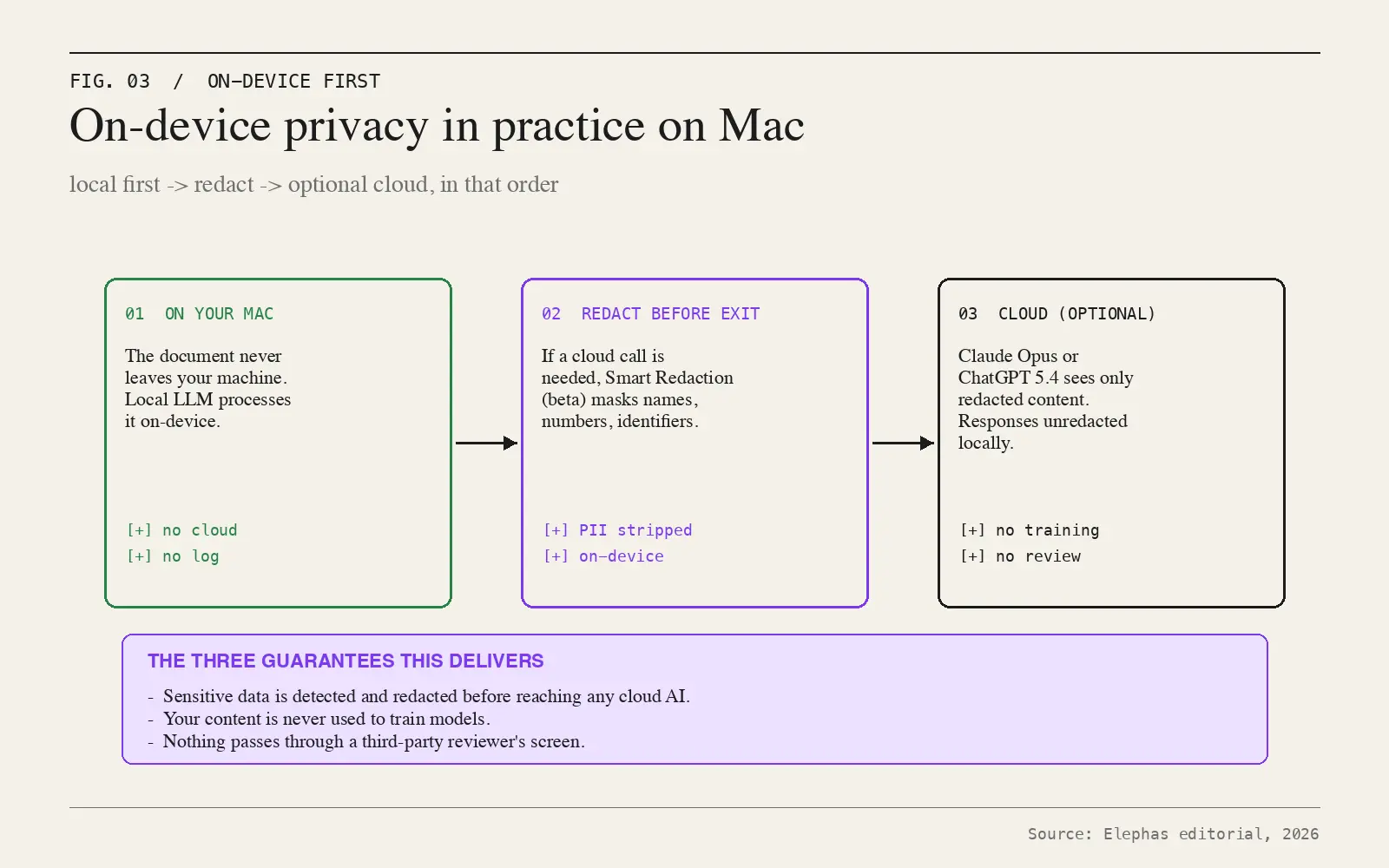
For individuals and teams who want responsible AI without surrendering information privacy, the pattern is the same in every privacy engineering brief: minimise input, redact before transmission, prefer on-device inference, and keep audit-grade control over your data. A walk-through on local AI vs cloud AI lays out the four boundaries each prompt crosses today.
Five practical defences that compound when used together:
- Minimise the input. Strip names, account numbers, and other personal information before pasting into any AI tool.
- Redact at the source. Use a tool that strips identifiers on your machine before the prompt leaves it.
- Prefer on-device inference. Run the model locally where the document never reaches the cloud, and retention concerns disappear.
- Audit your AI vendors. Demand a Data Processing Agreement, retention windows in days not years, clear privacy rights for end users, and disciplined risk management.
- Control consent at the browser layer. Privacy-by-default settings in Brave, Firefox, Safari, Chrome, and Microsoft Edge reduce ad-graph and cookie tracking.
Elephas is a privacy-friendly AI knowledge assistant for Mac, iPhone, and iPad. It provides built-in local LLM models, with no Ollama or third-party install required, so a draft contract, a clinical note, or a board paper can be reviewed entirely on-device.
When the workflow does call out to a cloud model (Claude Opus or ChatGPT 5.4, your choice), Smart Redaction (beta) automatically masks personal data and confidential terms before they leave your Mac. Local first, redact, then cloud, in that order.
That sequence delivers four guarantees consumer chatbot policies do not. Sensitive data is automatically detected and redacted before anything reaches a cloud AI model; Elephas operates a zero data retention policy with the cloud providers it routes to, so prompts are not stored on their servers; your content is never used to train AI models; and nothing passes through a third-party reviewer's screen.
What Most Users Still Don't Realize
The privacy risk most users still don't see is not a hacker or a leaked database. It is the lawful, default behaviour of the AI tools they already use, every day, on their phone and on their laptop.
Once you see that the data collection is structural and the policies permit it, the response shifts from “delete the chat” to “change the architecture.” The takeaways for the week ahead:
- The biggest AI privacy risks are not bugs. They are the vendor's default behaviours written into terms of service you accepted on signup.
- “I deleted the chat” is not the privacy threshold. Reviewed conversations and litigation-hold orders can preserve prompts for years.
- Regulation is catching up but lags by years. Until it lands, individual workflow discipline is your real defence: minimise input, redact, prefer local inference.
- Agentic AI will widen the surface area, not narrow it. Any new AI product you adopt should be judged on what it reads, alongside what it writes. A complete walk-through for regulated work is the AI for confidential workflows guide.
- If you're worried about the issues above, Elephas is a privacy-friendly AI knowledge assistant built for exactly this. It runs locally on your Mac with built-in local LLM models, automatically redacts PII before any cloud call leaves your machine, and operates a zero data retention policy with the cloud providers it routes to.

Try Elephas free on Mac
The privacy-friendly AI knowledge assistant with built-in local LLM models, Smart Redaction (beta), and explicit per-prompt model routing.
See current plans on elephas.app