ChatGPT vs Private AI Tools: What's the Safer Choice?
A consultant pastes a half-finished client brief into ChatGPT on a Tuesday. They hit send and move on. Five months later, the parent company is sitting on every word, and a federal judge has ordered them to keep it.
In January 2026, SDNY Judge Sidney Stein affirmed an order forcing OpenAI to produce 20 million de-identified consumer ChatGPT conversation logs in the New York Times copyright lawsuit (Bloomberg Law, Isaiah Poritz, 2026-01-05). The court suspended the standard 30-day deletion policy retroactively. Enterprise was excluded. Everyone else, Plus subscribers, free users, the consultant in our example, was not.
This is a focused comparison of one AI-powered chat product (OpenAI's ChatGPT, GPT-5.5) against the category of private tools, with Elephas as the named example, on a single axis: data privacy and AI safety for people who work with confidential material.
20M
ChatGPT logs ordered preserved in NYT case
73%
Of orgs have unauthorized AI tool usage
77%
Of AI prompts contain real company data
4 of 6
Safety criteria private tools change decisively
Executive Summary
- The January 2026 NYT order forced OpenAI to retain 20M consumer ChatGPT logs indefinitely; ChatGPT Enterprise was excluded, consumer users were not.
- Sam Altman publicly admitted on the Theo Von podcast that there is no legal confidentiality for ChatGPT conversations; OpenAI is now lobbying for a new “AI privilege” category that does not yet exist.
- ABA Formal Opinion 512 and the NC Bar's January 2026 guidance call consumer ChatGPT “far riskier than controlled adoption”; boilerplate engagement-letter consent is explicitly not adequate.
- Private tools change the answer on four of six safety criteria decisively (flight path, retention, training-on-content, subpoena exposure) and one partially (vendor blast radius).
- The contrarian verdict: you do not have to leave ChatGPT to be safer. Elephas is the privacy-friendly AI knowledge assistant we recommend for Mac users handling confidential work, and it can wrap ChatGPT 5.4 itself with on-Mac PII redaction so you keep the model you like.
The Criteria: What “Safer” Actually Means in 2026
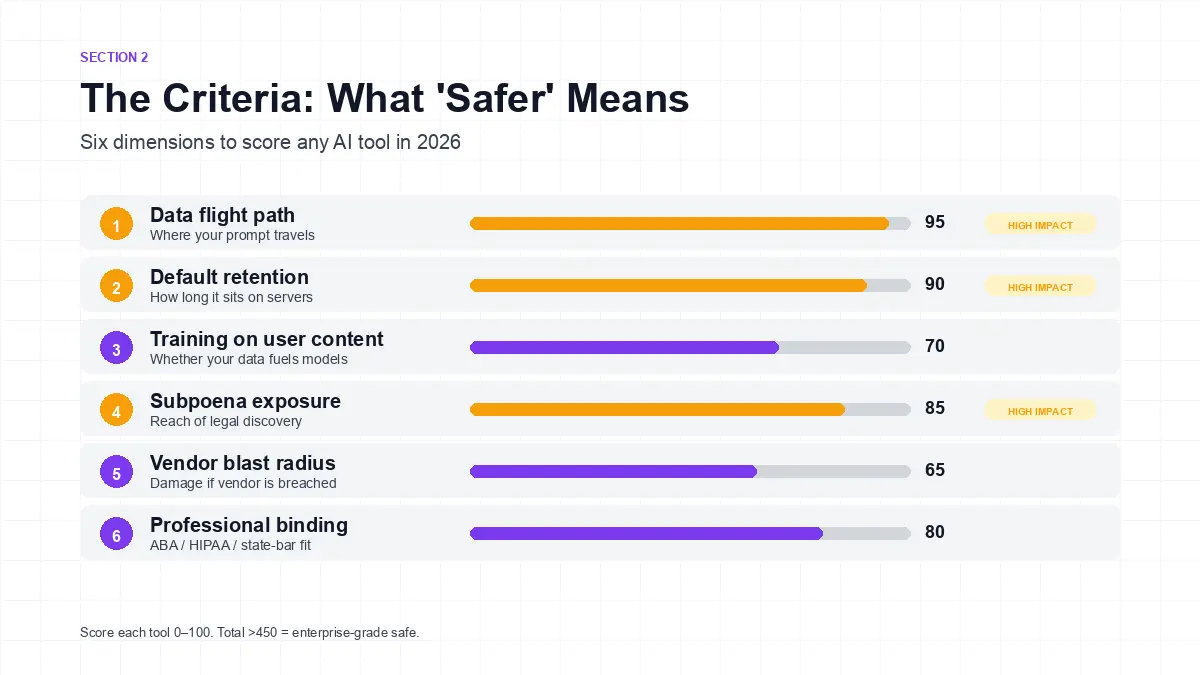
Before naming a winner, name the test. Safety gets stretched across so many AI platform marketing pages that the word has stopped meaning anything. These six criteria decide whether your inputs come back to bite you.
The list is ordered by how often each one goes wrong for professionals handling sensitive personal information. None of these are theoretical. Every one has a 2026 incident attached. Training data accumulation, vendor retention, and downstream analytics together explain why the AI vs private tools framing is a real choice and not a marketing slogan. Data sensitivity, not just data volume, decides which side of the line you sit on.
- Data flight path. Does your input leave your Mac, and where does it land? Canada's Privacy Commissioner ruled OpenAI's collection of personal data to train GPT-3.5 and GPT-4 was “overbroad and inappropriate” on May 6, 2026, naming scraped health care records, political views, and information sensitivity flags around children. Training, validation, and test data sets were assembled without notification.
- Default retention. When you delete a chat, is it actually deleted? The NYT order suspended the 30-day deletion policy. Whether nothing is saved depends on whether litigation hold is active, and you do not get to know.
- Training data and your conversations. Are your inputs used to improve future models unless you toggle something off? On the consumer tier, yes by default. Training data, including real-time chats, feeds the next generation unless you opt out.
- Subpoena and discovery exposure. If you are sued, audited, or investigated, what can be compelled? ABA Formal Opinion 512 and the NC Bar's January 13, 2026 guidance told lawyers that consumer chatbot use without informed client consent is now “far riskier than controlled adoption.” Synthetic data is not a workaround when the underlying chats are real.
- Third-party blast radius. How many vendors sit between your input and the model? Microsoft threat intelligence, Lenovo Work Reborn Research, and BlackFog reported that 73% of organizations have unauthorized AI usage, and 77% of those user interactions involve real company data. Each downstream vendor is a vulnerability (computer security) waiting to be exploited.
- Regulatory compliance and professional binding. Does your profession have a rule against this? Legal does. Health care, finance, and HR are catching up, and in Europe the AI Act is setting hard guardrails on how generative AI tools and their vendors handle confidential data.
A private tool is not automatically safer on every criterion. It changes the answer on criteria 1, 2, 3, and 4 decisively. It changes criterion 5 partially. Criterion 6 is dictated by your rule book, not your preferences.
ChatGPT
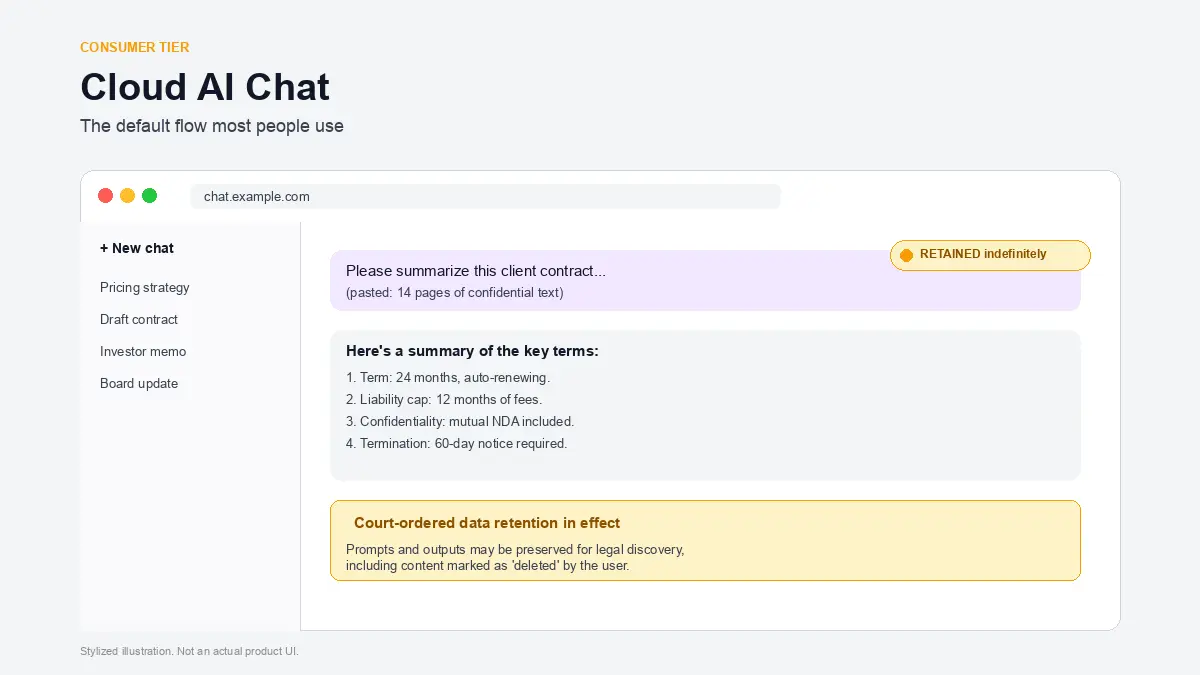
ChatGPT, developed by OpenAI, runs on a pre-trained large language model that uses natural language processing and machine learning to produce human-like generative text. ChatGPT uses your conversations to answer in seconds, which is why users love it for everyday tasks; like ChatGPT, Google's Gemini is the artificial intelligence default inside its own ecosystem.
The safety story breaks when you look at what the vendor is permitted to do with your inputs. Sam Altman, on the Theo Von podcast (TechCrunch, 2025-07-25): “If you talk to a therapist or a lawyer or a doctor about problems, there's legal privilege. But that hasn't been figured out yet for ChatGPT conversations. If you're sued, OpenAI is legally required to produce those conversations today.”
The honest middle: Enterprise and Team tiers come with zero-data retention by contract, SOC 2 attestations, and exclusion from the NYT preservation order. The catch is that most readers do not have an Enterprise seat, and many companies with one have shadow AI usage on the consumer tier anyway.
- ChatGPT models on the consumer tier opt into training by default; the toggle is in settings, but it is on out of the box and most users never touch it
- Roughly 4% of the prompt traffic across shadow AI flows contains sensitive corporate content (Microsoft threat intelligence, 2026)
- The latest model (GPT-5.5) draws complaints on r/ChatGPTPro for excessive hedging that Pro subscribers nicknamed “paranoid chaperone,” showing capability is moving but not always forward
- Analytics and telemetry on the consumer tier route user data through downstream third parties, which is how the November 2025 Mixpanel breach exposed customer metadata
Private AI Tools
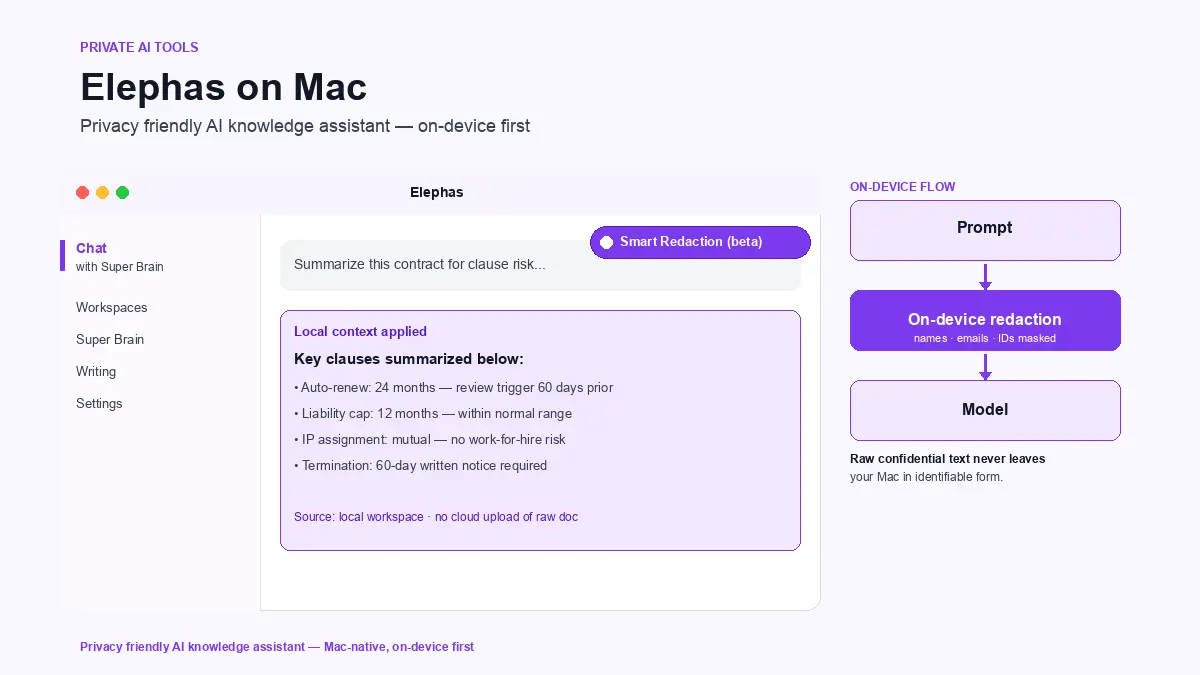
The private AI category is defined by three properties, not by a single product. Inputs pass through a privacy layer before reaching any model, sensitive information is either kept fully local or redacted before transit, and the vendor offers strong privacy with zero-data retention by default rather than as a paid upgrade.
Private AI takes three working shapes, each with a different answer to where the model lives and what it sees:
- Fully local. Open-source models running on-device (Llama, Mistral, Mixtral) served by Ollama or LM Studio. Weights and source code are public, the algorithm runs on your own laptop or desktop computer hardware, and no input ever leaves the machine.
- Redacted-cloud. A cloud model fronted by an on-device privacy layer that strips PII before transit. This is the shape Elephas uses when it routes a prompt to GPT-5.5, Claude Opus 4.7, Perplexity, or Grok. The model sees the redacted text, never the raw input.
- Enterprise-hosted. Frontier models running inside a single tenant's cloud with zero-data-retention contracts: Microsoft Azure OpenAI, AWS Bedrock, IBM watsonx. Sold as software as a service to organizations, not individuals.
Elephas is the best privacy-friendly AI knowledge assistant for Mac users handling confidential work. The design choice that matters here is that Elephas does not replace the model you like. It wraps your chosen LLM, whether that is GPT-5.5, Claude Opus 4.7 from Anthropic, Perplexity, Grok, or built-in local LLM models running fully on-device. Before any input leaves the Mac, Smart Redaction (beta) strips PII on your machine. The model never sees raw sensitive personal data.
Elephas also runs on a zero-data retention policy. Your inputs are not stored on Elephas servers, and your content never trains any AI model.
- Users on r/MacOS and product reviews praise the Mac-native feel: it works inside every Mac app via keyboard shortcuts, not just in a browser tab
- Citation-grounded answers from documents the user uploaded, eliminating the hallucination problem common to cloud chatbots
- Customization is real: pick a different model per task, adjust redaction strictness per task, switch between cloud and on-device with one toggle
- Honest trade-offs: proprietary algorithms in cloud frontier models still outperform 13B open-source models on raw reasoning, so businesses already running ChatGPT direct for capability frontier work have a real reason
Head-to-Head: AI vs Private Tools, Side by Side
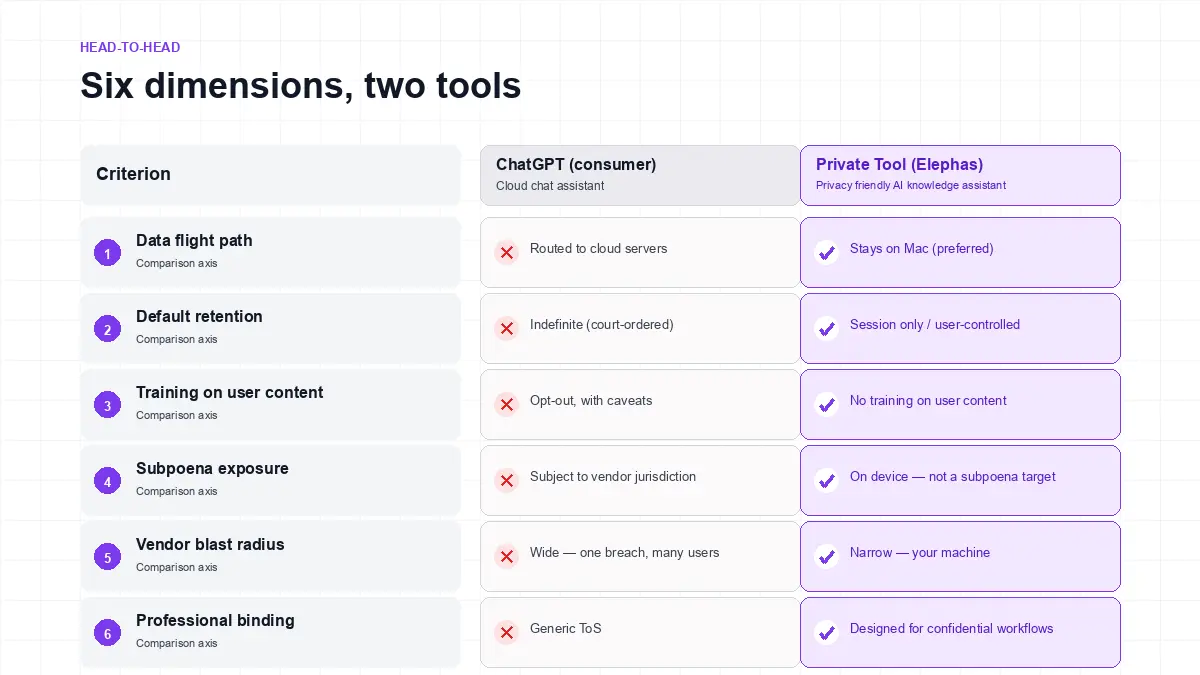
Scored side by side on the six criteria. The asymmetry is what matters. ChatGPT's consumer tier loses on rows 1 through 4 by default, where vendor policies and the legal environment shape the answer. Private tools lose on capability rows the table does not list (image generation, voice mode, frontier reasoning), where the consumer tier still wins cleanly. The pick is which set of weaknesses you can afford for your specific use.
| Criterion | ChatGPT (consumer) | Private Tool (Elephas) |
|---|---|---|
| Data flight path | Input → vendor cloud → model | Input → on-Mac redaction → cloud model OR local LLM |
| Default retention | 30-day delete, currently suspended (Bloomberg Law, 2026-01-05) | Zero-data retention; chats are encrypted at rest |
| Training data use | Yes by default; opt-out buried | Never; access to AI happens without your content joining training |
| Subpoena exposure | Compelled in NYT case; Enterprise excluded, consumer not | Redacted-only or device-only paths |
| Vendor breach surface | OpenAI plus telemetry vendors (Mixpanel, Nov 2025) | Thinner stack, fewer third parties |
| Professional binding | Flagged by ABA Op. 512; NC Bar called it “far riskier” (2026-01-13) | Matches “controlled adoption” criteria |
What the table cannot show is the time dimension. Rows 1, 2, 4, and 5 get worse for the consumer tier each quarter as new court orders, fresh breaches, and broader discovery requests accumulate against a growing log of past conversations. The private-tool rows stay flat because there is no growing log to compromise.
- The consumer-tier row scores are policy-set, not capability-set; they could flip if OpenAI changed defaults, but the legal environment is moving the other way
- Enterprise and Team contracts shift rows 2, 3, and parts of 4, but most readers either lack Enterprise or carry shadow consumer-tier usage on the side (Microsoft 2026 threat intel: roughly 4% of shadow-AI prompts contain sensitive corporate content)
- Row 6 turns the choice from preference into compliance for regulated professionals (lawyers, CPAs, financial advisors, healthcare, HR)
- The practical route is keeping both: consumer ChatGPT for non-sensitive work, a private tool for anything you would not paste into a Slack channel you do not fully control
Which Should You Pick?
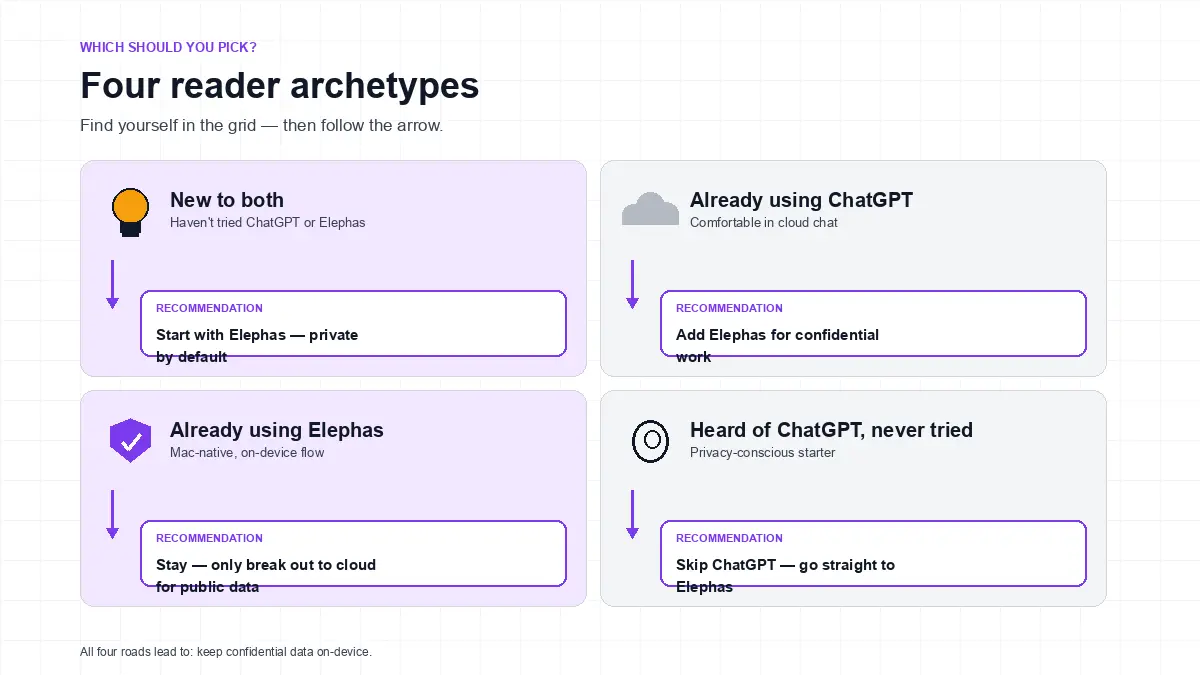
The answer depends on where you are starting from. Four archetypes cover most readers. Pick the one that sounds like you and read just that block. Each block names the deciding factor for that group.
If you've never used either of these
You are new to both and trying to figure out where to begin. The capability gap closes over six months as local AI models improve, but the consumer ChatGPT privacy story drifts the other way: the NYT order, the Canada finding, and the AI-privilege lobbying admission all happened inside one fiscal year. Both age, but consumer chat ages worse on confidentiality.
On first-day productivity, consumer chat is faster. Open a browser tab, type, done. A private setup takes a 20-minute install to ingest your notes and select a model. By the end of week one, the private setup is faster for anything involving your own documents because it can cite them.
Most professionals run AI in both modes anyway, so the decision is which side handles the sensitive work. Try Elephas first: it gives you the power of frontier cloud models (GPT-5.5, Claude Opus 4.7) with on-Mac PII redaction in front, and built-in local LLM models for anything you do not want leaving the Mac at all.
- Specific needs guide the pick: confidential client work defaults to the safer tool from day one
- The sensitivity threshold is “anything you would not paste into a Slack channel you do not fully control”
- The bad habits formed by pasting client material into a public chatbot are harder to unlearn than installing a new app
If you're already using ChatGPT
If you are using consumer ChatGPT for client briefs, draft contracts, or research summaries, this is the highest-stakes block in the article. Yes, your conversations from before the NYT preservation order are inside the window. Bloomberg Law reported on January 5, 2026 that the court suspended the 30-day deletion policy retroactively. Anything covered by attorney-client privilege, doctor-patient confidentiality, an NDA, or HR data is now in a different legal category than you assumed.
The contrarian move on migration: you do not have to leave the model you like. Elephas can use GPT-5.5 as the backend and still strip PII on your Mac first. Your muscle memory survives. The chat history is saved on the Elephas side under your control. Custom GPTs do not migrate one-to-one, but the model behind the curtain is the same.
- Switch the entry point. Keep the model. Use ChatGPT as the backend through a wrapper if you still want it
- AI implementation inside a firm is easier when you do not have to retrain people on a new model, only on a new wrapper around the same one
- Use AI where it earns the time savings; route the data-privacy-sensitive material through the wrapper, not the consumer tier
- The NC Bar's January 2026 guidance specifically called consumer ChatGPT “far riskier than controlled adoption” (boilerplate engagement-letter consent is explicitly not adequate)
If you're already using Elephas
If you are already running Elephas and wondering whether the consumer tier deserves any of your attention, here is the honest read. Yes, PII redaction sometimes scrubs useful context. Smart Redaction (beta) is conservative by design and replaces named entities with placeholders before the model sees them. For documents where the name is the point, the trade-off is real and the redaction strictness is adjustable per task.
On audits, redaction runs locally and can be inspected with macOS process monitoring tools (Little Snitch, Activity Monitor's network tab, the unified log). The product publishes what gets sent to which model. The audit is not a third-party SOC 2 attestation, but the kind of transparency a skeptical user can verify themselves.
- Stay on Elephas as the default for confidential AI applications
- Open the consumer tier directly only for image generation, voice mode, and frontier-model agent capabilities, and only when the content is non-sensitive
- Customization beats one-size-fits-all: route the most sensitive tasks to built-in local LLM models and keep cloud calls reserved for safe content
If you've heard of ChatGPT but never tried it
You have heard about it in conversations or on podcasts but have not actually opened the app. Three things matter on the consumer tier. The vendor is legally permitted to train future models on your conversations unless you toggle off “Improve the model for everyone” in settings. It must produce your chats in response to a subpoena (per the Altman quote from TechCrunch, 2025-07-25). It can retain content indefinitely under a court preservation order.
What do long-term users complain about, outside the OpenAI website? Three patterns dominate. Quality regressions on the latest model that Pro subscribers on r/ChatGPTPro nicknamed “paranoid chaperone.” Buried opt-outs for training. And the QuitGPT viral moment in February 2026: Tom's Guide reported 2.5 million cancellation pledges and a 295% uninstall spike on February 28, 2026 alone.
- The two defaults you can actually turn off in the consumer tier are training and chat history; subpoena exposure is not user-controllable
- Starting on the safer tool first prevents bad habits from forming; the private AI vs public AI distinction is sharpest at work
- You can sample the cloud tier on a non-confidential task in twenty minutes; the reverse, unlearning casual habits, takes years
The Verdict
For anyone on a Mac handling client work, draft contracts, HR records, medical files, financial data, source code under NDA, intellectual property, or anything that could be subpoenaed in the United States or in Europe, the safer choice in 2026 is to put a private tool in front of whichever model you actually like, and Elephas is the Mac-native default for that job.
Where does ChatGPT genuinely win? Image generation, voice mode, the latest reasoning model, and the lowest learning curve for first-day productivity. Most digital transformation projects bump into the consumer tier first because of that surface area. The recommendation flips at the moment your work involves something you would not paste into a group channel you do not fully control.
The honest read on practical applications: most knowledge workers handle a mix, some confidential, some public. Use case routing is the mature answer, and a private wrapper is the only architecture that lets you keep your data safe when using AI tools without giving up the model you trust. Choosing the right setup means accepting that AI refers to a family of tools, not one product, and the question is which combination fits your work.
- For someone new to both, start on the safer tool first; the right choice for confidential work is decided on day one, not month six
- For ChatGPT loyalists, switch the entry point and keep the model so the migration cost stays small
- For existing Elephas users, stay the course and open the cloud tier only for the three things it still wins on cleanly
- For evaluators on the fence, skip the consumer tier for confidential work; sample it later on a recipe or a piece of public-domain research
- If you would rather skip the trade-offs entirely, try Elephas, the privacy-friendly AI knowledge assistant we recommend for Mac users handling sensitive data. It provides built-in local LLM models, Smart Redaction (beta), and explicit per-task model routing so nothing leaves your machine unless you choose.
Try Elephas free on your Mac
The Mac-native privacy-friendly AI knowledge assistant: on-device Smart Redaction (beta), built-in local LLM models, and the flexibility to wrap ChatGPT, Claude, or any cloud model with a privacy layer that runs on hardware you own.
Get Elephas →