SpaceX Strikes $60 Billion Deal to Buy AI Coding Startup Cursor
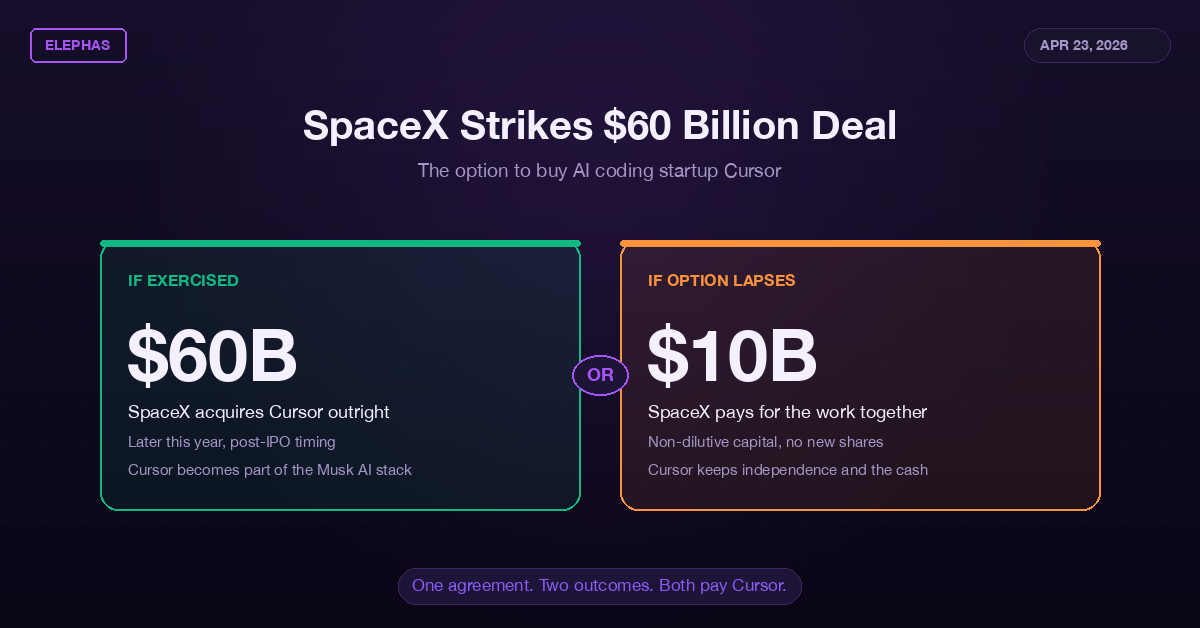
On April 21, 2026, Elon Musk’s rocket firm announced plans to acquire the San Francisco company in the coming months for $60 billion, or pay $10 billion for the two firms’ work together. The agreement arrives weeks before a planned stock debut.
$60B
agreed price, exercisable in the coming months
$10B
breakup fee if no acquisition happens
$1.25T
combined worth after the February merger
$2T
planned stock debut target, as early as June
Key Takeaways
In a post on Tuesday, the rocket maker described a partnership to build the world’s most useful AI models, with a $60 billion agreed price and a $10 billion alternative payment.
Musk merged his AI firm into the rocket maker in February, creating a combined valuation of $1.25 trillion.
The San Francisco start-up was founded in 2022 by Michael Truell, Sualeh Asif, Aman Sanger, and Arvid Lunnemark, and hit $100 million in annual recurring revenue in under two years.
A planned $2 billion independent round at over $50 billion is now off. The capital was earmarked for training needs, which the merged AI firm now supplies.
Inside the $60 Billion Agreement
The rocket maker said on Tuesday it had struck a deal with the San Francisco code-writing firm. The news arrived via social media, not a formal filing. Bloomberg and The New York Times confirmed the structure the same day. The move is unusual for the billionaire, whose companies, which also include Tesla, rarely buy outside businesses.
What the Announcement Said
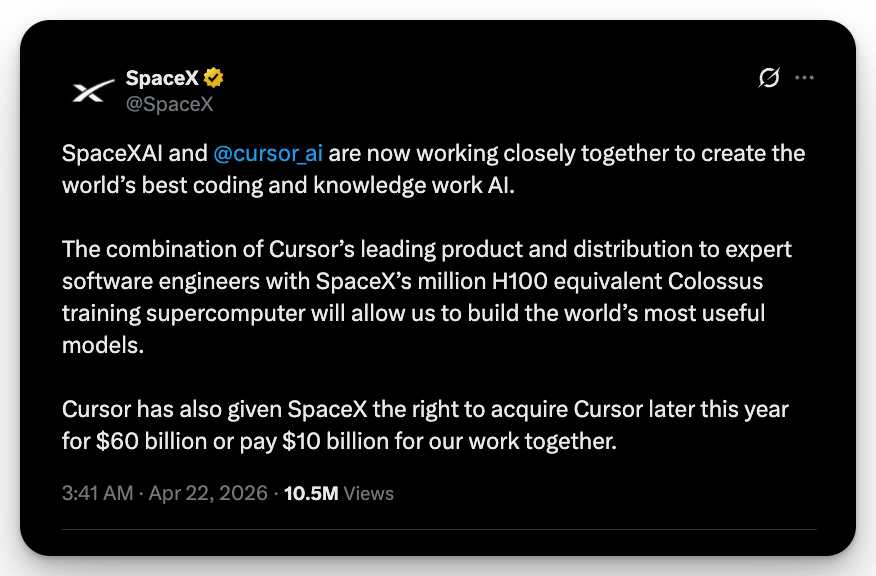
The announcement described the partnership and the acquisition terms. The full post reads:
“@SpaceX and @cursor_ai are now working closely together to create the world’s best coding and knowledge work AI. The combination of Cursor’s leading product and distribution to expert software engineers with SpaceX’s million H100 equivalent Colossus training supercomputer will allow us to build the world’s most useful AI models. Cursor has also given SpaceX the right to acquire Cursor later this year for $60 billion or pay $10 billion for our work together.”
CEO Michael Truell answered on X, calling it “a meaningful step on our path to build the best place to code with AI.” The Cursor account also posted a short confirmation: “We’re partnering with SpaceX to improve Composer.”
How the Option to Buy Works
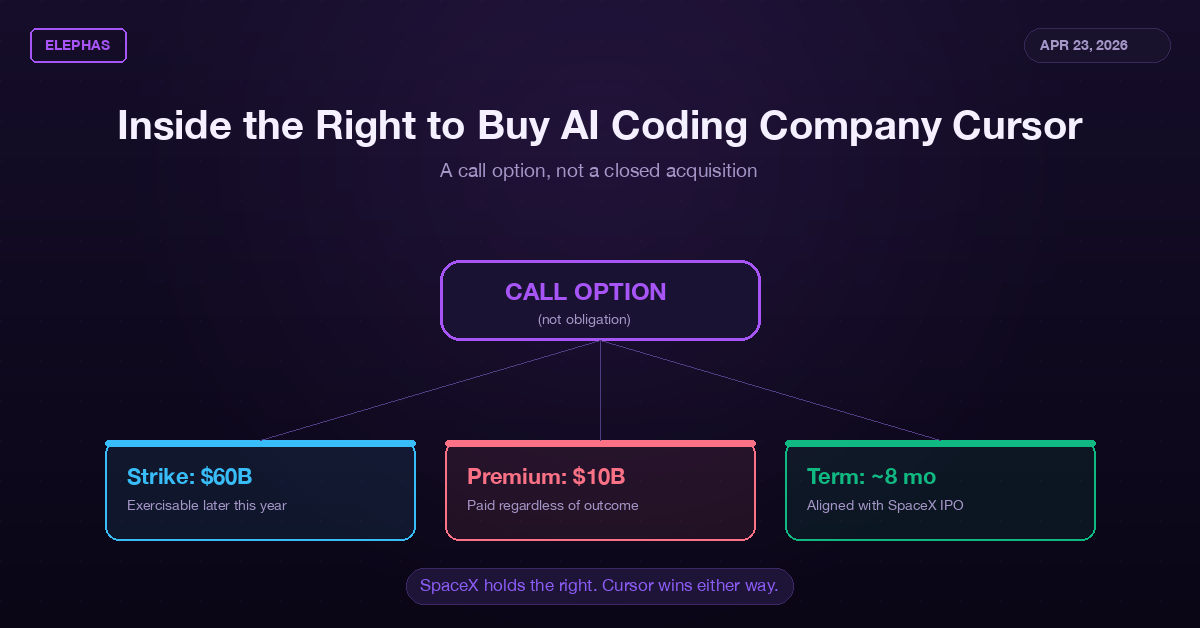
This is not a closed acquisition. The rocket firm holds a $60 billion call plus a $10 billion alternative if no transaction closes. Bloomberg describes the smaller figure as a breakup fee; The New York Times frames it as a capital injection available under the agreement. Both readings describe the same payment.
The structure ties to the upcoming IPO. A person familiar with the deal told Bloomberg that a full acquisition now would force updated filings and financial details, potentially delaying the listing. Under the framework, the target either accepts the $60 billion acquisition or keeps the $10 billion and stays independent. Sources describe the two outcomes as mutually exclusive.
The San Francisco Firm
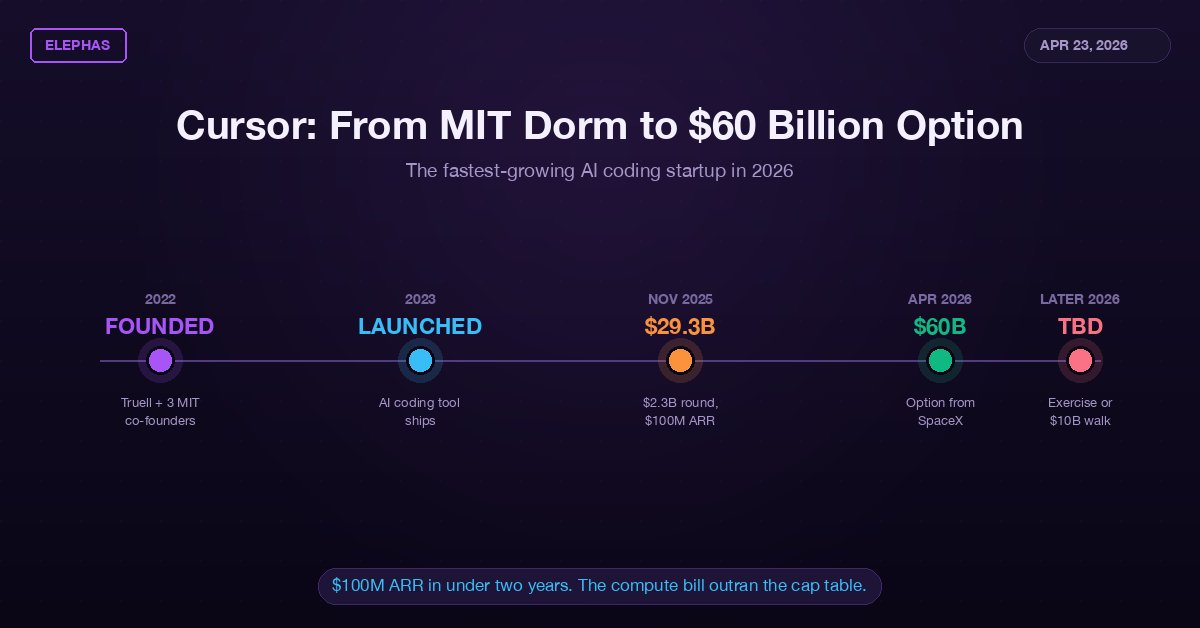
The code-writing software was founded in 2022 by Michael Truell, Sualeh Asif, Aman Sanger, and Arvid Lunnemark, who met at MIT. The AI coding tool the team launched in 2023 hit $100 million in annual recurring revenue in under two years. By November 2025, a $2.3 billion round placed the firm at nearly $30 billion. Investors include Nvidia, Alphabet’s Google, OpenAI’s venture fund, Andreessen Horowitz, Thrive Capital, Accel, DST Global, and Coatue. Total venture capital raised reached $3.4 billion.
The new partnership replaces a different plan. Just days before the announcement, CNBC reported the firm was in talks to raise $2 billion at over $50 billion, with Andreessen Horowitz co-leading. That round is now off.
Composer and the Model Ladder
The firm shipped Composer, its first agentic coding model, less than six months before the agreement. Composer 1.5 scaled reinforcement learning by over 20x. Composer 2 added continued pretraining and, according to the firm, reached frontier-level performance at a fraction of the cost of other models. Each step up in training, the firm wrote on its blog, delivered meaningfully more capable models.
Why the Deal Happens Now
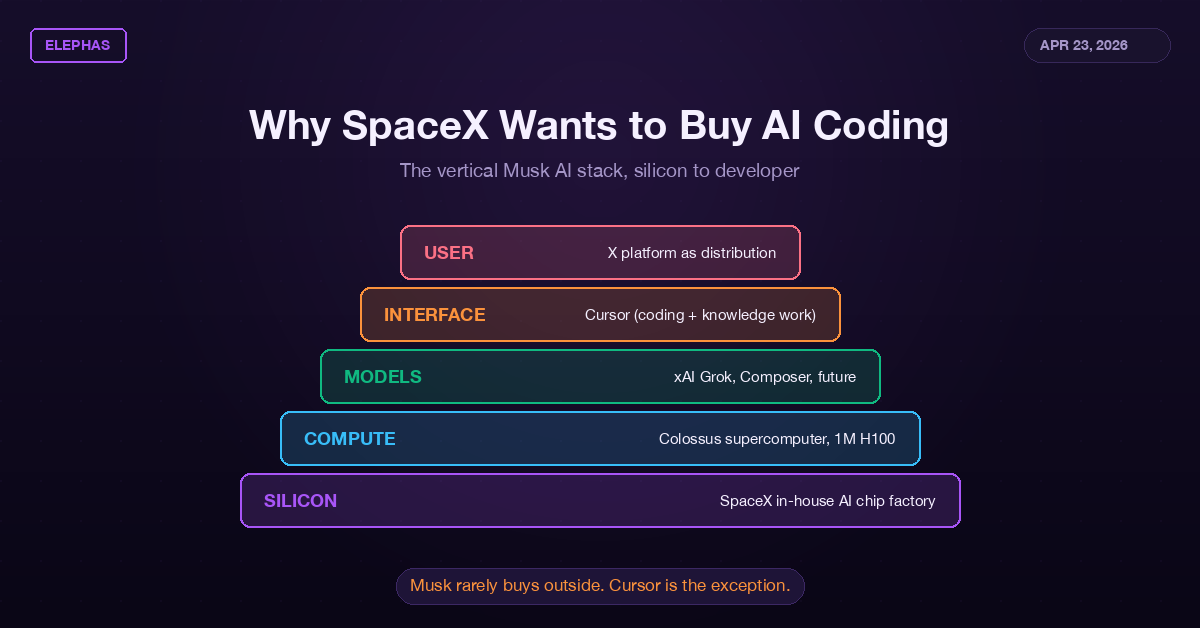
The rocket maker merged with xAI earlier this year, creating a combined firm worth $1.25 trillion. The AI unit had been trailing rivals in generative tools. After the merger, the billionaire said the unit was behind on software coding work and vowed to rebuild from the ground up.
In March, the AI unit hired Andrew Milich and Jason Ginsberg, two former leaders from the target, to refocus its work. The billionaire then posted on X that “xAI was not built right first time around, so is being rebuilt from the foundations up.” The agreement is the catch-up move that announcement foreshadowed.
The pattern is a break. While his companies, which also include Tesla, have a history of merging with one another, they rarely strike deals to buy outside firms.
The Training Bottleneck
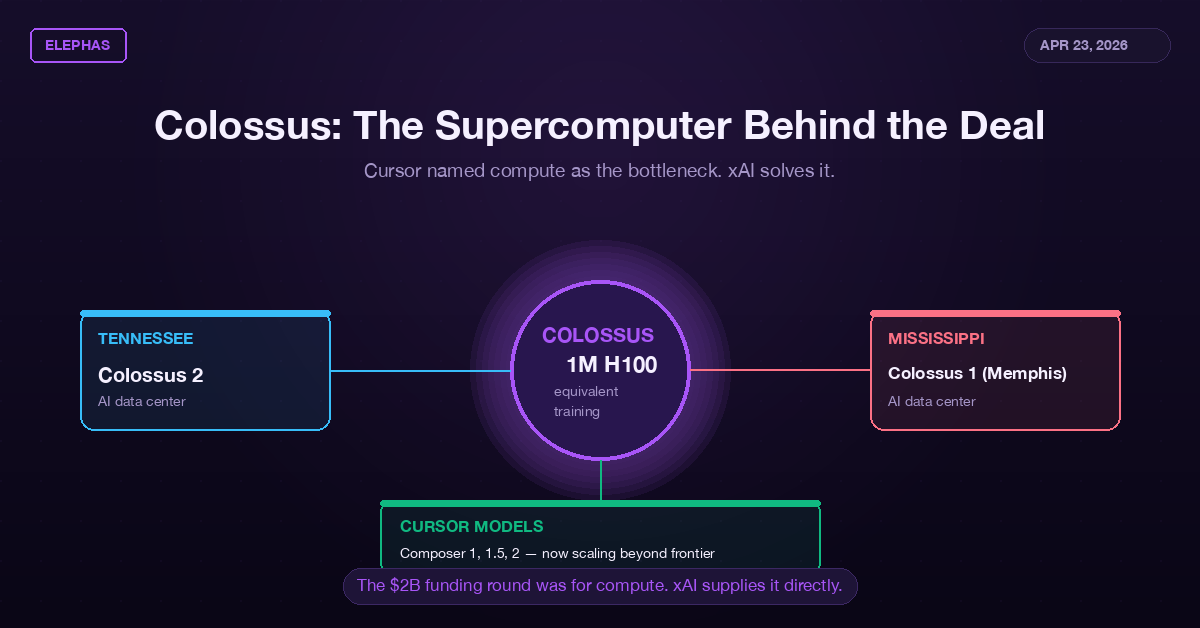
The partnership gives the target access to the merged firm’s training infrastructure, described in the X post as a million H100 equivalent cluster. Bloomberg reported that the rocket maker has massive data centers in Tennessee and Mississippi.
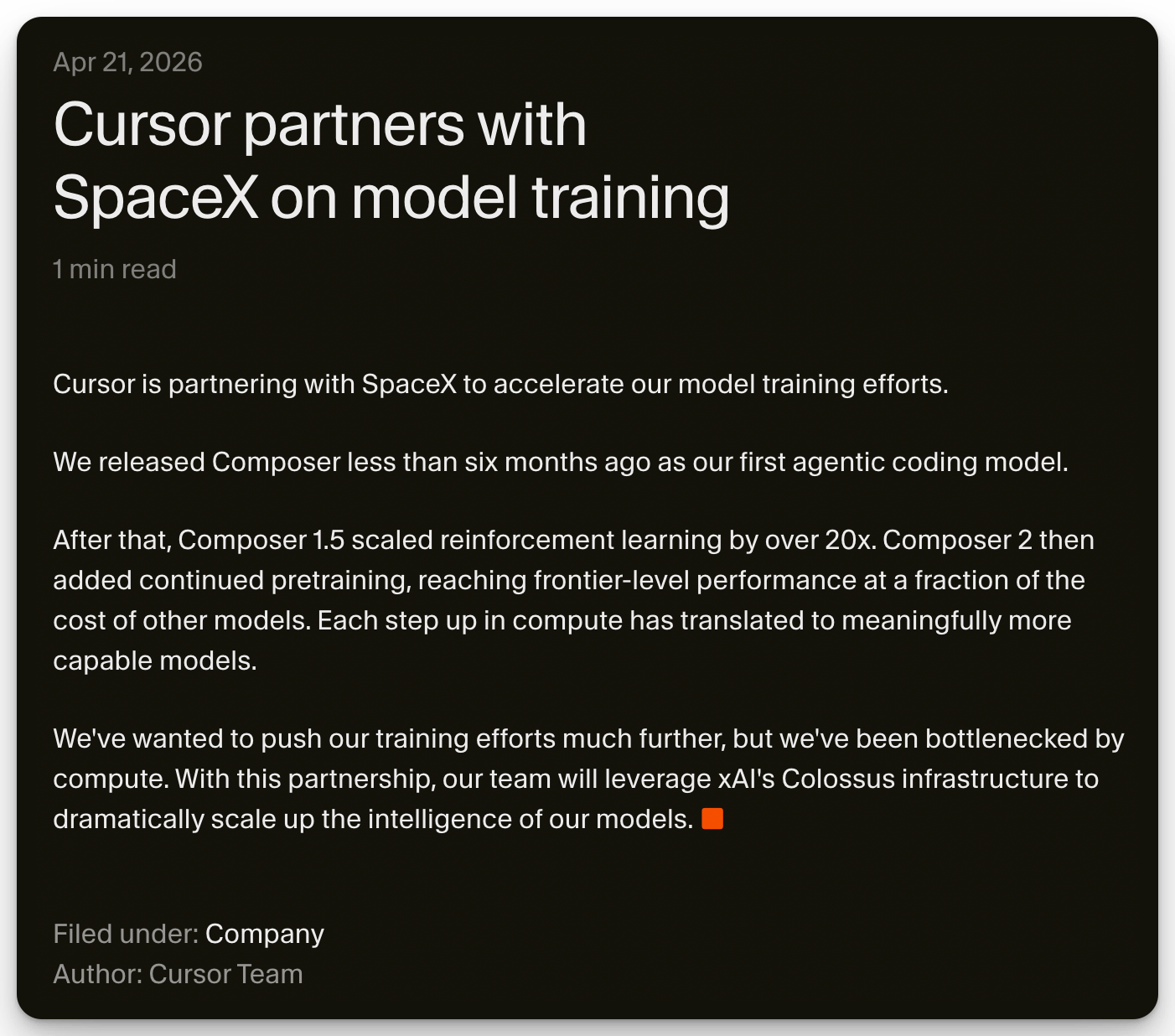
The target’s blog post described the trade-off directly: “We’ve been bottlenecked by compute. With this partnership, our team will leverage xAI’s Colossus infrastructure to dramatically scale up the intelligence of our models.” Per Bloomberg, the cancelled $2 billion funding round was earmarked for exactly that need.
President Oskar Schulz told Bloomberg the rocket maker’s team can help the firm “scale up our model efforts.” The New York Times describes the cluster as a machine capable of training large models.
The Race Against Claude Code and Codex
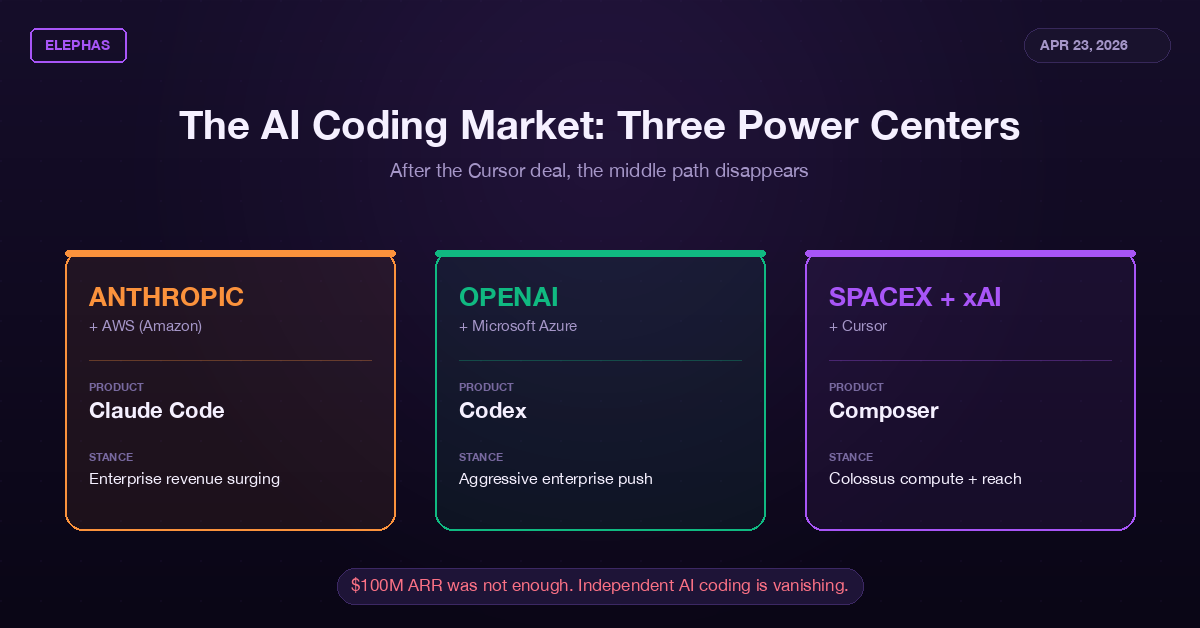
The market has become one of the most contested in enterprise software. Per The New York Times, Anthropic’s Claude Code has seen a surge in revenue from business customers, while the Codex team has courted enterprise buyers aggressively. CNBC has reported that Google and others have debuted similar products since the firm launched. Anthropic and OpenAI now represent the two incumbents the merged stack must dislodge.
The Awkward Investor Positions
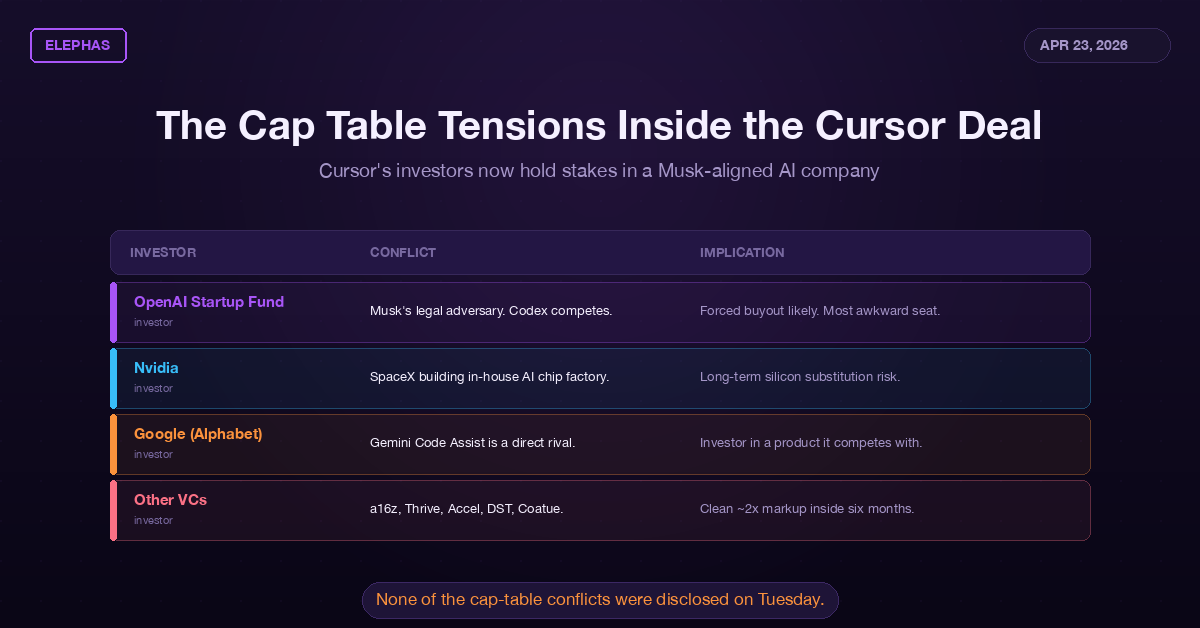
The cap table creates several conflicts. Per Bloomberg, the OpenAI Startup Fund is among the venture backers, while Codex competes directly with Composer. Nvidia is also an investor; per The New York Times, the rocket maker has pushed toward an AI chip factory, which over time could compete with its data center business. Google, via Alphabet, holds equity while running its own similar products per CNBC. None of these positions was disclosed on Tuesday.
Why the Stock Debut Decides the Timing
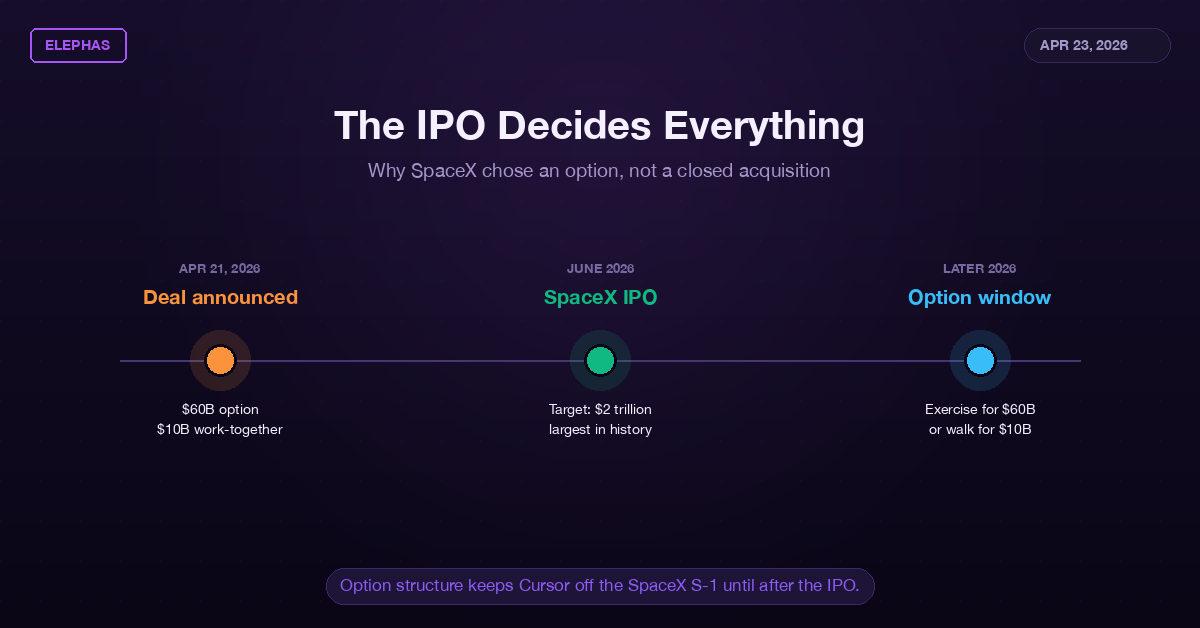
The rocket maker is preparing a stock debut as early as June, targeting a worth near $2 trillion. The New York Times described the listing as likely to be one of the largest ever. Per Bloomberg, a full acquisition now would force updated filings and financial details, potentially delaying the listing.
The option avoids immediate consolidation. The rocket maker can disclose the agreement without folding audited financials from the target into its prospectus. Bloomberg reported that the $10 billion is a breakup fee if the deal does not go through. The firm can stay private, access the merged cluster, and either accept a $60 billion acquisition or keep the $10 billion and stay independent.
The Brand Transfer
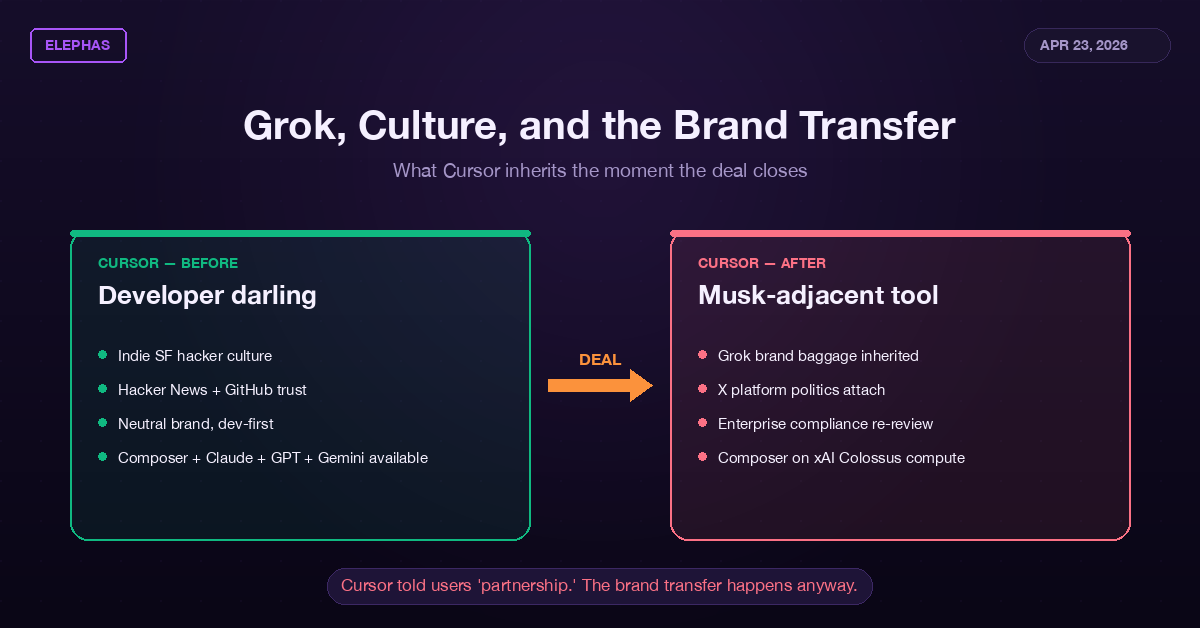
The firm’s user base is concentrated among software developers, the group described in the announcement as “expert software engineers.” The New York Times notes the merged AI firm created the Grok chatbot, and that brand association now extends to the target under the agreement.
The firm’s own blog entry on that same day is roughly 100 words long and titled “Cursor partners with SpaceX on model training.” It does not use the word acquisition, nor mention $60 billion or $10 billion, nor call the deal an option. The full structure came from Bloomberg and The New York Times.
What Comes Next
Two milestones will determine how the deal resolves. First, the stock debut. If the listing prices at or above its $2 trillion target, the $60 billion option becomes a test of the broader AI thesis. Second, the exercise decision in the coming months: either a full acquisition, or the $10 billion paid and the firm stays independent. The competitive response from Claude Code and Codex will also matter.
Sources
- Bloomberg: “SpaceX Strikes Deal With Cursor, With Option to Acquire for $60 Billion” (April 21).
- The New York Times: “SpaceX Strikes Deal With Cursor for $60 Billion” by Erin Griffith, Mike Isaac, and Ryan Mac (April 21).
- Cursor blog: “Cursor partners with SpaceX on model training” (April 21).
- CNBC: Bosa and Vanian on the planned $2 billion independent round at over $50 billion (April 19, 2026).
Related Reading