How to Build an AI-Powered Legal Research Library on Your Mac
A step-by-step guide to organizing statutes, case law, and contracts into private Super Brain knowledge bases—so you can query your entire legal library with AI, without sending a single document to the cloud.
Why Every Lawyer Needs a Private AI Research Library
Legal research is the backbone of every case, every motion, and every client consultation. But the traditional approach—manually searching through Westlaw, flipping between browser tabs, and maintaining sprawling folder hierarchies—hasn't evolved to match the volume of material modern lawyers handle.
AI tools like ChatGPT promised to change that, but they introduced a fatal flaw for legal professionals: every document you upload leaves your device and lands on a third-party server. As we've covered in our analysis of how AI can waive attorney-client privilege, this cloud transmission creates real privilege waiver risk.
The solution is an AI legal research library that runs entirely on your Mac. Using Elephas's Super Brain feature, you can build dedicated knowledge bases for every category of legal material—statutes, case law, contracts, internal memos—and query across all of them with natural language. No cloud. No third-party servers. No privilege risk.
What you'll build in this tutorial
- A structured document organization system for legal materials
- Dedicated Super Brains for statutes, case law, and contracts
- Cross-referencing queries that span your entire legal knowledge base
- A private, privilege-preserving research workflow on your Mac
For a broader look at AI tools designed for legal privacy, see our roundup of the best private AI tools for lawyers.
Organizing Your Legal Documents by Type
Before you create any Super Brains, you need a clean organizational structure. The quality of your AI research library depends directly on how well you categorize your source materials. Start by creating a dedicated folder on your Mac for your legal research library.
Recommended folder structure:
Naming conventions matter. Use consistent, descriptive file names that include the document type, jurisdiction, and date. For example: USC-Title42-Section1983-2025.pdf or Brown-v-Board-347US483-1954.pdf. This makes it easier to audit your library and ensures the AI can reference documents clearly in its citations.
Pro tip: Start with the materials you reference most frequently. You don't need to digitize your entire library on day one. Begin with 20–30 core documents per category and expand over time. The library compounds in value as you add materials.
Creating Super Brains for Statutes
Your first Super Brain should be your statutory library. Statutes are the foundation of legal analysis, and having instant AI-powered access to the specific provisions you work with most frequently will immediately accelerate your research workflow.
How to create your Statutes Super Brain:
Open Elephas and navigate to the Super Brain panel from the menu bar
Click "Create New Super Brain" and name it descriptively — e.g., "Federal Statutes - Civil Rights" or "California Business & Professions Code"
Drag and drop your statute PDFs from the organized folder you created in Step 1
Wait for Elephas to process and index the documents (progress bar will show completion)
Test with a query like: "What are the elements of a Section 1983 claim?"
Consider creating separate Super Brains by jurisdiction or practice area. A single “All Statutes” Super Brain will work, but splitting by jurisdiction—federal statutes, state statutes, regulations—gives you more targeted results. When you're researching a California employment law issue, you want answers sourced from California statutes, not a mix of fifty states.
Example queries for a Statutes Super Brain: “What is the statute of limitations for breach of fiduciary duty under Delaware law?” or “Summarize the key provisions of HIPAA Section 164.512 regarding disclosures for judicial proceedings.” The AI returns answers grounded in your uploaded statutory text with specific section citations.
Creating Super Brains for Case Law
Case law research is where an AI legal research library delivers the most dramatic time savings. Instead of running boolean searches across Westlaw and reading through dozens of irrelevant results, you can ask natural-language questions across your curated collection of relevant decisions.
Unlike ChatGPT—which notoriously fabricates case citations—a Super Brain only references cases you have actually uploaded and verified. This eliminates the hallucination risk that led to sanctions in Mata v. Avianca and similar cases.
Recommended case law organization strategy:
By practice area
Create a Super Brain for each area you practice — "Employment Discrimination Cases," "Contract Dispute Precedents," "IP Infringement Decisions." This keeps results focused and relevant.
By matter
For active litigation, create a case-specific Super Brain containing all relevant precedent for that matter. Upload the key decisions cited by both sides and query for distinguishing factors.
By court level
Separate Supreme Court decisions from circuit and state court opinions. When you need binding authority from a specific jurisdiction, this structure ensures your results come from the right court.
Once your case law Super Brain is populated, try queries like: “Which cases in this collection address the duty to mitigate damages in commercial lease disputes?” or “What did the court hold regarding personal jurisdiction over out-of-state defendants in these decisions?” The AI will cite specific passages from your uploaded opinions—real cases you can verify.
Creating Super Brains for Contracts and Agreements
Contracts are among the most privacy-sensitive documents in any law practice. They contain client names, deal terms, proprietary business information, and negotiation positions. This is precisely why a local AI research library is essential—you need AI-powered contract analysis without exposing confidential terms to third-party servers.
Build your Contracts Super Brain:
Create a Super Brain named by contract type — "Commercial Leases," "Employment Agreements," "SaaS Vendor Contracts," or "M&A Transaction Documents"
Upload your templates, executed agreements, and any amendments or side letters
Include relevant regulatory guidance or industry-standard terms for comparison
Query the Super Brain to compare clause language across agreements: "How do the indemnification provisions differ between these three vendor contracts?"
A contracts Super Brain becomes incredibly valuable during negotiations. Instead of manually comparing clause language across dozens of prior agreements, you can ask: “What limitation of liability caps have we accepted in previous SaaS agreements?” or “Show me how our standard termination clause has evolved over the last three template versions.”
Privacy note: Contract documents are among the highest-risk materials for privilege and confidentiality exposure. Never upload active client contracts to any cloud-based AI tool. Elephas's local processing ensures these documents never leave your Mac—a critical safeguard for maintaining client confidentiality obligations.
Querying Across Your Legal Knowledge Base
The real power of an AI legal research library emerges when you query across multiple Super Brains simultaneously. Legal analysis rarely involves a single category of material—you need to connect statutory text with case law interpretations and contractual obligations.
Elephas lets you select multiple Super Brains for a single query, enabling research workflows that would take hours to perform manually.
Cross-library query examples:
“What statutory provisions govern non-compete enforceability in California, and how have recent cases interpreted them?”
Super Brains: Statutes + Case Law
Returns the relevant Business & Professions Code sections alongside judicial interpretations from your uploaded decisions
“Does our standard vendor contract's force majeure clause align with how courts have interpreted force majeure post-COVID?”
Super Brains: Contracts + Case Law
Compares your contractual language against judicial holdings from your case law library
“What regulatory requirements apply to the data sharing provisions in our client's proposed SaaS agreement?”
Super Brains: Statutes + Contracts
Cross-references statutory data privacy requirements with the specific contract terms under review
Every answer includes citations to specific passages in your uploaded documents. You can click through to verify the source, check the context, and confirm accuracy before relying on the research in your work product. This is fundamentally different from generic AI chat tools that generate text without verifiable sources.
Advanced Tips: Cross-Referencing, Citation Tracking, and Updates
Once your basic library is operational, these advanced strategies will help you extract maximum value from your AI legal research library.
Cross-Reference Checking
Use multi-Super Brain queries to verify that your legal analysis accounts for all relevant authority. When drafting a motion, query your statutes and case law Super Brains together: "Are there any statutory provisions or case holdings that contradict the argument that [X]?" This adversarial self-check catches gaps before opposing counsel does.
Citation Chain Tracking
Build a dedicated Super Brain for a specific matter containing all cases cited by both sides. Then ask: "Which cases in this collection cite or distinguish [key decision]?" This helps you trace citation chains, identify the strongest authority, and anticipate opposing counsel's precedent arguments — all from your verified documents.
Keeping Your Library Current
Schedule a monthly maintenance routine: add new statutes after legislative sessions, upload recent relevant decisions, and update contract templates after each negotiation cycle. Elephas makes adding documents to an existing Super Brain as simple as dragging and dropping new files. Your library grows more powerful over time.
Practice Area Knowledge Bases
Beyond the three core categories, consider creating Super Brains for practice-area-specific resources: CLE materials, bar journal articles, regulatory guidance documents, and internal firm memoranda. Over time, these supplementary libraries become an institutional knowledge base that preserves expertise even as team members change.
For more on how Elephas supports legal workflows with privacy-first architecture, visit our Elephas for Legal Professionals hub page.
Frequently Asked Questions
What is a Super Brain in Elephas?
A Super Brain is Elephas's knowledge base feature that lets you upload documents — PDFs, Word files, text files, and 20+ other formats — and create a persistent, searchable AI library. When you query a Super Brain, the AI grounds its answers in your actual uploaded documents and provides source citations. For lawyers, this means you can build dedicated knowledge bases for statutes, case law, contracts, and other legal materials.
How many documents can I upload to a single Super Brain?
Elephas Super Brains can handle hundreds of documents per knowledge base. Most legal professionals create multiple Super Brains organized by topic — one for statutes, one for case law, one for contracts — rather than putting everything into a single massive library. This organization makes queries more precise and results more relevant.
Does building a legal research library in Elephas require technical skills?
No. Building a Super Brain is as simple as dragging and dropping files. There is no coding, no database configuration, and no command-line setup required. If you can organize files into folders on your Mac, you can build a legal research library in Elephas. The entire setup for a basic library takes under 30 minutes.
Can I query across multiple Super Brains at once?
Yes. Elephas allows you to query across multiple Super Brains simultaneously, which is essential for legal research that spans statutes, case law, and contractual language. This cross-referencing capability lets you ask a single question and get answers sourced from your entire legal knowledge base.
Is my legal research library stored privately on my Mac?
Yes. When you use Elephas with local AI models, your entire legal research library — every document, every Super Brain, every query — stays on your Mac. Nothing is transmitted to external servers. This local processing model preserves attorney-client privilege by eliminating any third-party disclosure risk.
What file formats does Elephas support for legal documents?
Elephas supports over 20 file formats including PDF, DOCX, TXT, RTF, HTML, and more. This covers virtually every format used in legal practice — from court filings and statutory compilations to contract drafts and client correspondence. You can upload documents directly from your Mac's file system or drag and drop them into a Super Brain.

Related Resources
Explore all AI for Lawyers resourcesSiri vs ChatGPT for Confidential Work
15 min readarticleCan You Upload Contracts to AI? Privacy Risks, Vendor Workflow, and Safer Alternatives for AI Contract Management
11 min readarticleAI for Sensitive Data: A Complete Guide to Using AI Tools Without Exposing Sensitive Company Information (2026 Edition)
10 min readarticleIs ChatGPT Attorney-Client Privilege Protected? The Heppner Ruling and Generative AI in Litigation
11 min readBuild Your Legal Research Library with Elephas
Turn your legal documents into a searchable, AI-powered knowledge base—entirely on your Mac. No cloud uploads. No privilege risk. No hallucinated citations. Start building your library today.
Try Elephas Free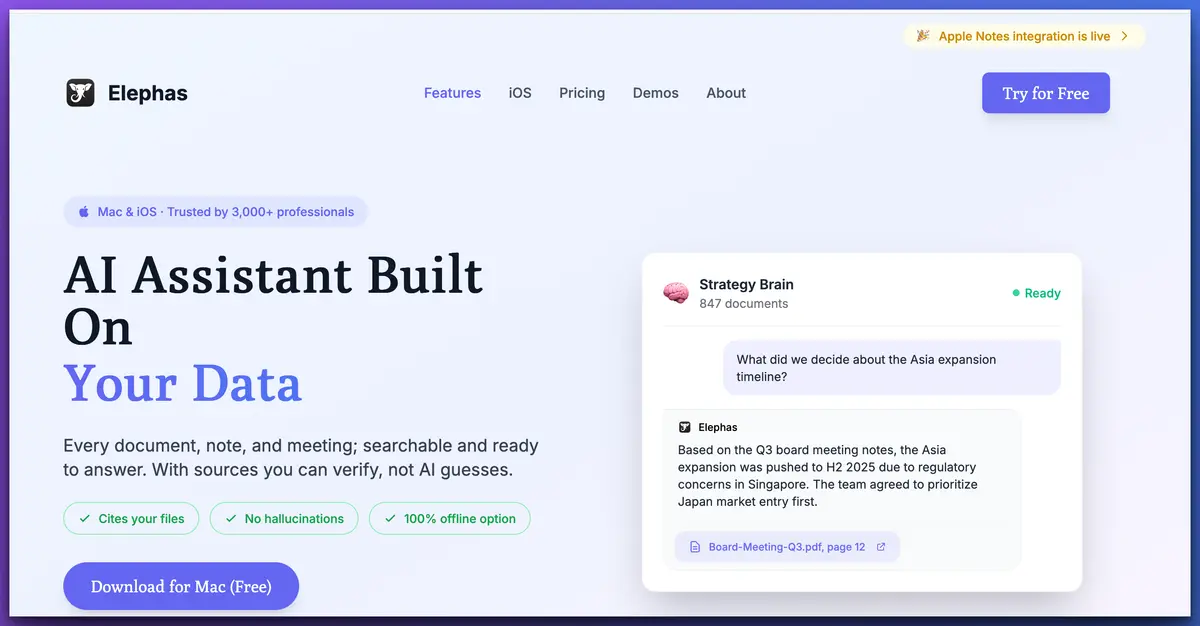
No credit card required. Build your first Super Brain in minutes.