Open WebUI vs OpenClaw: Security, Self-Hosting & Features Compared
Two open-source AI tools. One provides a secure, self-hosted ChatGPT alternative with built-in authentication. The other has 42,900 publicly exposed instances. Here's the full breakdown.
At a glance
Open WebUI is the safer, more practical choice for professional use. It provides a polished ChatGPT-like interface you self-host, with built-in authentication, role-based access control, Ollama integration for offline AI, and document RAG. OpenClaw's 42,900 exposed instances, lack of default authentication, and agent-first architecture make it fundamentally unsuitable for work involving any confidential data.
OpenClaw: Strengths and Weaknesses
OpenClaw is an AI agent framework focused on autonomous task execution. While it has a large community and flexible agent capabilities, its security posture is disqualifying for professional work.
What OpenClaw Does Well
Critical Security Failures
For the full investigation, see OpenClaw: 42,900 Instances Exposed.
Open WebUI: Strengths and Weaknesses
Open WebUI is a self-hosted, open-source AI chat interface designed as a private ChatGPT alternative. It integrates seamlessly with Ollama for local AI and supports multiple cloud providers, all behind proper authentication.
What Open WebUI Does Well
Considerations
Feature-by-Feature Comparison
Real-World Use Cases
Here's how the choice between these tools plays out in common professional scenarios:
Private ChatGPT for Your Team
The situation: Your company wants a ChatGPT-like AI chat tool but can't send confidential data to OpenAI's servers. You need a self-hosted solution with user management.
Research with Confidential Documents
The situation: You need to upload proprietary research documents and query across them using AI, without exposing them to third parties.
Offline AI for Secure Environments
The situation: You work in an air-gapped or restricted network environment where internet access is limited or prohibited for security reasons.
Verdict: When to Use Which Tool
OpenClaw might work if:
- You specifically need autonomous AI agents with tool use and code execution
- You're experimenting with AI workflows using only public data
- You have the expertise to fully secure and harden the deployment
- Security is not a concern for your use case
Use Open WebUI when:
- You want a private ChatGPT alternative you fully control
- You need built-in user authentication and role-based access
- You want to use local AI models via Ollama for complete privacy
- You need document upload and RAG for knowledge-based conversations
- Your team needs a shared AI tool with individual accounts
Consider Elephas if:
- You want zero-configuration privacy — no Docker, no self-hosting
- You prefer a native Mac app with system-wide AI access
- You want true offline AI that works without any server infrastructure
- You value a polished UX over open-source flexibility
For professionals who are comfortable with self-hosting, Open WebUI is the clear winner over OpenClaw. It delivers what most people actually need — a secure, private AI chat interface — without the security nightmares. For the comparison of all alternatives, see our complete OpenClaw alternatives guide.
Frequently Asked Questions
Is Open WebUI more secure than OpenClaw?
Yes, significantly. Open WebUI includes built-in authentication with sign-up/login, role-based access control (admin, user, pending roles), and runs as a self-hosted application you control. OpenClaw has 42,900 publicly accessible instances with no authentication by default. For any professional use, Open WebUI is dramatically safer.
Can Open WebUI work offline?
Yes. Open WebUI works fully offline when connected to a local Ollama instance running open-source models. All chat, document processing, and RAG queries run on your own hardware. OpenClaw requires cloud-connected LLM providers and cannot function offline.
How does Open WebUI compare to ChatGPT?
Open WebUI provides a ChatGPT-like interface that you self-host and control. You can use any AI model (local via Ollama, or cloud via OpenAI/Anthropic APIs). The key advantage is that your conversations and documents stay on your own infrastructure rather than being stored by OpenAI. The trade-off is that you manage the hosting yourself.
Does Open WebUI support document upload and RAG?
Yes. Open WebUI supports document upload with built-in RAG (Retrieval-Augmented Generation). You can upload PDFs, text files, and other documents, then query across them in conversation. Documents are processed and stored locally on your server.
Which is easier to set up — Open WebUI or OpenClaw?
Both require Docker for self-hosting, but Open WebUI has a simpler, more streamlined setup process. A single Docker command gets you a fully functional instance with authentication already enabled. OpenClaw's setup is more complex due to its agent architecture and multiple configuration options — and critically, it ships without authentication, requiring manual security hardening.
Should I choose Open WebUI, AnythingLLM, or Elephas?
Open WebUI is best if you want a self-hosted ChatGPT replacement with a polished web interface. AnythingLLM is better for structured document RAG with workspace organization. Elephas is the best choice if you want zero-configuration privacy on Mac — no self-hosting, no Docker, just install and go. All three are dramatically safer than OpenClaw.

Related Resources
Explore all AI Privacy & Security resourcesWant Privacy Without Self-Hosting?
Open WebUI is excellent for tech teams. For the easiest, most private AI experience — no Docker, no servers — try Elephas on Mac. Install, open, and start working.
Try Elephas Free for 7 Days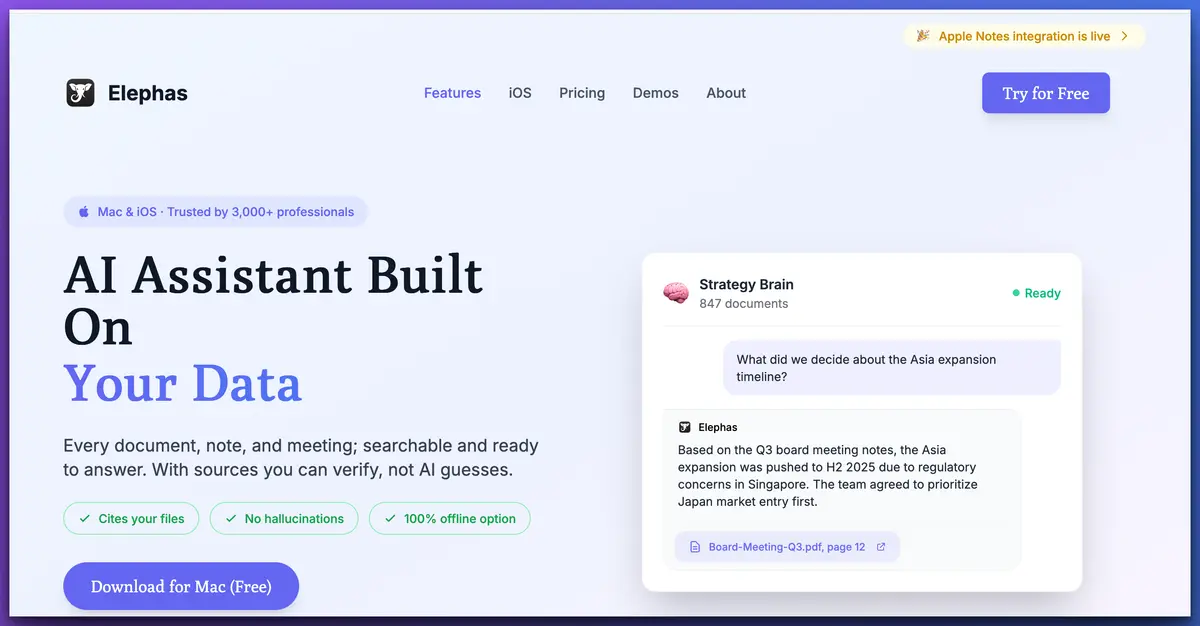
No credit card required. Full offline AI included.