AI Ethics CLE: What Lawyers Need to Know for State Bar Compliance
State bars across the country are issuing AI ethics guidance, mandating disclosure requirements, and incorporating AI competence into CLE obligations. Here's what you need to know to stay compliant as of 2026.
Key takeaway
AI ethics is no longer optional continuing education—it's becoming a core competence requirement. ABA Formal Opinion 512 established the framework, and state bars are building on it with jurisdiction-specific rules. Lawyers who ignore AI ethics CLE risk not just falling behind on credits, but violating competence duties when they inevitably use AI tools without understanding the ethical implications.
Why AI Ethics CLE Is Emerging Now
The rapid adoption of generative AI tools by legal professionals created an urgent need for ethical guardrails. Three developments converged in 2025–2026 to make AI ethics CLE a priority:
The Mata v. Avianca Wake-Up Call
When attorneys submitted AI-hallucinated case citations to a federal court, it became clear that the legal profession needed formal training on AI risks. The resulting sanctions weren't just about negligence — they exposed a systemic competence gap.
ABA Formal Opinion 512
Released in 2024, Opinion 512 established that existing ethical duties — competence, confidentiality, communication, and fees — apply directly to AI use. This created a framework that state bars could build on with specific CLE requirements.
Widespread AI Adoption Without Guardrails
Surveys show that over 70% of lawyers have used generative AI in their practice, but fewer than 30% have received formal training on the ethical implications. State bars recognized that voluntary education wasn't keeping pace with adoption.
For a deep dive into the ABA framework, see our ABA Opinion 512 Practical Compliance Guide.
State-by-State AI Ethics Requirements (as of March 2026)
Approaches vary by jurisdiction, but the direction is clear: state bars are building AI ethics into their regulatory frameworks. Here's where the major jurisdictions stand:
California
Active GuidanceThe State Bar of California issued formal ethics guidance on generative AI in 2024, emphasizing competence and confidentiality duties. California lawyers using AI must understand how the tools process data and must not submit AI-generated content without independent verification. The state's ethics hotline has reported a surge in AI-related inquiries, and CLE providers have responded with California-specific AI ethics programming.
Florida
Disclosure RequiredFlorida was one of the first states to require AI disclosure in court filings. The Florida Bar's ethics opinions have specifically addressed confidentiality risks from cloud-based AI tools. Florida lawyers must disclose AI use in certain court submissions and ensure that AI tools comply with the state's client confidentiality rules.
New York
Active GuidanceNew York courts have issued standing orders and guidance on AI use in litigation. Several New York federal judges require AI disclosure certifications. The New York City Bar Association has published detailed guidance on ethical AI use, and CLE programs specifically addressing New York's requirements have become widely available.
Texas
Emerging RulesThe State Bar of Texas has begun addressing AI ethics through its ethics committee. While Texas hasn't issued a comprehensive AI ethics opinion yet, the state's large legal market and active bar association make formal guidance likely. Several Texas CLE providers now offer AI ethics programming that addresses the state's existing rules on competence and technology.
Illinois
Formal GuidanceThe Illinois State Bar Association has issued guidance on AI use in legal practice, focusing on competence requirements and data protection. Illinois lawyers are expected to understand how AI tools handle confidential information and to supervise AI use by non-lawyer staff under Rules 5.1 and 5.3.
New Jersey
Active RequirementsNew Jersey has been proactive on AI regulation in the legal profession. The state's Advisory Committee on Professional Ethics has addressed AI-specific issues, and New Jersey courts have adopted local rules on AI disclosure. The state's CLE Board has recognized AI ethics as qualifying for ethics credits.
Pennsylvania
Formal GuidancePennsylvania issued formal guidance on AI use in legal practice, addressing confidentiality concerns with cloud-based AI tools and competence requirements for AI-assisted legal work. The state bar has emphasized that lawyers must understand the data handling practices of any AI tool they use.
Oregon
Ethics OpinionThe Oregon State Bar issued an ethics opinion specifically addressing AI use in legal practice. Oregon's approach emphasizes the duty of competence in understanding AI capabilities and limitations, and the confidentiality obligations that apply when using cloud-based AI tools.
Note: AI ethics rules are evolving rapidly. Check your state bar's website for the most current guidance. This summary reflects the landscape as of March 2026.
ABA Model Rules Implicated by AI Use
AI ethics CLE programs focus on five core Model Rules that directly govern how lawyers can use AI tools. Understanding these rules is the foundation of any AI compliance strategy:
Rule 1.1 — Competence
Understand the AI tools you use
Lawyers must have the technical competence to understand how their AI tools work — where data is processed, what models are used, and what the tool's limitations are. You don't need to be an AI engineer, but you need to understand the basics of how the tool handles your data and the known risks (like hallucination).
Rule 1.6 — Confidentiality
Protect client data from AI disclosure
Cloud-based AI tools transmit client data to third-party servers, which may constitute an unauthorized disclosure under Rule 1.6. Lawyers must take reasonable measures to protect confidential information — which increasingly means understanding the data practices of any AI tool they use and choosing tools that minimize disclosure risk.
Rule 5.1 & 5.3 — Supervisory Duties
Oversee AI use by associates and staff
Partners and supervising lawyers have a duty to ensure that associates, paralegals, and staff use AI tools ethically. This includes establishing firm-wide AI policies, providing training on approved tools, and monitoring for unauthorized use of AI tools that don't meet the firm's data protection standards.
Rule 3.3 — Candor Toward the Tribunal
Verify AI-generated content before submission
The Mata v. Avianca case demonstrated what happens when AI-generated content isn't verified. Rule 3.3 requires lawyers to ensure that all representations to the court are accurate. AI-generated legal research, citations, and arguments must be independently verified before submission — the AI's output is a draft, not a final product.
Rule 1.5 — Fees
Bill ethically for AI-assisted work
When AI dramatically reduces the time needed for a task, billing full hourly rates for that time raises ethical questions. Lawyers should consider value-based billing for AI-assisted work, disclose AI use in billing descriptions, and ensure that fees remain reasonable relative to the actual effort and value delivered.
Core Topics Covered in AI Ethics CLE Programs
Whether you're attending a structured CLE program or building your own AI ethics knowledge, these are the essential topics every lawyer should understand:
Data Privacy and Confidentiality
- How cloud AI tools process and store your data
- The difference between architectural and policy privacy
- Third-party disclosure risks and privilege waiver
- Local vs. cloud processing for sensitive legal work
AI Hallucination and Verification
- How and why AI models generate false information
- Case law citation verification procedures
- Verification workflows for AI-assisted research
- Disclosure obligations when AI was used in work product
AI Tool Evaluation and Selection
- Assessing data handling practices of AI tools
- Reading AI privacy policies critically
- Choosing between local and cloud-based AI tools
- Evaluating AI tools for specific legal workflows
Firm Governance and Policy
- Creating a firm-wide AI usage policy
- Training requirements for associates and staff
- Approved tool lists and prohibited uses
- Incident response for AI-related data exposure
Practical Compliance Steps for Lawyers
AI ethics CLE isn't just about earning credits—it's about implementing real changes in your practice. Here's what you should do right now:
Audit Your Current AI Tool Usage
Document every AI tool you and your staff use, including consumer tools like ChatGPT. For each tool, identify where data is processed, the retention policy, and whether the tool trains on your inputs. This audit is the foundation of your compliance strategy.
Create or Update Your Firm AI Policy
Establish approved tools, prohibited uses, and verification requirements. Your policy should address data classification (what can and can't be processed through AI), client disclosure obligations, and billing practices for AI-assisted work.
Choose Privacy-First AI Tools
For any work involving client data, privileged communications, or confidential information, use AI tools that process data locally on your device. This eliminates the largest category of AI ethics risks — third-party data disclosure — by architecture rather than policy.
Implement Verification Workflows
Every piece of AI-generated content — citations, research, drafting, analysis — must be independently verified before use in client work or court submissions. Establish a formal review process and document your verification steps.
Stay Current on Your State's Rules
AI ethics rules are evolving rapidly. Subscribe to your state bar's ethics updates, attend AI-focused CLE programs annually, and designate someone in your firm as the AI compliance lead responsible for tracking regulatory changes.
How Local-Processing AI Simplifies Compliance
The majority of AI ethics concerns stem from a single architectural decision: sending data to cloud servers. Local-processing AI tools like Elephas eliminate most of these concerns by keeping data on your device:
When data never leaves your device, there is no third-party disclosure, no external logs to subpoena, and no privacy policy that can change overnight. This is why AI ethics CLE programs increasingly distinguish between cloud and local AI tools—the compliance posture is fundamentally different. For a detailed look at how privilege is affected, see our guide on how AI tools can waive attorney-client privilege.
What to Watch in 2026–2027
The AI ethics landscape for lawyers is evolving quickly. Here are the trends to monitor:
More states will issue formal AI ethics opinions — expect 30+ states to have specific AI guidance by end of 2027
Mandatory AI disclosure in court filings will become standard in most federal courts
State bars will begin requiring AI-specific CLE credits as a distinct category, not just general ethics
Firms will face malpractice claims specifically related to AI misuse — creating precedent that shapes future rules
AI tool vendors will be required to provide transparency reports on data handling for legal clients
Healthcare attorneys face additional complexity where HIPAA intersects with AI ethics—see our guide on HIPAA-compliant AI for healthcare attorneys
Frequently Asked Questions
Are AI ethics CLE credits mandatory in any state?
As of March 2026, several states have incorporated AI ethics into their CLE requirements, though approaches vary. California and New York have been among the most proactive, with specific guidance on AI-related ethics obligations. Florida, Illinois, and New Jersey have issued formal ethics opinions that effectively require lawyers to understand AI ethics as part of their competence duty. The trend is clearly toward more mandatory requirements — if your state hasn't mandated it yet, it likely will soon.
How many CLE credits are typically offered for AI ethics courses?
AI ethics CLE programs typically offer 1 to 3 credits, depending on the depth of coverage. Introductory sessions covering the basics of AI ethics for lawyers usually run 1 to 1.5 credits. More comprehensive programs covering state-specific rules, practical compliance strategies, and hands-on tool evaluation may offer 2 to 3 credits. Many state bars now accept these credits toward the ethics component of your annual CLE requirement.
Do online AI ethics CLE courses count toward my requirements?
Most states now accept online CLE courses, including AI ethics programs. The COVID-19 pandemic accelerated acceptance of remote learning, and most jurisdictions have made permanent allowances for online CLE. However, some states cap the number of online credits you can earn per reporting period, or require a certain portion to be completed live (synchronous). Check your state bar's specific rules on distance learning and self-study credits.
What ABA Model Rules are most relevant to AI ethics?
The key Model Rules implicated by AI use are: Rule 1.1 (Competence) — requiring lawyers to understand the technology they use; Rule 1.6 (Confidentiality) — protecting client information from unauthorized disclosure through AI tools; Rule 5.1 and 5.3 (Supervisory Duties) — overseeing AI use by associates and staff; and Rule 3.3 (Candor Toward the Tribunal) — ensuring AI-generated content is accurate. ABA Formal Opinion 512 provides the most comprehensive framework for applying these rules to AI.
Can I use AI tools to prepare for my AI ethics CLE?
Yes, but with an important caveat — this is precisely the kind of situation where you need to practice what you preach. If you're using a cloud-based AI tool to research ethics obligations, you're potentially demonstrating the very risks the CLE is designed to address. Using a local-processing tool like Elephas to prepare for AI ethics CLE lets you leverage AI assistance while modeling the privacy-first approach these programs recommend.
What should a firm-wide AI ethics training program cover?
A comprehensive firm AI ethics program should cover: (1) your state's specific AI rules and disclosure requirements, (2) the firm's AI usage policy including approved and prohibited tools, (3) data classification — what can and can't be processed through AI, (4) verification procedures for AI-generated work, (5) client communication and disclosure obligations, (6) billing practices for AI-assisted work, and (7) incident response if confidential data is inadvertently exposed through AI. Annual refresher training is recommended given how quickly the regulatory landscape is evolving.

Related Resources
Explore all AI for Lawyers resourcesSiri vs ChatGPT for Confidential Work
15 min readarticleCan You Upload Contracts to AI? Privacy Risks, Vendor Workflow, and Safer Alternatives for AI Contract Management
11 min readarticleAI for Sensitive Data: A Complete Guide to Using AI Tools Without Exposing Sensitive Company Information (2026 Edition)
10 min readarticleIs ChatGPT Attorney-Client Privilege Protected? The Heppner Ruling and Generative AI in Litigation
11 min readStay Compliant with Privacy-First AI
Elephas processes everything on your Mac. No cloud disclosure, no third-party data risk, no complex privacy policies to evaluate. Compliance by architecture, not by policy.
Try Elephas Free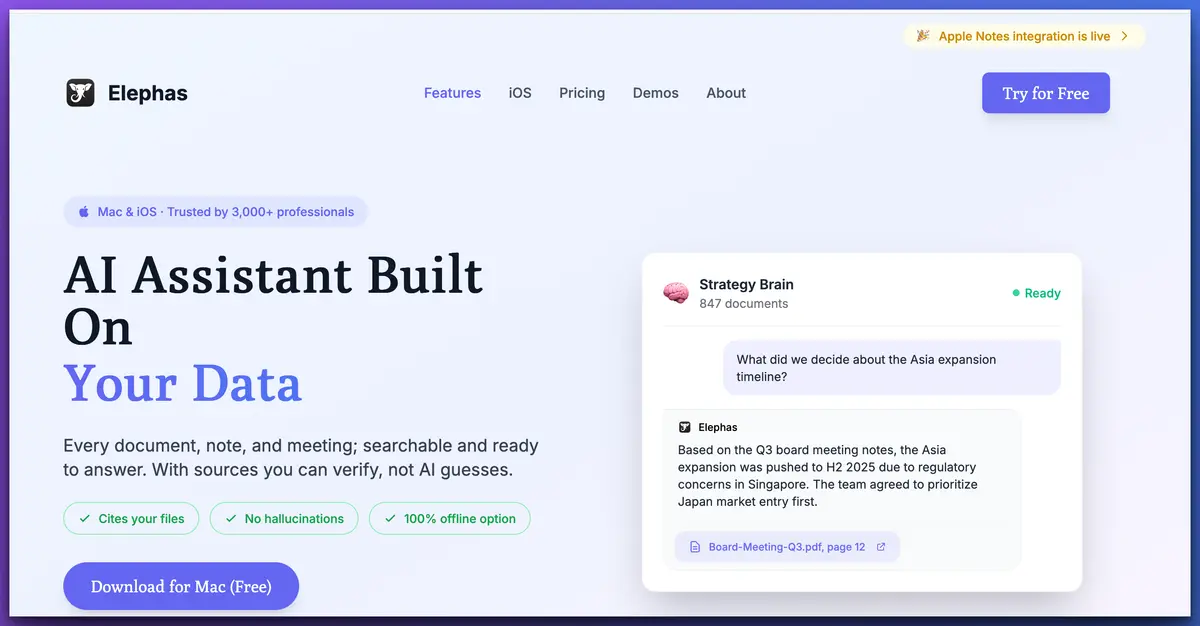
No credit card required. True offline AI for legal professionals.