Will AI Take My Job? Why the CEOs Who Said Yes Are Now Saying No
For about two years, the people building AI told you the same thing: it was coming for your job. Then, in a single week of May 2026, several of them changed their answer.
So if you are asking "will AI take my job," you are now getting two opposite replies from the same mouths. Sam Altman, the head of OpenAI, spent years warning that AI would wipe out large parts of white-collar work. On May 26, 2026, speaking to a banking conference in Sydney, he said he was "delighted to be wrong" about how fast that would happen.
This article looks at what these leaders said before, what they say now, and the real reasons the message flipped. Every quote below is taken from the person who said it. The short version: very little about the technology changed in that week. What changed was who they needed to convince.
50%
Entry-level white-collar jobs Amodei once said could vanish
70,474
Tech jobs cut in Q1 2026 (Layoffs.fyi)
$1T
Valuation OpenAI is reportedly targeting at IPO
16%
Employment drop for early-career workers in the most AI-exposed jobs (Stanford)
Executive Summary
- In May 2026 Sam Altman said he was "delighted to be wrong" about AI causing fast white-collar job loss
- Anthropic's Dario Amodei, who once warned half of entry-level jobs could go, now says AI may expand the work people do
- Goldman Sachs CEO David Solomon never bought the panic, pointing to a century of US job creation after automation
- The reversal lines up with three things at once: looming IPOs, public anger including attacks on Altman's home, and AI costing more than expected
- Layoffs are real (about 50,000 cuts cited AI through April 2026), but trackers disagree on whether AI is the cause or the scapegoat
- The Yale Budget Lab found no clear unemployment rise through March 2026 for the workers most exposed to AI
What Sam Altman used to say
Altman did not hint at job loss. He stated it plainly, more than once.
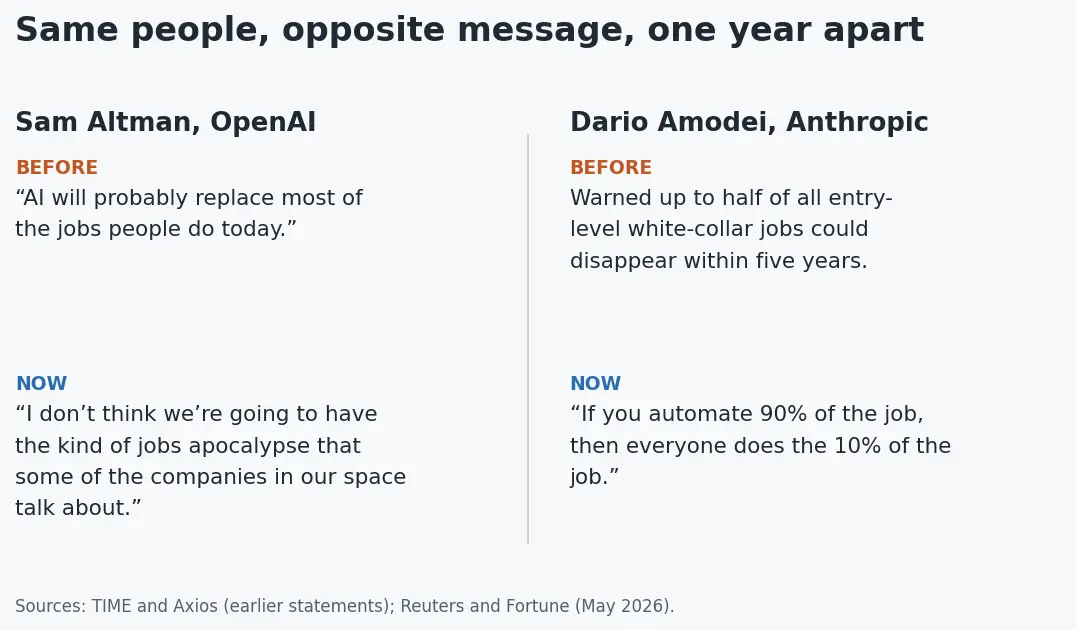
He said AI would "probably replace most of the jobs people do today." He said entire job categories would be "totally, totally gone." People pushed out, he said, would "find all sorts of new things to do." TIME collected these earlier statements when it reported on his reversal.
In June 2025, on the Uncapped podcast hosted by his brother Jack, Altman put it this way, as quoted by Fortune:
"A lot of jobs will go away…we have always been really good at figuring out new things to do…I'm not a believer that that ever runs out."
He was not alone. Dario Amodei, head of Anthropic, went further. He told Axios in 2025 that up to half of all entry-level white-collar jobs could disappear in the next one to five years, and that unemployment could climb to 10 to 20 percent.
"We, as the producers of this technology, have a duty and an obligation to be honest about what is coming," Amodei said. "I don't think this is on people's radar."
What they say now
The new message is softer, and it arrived fast.
At the Commonwealth Bank of Australia conference, Altman told the bank's chief executive Matt Comyn that his early fears had not played out. Reuters reported his words directly:
"I'm delighted to be wrong about this, I thought there would have been more impact on entry-level white-collar jobs being eliminated by now than has actually happened."
He said he and his team had been "roughly right" about the technology when ChatGPT launched in 2022, but "pretty wrong" about its effect on jobs and the economy.
He gave a personal example. He had tried letting AI answer his Slack and email messages, signing them "this is Sam's AI." He went back to answering them himself.
"We really do care about our interactions with people and this thing, which is a huge amount of my time, is not something that I can imagine myself outsourcing to an AI anytime soon," he told the conference.
His final line was the headline: "I don't think we're going to have the kind of jobs apocalypse that some of the companies in our space advocate or talk about."
Two details complicate the reassurance. He did not fully retract. Right after saying he had seen a real risk worth talking about, he added that it "still may" happen.
He also delivered the calm message to a room that was already cutting. Reuters noted that HSBC, Amazon, Standard Chartered and the host bank itself, the Commonwealth Bank of Australia, had all announced jobs being replaced by AI. The phrase "companies in our space" also reads as a swipe at his main rival, Anthropic.
Amodei shifted too. Instead of half of all entry-level jobs vanishing, he now describes AI as something that grows the work rather than ending it. Fortune quoted his new framing:
"If you automate 90% of the job, then everyone does the 10% of the job. And the 10% kind of expands to be 100% of what people do and kind of 10-times their productivity."
The same answer keeps changing with the audience
It is worth sitting with that contradiction. The honest answer is that the people you would expect to know keep giving different answers depending on the room they are in.
One comment on the news, posted to r/technology, became the most upvoted reply in the thread with around 4,900 votes. It read, in full: "He figured out it was an unpopular thing to say."
Another, from a user called nojjers, made the same point at length:
"The funniest part of this is that nothing about AI or the labour market has changed, just the audience he's talking to. When he's courting investors it's 'this will replace half of all jobs, better get in now or be disrupted,' and when he's talking to a room full of workers and regulators it's suddenly 'actually it'll mostly just help you write emails faster.'"
Some readers pushed the point harder. A commenter called Legitimate_Concern_5 described it as a money trail:
"When he wanted to raise money from investors he told them the jobs would disappear and if they wanted a share of all labor in the future they would get it by investing. Now he needs money from the public who won't buy based on fear, so looks like the jobs are staying."
Others flagged a plain logic problem. A user named jolard argued that the company cannot have it both ways. If it still believes human-level AI is close, then large job losses follow soon after, so either the timeline or the reassurance has to be wrong. "So either he is lying about AGI," jolard wrote, "or he is lying about the jobs apocalypse. He can't have it both ways."
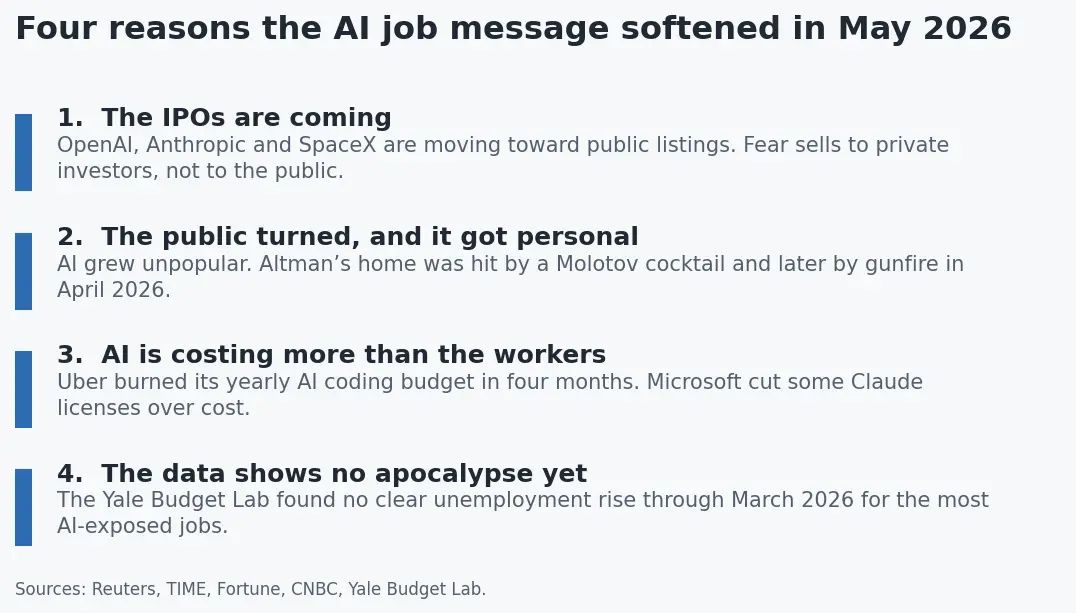
Below are the four reasons that best explain the flip. They are not guesses. Each one is tied to something that happened in the same window.
Reason 1: The IPOs are coming
The biggest AI companies are about to ask the public for money, and fear does not sell well to ordinary buyers.
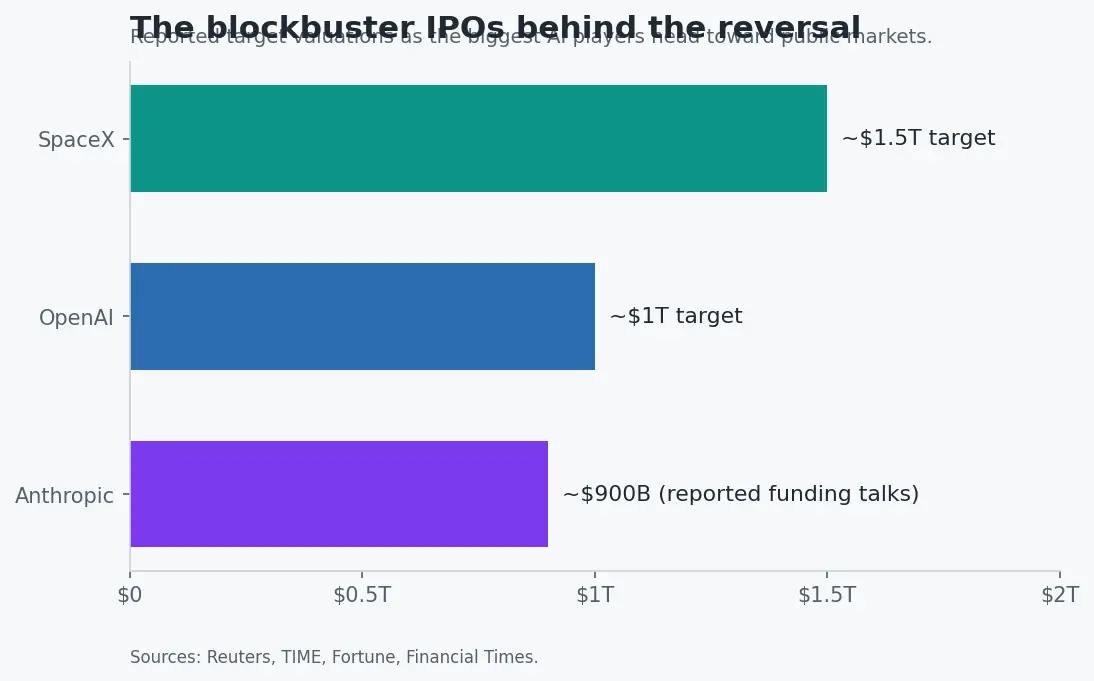
OpenAI is preparing to file for a US stock listing, Reuters reported, with talk of a valuation near one trillion dollars. TIME laid out the wider picture: OpenAI wants to reach 280 billion dollars in revenue by 2030, up from about 25 billion today.
SpaceX is eyeing a 1.5 trillion dollar listing. Anthropic has reportedly been in talks for 30 billion dollars in funding at a 900 billion dollar valuation.
The argument many people made is simple. A scary story about job loss is useful when you are raising money from businesses that want to cut staff. It is a problem when you are about to sell shares to teachers, nurses, and retirement funds.
- A commenter on r/technology, waitmarks, put it this way: "They are switching from private investor mode to public investor mode to get ready for the IPO. The AI will take everyone's job was to sell it to private investors and business owners. Now that needs to go away to sell shares to the public post IPO."
- On r/csMajors, a user named IsThisNickTaken_ was blunter: "We are the exit liquidity for the early investors and employees holding stock."
- Another, jmclondon97, with 13 upvotes on the Fortune thread: "Lol this is because of their IPO. I guarantee he doesn't believe this."
The logic cuts both ways, and it is worth being fair about that. One commenter pointed out that a company about to go public might prefer to claim its technology is powerful enough to replace whole workforces, because that promises growth.
The counter is that the buyers change. The earlier fear pitch was aimed at businesses and private investors who wanted to cut staff. A public listing pulls in pension funds and ordinary retirement accounts, the kind of "moral" money, as one reader put it, that does not want to be told it is funding mass unemployment. The point is not that the IPO theory is proven. It is that the reversal lines up almost exactly with the move toward public markets.
Reason 2: The public turned, and it got personal
The mood around AI soured, and for Altman it stopped being only about press coverage.
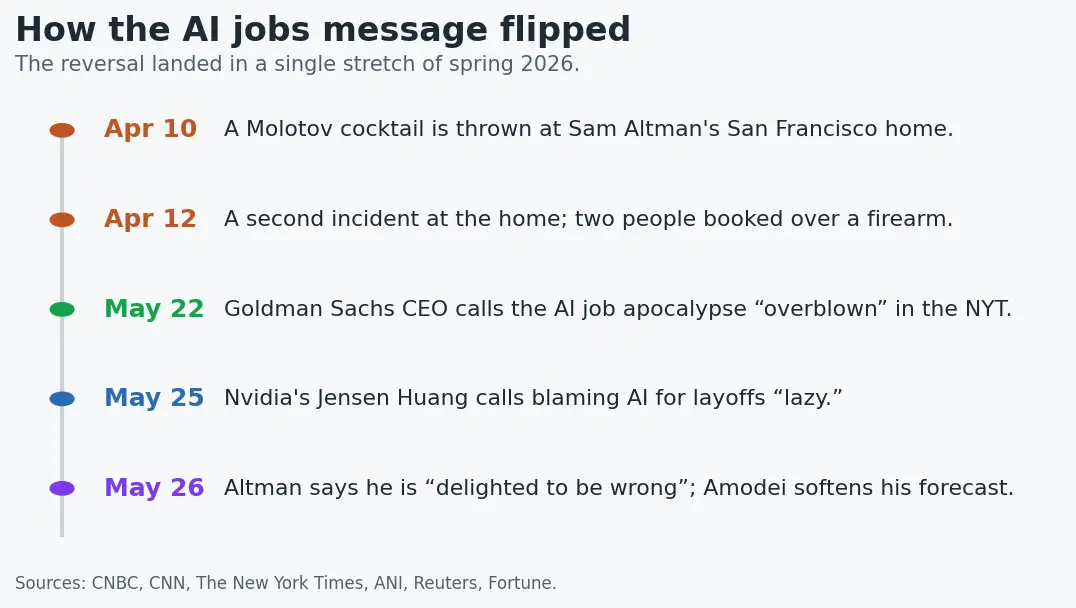
On April 10, 2026, a man threw a Molotov cocktail at Altman's San Francisco home at around 4 a.m., setting an exterior gate on fire. CNBC and NPR reported that the suspect, 20-year-old Daniel Moreno-Gama, had traveled from Texas and was charged with two counts of attempted murder and attempted arson. No one was hurt.
Two days later, on April 12, police investigated a second incident at the home and booked two people on suspicion of negligent discharge of a firearm. These events were not rumors. They were covered by CNBC, NPR, CNN, ABC News and others.
On Reddit, people connected them directly to the change in tone.
- chevalier716, with about 200 upvotes: "People firebombed and shot at his house, that's what changed."
- A user on r/Layoffs, JumpingJack79: "He is delighted to have fewer Molotovs thrown at his house, I'll grant him that."
Some executives drew the anger by name. Standard Chartered's chief executive, Bill Winters, was widely criticised after saying the bank was replacing "lower-value human capital" with technology, alongside a plan to cut thousands of back-office roles by 2030. He later apologised for the phrase, saying simply, "For that I am sorry."
The anger showed up in calmer settings too. Several commenters pointed to graduation ceremonies in May where students booed executives who praised AI, and said the younger generation was turning against the technology. One r/technology comment with around 200 upvotes captured the mood: "The damage is already done Sammy. Demoralized the work force, enraged the youth, pissed off citizens against data centers."
Peter Wildeford, Head of Policy at the AI Policy Network, told TIME that public feeling is a likely driver of the shift:
"Public opinion research has made pretty clear that Americans feel quite negative about AI. The AI industry, and in particular Sam Altman, has responded with an about-face. It's hard to say whether they've actually changed their forecasts for AI's economic impact, or whether they're just trying to change the narrative."
Reason 3: AI is costing more than the workers it was meant to replace
The plan was that AI would be cheaper than people. For a growing number of companies, the bill is saying otherwise.
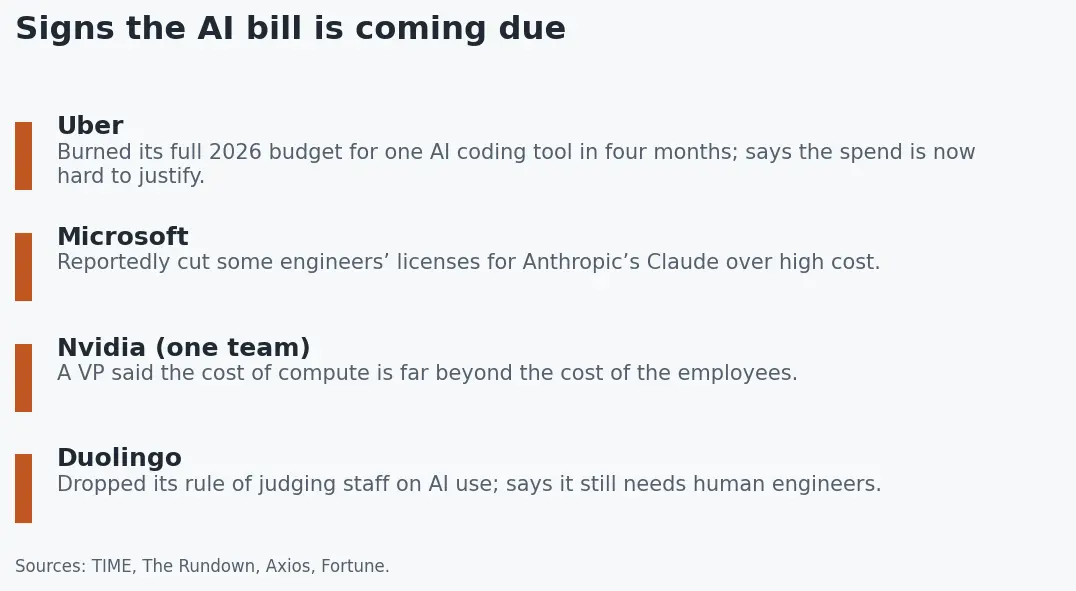
Uber's chief technology officer, Praveen Neppalli Naga, went viral in April after admitting the company burned through its entire 2026 budget for one AI coding tool in four months.
Uber's president and chief operating officer, Andrew Macdonald, said on a podcast posted May 22 that the spending is getting "hard to justify," because more AI usage was not clearly producing more useful features. Uber has been slowing hiring to pay for the AI, he added.
Other companies are seeing the same math.
- Bryan Catanzaro, Nvidia's vice president of applied deep learning, told Axios: "For my team, the cost of compute is far beyond the costs of the employees."
- Microsoft has reportedly started canceling licenses for its engineers to use Anthropic's Claude because of the cost, according to TIME.
- A worker on r/technology, coporate, summed up the trap with 55 upvotes: "AI to be profitable requires the cost for a company to be higher than an equally trained employee."
There is a twist worth noting. Some of the layoffs blamed on AI may be paying for AI rather than reflecting its gains. Reuters reported that Meta planned to cut 20 percent or more of its staff partly to offset its heavy spending on the technology. In that version of events, the cuts free up cash for chips and data centers before any clear productivity payoff has arrived.
This is also why some firms quietly stopped pushing AI on staff. Duolingo announced an "AI-first" policy in April 2025 and said it would judge employees on their AI use. After backlash, including users deleting the app, the company dropped that rule. Chief executive Luis von Ahn explained the reversal on a podcast:
"The most important thing in your performance is that you are doing whatever your job is as well as possible. A lot of times AI can help you with that. But if it can't, I'm not going to force you to do that."
He also said the technology is not ready to replace his engineers: "It's not yet the case that AI is better at coding than humans. I think you still really need engineers, and you're going to need them for a long time." A survey by WalkMe, an SAP company, found more than a third of employees skip AI on tasks because it slows them down or costs more time.
Reason 4: The data never showed the apocalypse
The fear was big. The measured effect, so far, is small.
The Yale Budget Lab, which tracks AI's effect on work, found no meaningful change in unemployment through March 2026 for workers in jobs most exposed to AI, measured since ChatGPT launched in late 2022. It concluded AI was likely not the cause of any weakening in the labor market.
A Brookings report reached a similar conclusion, noting that "rapid advances in AI capability are not translating automatically into broad economic gains or meaningful adoption." Adoption, it said, "is also likely to be costly and uneven."
In other words, the tools got better quickly, but companies are slow to actually fold them into daily work. That gap between what AI can do in a demo and what it does in a real office is a large part of why the predicted wave has not arrived on schedule.
Why the replacement has been slower than promised
There is a practical reason behind the slow pace: the tools are often not reliable enough to run without a person checking them.
The clearest explanation of why came from a worker, not a chief executive. AI models work by predicting the next word, so they carry a small error rate at every step. When the output of one task becomes the input of the next, those errors stack:
"That 5% stacks and builds to 100% error rates if the erroneous output is used as input for the next stage," wrote a commenter named shitty_mcfucklestick on r/technology. "It's like changing the angle on a line that's 1km long. A small margin of error in the angle ends up being a huge distance on the other end."
This matches what some hiring managers describe. One commenter who works in software said firms have stopped hiring junior staff, not because AI does the junior work well, but because junior staff are the least able to spot the model's confident mistakes. The senior person who reviews the AI still has to exist.
It also matches Altman's own example. The "human part" he could not hand to a machine, answering his own messages, is the same part that keeps a person in the loop across most jobs. Until the error rate drops far enough to trust without checking, AI stays a tool that speeds people up rather than a worker that replaces them.
What the layoff numbers actually say
Here is where it gets uncomfortable, because jobs are being cut. The disagreement is about the cause.
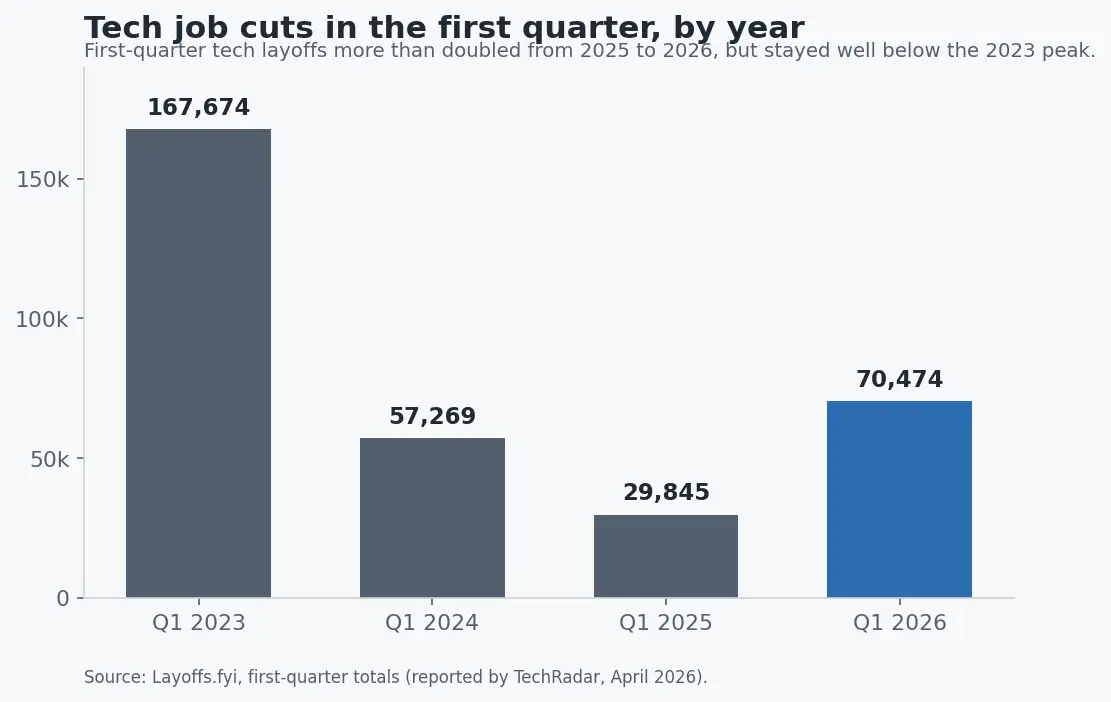
The cuts are real and large:
- The outplacement firm Challenger, Gray & Christmas said AI was cited as the reason for nearly 50,000 job cuts through April 2026, according to TIME.
- Nikkei Asia reported that 78,000 to 80,000 tech jobs were cut worldwide in the first quarter of 2026, about three-quarters of them in the US, with nearly half blamed on AI or automation. TechRadar noted that share may be an undercount, because many firms simply label the cuts cost-cutting.
- The tracker Layoffs.fyi counted 70,474 tech job losses in the first quarter of 2026, more than double the same period in 2025.
- Meta cut about 8,000 roles in May, roughly 10 percent of its staff, citing a shift to AI. Intuit cut 17 percent of its workforce, about 3,000 people. Freshworks and Coinbase also announced major layoffs and pointed to AI.
But citing AI is not the same as being replaced by AI. Andy Challenger, of the firm that tracked the 50,000 figure, made the distinction carefully:
"Regardless of whether individual jobs are being replaced by AI, the money for those roles is."
That points to a quieter story. Companies are moving cash from salaries to data centers and chips, then naming AI as the reason. Babak Hodjat, Chief AI Officer at Cognizant, told Nikkei Asia that AI is partly a scapegoat for ordinary cost-cutting and for correcting the over-hiring of the pandemic years.
A second worry runs underneath the layoff debate. If AI cuts deeply into middle-class jobs, fewer people can afford the products these companies sell. A widely upvoted r/technology comment made the point bluntly: mass layoffs aimed at middle-class jobs mean fewer middle-class buyers, and since those buyers drive the market, the firms doing the cutting "just put sugar in the gas tank."
The same thread also described how this would actually feel for workers. Commentor9001, with 122 upvotes, predicted a slow squeeze rather than a sudden event:
"The ai job crisis will be silent, not massive layoffs. It will be the people that aren't hired, the slowly declining total labor force, the roles that are eliminated as people retire, the company divisions which never are created to start because it's automated away."
The case that AI will not take your job
Not everyone reversed, because not everyone panicked in the first place. The clearest steady voice is David Solomon, the chief executive of Goldman Sachs.
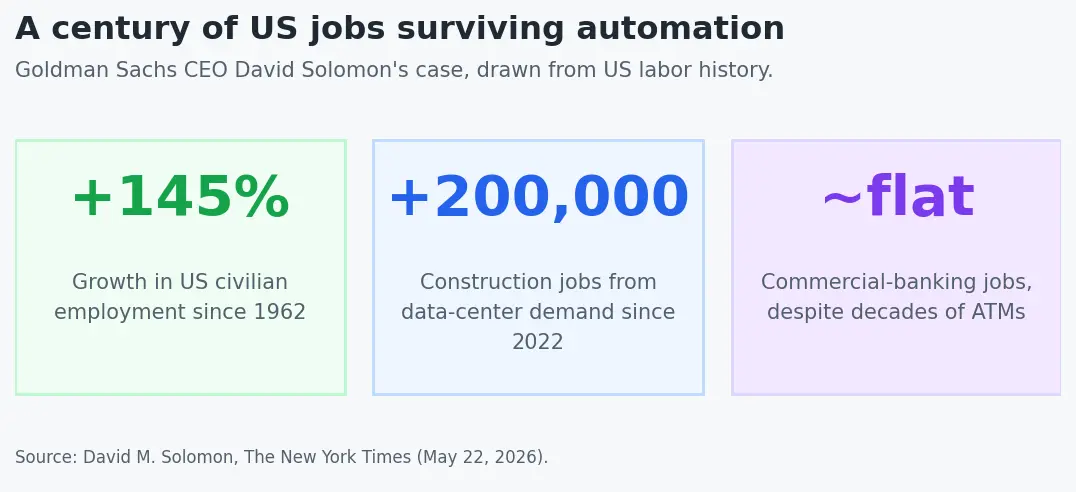
In a New York Times opinion piece on May 22, 2026, titled "I'm the C.E.O. of Goldman Sachs. The A.I. Job Apocalypse Is Overblown," he argued that the United States keeps making new jobs after every wave of automation. He did not deny disruption. "Will A.I. disrupt the labor market? Absolutely," he wrote. His case rested on history and numbers:
- Goldman's economists estimate AI may automate 25 percent of current work hours over the next decade, not 25 percent of jobs.
- Demand for data centers has already created more than 200,000 construction jobs since 2022.
- Since 1962, US civilian employment has grown about 145 percent, faster than the working-age population.
- A 2018 study by the Nobel winner Daron Acemoglu found that AI's job-cutting effect is usually offset by new demand for labor created by higher productivity.
- Even after decades of ATMs, digital banking and bank mergers, he noted, employment in US commercial banking sits at roughly the same level as the mid-1990s.
- US companies create and destroy between 25 and 35 million jobs every year, while net job creation is only a few million. Large churn under a small net change is normal.
Solomon's sharpest line was a question aimed at anyone who thinks better tools mean less work: "Do any of us feel like we have less to do these days despite the convenience of Excel, email or Zoom?"
He did not pretend the change is painless. He wrote that AI "separates labor from productivity in magnitudes we haven't seen before," and pointed to earlier shifts that hollowed out towns like Gary, Indiana before living standards later rose.
His proposed answer was policy, not luck: large-scale reskilling, more money for vocational schools and community colleges, and encouragement for AI that supports workers instead of replacing them. At Goldman itself, he said, AI may mean fewer people in regulatory reporting and client onboarding, which frees the firm to hire more bankers and traders who deal with clients directly.
Jensen Huang, the head of the chipmaker Nvidia, was even more direct. In an interview with CNA, reported by ANI, he called the habit of blaming AI for layoffs "lazy."
"AI has just arrived, how is it possible they're already losing jobs? How is it possible that AI became productive and useful only six months ago, and they were somehow laying people off two years ago because of AI? It doesn't make any sense. It was just a way for them to sound smart and I really hate that. I think we're scaring people and that's irresponsible."
His advice to worried workers was practical: "You're not going to lose your jobs to AI, you're going to lose your job to somebody who learnt AI better than you." He compared it to the arrival of the personal computer, which did not erase work but left behind people who refused to use it.
Some economists frame the optimism through an old idea called the Jevons paradox: when something gets cheaper, people use far more of it. Torsten Slok, chief economist at Apollo, applied it to AI:
"Lower cost per interaction does not mean fewer interactions. It means more customers served, more channels opened and more markets worth reaching. The technology that was supposed to shrink the industry is fueling its expansion."
He noted that radiologists and call center staff, both long predicted to vanish, have held steady or grown.
If your job changes, what actually helps
If tasks are what get automated, the useful question is which tasks, and which skills are left standing.
Jensen Huang's answer to worried parents was that it barely matters what their children study. "I think that it won't matter," he said. "All the things that used to matter are still things that are going to matter in the future." His advice was to ask one question of any field: "How can AI help elevate my learning, my craft, my purpose?"
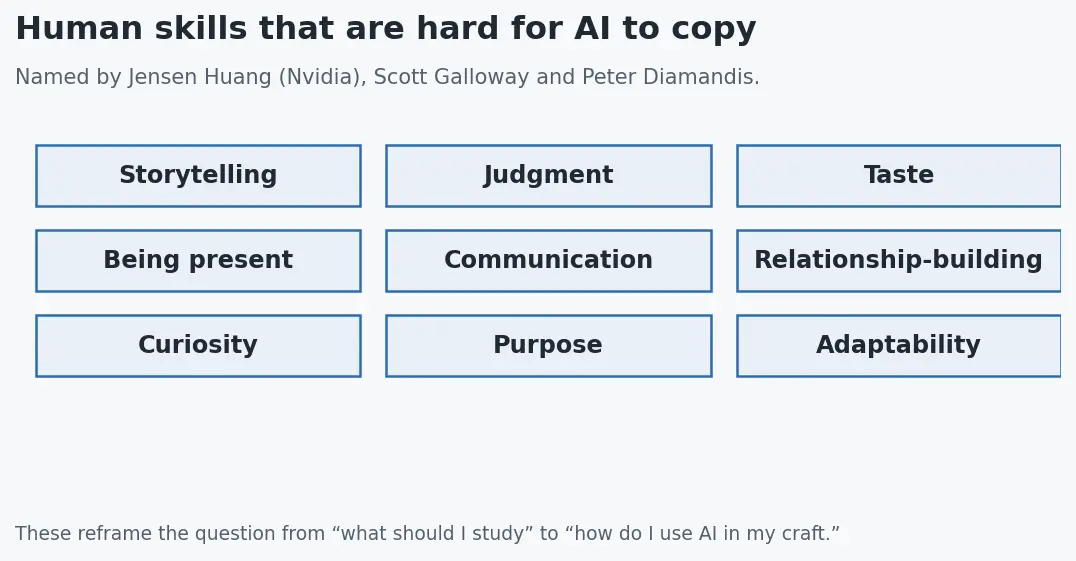
The skills he named are hard for a model to copy: storytelling, judgment, taste, and being present in the moment. "The ability to tell a story for an audience will remain just as important in the future as it is today," he said. Other voices land in the same place. The professor and entrepreneur Scott Galloway has pointed to communication and relationship-building, and the futurist Peter Diamandis to curiosity, purpose and adaptability, as the durable human strengths.
The threat is also not the same in every job. The same Uber executive who doubted the value of white-collar AI spending called self-driving cars "existential" for his company, saying that shift would not take decades but also would not arrive in a couple of years. For office work the pressure is on tasks. For driving and other physical work, the timeline is its own separate question.
The newsletter The Rundown summed up the practical takeaway. With jobs being cut whatever the true cause, it advised readers to "ask how AI can elevate your craft and focus on creativity, judgment, and taste."
The honest answer on whether AI will take your job
Strip away the spin from both sides, and a usable answer remains.
No single job category has been wiped out yet. The Yale Budget Lab found no clear jump in unemployment for the workers most exposed to AI. The people who promised an overnight collapse have walked it back, and they did so in the same week they started courting public investors and dealing with public anger. That timing should make you cautious about taking either the doom or the comfort at face value.
What the evidence does support is narrower and more useful:
- Tasks are being automated faster than whole jobs. Huang's framing fits the data: "A job is like a basket of tasks. Many of those tasks will be automated."
- Entry-level work is the most exposed. Solomon cited a Stanford study that found a 16 percent relative drop in employment for workers aged 22 to 25 in the most AI-exposed jobs, like software and customer service.
- The risk right now is fewer openings, not mass firings. Hiring freezes and unfilled roles are doing the damage, which is harder to see than a layoff.
- Cost and reliability are slowing AI down. The tools still make confident mistakes, and in many cases they cost more than the staff they were meant to replace.
The most honest summary may have come from Wildeford, who pointed out that even the experts cannot agree on the one thing that matters most: whether people whose tasks get automated end up unemployed, or simply move into new kinds of work.
For now, the safer bet is the one Huang offered. AI is unlikely to take your job on its own this year. The person who learns to use it well, in your field, is the competition to watch. And the next time a CEO tells you exactly what AI will do to your job, it is worth asking a simple question first: who are they talking to, and what are they selling that day.

Related Resources
Explore all AI Productivity resourcesJack Dorsey Fires 4,000 at Block: Why AI Fluency Is Now a Career Survival Skill
8 min readarticlePerplexity Computer vs Claude Cowork: Which AI Agent Should Run on Your Mac?
18 min readarticleChatGPT Business vs Plus: Which Plan Is Right for Your Firm?
15 min readarticlePerplexity Computer Review (2026): What It Actually Does, What It Costs, and Who It's For
11 min readSources
- Reuters: OpenAI's Altman says AI unlikely to lead to a jobs apocalypse (May 26, 2026)
- Euronews: No AI jobs apocalypse so far, says OpenAI's Sam Altman
- CNBC: Sam Altman's home hit with Molotov cocktail
- CNN: Suspect in attack on Altman's home charged
- TIME: Sam Altman Says AI 'Jobs Apocalypse' Probably Won't Happen (Rebecca Schneid)
- Fortune: Altman and Amodei walk back AI jobs apocalypse as they eye IPOs (Sasha Rogelberg)
- The New York Times: I'm the C.E.O. of Goldman Sachs. The A.I. Job Apocalypse Is Overblown (David M. Solomon)
- Channel NewsAsia (CNA): 'Lazy' narrative to connect AI to job cuts, says Jensen Huang
- Business Insider: Jensen Huang says it doesn't matter what kids study in the AI era
- TechRadar: Nearly 80,000 tech workers have already lost their jobs in 2026