OpenAI Is Taking Legal Action Against Apple Over the Siri-ChatGPT Deal: What It Actually Means
Bloomberg reported on May 14, 2026, that OpenAI engaged outside counsel to weigh a breach of contract notice against Apple over the 2024 ChatGPT Siri integration.
- The instrument is a breach of contract notice, not a filed lawsuit (Reuters).
- OpenAI's outside firm was engaged shortly before May 14 (Bloomberg).
- Apple did not immediately respond to requests for comment; OpenAI has not addressed the report publicly.
- A federal jury dismissed Musk's OpenAI claims on May 18, 2026 as filed too late under the statute of limitations. Musk has said he will appeal to the Ninth Circuit.
- Apple's WWDC keynote on June 8, 2026 is the implicit deadline.
Strip the headlines and the practical story for anyone using an iPhone is simpler than the corporate fight suggests. What changes for your data when Siri talks to ChatGPT depends on three settings most people never check.
$1B/yr
Apple's Gemini deal with Google
1.2T
parameters in custom Siri Gemini
OFF
ChatGPT extension is off by default
June 8
WWDC 2026 Siri vendor swap reveal
Executive Summary
- OpenAI engaged outside counsel for a breach of contract notice over the 2024 ChatGPT-Siri deal, before WWDC June 8.
- Apple is paying Google roughly $1 billion per year for a custom 1.2 trillion parameter Gemini model that takes the Siri foundation slot at iOS 27 launch.
- The ChatGPT extension is off by default. With it off, Siri sends nothing to OpenAI.
- With a linked ChatGPT account, OpenAI's standard privacy policies apply and your data may be used to train their models.
Why a Breach of Contract Notice Carries More Weight Than a Filed Lawsuit
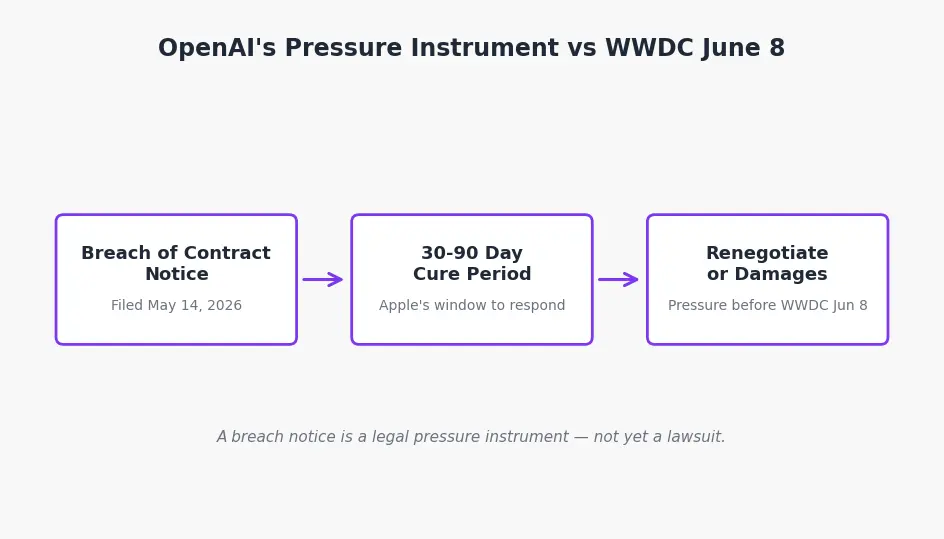
A breach of contract notice is not litigation. It is a pressure instrument. Formal notice triggers a cure period before damages are claimable. OpenAI is not chasing damages. It is trying to claw back distribution prominence inside Siri before Apple stands on the WWDC stage on June 8. That is the substance of OpenAI's legal action against Apple.
- Breach notices trigger a 30 to 90 day cure period.
- It forces renegotiation, not damages.
- The Musk v. Altman jury rejected all of Musk's claims on May 18, 2026 on statute of limitations grounds. Musk has signaled a Ninth Circuit appeal but the case is no longer trial-gating.
- “Stopping short of a full lawsuit” is Reuters' framing.
Apple's 2024 ChatGPT partnership gave OpenAI default placement on roughly 1.3 billion iPhones, an audience Apple's Google-Safari deal monetizes for about $20 billion per year as of 2022. OpenAI modeled billions in subscription revenue against that template. None converted.
- ChatGPT Plus runs $20 per month; the Apple-routed flow takes a 15 percent in-app cut on the first year of any subscription.
- The active iPhone install base sits north of 1.38 billion devices as of Apple's January 2026 earnings call.
- Industry estimates put iOS Settings to ChatGPT Plus conversion below 0.1 percent, single-digit basis points on the install base.
- Google's $20 billion Safari payment is roughly 36 percent of Apple's Services gross margin, the bar OpenAI was implicitly measured against.
- OpenAI's ARR was around $5.5 billion in late 2025; the Siri funnel was the path to doubling it without buying ads.
Reuters killed the obvious narrative with one carve-out: “the partnership was not meant to be exclusive from the start.” So the Apple OpenAI breach of contract claim is about something specific. Likely promotion guarantees, integration depth, or subscription conversion KPIs that did not land.
- ChatGPT-via-Siri appears in a “small window, with limited information” (Bloomberg).
- Apple takes a revenue share on in-Settings ChatGPT subscriptions while flagging privacy concerns.
- An OpenAI executive told Bloomberg that Apple's market power lets it dictate terms.
- Federighi's “pioneer and market leader” quote reads very differently in 2026.
After Apple presents Gemini-powered Siri and the Extensions picker on June 8, OpenAI's window closes.
How the WWDC 2024 Deal Quietly Became the Apple Google Gemini Deal
June 2024 WWDC: Apple announced ChatGPT into Siri, Image Playground, Genmoji, and Writing Tools. Federighi called OpenAI a “pioneer and market leader.” No cash exchanged. OpenAI bet on a subscription funnel pulling Plus signups from iOS Settings.
- Apple Maps replaced Google Maps in 2012; TechCrunch called the replacement “markedly inferior.”
- Jobs' 2010 open letter “effectively doomed” Flash on iPhone.
- Spotify's grievance was validated by a 1.8 billion euro EU fine in March 2024.
- The pattern: Apple embraces a partner, ships a competing product, partner gets ejected.
Things soured fast. Apple executives were “fuming for more than a year” over OpenAI poaching hardware engineers. OpenAI then acquired Jony Ive's startup. The team is building what Altman has called a new kind of computing form factor, widely framed as a hardware alternative to the iPhone.
- OpenAI's Ive acquisition closed in May 2025 for a reported $6.5 billion in stock.
- Roughly 24 hardware veterans from Apple's design and silicon teams have moved to OpenAI since the partnership shipped.
- Altman publicly aimed for a “post-screen” device, the exact category Apple's Vision business has yet to make profitable.
- Apple's internal AI org was restructured under John Giannandrea twice between 2024 and 2026, a public sign of churn.
- Federighi never re-used the “pioneer and market leader” line after WWDC 2024 in any subsequent keynote or earnings call.
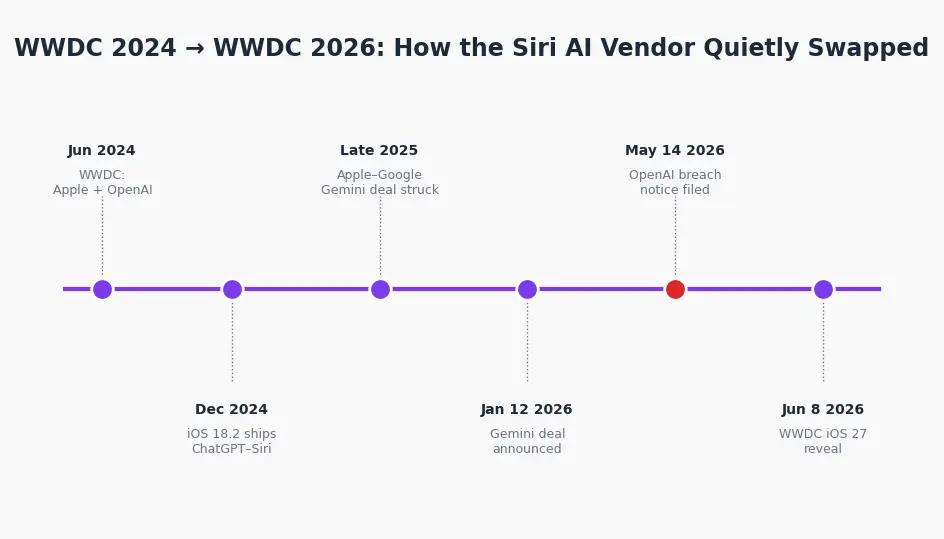
Apple and Google struck the Gemini deal in late 2025 and announced it January 12, 2026, per Bloomberg's original scoop. Apple pays Google roughly $1 billion a year for a custom 1.2-trillion-parameter Gemini model (reportedly). Google licenses the pretrained base, Apple handles post-training and keeps the safety layer in-house. Gemini-powered Siri is unveiled at WWDC 2026, with full consumer rollout in iOS 27 later in the year.
- Apple paid Google about $20 billion per year as of 2022 for the Safari search default.
- Google briefly touched a $4 trillion market cap after the Siri Gemini announcement.
- Anthropic is in iOS 27 picker testing; its $30 billion raise at over $900 billion partly rests on this distribution.
- The 1.2 trillion parameter figure is single-sourced; treat as “reportedly.”
Your Siri's upstream AI provider is set to change once Gemini-powered Siri ships, and you did not pick it. The iOS 27 Extensions picker that several outlets have reported, opening Siri up to Claude, Gemini, and reportedly Grok, is expected to land at WWDC June 8. Until it ships, none of those vendor swaps are user-visible.
How Siri Actually Handles Your Data With ChatGPT
What Siri does with your prompt depends on three distinct states. The privacy outcome is very different in each. Apple's own ChatGPT extension legal page lays out the rules.
- On-device Apple Intelligence stays on the phone, never routed to any third party.
- Private Cloud Compute is Apple's attested server environment. Apple cannot inspect what runs there.
- An Oblivious HTTP relay strips your IP before any PCC request lands.
- Nothing in either path reaches OpenAI's servers.
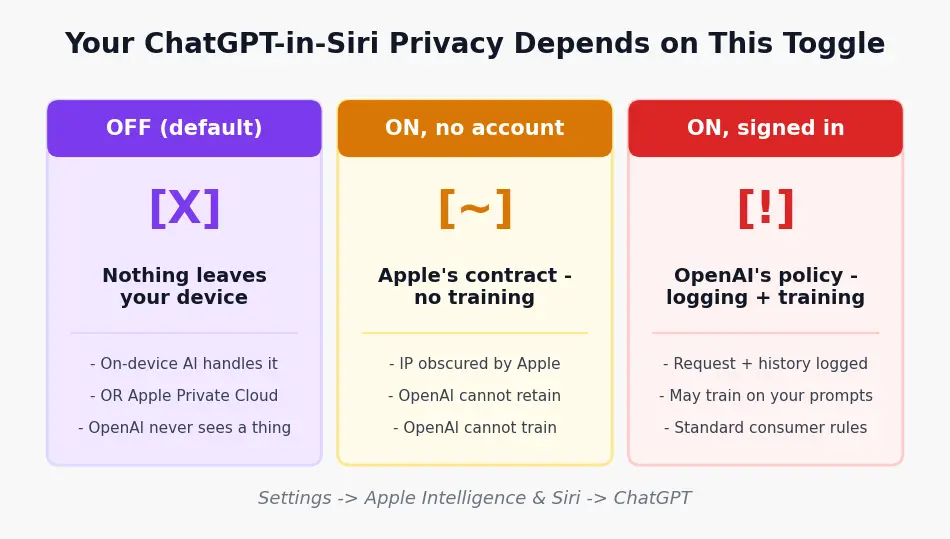
Two of the three states are privacy-safe. With the extension OFF (the default), Siri sends nothing to OpenAI and your request stays inside Apple's on-device or Private Cloud Compute stack. With it ON but no ChatGPT account linked, Apple obscures your IP and OpenAI is contractually barred from storing the request or training on it.
- The extension toggle lives under Settings, Apple Intelligence and Siri, ChatGPT.
- In State 1, the panel has never been opened to flip the toggle, so OpenAI has zero touchpoints.
- In State 2, only approximate general location passes through, derived from IP-to-region for fraud and legal use.
- Apple acts as the privacy intermediary. The contract is Apple's, not yours.
- OpenAI cannot retain the request, cannot train on it, cannot reuse it.
State 3 is where the privacy guarantees thin out. The extension is ON and you have signed in with a ChatGPT account, usually to access paid ChatGPT features through Apple. The carve-out is gone, and OpenAI's own consumer privacy policy applies to everything that flows through.
- Signing in is the single action that flips the relationship.
- ChatGPT consumer retention covers requests, attachments, and session history.
- Subscription convenience comes with full standard logging.
- OpenAI may use the logged data to train or improve its models under that policy.
- Most users do not notice the change because the in-Settings sign-in mirrors a flow they have already accepted on the web.
Siri is acting as a medium. The privacy outcome is set by which of the three states you are in, and only one of them dissolves Apple's contractual protection.
What This Means For Your Daily Siri Use
The practical answer for anyone using Siri today is short. If you have never touched the ChatGPT toggle, nothing changes. If you turned the extension on without signing into a ChatGPT account, you still have Apple's contract holding the line. If you signed in, your prompts and attachments are flowing under OpenAI's standard consumer policy.
- Check the toggle: Settings, Apple Intelligence and Siri, ChatGPT.
- Off means nothing leaves your device for OpenAI.
- On without sign-in means Apple's contract applies and OpenAI cannot retain or train.
- On with sign-in means OpenAI's consumer policy applies, retention included.
The Gemini swap changes the equation silently. Once iOS 27 ships, the foundation model behind Siri itself, the one used for on-device-to-cloud escalation that is not routed to ChatGPT, becomes a custom 1.2 trillion parameter Gemini model. You will not pick it. The change happens at the OS level.
- The Extensions picker, when it lands, would let you point Siri at Claude or reportedly Grok per task.
- Each picker provider has its own retention and training rules, set by the vendor, not Apple.
- None of these provider switches ship with an obvious in-flow privacy callout at the prompt step.
- The cloud AI risk surface for Siri quietly multiplies as more vendors enter the picker.
- Apple's safety post-training layer stays in-house, but it does not unwind a vendor's logging once the prompt leaves the device.
The auto-delete feature for the standalone Siri app helps only at the Apple side. It controls Apple-side retention of your interactions, so it does not pull back data that has already gone to a third-party provider under your own account. Knowing which state you're in is the only real protection.
What the WWDC June 8 Keynote Will Actually Decide
Three forward beats matter between now and the keynote. Whether OpenAI files anything formal before June 8. What Apple confirms on stage, including the Gemini-powered Siri reveal, the reported Extensions picker UI, and any inline privacy disclosure. What the next iOS integration after Gemini looks like, because the pattern of silent vendor swaps is now established.
- WWDC keynote June 8, 2026; iOS 27 Extensions ship Fall 2026.
- Apple's standalone Siri app launches with auto-delete options at WWDC.
- The Anthropic Claude integration is in iOS 27 picker testing.
- Vendor-swap precedent: Apple Maps (2012), Flash (2010), Spotify (2024).
- The Musk v. Altman jury verdict on May 18, 2026 ended the trial that had been gating OpenAI's filing calendar. Musk has signaled an appeal to the Ninth Circuit.
The privacy story behind the dispute outlasts whatever filing or settlement arrives. WWDC 2026 is when the picker becomes user-visible. From that day on, the question of which cloud got your last prompt will matter more to everyday users, not just headline writers.