How a Criminal Defense Investigator Uses Elephas for Case Preparation
Criminal defense is the most privacy-sensitive legal work imaginable. Here's how an independent investigator uses local AI to organize evidence, find inconsistencies, and prepare defense materials — without any data leaving his Mac.
About this case study
Marc is a composite character based on common workflows used by criminal defense investigators. The scenarios below represent realistic use cases for AI-assisted case preparation in criminal defense work. Details have been constructed to illustrate typical workflows rather than any specific case.
Meet Marc: Independent Criminal Defense Investigator
Marc works as an independent criminal defense investigator, contracted by defense attorneys to build the factual foundation of their cases. He handles serious felony matters — assault, drug trafficking, fraud, and occasionally homicide cases. His work involves:
Interviewing witnesses and documenting statements
Reviewing police reports and body camera transcripts
Analyzing forensic evidence reports
Reconstructing timelines of events
Identifying inconsistencies across testimony and evidence
Preparing investigation summaries for defense counsel
Every document I handle could determine whether someone goes to prison or goes home. I can't have any of that data sitting on someone else's server — not OpenAI's, not Google's, not anyone's. When the defense attorney tells me the case is sealed, it needs to stay sealed.
The Challenge: Organizing Sensitive Case Materials with AI
Criminal defense cases generate enormous volumes of documents. Before AI, Marc spent days manually cross-referencing witness statements, building timelines from police reports, and searching through forensic evidence for relevant details. He knew AI could help — but the privacy requirements were non-negotiable:
Cloud AI Was Not an Option
Criminal case files contain the most sensitive information in the legal system — witness identities, informant details, defense strategy, alibi evidence, and sealed court materials. Uploading any of this to ChatGPT, Claude, or Google's AI would be a catastrophic breach of confidentiality. Defense attorneys could face sanctions, and witnesses could be endangered.
Enterprise Legal AI Was Too Expensive
Platforms like CoCounsel and Harvey AI charge $500–1,000+/month — designed for large law firms with institutional budgets. As an independent investigator working with small defense practices, Marc needed something that worked within a solo practitioner's budget without compromising on privacy.
Generic Note-Taking Apps Fell Short
Marc tried using standard note-taking and document management tools, but they couldn't do what he needed: understand the content of documents, find connections between different files, and answer specific questions about the evidence. He needed AI-powered analysis, not just document storage.
How Marc Uses Elephas for Case Preparation
Marc discovered Elephas when searching for a local AI tool that could process documents without any cloud dependency. Here's how he uses it across a typical criminal defense case:
1. One Super Brain Per Case
For each new case, Marc creates a dedicated Super Brain in Elephas. He uploads all case materials — every witness statement, police report, forensic analysis, body cam transcript, and piece of correspondence. The Super Brain indexes everything locally, creating a searchable knowledge base that exists only on his Mac.
2. Timeline Reconstruction
One of Marc's most time-consuming tasks is building an accurate timeline from multiple sources. Different witnesses recall different times, police reports may conflict with body cam footage, and forensic evidence establishes its own timeline. With Elephas, Marc queries across all documents at once:
I used to spend two full days building a timeline for a complex case — reading every report, cross-referencing timestamps, flagging conflicts. Now I upload everything into a Super Brain and ask it to build the timeline. I still verify every entry, but the AI gets me from zero to a working draft in about an hour. That's a day and a half I can spend on actual investigation.
3. Witness Statement Inconsistency Detection
Finding inconsistencies between witness accounts is gold for the defense. Marc uses Elephas to cross-reference statements and identify conflicts that would take hours to find manually:
4. Preparing Investigation Summaries for Defense Counsel
Defense attorneys need concise, organized summaries of Marc's findings. With Elephas, Marc can generate structured summaries that highlight key findings, evidence gaps, and potential defense angles — all grounded in the actual case documents:
Summarize the three strongest inconsistencies in prosecution witness testimony
Draft an investigation summary covering the alibi evidence and supporting documentation
List all evidence gaps — what's missing from the prosecution's case file that should be there
Create a witness credibility assessment based on consistency of their statements across depositions
5. Offline Mode: In the Field and at Court
Marc regularly works in environments with no internet access — or where using cloud services would be inappropriate. Elephas's offline mode is essential for:
Results: Faster Preparation, Stronger Defense
The time savings matter, but honestly the privacy is what sold me. I sleep better knowing that none of my case files have ever touched a cloud server. When a defense attorney asks me if our investigation materials are secure, I can say yes without any qualifications. Nothing left the device. That's it.
For more on how offline AI tools protect legal work product, see our guide on offline AI for legal discovery. And for a broader look at AI tools for independent legal professionals, check out the solo practitioner's guide to AI-powered legal work.
Lessons for Other Legal Professionals
Marc's workflow isn't unique to criminal defense. The same approach works for any legal professional handling sensitive documents:
Family Law Attorneys
Organize custody evaluations, financial disclosures, and communication records per case — all locally processed.
Immigration Lawyers
Build Super Brains for asylum cases with country condition reports, client testimony, and supporting evidence.
Personal Injury Attorneys
Process medical records, accident reports, and expert analyses for each plaintiff without cloud exposure.
Compliance Investigators
Review internal documents, communications, and financial records for corporate investigations — entirely offline.
For a step-by-step guide on building legal knowledge bases, see our tutorial on building an AI-powered legal research library on your Mac.
Frequently Asked Questions
Can Elephas handle the volume of documents in a criminal case?
Yes. Elephas's Super Brain feature can process hundreds of documents per knowledge base. For a typical criminal defense case — witness statements, police reports, forensic reports, correspondence, and exhibits — the volume is well within Elephas's capabilities. You can create separate Super Brains per case and query across all documents simultaneously.
What file formats does Elephas support for legal case files?
Elephas supports 20+ file formats including PDF, DOCX, TXT, RTF, HTML, CSV, and more. This covers the vast majority of document types you'll encounter in criminal defense work — from scanned police reports (PDF) to body cam transcripts (TXT/DOCX) to forensic lab results (PDF). You can upload mixed-format documents into a single Super Brain.
Is offline mode really important for criminal defense work?
Critically important. Criminal defense investigators often work in environments where internet access is unreliable or where using cloud services would be inappropriate — jails and detention centers, courthouses with restricted WiFi, field investigations, and client meetings. Elephas's offline mode means you can query your entire case knowledge base without any internet connection, and no data ever touches a network.
Can opposing counsel subpoena my AI-assisted investigation notes?
When you use a cloud-based AI tool, the cloud provider's logs of your queries and their responses could potentially be subpoenaed — revealing your investigation strategy. With Elephas, all processing happens locally on your Mac. There are no external server logs, no cloud-stored query histories, and no third-party records of your investigation. Your work product stays on your device, protected by the same work product doctrine that protects your physical notes.
How does this approach compare to dedicated legal AI platforms?
Dedicated legal AI platforms like CoCounsel or Harvey AI offer specialized legal features but are cloud-based and cost $500–1,000+/month. For criminal defense investigators — particularly independent investigators working with small firms — Elephas offers the core capability needed (document processing, knowledge base querying, AI-assisted analysis) from $19/month with the privacy advantage of local processing. For highly sensitive criminal defense work, the privacy benefit alone may justify the choice.

Related Resources
Explore all AI for Lawyers resourcesSiri vs ChatGPT for Confidential Work
15 min readarticleCan You Upload Contracts to AI? Privacy Risks, Vendor Workflow, and Safer Alternatives for AI Contract Management
11 min readarticleAI for Sensitive Data: A Complete Guide to Using AI Tools Without Exposing Sensitive Company Information (2026 Edition)
10 min readarticleIs ChatGPT Attorney-Client Privilege Protected? The Heppner Ruling and Generative AI in Litigation
11 min readKeep Every Case File on Your Device
Elephas gives you AI-powered case preparation with zero cloud exposure. Build Super Brain knowledge bases per case, query across hundreds of documents, and work offline — all from $19/month.
Try Elephas Free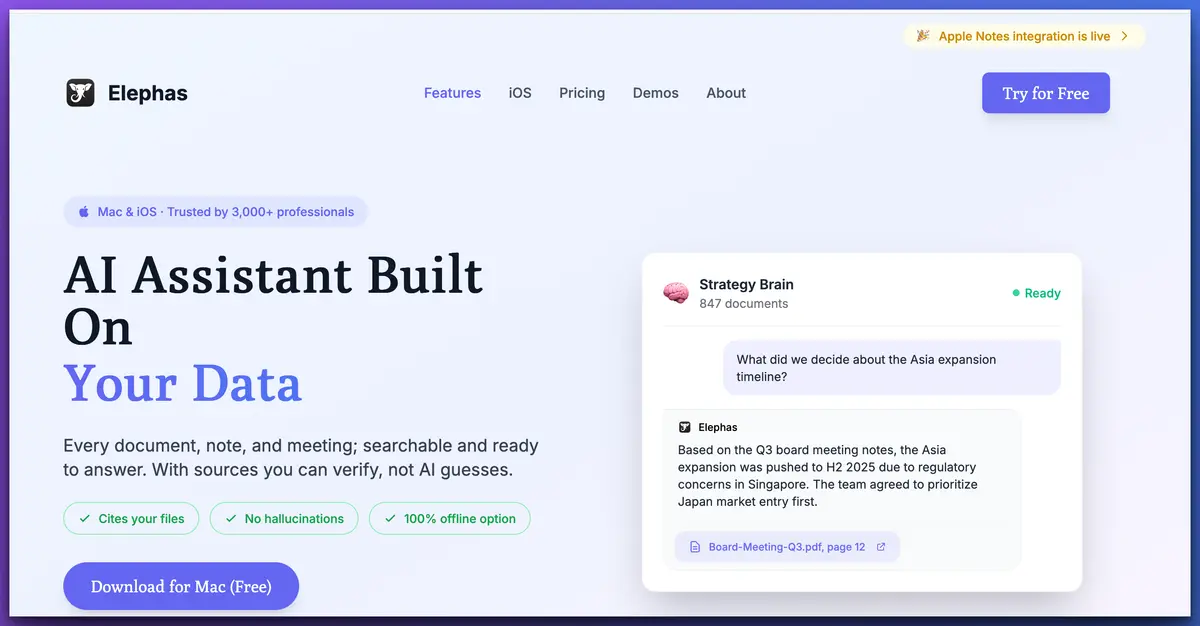
No credit card required. True offline AI for legal professionals.