Offline AI for Legal Discovery: Processing Case Files Without Cloud Exposure
Cloud-based AI tools create privilege waiver risk every time you upload a case file. Here's how to leverage AI-assisted document review while keeping every byte on your local machine.
Key takeaway
Legal discovery involves reviewing the most sensitive documents in any matter—privileged communications, work product, confidential business records. Uploading these to cloud AI services creates third-party disclosure and privilege waiver risk. Offline AI tools like Elephas let you get AI-assisted review without any cloud exposure, preserving privilege by architecture.
The Cloud Problem in Legal Discovery
Modern legal discovery generates enormous document volumes. AI can dramatically accelerate review—but the dominant AI tools all require uploading documents to cloud servers. For discovery materials, this creates serious problems:
Privilege Waiver Through Third-Party Disclosure
When you upload privileged documents to a cloud AI service, you've made a third-party disclosure. Even if the provider promises confidentiality, the transmission itself can constitute waiver. Courts have increasingly scrutinized whether AI-assisted review preserves privilege when documents leave the attorney's control.
Discovery of Your Review Process
Cloud AI providers maintain logs of your interactions. These logs — including the documents you uploaded and questions you asked — could be subpoenaed by opposing counsel. Your entire review strategy, the documents you flagged, and the questions you asked about them could become discoverable.
Protective Order Compliance
Many protective orders restrict how confidential documents can be stored and processed. Uploading documents to cloud AI services may violate these restrictions, especially when the protective order limits third-party access or requires specific security measures.
Client Confidentiality Obligations
Beyond privilege, lawyers have ethical obligations to protect client confidences. ABA Model Rule 1.6 and its state equivalents require reasonable measures to prevent unauthorized disclosure. Cloud processing of discovery materials raises questions about whether this standard is met.
For a deeper analysis of privilege risks, see our guide on how AI tools can waive attorney-client privilege.
How Offline AI Solves the Discovery Problem
Offline AI tools process documents entirely on your local machine. No data is transmitted to external servers. This eliminates every cloud-related risk in one architectural decision:
No Third-Party Disclosure = No Privilege Waiver
When documents never leave your device, there is no third-party disclosure. Period. The strongest possible position for preserving privilege during AI-assisted review.
No External Logs = Nothing to Subpoena
With local processing, there are no cloud provider logs of your review activity. Opposing counsel cannot subpoena what doesn't exist. Your review strategy stays confidential.
Protective Order Compliance Built In
Documents processed locally never leave the controlled environment. This inherently satisfies most protective order restrictions on document handling and third-party access.
Work Anywhere — Courtroom, Secure Facility, Plane
Offline AI works without internet. Review discovery documents in secure facilities, during travel, or at the courthouse. No connectivity requirements, no data exposure.
Practical Workflow: AI-Assisted Discovery Review with Elephas
Here's how to set up an offline AI discovery workflow using Elephas's Super Brain feature:
Create a Case-Specific Super Brain
In Elephas, create a new Super Brain for each matter. Name it descriptively — "Smith v. Jones - Discovery" — so you can maintain clear separation between cases. Each Super Brain is an isolated knowledge base processed entirely on your Mac.
Upload Discovery Documents
Upload your discovery document set into the Super Brain. Elephas handles 20+ file formats — PDFs, Word documents, emails, spreadsheets, text files. The AI indexes and processes everything locally, building a searchable knowledge base from your case materials.
Query Across Your Entire Document Set
Ask natural language questions across all uploaded documents: "Which emails discuss the contract amendment?" or "Identify all documents mentioning the December board meeting." The AI searches your entire case file and returns answers with citations to specific documents and passages.
Identify Privileged Documents
Use AI queries to flag potentially privileged materials: "Which documents contain communications between counsel and client?" or "Identify documents that reference legal advice or attorney work product." Build your privilege log efficiently with AI assistance — all locally.
Draft Review Summaries and Memos
Ask Elephas to summarize key themes across your document set, identify relevant documents for specific issues, or draft internal review memos. Every response cites your actual documents, so you can verify claims against the source material.
Cloud AI vs Offline AI for Discovery: Side-by-Side
Discovery Scenarios Where Offline AI Excels
Privilege Review for Document Production
Upload the entire document set into a Super Brain. Query for privilege indicators — attorney names, "legal advice," "attorney-client," "work product" — across thousands of pages. Flag potentially privileged documents and build your privilege log without exposing a single page to cloud services.
Key Document Identification
When you receive a large production from opposing counsel, upload everything into a Super Brain. Ask targeted questions: "Which documents reference the February acquisition?" or "Find all communications between the CEO and CFO about revenue projections." Get answers with document-level citations in seconds.
Deposition Preparation
Upload deposition transcripts, exhibits, and related correspondence. Query across all materials to identify contradictions, timeline gaps, and areas for follow-up questioning. Your deposition strategy stays entirely on your local machine.
Litigation Hold Compliance
Process preserved documents locally to identify relevant materials, assess their significance, and categorize them for potential production — all without creating additional copies on external servers that could complicate your preservation obligations.
Frequently Asked Questions
Can offline AI really handle legal discovery volumes?
Yes. Modern local AI models running on Apple Silicon Macs can process hundreds of documents efficiently. Elephas's Super Brain feature lets you upload entire case files — contracts, depositions, correspondence, exhibits — and query across all of them locally. For extremely large matters (100,000+ documents), you may still need dedicated e-discovery platforms, but for small-to-mid-size cases, offline AI handles the volume well.
Does using offline AI for discovery create privilege issues?
The opposite — offline AI eliminates the privilege issues that cloud-based tools create. When documents are processed entirely on your local machine, there is no third-party disclosure. No data leaves your device, no logs exist on external servers, and no subpoena can compel a cloud provider to produce your review notes. This is the strongest possible position for privilege preservation.
How does offline AI document review compare to Relativity or similar e-discovery platforms?
Dedicated e-discovery platforms like Relativity excel at processing massive document volumes with features like predictive coding, Bates numbering, and production formatting. Offline AI tools like Elephas complement these platforms by providing privileged analysis — reviewing documents for strategy, identifying key arguments, and drafting summaries — without exposing case content to additional cloud services.
What file formats can Elephas process for discovery review?
Elephas supports 20+ file formats including PDF, DOCX, TXT, RTF, HTML, CSV, and more. This covers the vast majority of document types encountered in legal discovery. You can upload entire folders of mixed-format documents into a Super Brain and query across all of them simultaneously.
Can I use offline AI to review privileged documents for production decisions?
Absolutely. This is one of the strongest use cases for offline AI in discovery. You can upload potentially privileged documents, ask the AI to identify privilege indicators (attorney names, legal advice language, work product references), and make privilege designations — all without any cloud exposure. Your privilege log preparation stays entirely local.
Is Elephas suitable for document review in litigation holds?
Yes. Elephas can help you review preserved documents during a litigation hold without creating additional copies on cloud servers. Process documents locally, identify relevant materials, and categorize them for production — all while maintaining the integrity of your preservation obligations.

Related Resources
Explore all AI for Lawyers resourcesSiri vs ChatGPT for Confidential Work
15 min readarticleCan You Upload Contracts to AI? Privacy Risks, Vendor Workflow, and Safer Alternatives for AI Contract Management
11 min readarticleAI for Sensitive Data: A Complete Guide to Using AI Tools Without Exposing Sensitive Company Information (2026 Edition)
10 min readarticleIs ChatGPT Attorney-Client Privilege Protected? The Heppner Ruling and Generative AI in Litigation
11 min readProcess Discovery Documents with Zero Cloud Exposure
Elephas keeps every case file on your Mac. Build Super Brain knowledge bases per matter, query across thousands of documents, and preserve privilege by architecture. Start your free trial today.
Try Elephas Free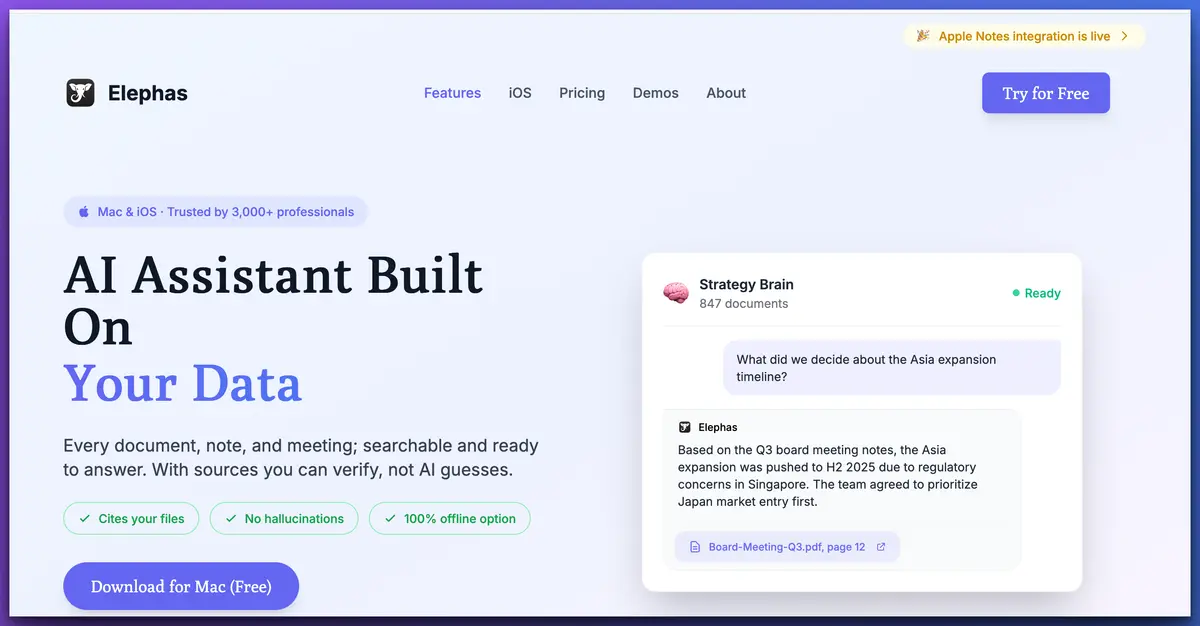
No credit card required. True offline AI for legal professionals.