Claude Memory: Anthropic Shows How Its AI Agents Dream
On 6 November 2026, Anthropic shared new research on Claude memory for AI agents [AI that works through tasks step by step on its own]. The post explains how Claude keeps notes between sessions and reads them again later.
Its main idea is called dreaming, where Claude goes back over old work logs between tasks to fix wrong notes. This piece settles two points: whether dreaming really fixes those notes in Anthropic's tests, and what agent memory keeps about your data.
Below, we cover what Anthropic tested and the scores it reports.
Executive Summary
- Anthropic's 6 November 2026 post explains how Claude saves notes in one session and uses them in the next.
- Dreaming lets Claude check its saved notes against old work logs and fix the ones that are wrong.
- In one Pokémon run each, Claude Sonnet 3.7 wrote 413 memory files and earned one badge [a mark of progress in the game], while Claude Fable 5 wrote nine files and earned four.
- On merger questions that needed several documents, a wiki [a set of linked pages that Claude writes and keeps up to date] built by dreaming lifted scores from 73% to 87%.
- Anthropic's own docs say its hosted memory stores and dreams are not eligible for zero data retention [an arrangement some business customers can request, under which Anthropic does not store their prompts and answers after a request].
- Elephas keeps your documents on your computer and hides names, email addresses and phone numbers there before a question goes to a cloud model.
How Claude memory works for agents, according to Anthropic
Anthropic's research post, "The components of agent memory", was written by Lance Martin and published on 6 November 2026.
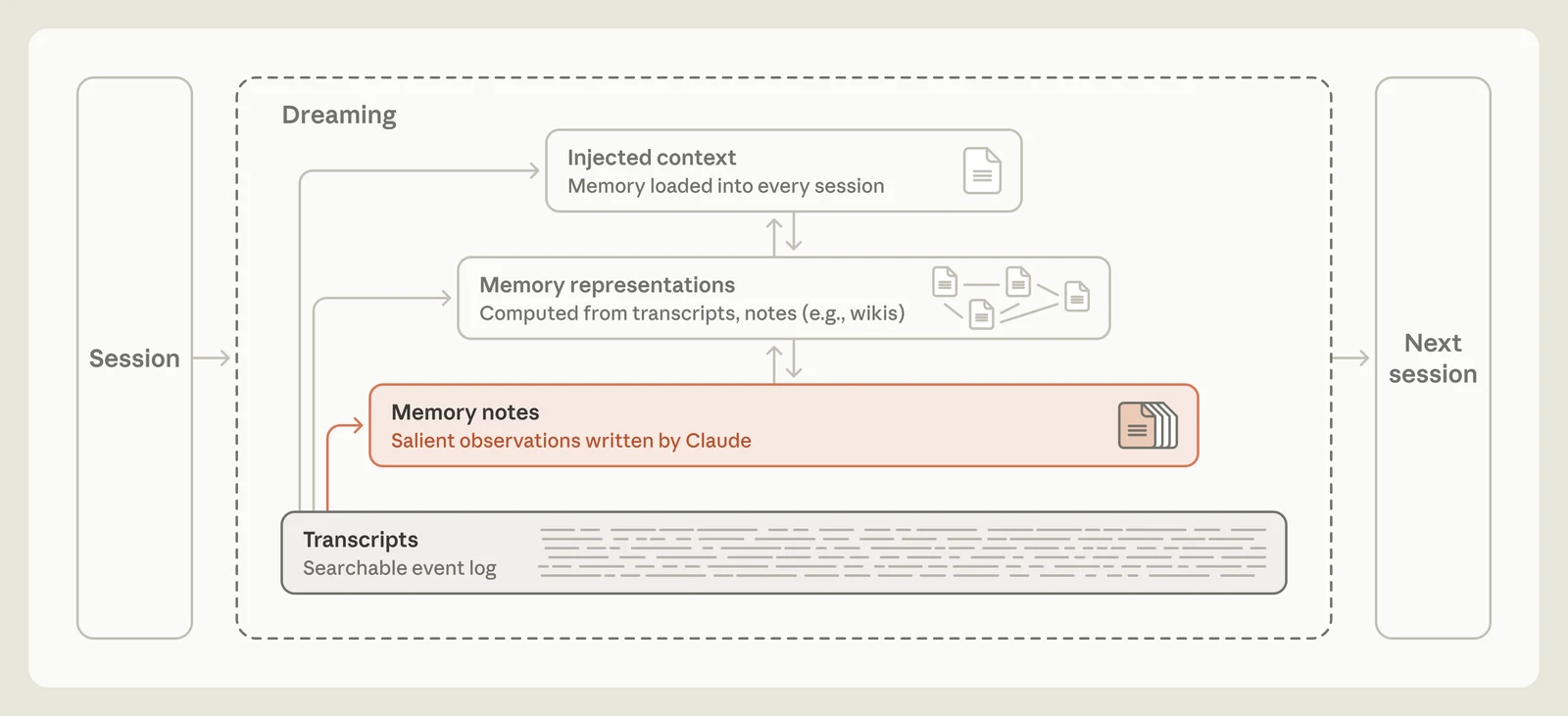
Image source: Anthropic
By agent memory, Anthropic means what Claude learns from its work and from the people it helps, saved as notes it can read in a later session. A session is one stretch of work, and each new session starts fresh. Our piece on Claude Projects covers how saved context works in the Claude app.
The post compares this to the human brain. People take in new memories during the day, and much of the sorting seems to happen during sleep. Anthropic says agents can split the work in the same way.
- Claude can also tag important moments in its work log as they happen, so they are easier to find later.
- Anthropic says dreaming can also shape which notes are loaded at the start of future sessions.
- The idea builds on sleep-time compute [letting a model use idle time between tasks to sort out what it already has], a 2025 paper from researchers at Letta and UC Berkeley.
- Anthropic says memory does not include changes to the model itself, what it learns inside a single chat, or chat summaries that replace older turns.
What Claude saved to memory in Anthropic's game test
Anthropic says Claude has become much better at choosing what is worth saving.
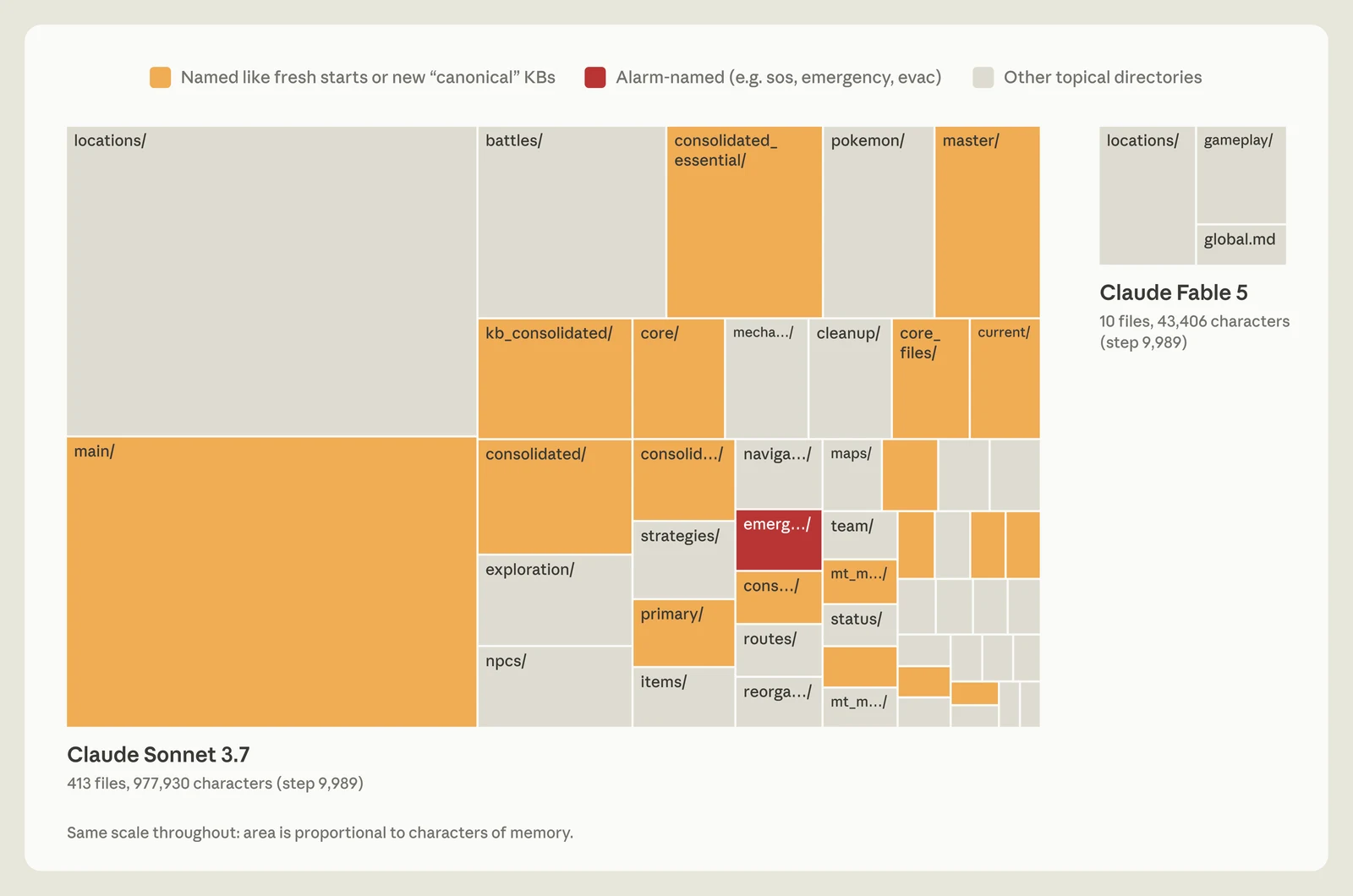
Image source: Anthropic
In one test, Claude played the game Pokémon Red with a memory folder it could read and write. Anthropic compared one run each of two models. About 10,000 steps in, Sonnet 3.7 had written 413 memory files across 225 folders and earned one badge.
Fable 5 wrote nine files in two folders, plus one top file called global.md, and earned four badges. Anthropic says the older model saved things it could already see on screen, so its notes kept going out of date.
- Fable 5 used memory mainly for things the game did not show, such as plans, strategies, and tested rules.
- At one point, Sonnet 3.7 spent 17 steps creating six files and deleting nine, with no moves in the game.
- Claude Opus 5.5 kept a small set of notes on its current goal and next steps, and finished the game.
- On CL-Bench 1.0, a database question test, Claude Opus 5 was the first model Anthropic names as closing the full learning loop [writing down a rule, how it knew the rule was true, and traps it had found].
- On CL-Bench, Claude Opus 5.5 and Claude Sonnet 5.5 also closed the learning loop and, with memory, scored about the same as Opus 5.
Why a fixed memory rule cut the gain for stronger models
Anthropic found it helps to tell Claude what memory is for, and not how to use it.
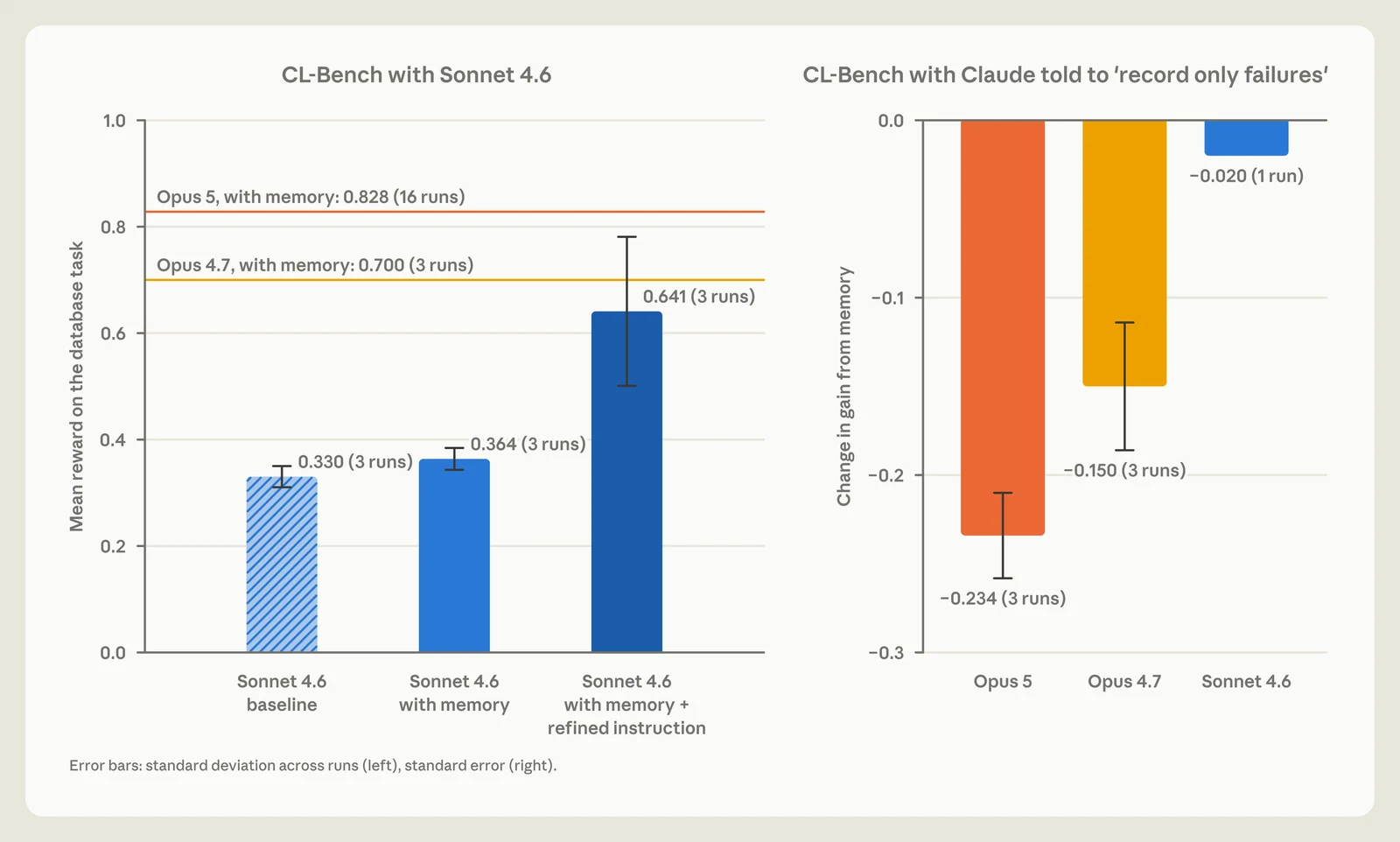
Image source: Anthropic
On that same CL-Bench test, Anthropic says it simply told Claude that a memory folder was there. For Opus 4.7 and Opus 5, that was enough to use memory well and raise their scores.
When Anthropic added a fixed rule to "record only failures," both models lost much of the gain that memory had given them.
- Older models needed more help. Sonnet 4.6 often did not open its memory folder at all.
- Telling Sonnet 4.6 to read its memory first and test its guesses nearly doubled its score.
- Sonnet 5 read its memory before answering 9 out of 10 times without being told.
- Anthropic says it now gives newer models simple guidance and leaves the choice of what to save to Claude.
How Claude dreaming fixed a wrong note in a game test
Anthropic's first dreaming example comes from the same Pokémon game, where one wrong note kept sending Claude the wrong way.
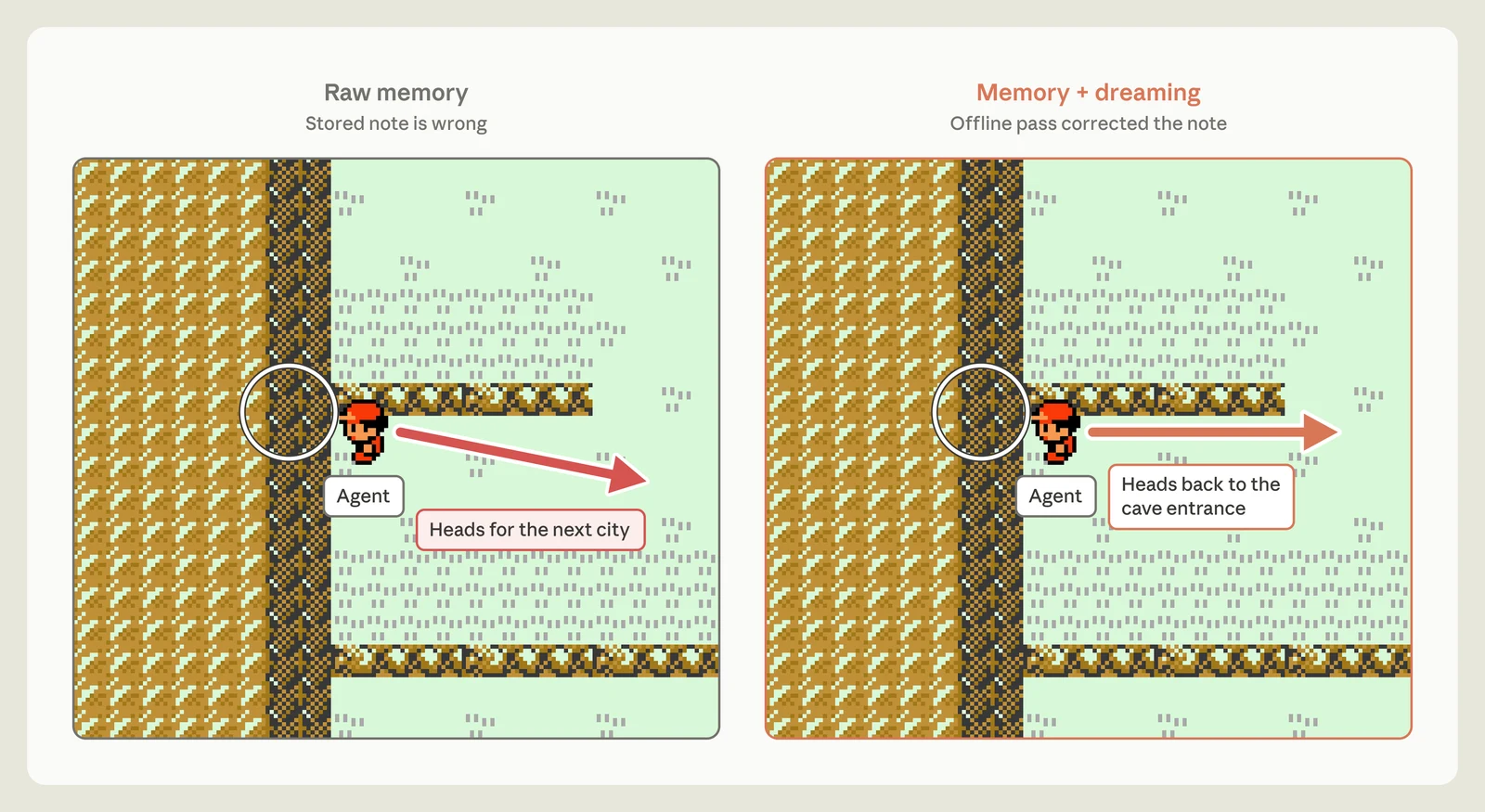
Image source: Anthropic
In that run, Claude wrote down that a key building sat on the wrong side of a mountain cave. Trusting that note, it walked off a one-way ledge and landed back on a route it had already passed.
With the wrong note, Claude fell back onto that route three times and the run ended before the next city, Anthropic reports. After dreaming, Claude checked the note against the log, rewrote it, went back into the cave, and reached the next city.
- Notes can be wrong from the start, or go out of date as things change.
- With the wrong note, Claude wrote that it would stop rather than keep looping, and the test setup's automatic reply told it to continue.
- Anthropic's docs say a dream never changes the original memory store, so the new one can be reviewed and thrown away.
- Anthropic's docs say a dream reads 1 to 100 past sessions and writes a new, separate memory store [a saved set of memory notes].
Dreaming built wikis that helped on some questions
Dreaming can also build a wiki to help Claude find what it knows. On merger questions that needed several documents, Anthropic's research found the wiki lifted Claude's score from 73% to 87%.
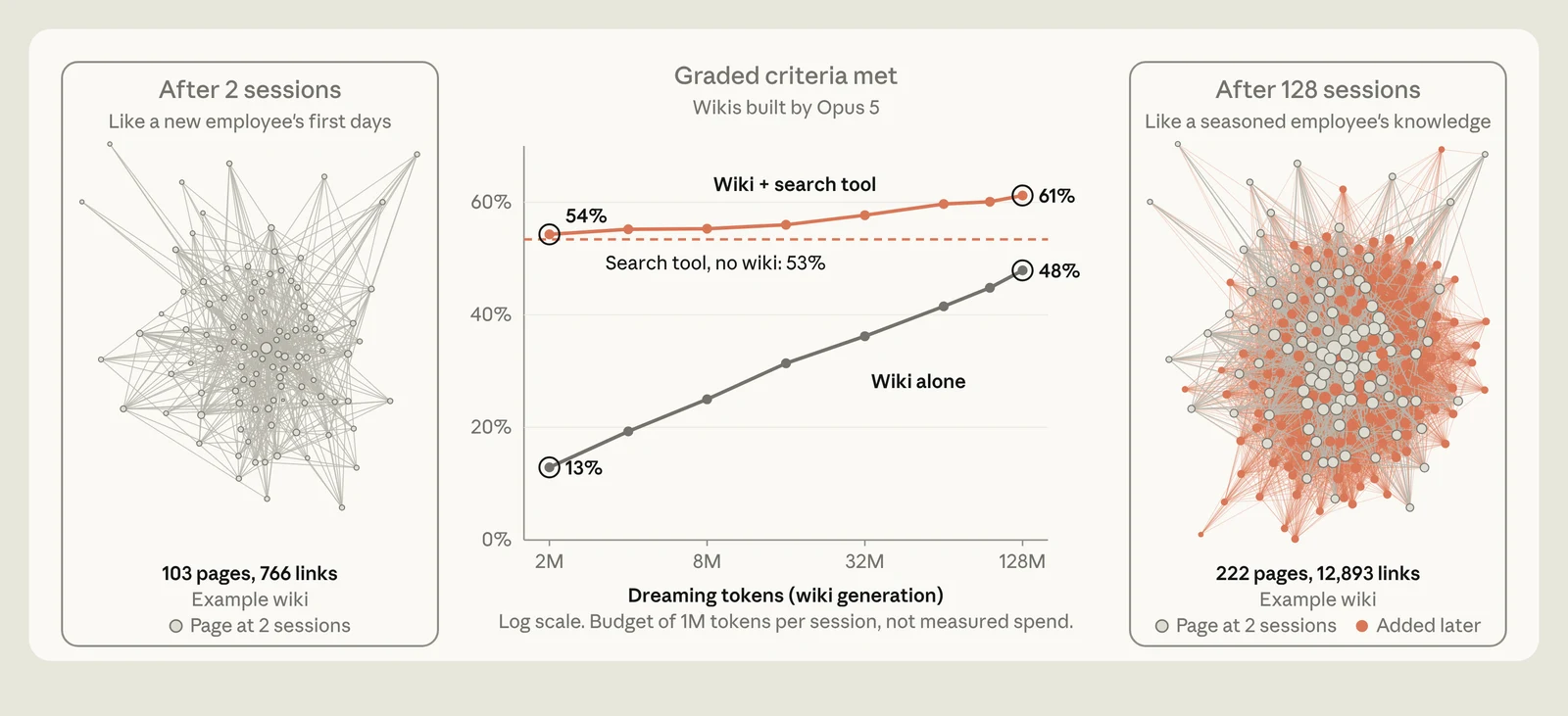
Image source: Anthropic
Anthropic says it tested this on about 350,000 internal files, roughly 420 million tokens [small pieces of text that AI models read], from Stainless, a software company it bought in May. Opus 5 agents built the wiki over 128 sessions.
As the wiki grew from two sessions to 128, the share of graded points Claude met on 25 questions rose from 13% to 48%. With search and the wiki together, the score rose from 54% to 61%.
In a contract test, the wiki first kept 41 of 57 graded facts, or 72%, and all 57 after Claude rewrote its own wiki instructions.
| Test | Without the wiki | With the wiki |
|---|---|---|
| Stainless questions, search plus wiki | 53% (search only) | 61% |
| Merger questions that needed several documents | 73% (search only) | 87% |
- Using search and the wiki together also saved about 20,000 tokens per question.
- On one legal task, most answers sat in a single document, and the wiki showed no clear gain.
- On another, the wiki grew larger than the documents it was built from.
- A second dreaming pass found nine links to a missing wiki page and pointed them to an existing page.
What Claude memory means for your data
Anthropic's docs set out where Claude memory notes are kept and which data rules apply to them.
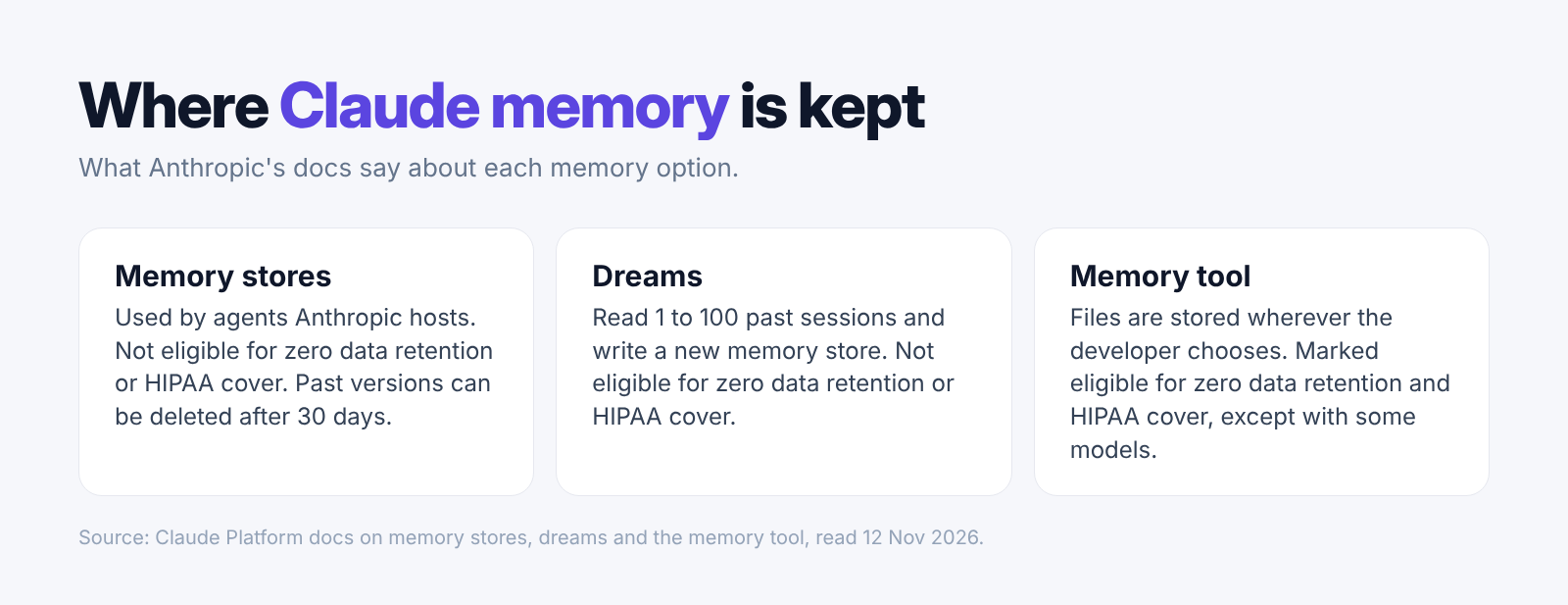
For agents Anthropic hosts, memory is kept in memory stores. The memory store docs mark these as not eligible for zero data retention or HIPAA [the US health privacy law] cover, and the dreams docs say the same for dreams.
The same docs warn about prompt injection [hidden instructions placed in web pages or files]. If an agent reads untrusted content, an attack could write bad notes into its memory, and later sessions would trust them. Our report on AI agent security risks covers more of these attacks.
- Every change to a memory store creates a saved version, and past versions can be deleted after 30 days.
- Developers can scrub sensitive text out of that version history with a redact step.
- Anthropic's separate memory tool stores files wherever the developer chooses, such as files on disk, a database, or cloud storage.
- The memory tool docs say Claude usually refuses to write sensitive information to memory files.
- In Claude Code [Anthropic's coding tool], auto memory [notes Claude Code keeps for itself] loads only the first 200 lines or 25KB of its main memory file into each session.
Elephas keeps your documents on your computer
Elephas is a private AI app for your documents, and your documents stay stored on your computer. With cloud AI tools such as ChatGPT and Claude, your questions and uploads go to the provider's servers. Our piece on Claude shared chats covers how some of those chats ended up on Google.
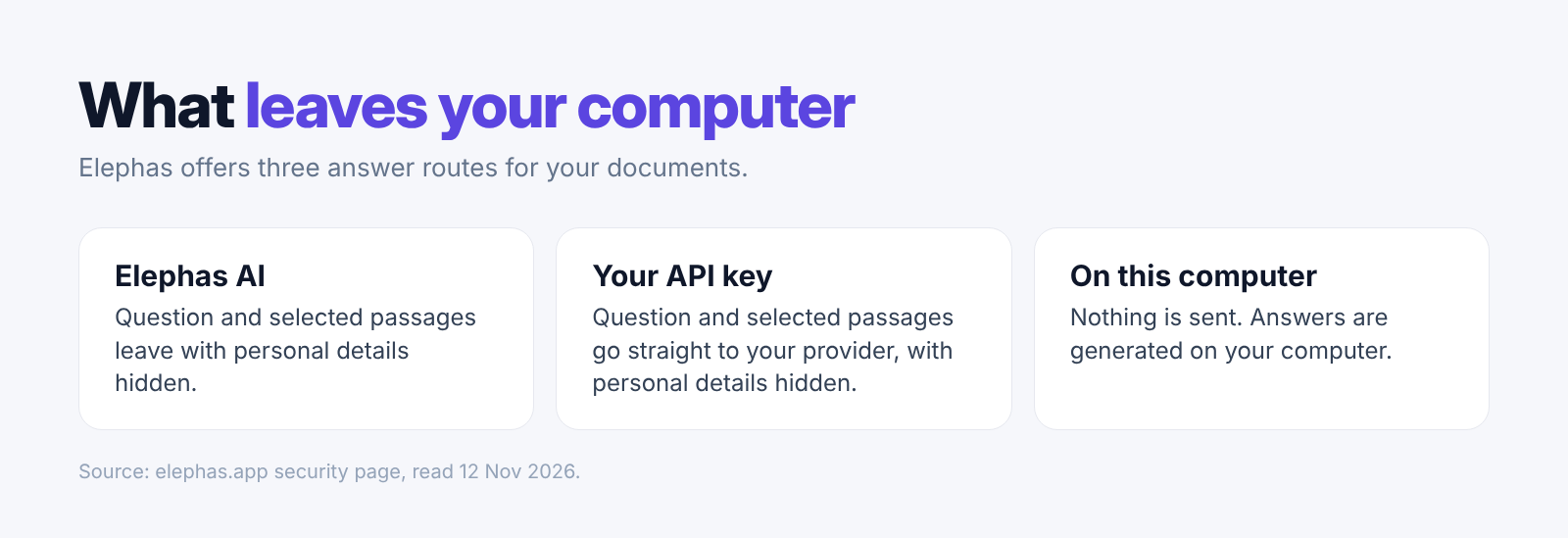
When you use a cloud model through Elephas, it hides names, email addresses and phone numbers on your computer before the question goes out, then puts them back in the answer. Our guide to what PII is covers these personal details in more depth. You can see what was hidden under every answer.
- Elephas AI runs open-source models in Elephas's own cloud, and it does not store your questions or use them to train models.
- With the on-computer model, your questions and documents are not sent anywhere.
- Your search index and chats are kept in an encrypted database on your computer.
- Elephas runs on Mac and Windows, and plans start at $19 a month with a 7-day free trial.
Conclusion
Anthropic ends its post with problems it has not solved yet. Saving notes during a task pulls Claude's attention away from the work, while dreaming happens later, so its fixes may not be ready straight away. Keeping memory correct also costs computing power, so Anthropic suggests aiming dreaming at notes that are likely to change.
It also suggests tuning how often dreaming runs, based on how often each note is read. Anthropic adds that no model can really know what future sessions will need.
FAQ
What is Claude memory?
Claude memory is a set of notes Claude saves from its work and reads again in a later session. Anthropic says it covers what Claude learns from tasks and from the people it helps, kept outside the model itself.
What is Claude dreaming?
Dreaming is a separate pass where Claude reads its past work logs next to its saved notes. It merges repeated notes, fixes wrong ones, and can build linked pages that make memory easier to search.
Is Claude agent memory covered by zero data retention?
Not the hosted kind. Anthropic's docs mark memory stores and dreams for Claude Managed Agents [Anthropic's service for running agents on its servers] as not eligible for zero data retention or HIPAA cover. Zero data retention is an arrangement some business customers request, not a setting every user has.
The separate memory tool is marked eligible for both, except with some models Anthropic names in its docs, because the developer keeps the files wherever they choose.
Can I use Claude dreaming today?
Dreams are a research preview for Claude Managed Agents, and developers need to request access. Anthropic has also shared cookbook guides [step-by-step code examples] for getting started with dreaming and knowledge wikis.
What did Anthropic test Claude memory on?
Anthropic used the game Pokémon Red, a database question test called CL-Bench 1.0, and about 350,000 internal files from Stainless. It also used legal tasks from the Harvey LAB benchmark [a test that grades legal briefs written from a set of documents].