What Is PII? Examples, Types, and How to Keep It Out of AI Tools
The short answer to "what is PII": personally identifiable information (PII) is any detail that can point to a specific person. It can do that in 2 ways: on its own, like a Social Security number, or combined with other data, like a ZIP code plus a date of birth.
Spotting PII matters most before you paste into AI chats.
This guide covers examples, sensitive PII, AI chat apps and how to protect PII.
Quick answer
- PII is any detail that can identify a specific person, alone or combined (NIST).
- ZIP code, gender and birth date together likely made 87% of Americans unique in a 2000 study.
- Use placeholders before you paste. Asking the AI to remove details means they were already sent.
What Is Personally Identifiable Information (PII)?
NIST defines personally identifiable information as information that can be used to "distinguish or trace an individual's identity". It counts in 2 ways: alone, like a name or biometric record, or combined with other details that are linked or linkable to a specific person, like a date and place of birth.
"Linked" means already tied to a person; "linkable" means someone could tie it using an outside source.
PII vs Personal Data Under GDPR
The General Data Protection Regulation (GDPR, the EU privacy law) uses a wider idea, personal data: any information about an identified or identifiable person, including location data and online identifiers (GDPR Article 4).
PII vs PHI
Protected health information (PHI) is narrower than PII. Under the Health Insurance Portability and Accountability Act (HIPAA), it is individually identifiable health information held or sent by a covered entity or its business associate: a health plan, clearinghouse, or provider who sends health data in electronic standard transactions.
| Term | Defined by | Covers |
|---|---|---|
| Personally identifiable information | NIST (US) | Any detail that can trace a person |
| Personal data | GDPR (EU) | Anything about an identifiable person |
| Sensitive personal information | California Consumer Privacy Act (CCPA) | A named list, such as government IDs |
| PHI | HIPAA (US) | Identifiable health information that HIPAA covered entities hold or send |
What Are Examples of PII?
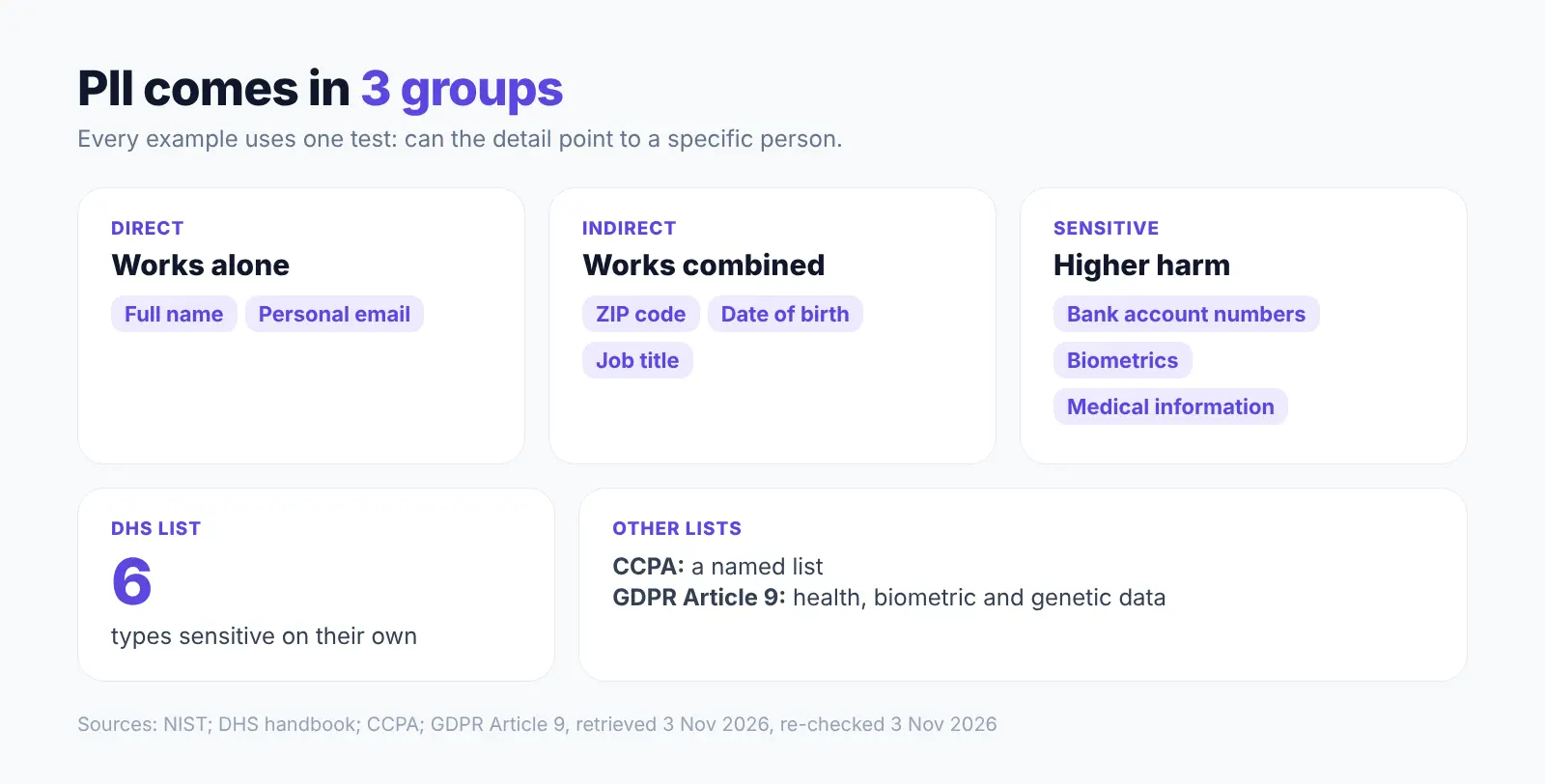
Examples of PII fall into 3 groups: direct identifiers like a full name, indirect identifiers that work when combined like a ZIP code, and sensitive details like bank account numbers or biometrics. NIST SP 800-122 lists these examples of information that may be considered PII.
Direct identifiers:
- Full name: also a maiden name or alias.
- Social Security number (SSN): a personal ID number.
- Passport number: a travel ID.
- Driver's license number: a driving ID.
- Taxpayer ID number: a tax ID.
- Bank account or credit card number: a money account.
- Street address: where you live.
- Email address: your inbox.
- Phone number: mobile or personal.
- Photo of your face: shows who you are.
- Fingerprints or voice signature: biometrics (body-based IDs).
Devices and property:
- IP address: marks a device online; counts when it links to a person.
- MAC address: a fixed ID for one device; counts when it links to a person.
- Vehicle registration number: points to a car you own.
Indirect details, linked or linkable to the above:
- Date and place of birth: when and where you were born.
- Race, religion or weight: personal traits.
- Activities and location: what you do and where.
- Job, medical, education or financial details: life records.
Safer Swaps for Common PII
| PII example | How it identifies | Safer swap |
|---|---|---|
| Name, personal email, phone number | Alone | [NAME_1], [EMAIL_1], [PHONE_1] |
| Social Security, passport, driver's license or financial account number, fingerprint, face scan | Alone, sensitive | Delete it |
| ZIP code, date of birth, job title, employer | Combined | Region, age range, plain role |
| Doctor's note | Combined, sensitive | "a medical absence" |
Sensitive vs Non-Sensitive PII
The DHS handbook calls personal details sensitive when their loss could cause substantial harm, embarrassment, inconvenience or unfairness.
- DHS lists 6 types that are sensitive on their own: Social Security numbers, driver's license or state ID numbers, passport numbers, Alien Registration numbers, financial account numbers and biometric identifiers.
- The CCPA uses a named list instead, and GDPR Article 9 names health, biometric and genetic data.
What Is Not Considered PII
A date of birth, a business phone number or employment information on its own usually isn't PII, according to the University of Pittsburgh's guide. Each one can become PII once linked to a name or other identifier.
NIST lists date of birth as linked or linkable information, so treat it as PII once it sits next to a name or other details.
How Can Indirect Details Identify a Person?
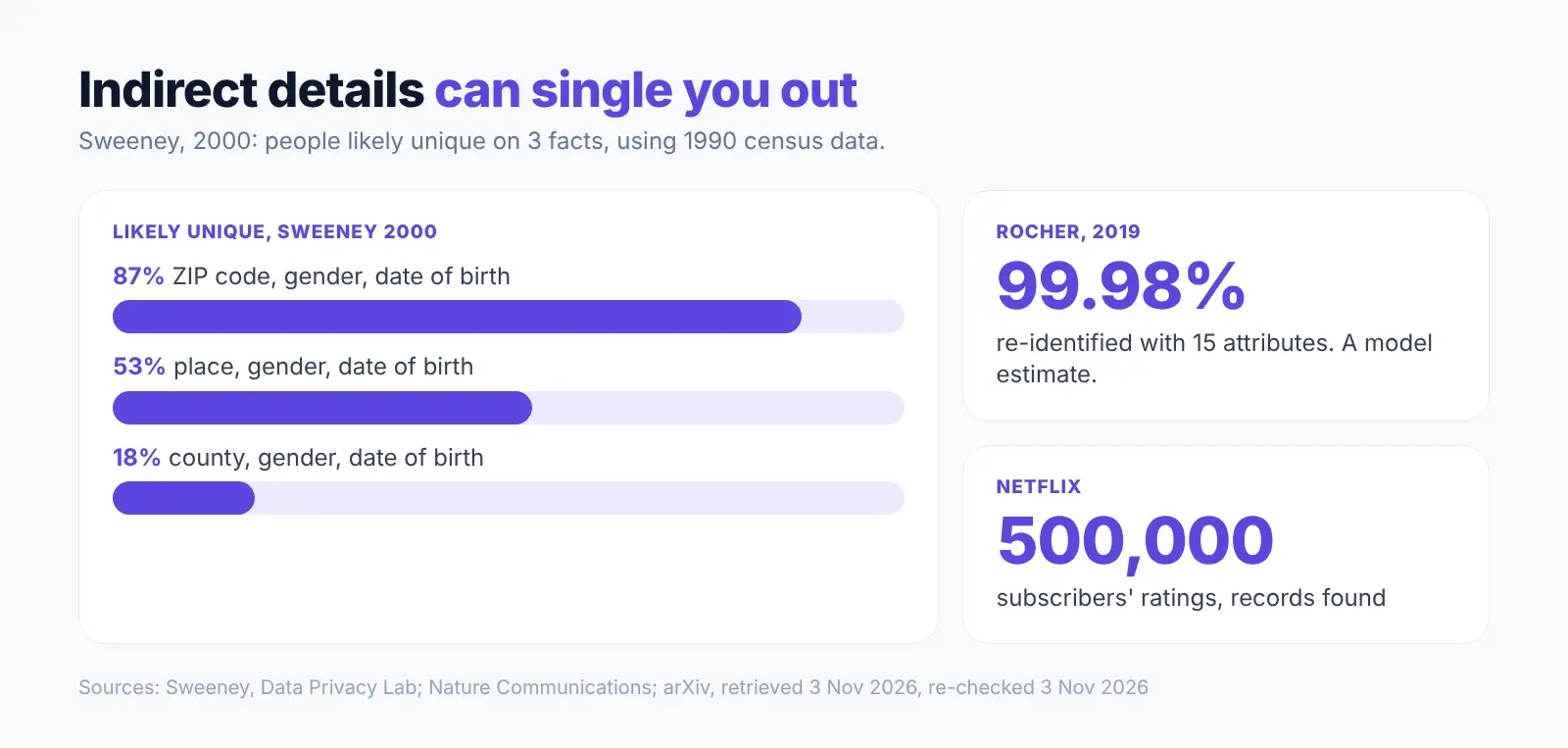
Indirect details can identify a person: a 2000 study by Latanya Sweeney found that 87% of Americans (216 million of 248 million) were likely unique on 3 facts, their 5-digit ZIP code, gender and date of birth, using 1990 census data (Sweeney).
According to a 2019 study in Nature Communications by Luc Rocher and colleagues, 99.98% of Americans would be correctly re-identified in any dataset using 15 demographic attributes (basic personal facts), a model estimate tested on 210 populations (Nature).
- In Sweeney's 2000 study, 53% were likely unique on place, gender and date of birth, and 18% on county, gender and date of birth.
- Researchers found people's records in the released ratings of 500,000 Netflix subscribers, knowing only a little about each (arXiv).
- An email with no name but a job title and office town can still point to one employee.
What Happens to PII in ChatGPT, Claude or Gemini?
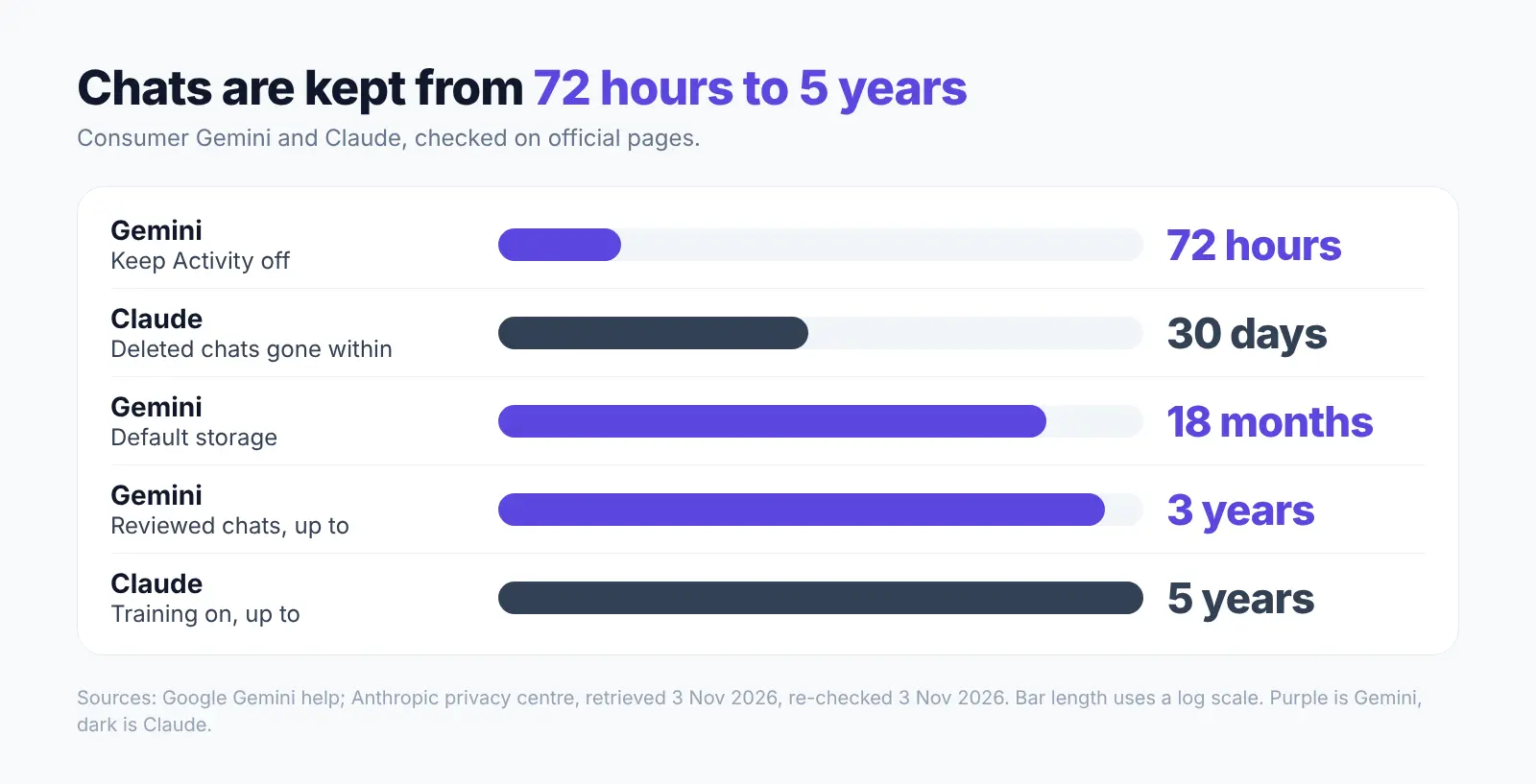
ChatGPT, Claude and Gemini carry 3 risks for pasted PII: training, human review and storage, per official pages checked on 3 November 2026.
- Human review: Google says reviewers read a subset of Gemini chats and asks you not to enter confidential information (Google).
- Claude storage: deleted chats go within 30 days, and de-identified chats stay up to 5 years if training is on (Anthropic).
- Gemini storage: 18 months by default; reviewed chats up to 3 years (Google).
| App | Trains on chats | Private mode |
|---|---|---|
| ChatGPT | Free, Plus and Pro, unless "Improve the model for everyone" is off (OpenAI) | Temporary Chat: not used for training |
| Claude | If allowed, or if flagged for safety review (Anthropic) | Incognito: no training |
| Gemini | Yes, with Keep Activity on | Keep Activity off: kept 72 hours |
OpenAI's help pages on how long chats are kept could not be checked for this guide.
At work, a 2026 Cyberhaven report found 39.7% of AI interactions involve sensitive data (Cyberhaven).
A 2025 IBM report found that high shadow AI (unapproved AI tools) added USD 670,000 to the average data breach cost (IBM). For work accounts, see ChatGPT Business data privacy.
Is Redacted or Shared Text Still PII?
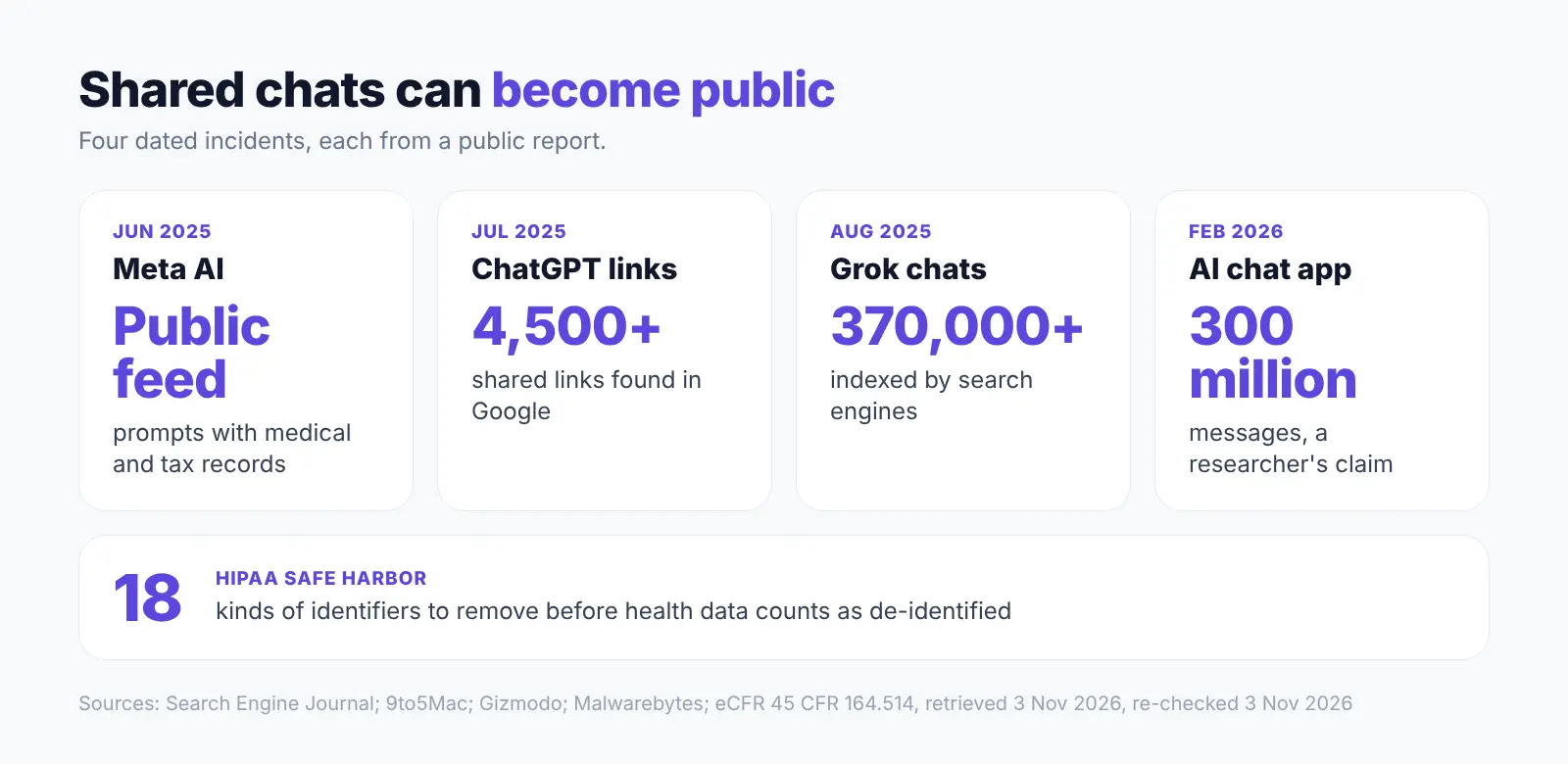
Redacted text is still PII when someone can put the names back: under GDPR Recital 26, data with names swapped for codes stays personal data while a key exists. HIPAA's Safe Harbor rule lists 18 kinds of identifiers to remove before health data counts as de-identified (no longer tied to a person).
Redaction blacks a detail out, pseudonymization swaps it for a code, and anonymization leaves no way back.
GDPR fines go up to EUR 20 million or 4% of worldwide annual turnover (yearly revenue), whichever is higher (GDPR Article 83(5)).
Shared Chat Links Can Become Public
A share link is a public web page, so never share chats holding personal details.
- June 2025: Meta AI's public feed showed prompts with medical and tax records (Gizmodo).
- July 2025: Fast Company found over 4,500 shared ChatGPT links in Google, some with names and resumes (Search Engine Journal).
- August 2025: more than 370,000 Grok chats were indexed by search engines (9to5Mac).
- February 2026: a researcher claimed access to 300 million messages from a third-party AI chat app (Malwarebytes).
What to Do After a PII Leak
If your PII leaks, use IdentityTheft.gov to report identity theft and get a step-by-step recovery plan to help you limit the damage and fix your credit.
How Do You Protect PII by Hand or With Elephas?
The quickest way to protect PII before you paste takes 5 steps: keep only what the AI needs, swap names for placeholders, blur combinations, turn training off and redact first.
Protect PII in 5 Steps
- Keep only relevant data: NIST SP 800-122 says organizations should minimize the use, collection and retention of PII to what is strictly necessary.
- Swap direct identifiers: give the same person the same placeholder, and keep the key on your computer.
- Blur combinations: turn an exact date into a month and a ZIP code into a region.
- Turn training off: use the settings in the table above.
- Redact before you upload: never ask the AI to clean the text for you.
Our private AI research guide has more detail.
Before and After With Placeholders
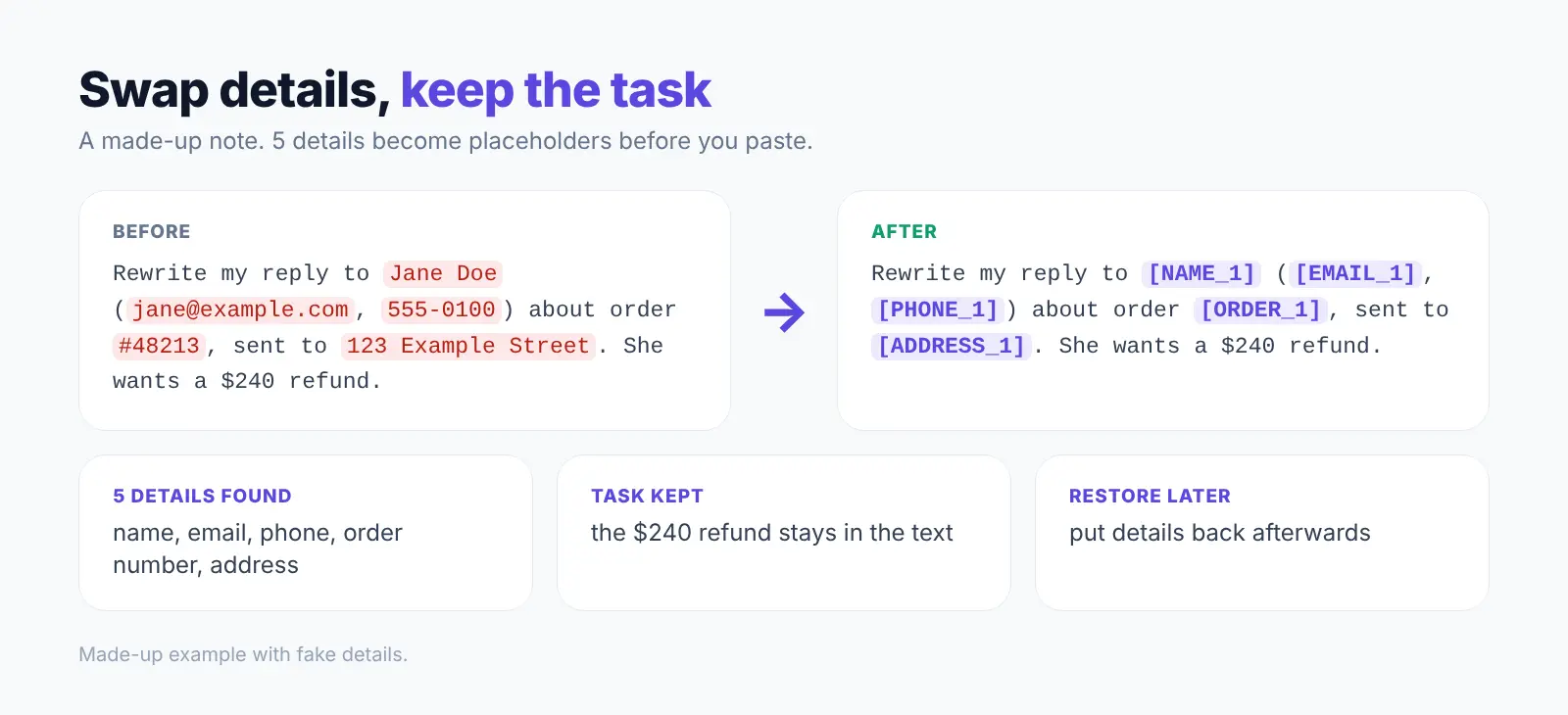
A made-up note: the task survives, and you restore details afterwards.
- Before: Rewrite my reply to Jane Doe (jane@example.com, 555-0100) about order #48213, sent to 123 Example Street. She wants a $240 refund.
- After: Rewrite my reply to [NAME_1] ([EMAIL_1], [PHONE_1]) about order [ORDER_1], sent to [ADDRESS_1]. She wants a $240 refund.
Our free anonymize text tool finds names, emails, phone numbers, addresses and ID numbers and swaps them for placeholders. It runs in your browser and is free with no sign-up. It can miss some details, so read the masked text before pasting.
Doing It Automatically
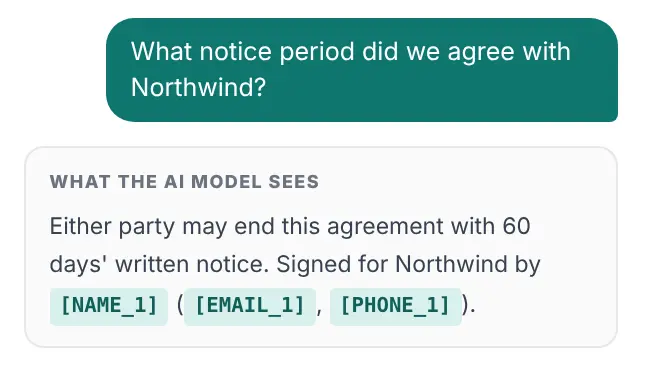
Elephas is a private AI app for your documents that answers questions from your own files and hides personal details on your computer before a question leaves it. The free tool masks one paste at a time. The app covers questions about your files.
Names, email addresses and phone numbers are swapped out before your question reaches the cloud model, then put back in the answer. Under every answer you can see what was hidden. Detection runs on your computer. The site says plainly: "This is detection, not a guarantee."
Your question and the selected passages go to the cloud model with those details hidden. Your documents stay on your computer. The app runs on Mac (macOS 14 or later, Apple Silicon) and Windows 10 or 11, 64-bit. Plans start at $19 a month, with a 7-day free trial and no card.
FAQ: Quick Answers About PII
Most questions come down to 1 test: whether a detail, alone or combined, points to a specific person.
- Checking one detail: use the examples lists and table.
- Handling health records: treat them as sensitive, and as PHI if a HIPAA covered entity holds them.
- Wanting it done on every question about your files: use a private AI app for your documents that hides personal details before your question leaves your computer.
What are three examples of PII?
A full name, a Social Security number and a personal email address are three common examples, since each one points to a specific person on its own. A ZIP code or date of birth counts too once it's combined with other details.
Is your SSN considered PII?
Yes. A Social Security number (SSN) identifies you on its own, and the DHS handbook lists it as sensitive without any other detail. The Department of Labor warns that losing such data can lead to identity theft, so never paste an SSN into a chatbot.
Is an email address PII?
Usually, yes. A personal email address points to one person, and California's CCPA summary names email address as personal information. The University of Pittsburgh guide says a business email alone doesn't count, yet it can identify someone once linked to a name.
Is an IP address PII?
Often, yes. An IP address (the number that marks a device online) counts when tied to a specific person, as the University of Pittsburgh guide notes, and the GDPR names online identifiers as personal data. Leave customer IP addresses out of prompts.
Is income PII?
On its own, usually not. The University of Pittsburgh guide lists financial information among details that don't identify someone alone, since many people could share them. Once linked to a name, it can identify a specific person, so round the figure or drop the name.