Claude Shared Chats and Google: The Explanation Has a Gap
On 25 July 2026, a Reddit post said one search command was returning other people's Claude conversations. Within two days, more than a dozen outlets had landed on a single explanation for the Claude shared chats Google was listing: Anthropic had simply forgotten to add a tag telling search engines not to list them.
That explanation is checkable, and it does not match what people say they saw. A page search engines are blocked from opening can still show up if someone links to it elsewhere, but Google lists it as a bare address with no preview.
4
Shared-chat indexing incidents in under 3 years
~6 mo
How long a Google removal request hides a listing
4,500
ChatGPT conversations a search box found in July 2025
0
Published counts for the July 2026 Claude story
Executive Summary
- More than a dozen outlets reported that Anthropic forgot a do-not-index tag on Claude's share pages. The tag is there. It just never gets read, because claude.ai's robots.txt tells search engines not to open
/share/pages at all. Daniel J Glover published this finding on 26 July 2026. - There is no way to tell when that tag was added, because Anthropic blocks the Internet Archive from ever seeing a share page. It could have gone up at any point, even as the fix.
- A blocked page can still turn up in results if someone links to it elsewhere, but Google says plainly that listing “won't have a description.” A bare link with no preview is not a readable conversation, and nobody has explained how people were reading whole conversations.
- Results people found over the weekend of 25 July 2026 disappeared, reportedly through a removal request. That hides listings on one search engine for about six months. It deletes nothing and does not touch the robots.txt rule.
- None of this was stoppable from your side, but the exposure starts with what you type. Elephas masks names, client details and dollar amounts on your Mac before a prompt reaches a cloud AI model, on every plan including Free, so an exposed copy shows a placeholder instead of the real thing.
Are Claude Chats Private, and What Nobody Could Actually Show
It all traces back to one Reddit post from 25 July 2026. Every write-up that followed cites it and adds no new reporting. Nobody published a count, and the nearest thing to a figure is the word “hundreds,” traced to that same thread. The most alarming details, API keys and resumes carrying real names, come from one developer's post on X that we could not retrieve, and no outlet has reproduced a single example.
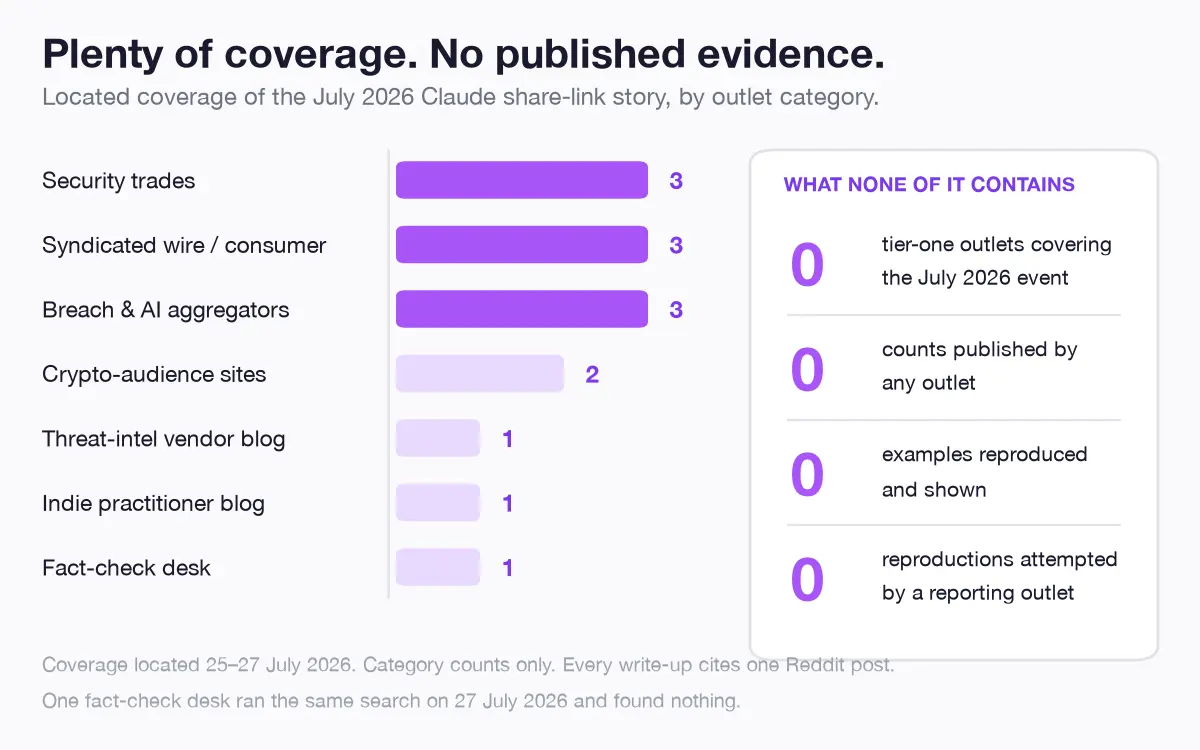
- Located coverage runs to security trades, AI-news sites, crypto outlets, regional press and one independent blog. No coverage was found from TechCrunch, The Verge, Wired or Forbes.
- Anthropic had made no public statement, status-page entry or release note as of 27 July 2026. Three separate outlets noted that silence.
- A shared conversation only ever includes what you typed. Any file you attached stays out of the snapshot entirely.
Google's results disappeared over that weekend, which Glover attributes to a Search Console removal request. That is likely why LatestLY's fact-check desk found nothing when it ran the same search on 27 July 2026. It rated the story 2 out of 5, “Unverified,” for resting on a single source and social media posts.
The pushback is fair. A developer quoted by IBTimes UK: “These are not private conversations. Users explicitly set them to public URLs.” Glover put it more bluntly on 26 July 2026: “This was not a breach of Anthropic's systems. It was a share button doing exactly what it was built to do, combined with a search engine configuration that could not do what it appeared to do.”
Neither point settles whether people understood what they were publishing. Anthropic's own help page on sharing chats, updated 15 June 2026, never uses the words search engine, crawl or discoverable. Forbes interviewed a user in September 2025 who said, anonymously, that they had never posted their conversation anywhere.
How Claude Shared Chats Google Never Fetched Can Still Be Listed
Claude's share pages do carry an instruction telling search engines not to list them. It travels in the page's response headers, the technical note a website sends along with every page it serves. On 27 July 2026, a share page we requested using Google's crawler identity sent that instruction back, worded x-robots-tag: none.
But claude.ai's robots.txt, a file that tells search engines which pages they may open, also tells crawlers never to open any /share/ page. A crawler that follows that rule never reads the instruction on the page it was told to skip. Daniel J Glover published this same finding on 26 July 2026, a day before we checked it ourselves.
- The common path to one of these pages: someone pastes the link into a public Slack workspace, a GitHub issue, or a Reddit reply. Google can find the address there without opening claude.ai itself.
- In September 2025, during an earlier round of this problem, Anthropic spokesperson Gabby Curtis told Forbes the company does “actively block them from crawling our site.” That blocking is exactly what keeps the do-not-index instruction from ever being read.
- robots.txt only binds crawlers that agree to follow it. It is a request, not a lock.
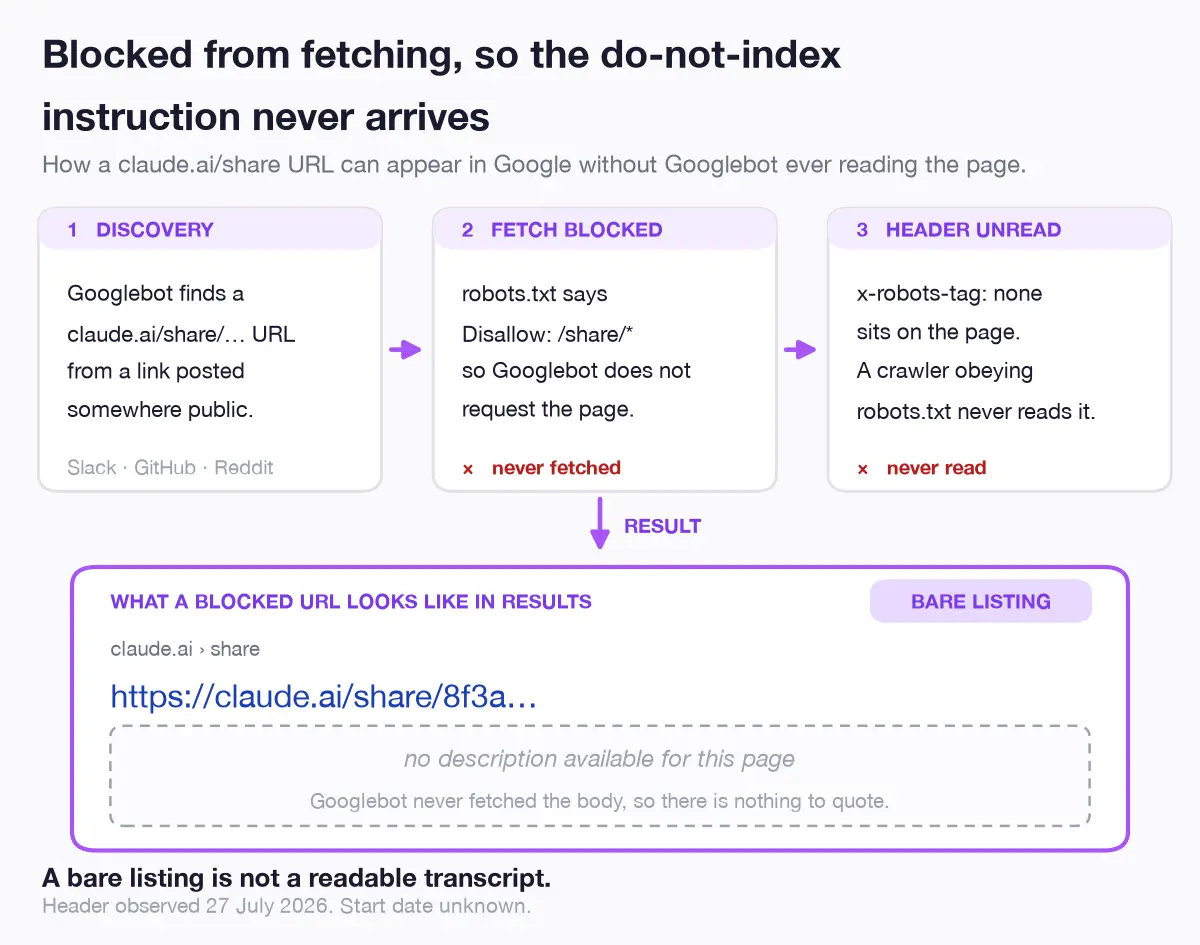
Wayback snapshots show that robots.txt rule in place on 15 November 2025, and again on 10 July 2026, fifteen days before this story broke. Glover dates its arrival more precisely, to 1 or 2 August 2025, days after the near-identical ChatGPT story. There is no way to tell when the instruction on the page itself was added, because Anthropic blocks the Internet Archive from fetching a share page. It may have gone up recently, as the fix.
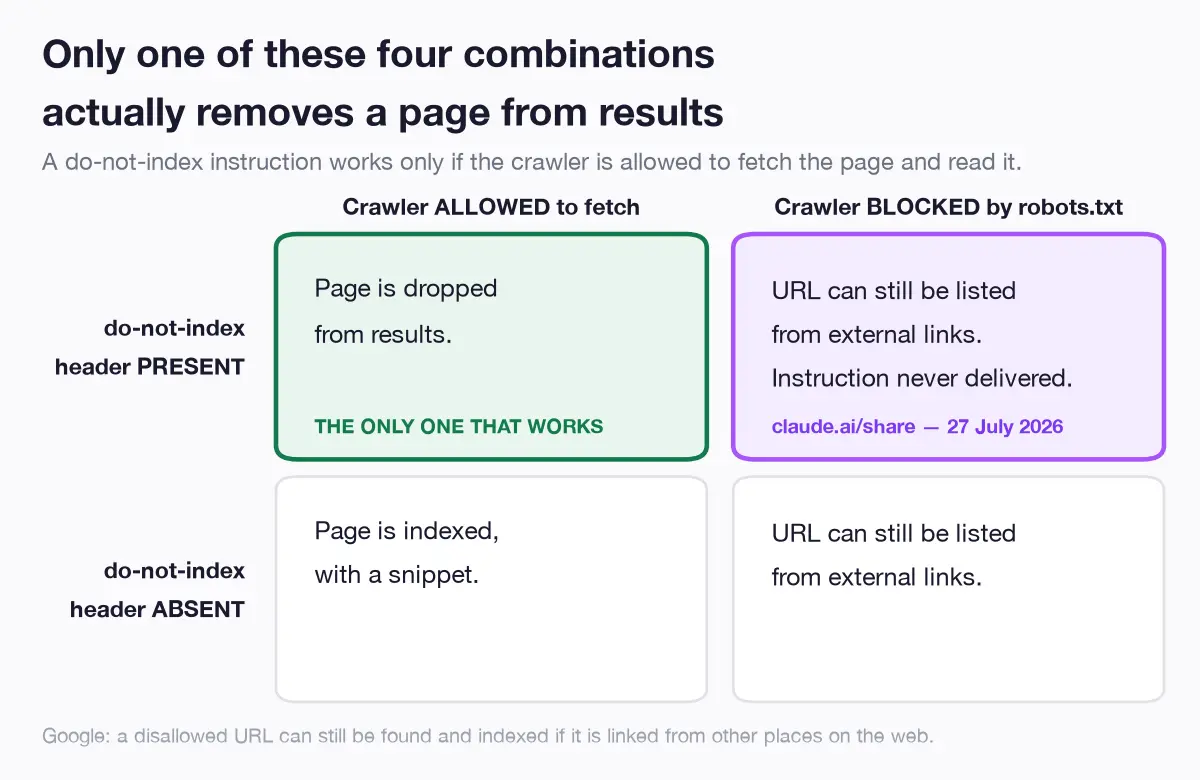
A blocked page can still turn up in results if linked from elsewhere, but Google says, in its own words, that “the search result won't have a description,” since its crawler never opened it. A bare address with no preview is not a readable conversation. Nobody covering this story has explained how people were reading whole ones if that is all Google could show.
Gone From Google Is Not the Same as Gone
Getting a page out of Google's results is not the same as making it disappear. Google says a “noindex tag only blocks your page from showing up in Google search results,” and a removal request buys about six months of invisibility on one engine. It removes nothing from the page itself. Anthropic points to unsharing as the step that does that.
- A removal request covers one search engine at a time, and each one has to be asked separately. The Decoder reported that the same chats stayed visible longer on Bing and Brave Search.
- Digital Digging put the number of ChatGPT conversations preserved on the Internet Archive at around 110,000, a separate copy that a search-engine removal request cannot touch.
- Nobody has tested what an unshared Claude link actually returns afterward, so treat any claim about it, this article's included, as unverified.
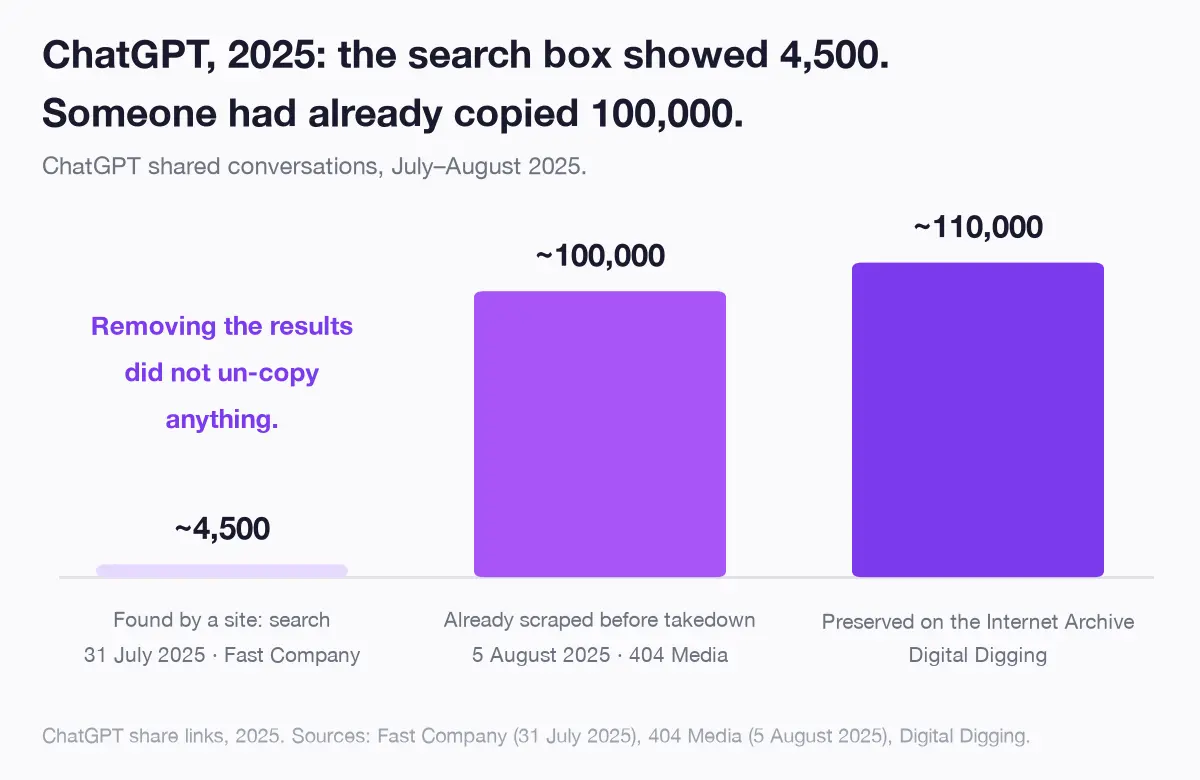
Fast Company ran a search on 31 July 2025, during the ChatGPT case, and found nearly 4,500 conversations. A researcher scraping that same exposure had already collected close to 100,000, reported by 404 Media on 5 August 2025. The gap between those two numbers is the gap between what a search box shows you and what has already been copied.
Four Times in Under Three Years, and What It Asks of You
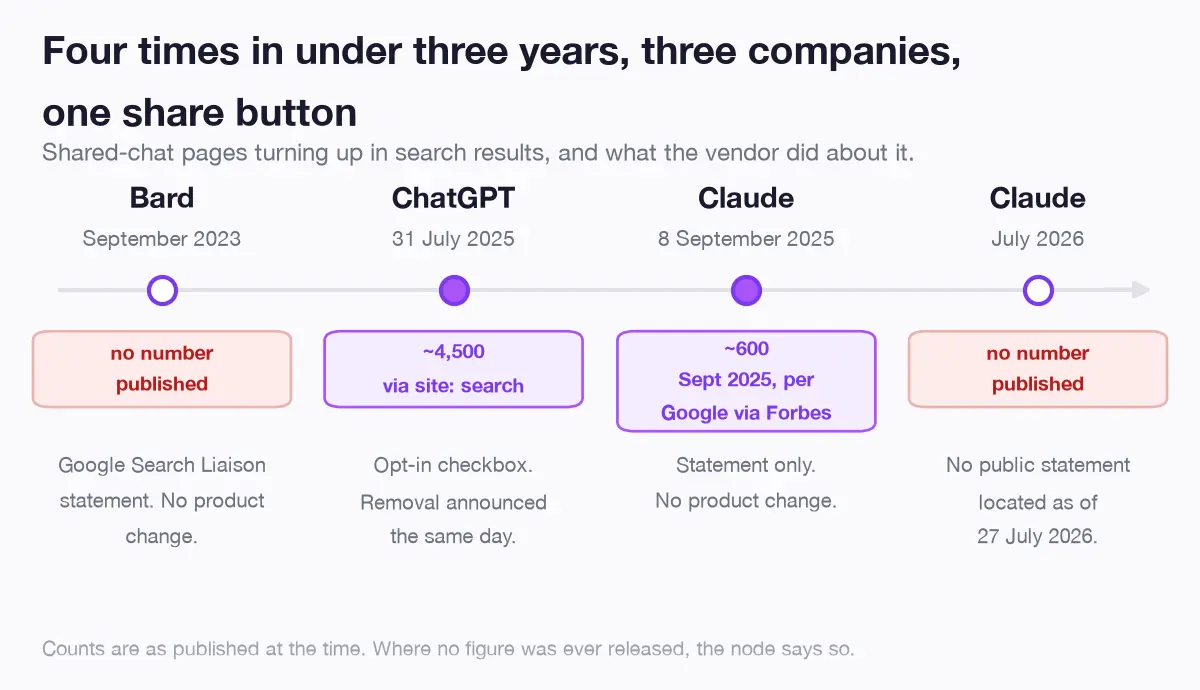
Deindexing keeps getting offered as the fix, but this is not one company's bad week. This is the fourth time in under three years that a share button has meant a private link to the person clicking it and a published page to the open web.
- September 2023, Google's Bard: Google's Search Liaison said, “we don't intend for these shared chats to be indexed by Google Search.” No scale was ever published.
- 31 July 2025, ChatGPT: sharing was an opt-in checkbox, and OpenAI announced it was removing the feature that same day, saying it “introduced too many opportunities for folks to accidentally share things they didn't intend to.”
- 8 September 2025, Claude: Anthropic issued a statement. No product changed.
- July 2026, Claude: no count and no public statement located as of 27 July 2026.
For a lawyer, doctor or consultant, an incident like this does not create the exposure, it reveals one already there. The ABA's Model Rule 1.6(c) requires a lawyer to “make reasonable efforts to prevent the inadvertent or unauthorized disclosure of, or unauthorized access to, information relating to the representation of a client,” a standard about effort, not outcome. Opinion 512 applies it to AI tools used on client work.
- ABA Formal Opinion 512, dated 29 July 2024, states: “merely adding general, boiler-plate provisions to engagement letters purporting to authorize the lawyer to use GAI is not sufficient.”
- Under 45 CFR 164.402, an impermissible disclosure of protected health information, meaning medical information tied to a patient, is presumed a breach unless a risk assessment shows little chance the information was actually compromised.
- 45 CFR 164.404 sets the clock: notification is due within 60 calendar days of discovery.
Judge Jed S. Rakoff ruled from the bench on 10 February 2026 in United States v. Heppner, No. 25 Cr. 503 (JSR) (S.D.N.Y.), with written reasons filed on 17 February 2026. About thirty-one documents of Bradley Heppner's exchanges with Claude were protected by neither attorney-client privilege nor the work-product doctrine, the rule that shields a lawyer's own analysis and preparation from being shown to the other side in a lawsuit.
His first reason was the simplest: “Because Claude is not an attorney… that alone disposes of Heppner's claim of privilege.” The second was that the exchanges were not confidential, since he had already disclosed them to Anthropic under a policy allowing training use and third-party disclosure. Heppner decided nothing about share links, and Anthropic's own legal-work guidance says later decisions have gone the other way.
How to Check Your Claude Shared Chats, and What to Change
The first step is knowing what you have already made public. Claude keeps a full list of every conversation you have shared, and it is easy to go years without opening it. The path is Settings, then Privacy, then Privacy settings, then “Manage” next to “Shared chats,” where each row has its own Unshare button.
- Unshare it. Deleting the conversation is a different action, and unsharing is the only revocation route Anthropic's help page of 15 June 2026 describes.
- Read every title before you decide. Unshare anything you would not want a stranger to search for.
- Treat any password or API key in a shared conversation as already compromised, not just at risk, and rotate it.
The share button belongs to Anthropic, the crawler belongs to Google, and no tool on your side could have stopped these pages from being listed. The chain runs from what you type, through what the provider stores, whether you press Share, and whatever happens later. You only control that first link.
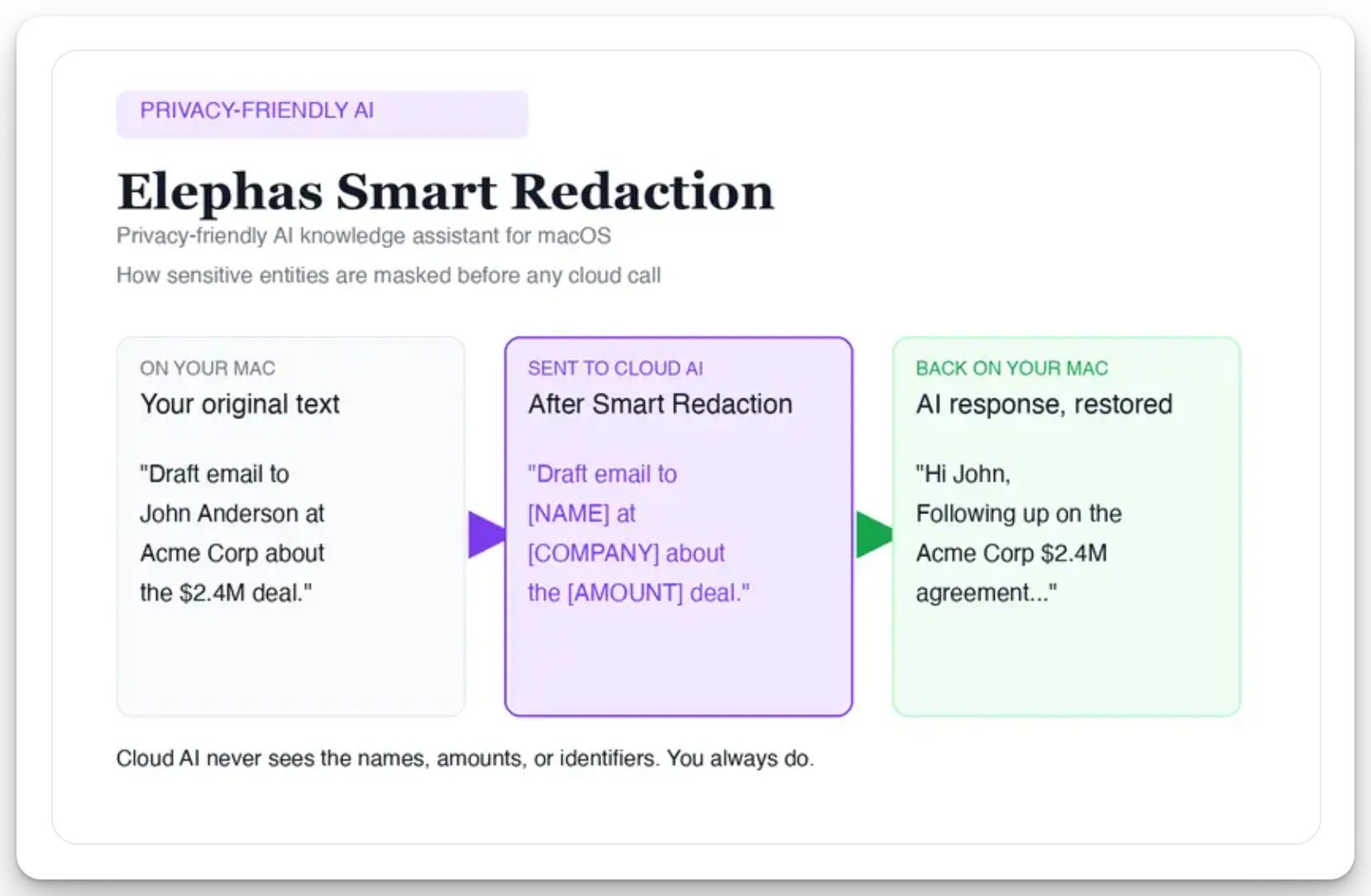
That first link is where masking helps. Elephas removes names, dates, dollar amounts and other identifying details on your Mac before a prompt reaches a cloud AI model. If a copy is exposed later, by a leaked link or a provider mistake, it shows a placeholder like [NAME] instead of the real value. The real values return once the answer comes back to your device.
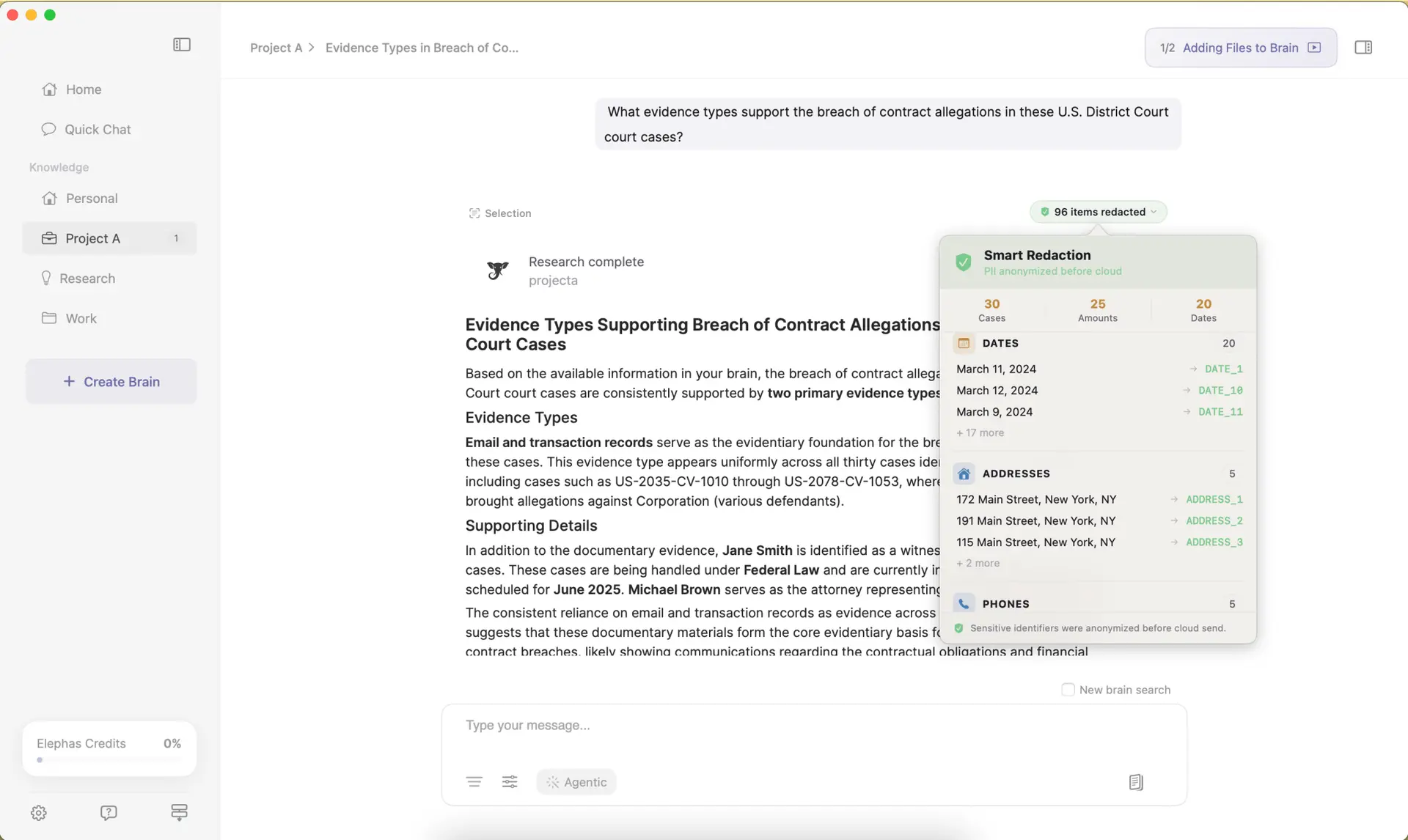
Smart Redaction runs on every Elephas plan, including Free. It will not help with a conversation you chose to publish, and it cannot undo a password that has already leaked. What it changes is what a leak is worth. If your prompt only ever held [NAME] and [AMOUNT], that is all a stray copy has to show. It would not have stopped these pages being listed. Nothing on your Mac could have.
What to Watch Next
Only OpenAI changed its product. Everyone else issued a statement, filed a removal request, or said nothing anyone could find. Anthropic said in 2025 that it blocks crawlers from these pages, and blocking a crawler is not the same as making a page unlistable. Every fix demanded this time changes what a search engine shows you, not what the page still holds.
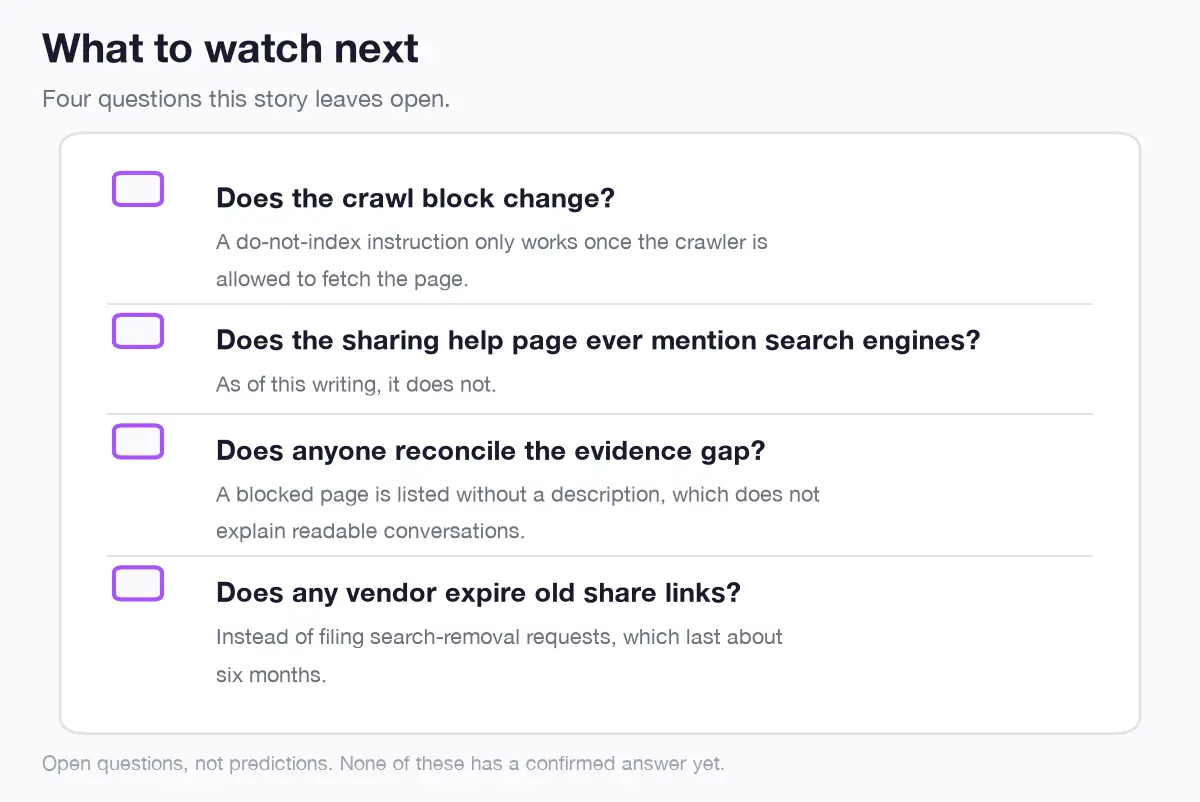
- Whether the
Disallow: /share/*line in robots.txt ever changes, since a do-not-index instruction only works once a crawler is allowed to read the page it sits on. - Whether Anthropic's sharing help page ever adds the words search engine, crawler or index.
- Whether anyone explains how readable conversations were turning up when this mechanism only produces a bare link: an earlier fetch, a crawler that ignored the rule, or copies sitting entirely outside Google.
- Whether any AI company starts expiring old share links automatically, instead of leaving removal requests to users.
- And on your side, whether you have opened your own shared-chats list yet. Elephas cannot see or change how a provider indexes a page, but masking sensitive details before you send them is the one part of this chain that is entirely up to you, on every Elephas plan, including Free.
Elephas masks the part you control
Smart Redaction strips names, dates and dollar amounts before a prompt reaches the cloud, on every plan including Free. Available on Mac, iPhone, and iPad.
Try Elephas Free →