Data Anonymization: How to Hide Personal Details Before You Share Data or Use AI
Data anonymization means changing data so that nobody can tell who it is about, even when they mix it with other data they can easily get. Once data is truly anonymous, EU privacy law no longer treats it as personal data (Recital 26 of the GDPR).
It matters more now that people paste work into AI. A preprint study accepted at the IEEE Symposium on Security and Privacy 2027 found that 21 of 42 chatbot websites (50%) sent conversation titles to outside trackers (Bekos et al., arXiv).
This guide covers what counts as anonymous data, the main techniques, why removed names can still be traced, and 6 checks to run before you paste.
Quick answer
- Anonymous data can't reasonably be linked back to a person. Swapping names for labels like PERSON_1 is pseudonymization (a swap you can undo), and EU law still treats that as personal data.
- The main techniques are removing, masking, generalizing (making a detail broader), swapping in placeholders, adding small random changes and making synthetic data.
- Names are only the start. A study found 87% of Americans in 1990 census data were likely unique on ZIP code, gender and date of birth (Sweeney).
- Before you paste into AI, cut what the task doesn't need, remove contact details and IDs, and make dates, pay and places broader. The result is usually pseudonymized, not legally anonymous (the 6 checks).
- Elephas is a private AI app for your documents that hides personal details such as names, emails and phone numbers on your computer before cloud AI requests. 7-day free trial, from $19 a month.
What is data anonymization, and why does it matter?
Data anonymization means removing or changing personal details so that nobody can tell who the data is about.
Personal data is any detail that points to a person. Some details do this on their own, like a name, an email address, a phone number, a Social Security number or an IP address. Others only do it when combined, like a job title, a birth date and a town.
Anonymous data has neither kind left that could point to a person. Teams anonymize data for four main reasons:
- Privacy: details stay safe when data is shared.
- Rules: truly anonymous data falls outside the General Data Protection Regulation (GDPR, the EU privacy law).
- Smaller leaks: if a file leaks, nobody in it can be named.
- Safer AI use: text pasted into cloud AI leaves your computer. On 26 October 2026, Cloudflare said a flaw in one hosted AI model put other customers' request data into 155 responses.
The downside is that every removed detail makes the data less useful, so remove only what you must.
Anonymized data, pseudonymization or data masking: what is the difference?
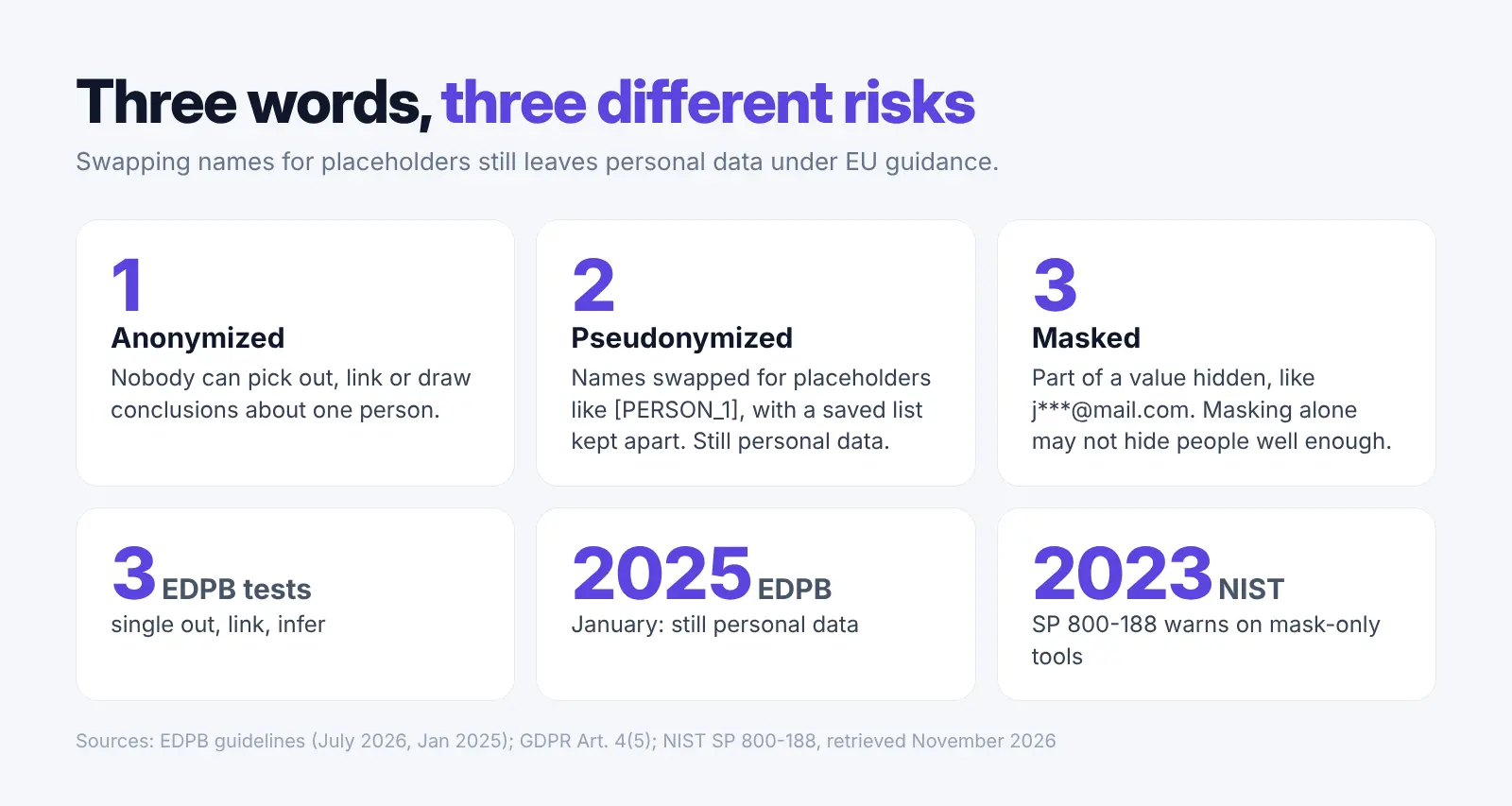
Of these 3, only anonymized data can't be traced back to a person. The EDPB (the group of EU privacy regulators) gives 3 tests in its draft anonymization guidelines from July 2026. Nobody should be able to pick out one person's record, link it to other data, or learn something specific about them.
Pseudonymization means swapping details for placeholders, such as PERSON_1 or EMAIL_1, while a separate list says who is who (GDPR Article 4(5)). Because the list can undo the swap, the EDPB's January 2025 guidelines say this is still personal data.
Data masking hides part of a value, such as j***@mail.com. Masked data can stay personal data, because the rest of the record can point to someone. NIST SP 800-188 (from the US standards body) warns that masking alone may not hide people well enough.
- EU: pseudonymized data stays personal data.
- UK: the Information Commissioner's Office (ICO, the UK privacy regulator) published final anonymization guidance in 2025 (Pinsent Masons).
- US health data: the Health Insurance Portability and Accountability Act (HIPAA) has two routes, Safe Harbor and Expert Determination, and HHS says both leave a small risk.
Why can someone still be identified after you remove the name?
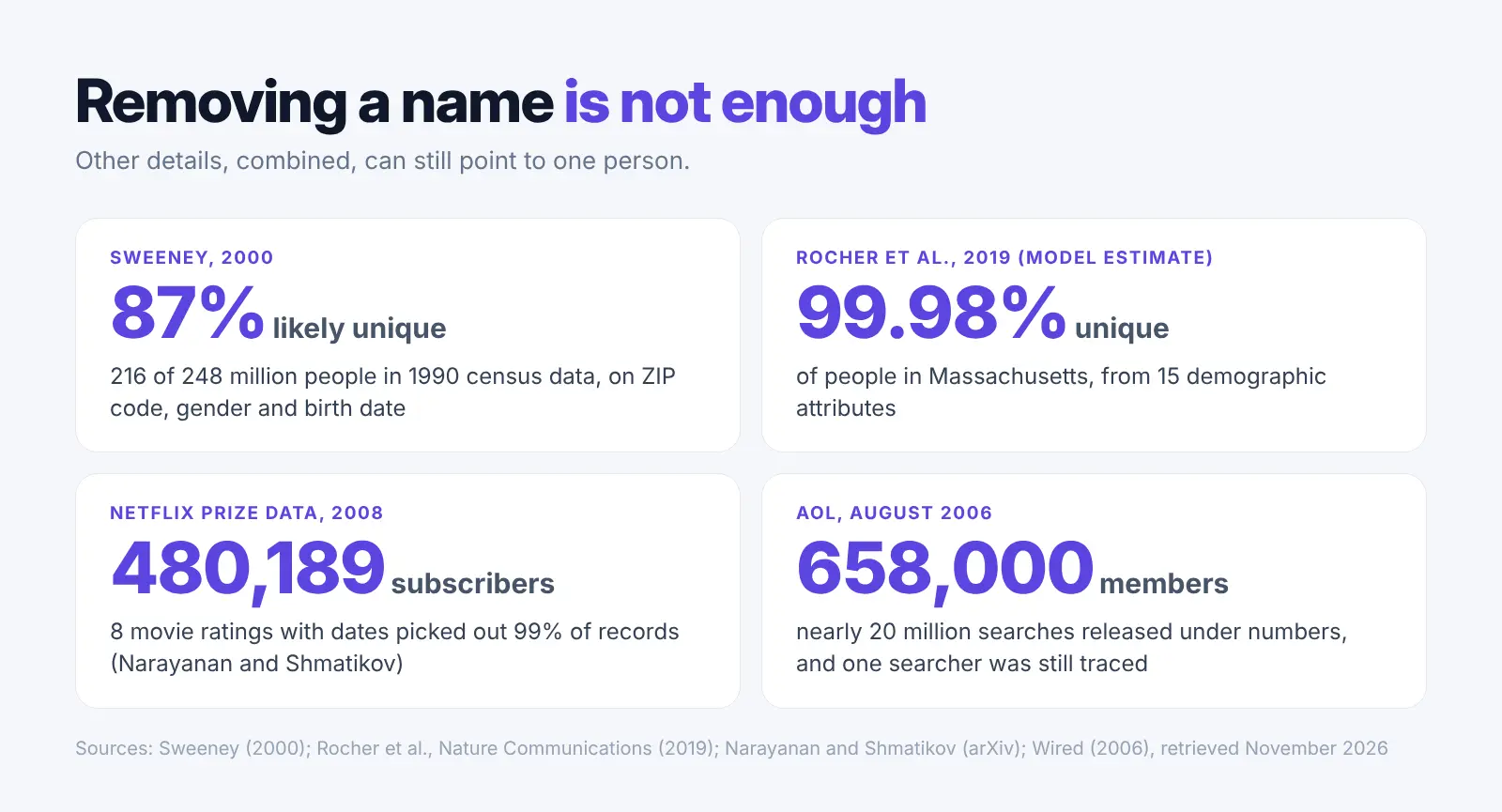
Small details add up. A 2000 study by Latanya Sweeney found that 87% of the US population in 1990 census data were likely unique on 5-digit ZIP code, gender and date of birth (Sweeney).
A 2019 model by Rocher and colleagues in Nature Communications estimated that 15 basic details would make 99.98% of people in Massachusetts unique.
Making places broader helps: with town instead of ZIP code, about 53% were still likely unique, and 18% at county level (Sweeney).
A 2008 study by Narayanan and Shmatikov found that 8 movie ratings with rough dates could single out 99% of records in the Netflix Prize data from 480,189 subscribers (paper).
- Each extra detail you keep makes a match easier.
- In 2006, AOL released nearly 20 million searches from 658,000 members under numbers instead of names, and reporters still traced one searcher (Wired).
- A rare job in a small area carries a strong risk of being traced back (UBC data guide).
Which anonymization techniques fit each everyday field?
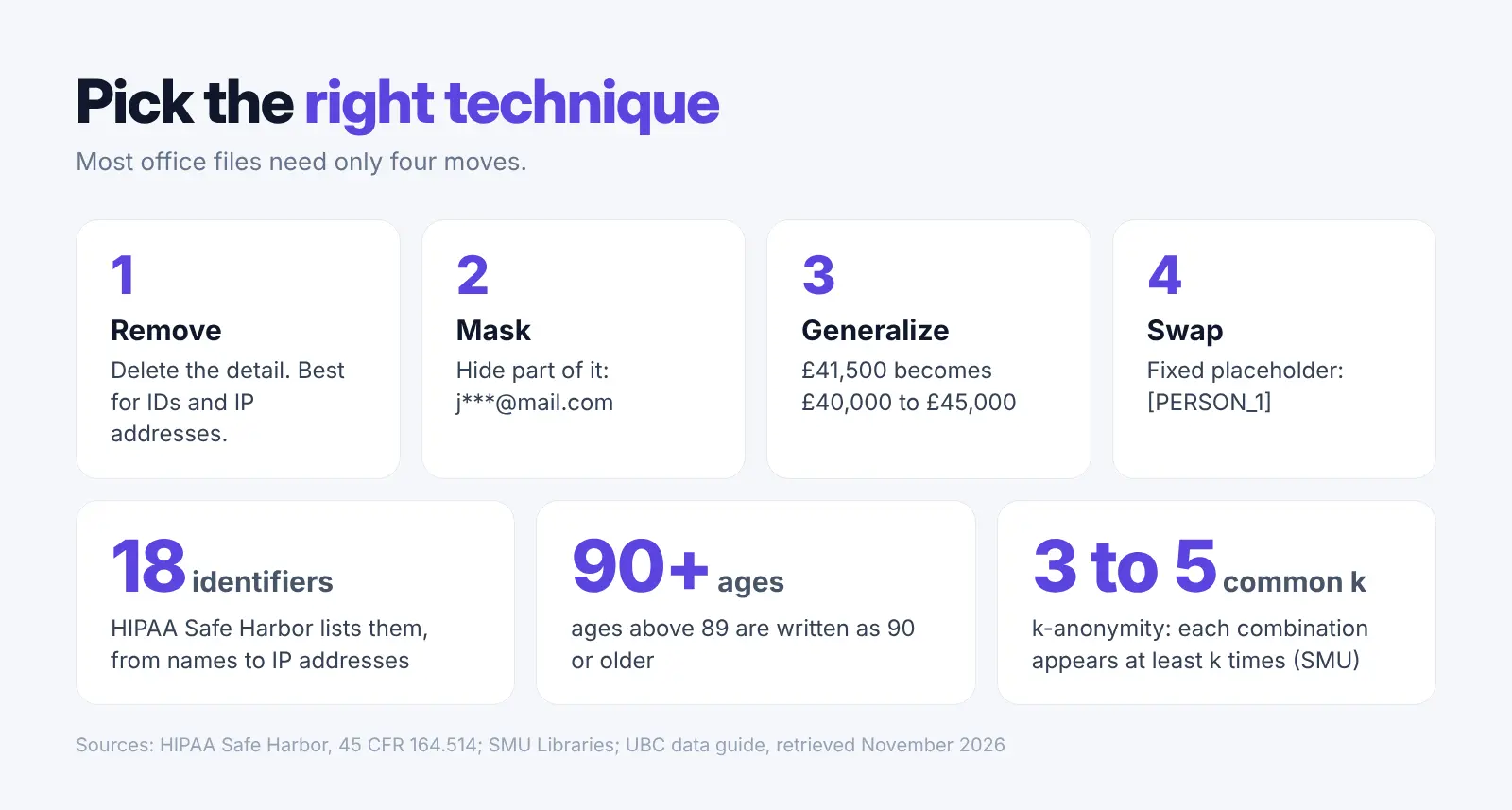
Most office files need just 4 techniques: remove, mask, generalize or swap in a placeholder.
Each one fits a different detail: masking hides part of an email, deleting removes a phone number, and generalizing turns a salary into a pay band and a date of birth into a year.
The main types of data anonymization techniques are:
- Removing: delete the detail completely.
- Masking: hide part of a value with stars or symbols.
- Generalizing: make a detail broader, like an age band instead of a birth date.
- Swapping in placeholders: replace a detail with a label like PERSON_1 (this is pseudonymization).
- Noise: add small random changes to numbers, or swap values between records.
- K-anonymity: make sure every mix of details is shared by at least k people. SMU Libraries says a k of 3 to 5 is common.
- Synthetic data: make up new records that look like real ones.
For US health data, the HIPAA Safe Harbor rule lists 18 kinds of identifiers to remove, from names to IP addresses.
| Field | Technique | Example after | Basis |
|---|---|---|---|
| Name | Placeholder, or remove | PERSON_1 | HIPAA list |
| Email address | Mask, placeholder or remove | j***@mail.com, or EMAIL_1 | HIPAA list |
| Phone number | Remove, or placeholder | PHONE_1 | HIPAA list |
| Salary | Band it, or remove if not needed | £40,000 to £45,000 a year | Our rule of thumb |
| Date of birth | Year or age band; ages above 89 become 90 or older | 1983, or 40 to 49 | HIPAA Safe Harbor |
| Job title | Use a wider title if few people hold it | finance staff | Our rule of thumb; UBC |
| Town or ZIP code | Wider region; first 3 ZIP digits only if over 20,000 people | A US state, or 021 | HIPAA Safe Harbor (US) |
| ID numbers (Social Security number, passport, account) | Remove completely | ID_REMOVED | HIPAA list |
| IP address | Remove | IP_REMOVED | HIPAA list |
How do you anonymize data before you paste it into AI?
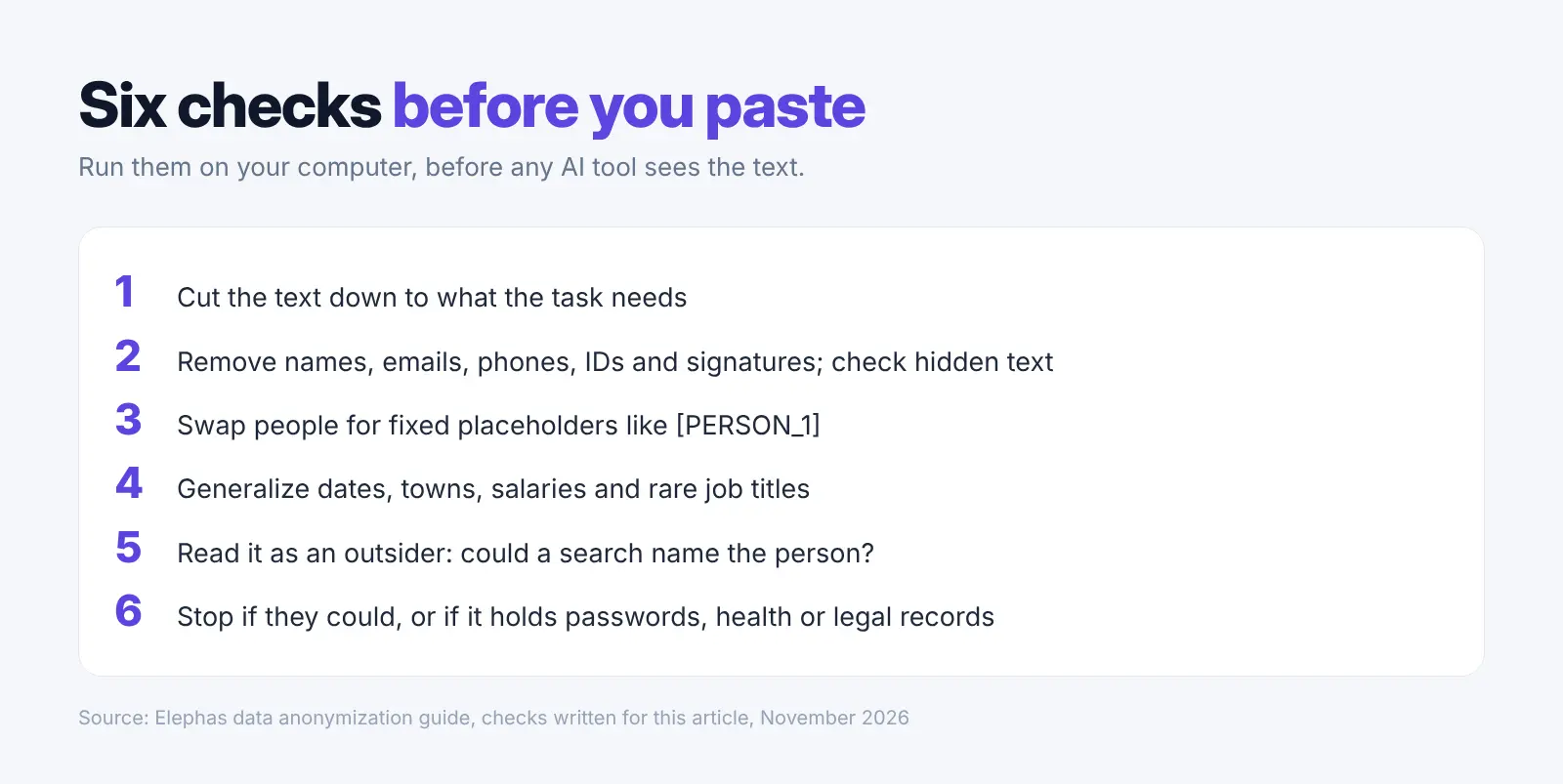
To anonymize data, run 6 checks on your computer before any AI tool sees it, because asking a chatbot to clean text sends it the original. The result is usually pseudonymized text, not legally anonymous data, so keep handling it with care.
- Cut the text down to what the task needs.
- Remove names, emails, phone numbers, ID numbers and signatures, and check comments and tracked changes.
- Swap people for fixed placeholders like PERSON_1 only where the AI must follow who is who.
- Make exact dates, towns, salaries, rare job titles and project names broader.
- Read the rest as an outsider and check whether a colleague or a web search could name the person.
- Stop if they could, or if the text holds passwords, health or legal records.
Sample text written for this guide (not a real case)
Before: "Dana Ortiz, our only payroll officer in Leeds, earns £41,500 and asked to move to part-time hours on 12 March 2026. Email: dana.ortiz@example.com."
After: "PERSON_1, a staff member in the UK, earns £40,000 to £45,000 and asked to move to part-time hours in March 2026."
The AI can still draft a reply, because the task, the month and the pay band stay.
For a quick first pass, our free text anonymizer finds names, emails, phone numbers, addresses and ID numbers and swaps them for placeholders. It runs in your browser, free with no sign-up, and can miss details such as a rare job title, so check before you paste.
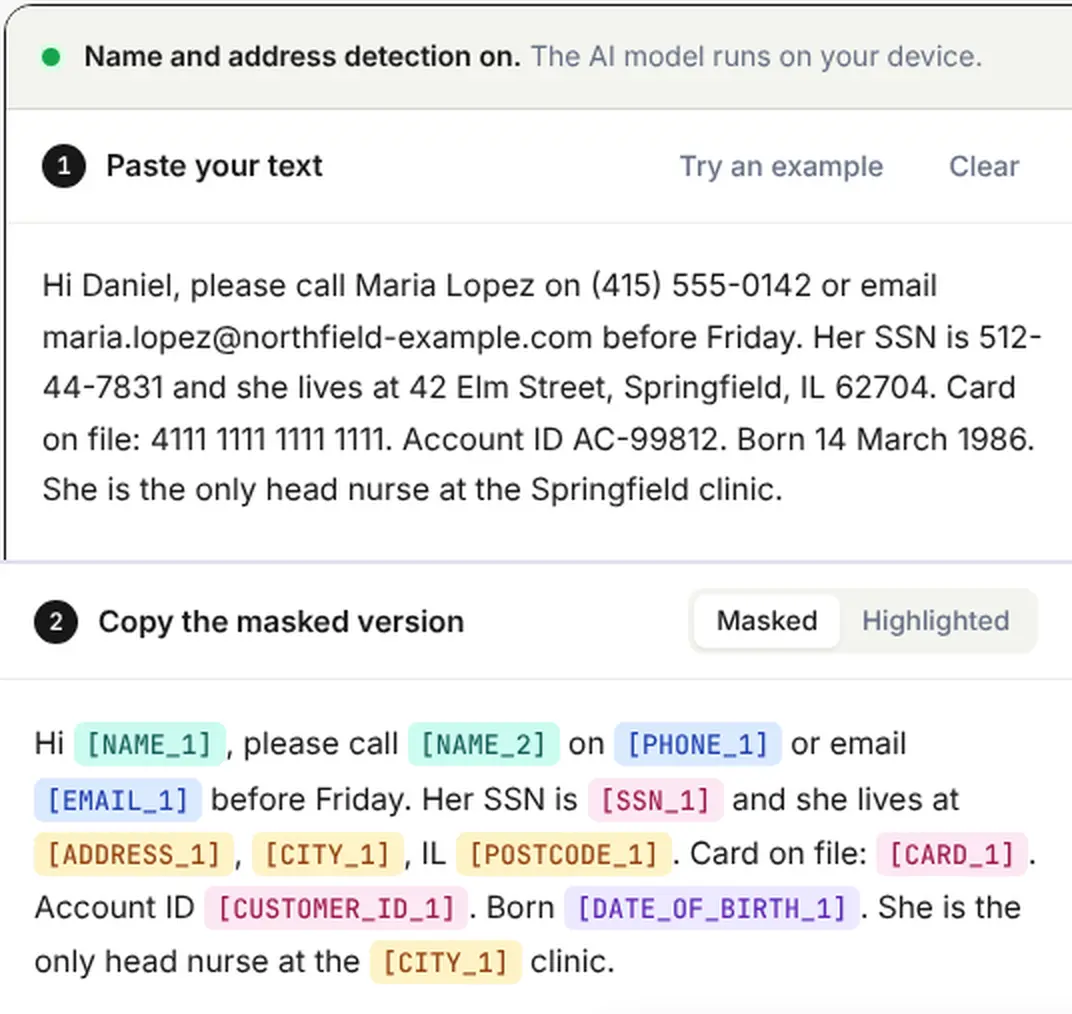
- Before you paste text into an AI tool, strip out names and IDs first. Broad facts can safely stay if, together, they can't point to one person.
- Keep your swap-back list away from the AI tool and the cleaned file.
- Check attachments too: cleaning the prompt doesn't clean the uploaded spreadsheet. See our sensitive data guide.
The safer solution: let Elephas hide details before AI sees them
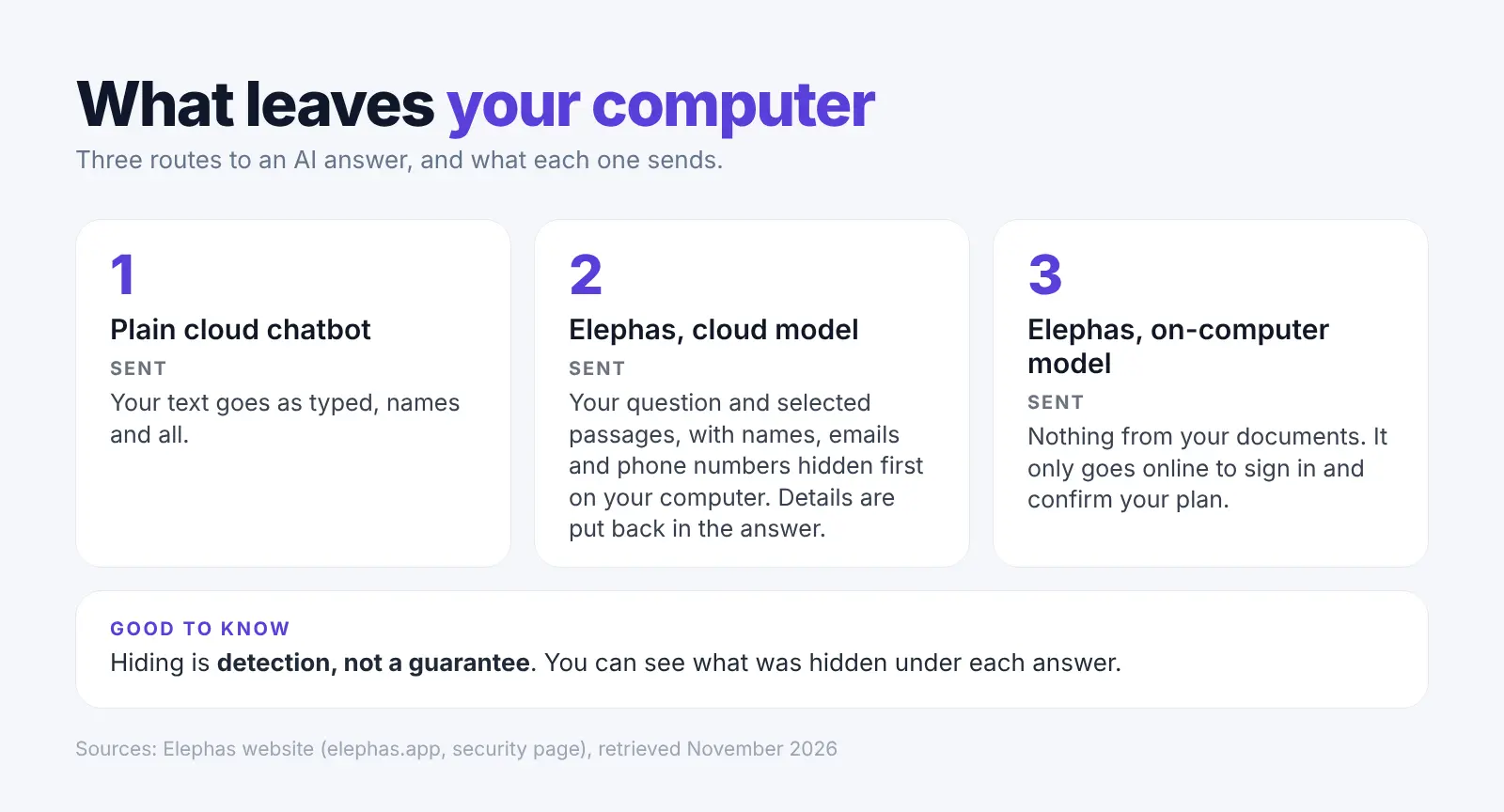
If you often ask AI about contracts, HR notes or email threads, Elephas hides personal details such as names, email addresses and phone numbers on your own computer before any cloud AI request, then puts them back in the answer.
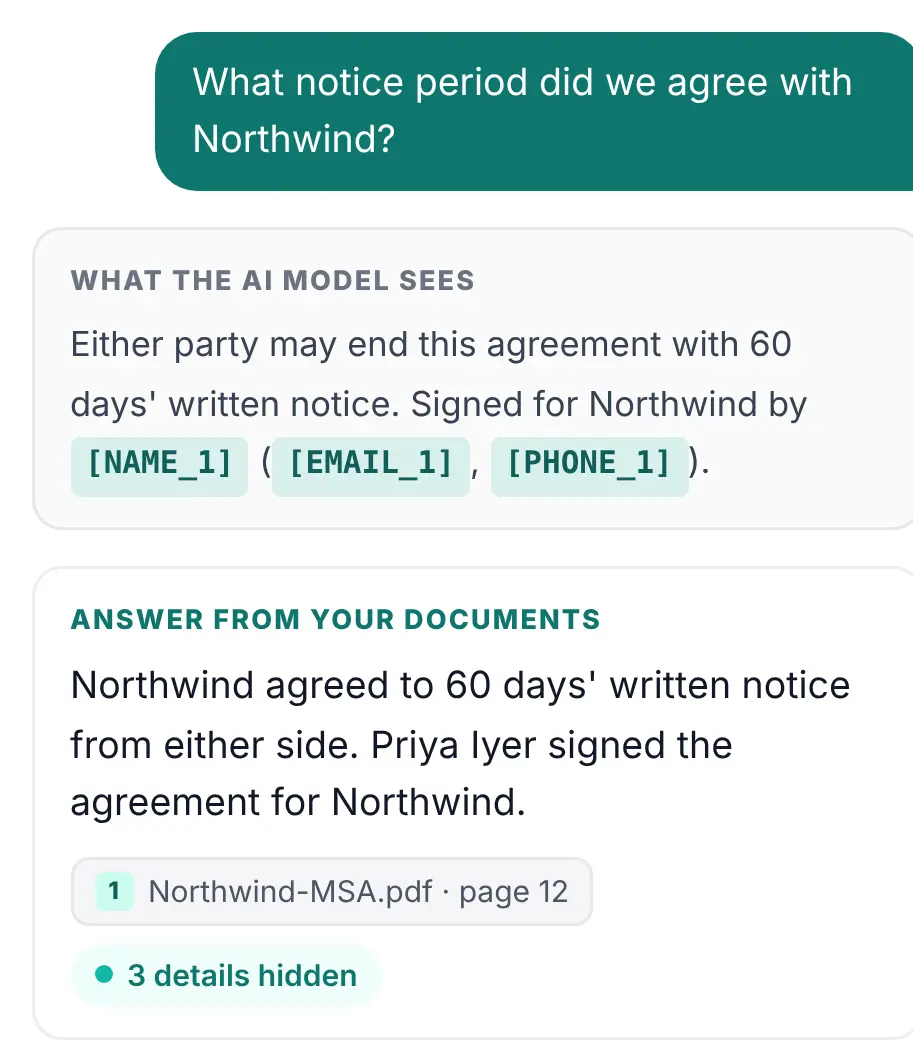
Answers come from your own files and cite the source, and your documents stay stored on your computer. Under each answer you can see what was replaced. This is detection, not a guarantee, so check it.
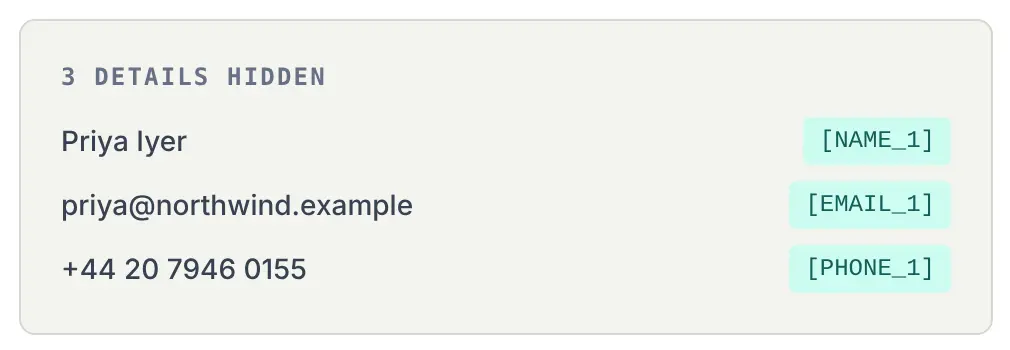
- Your question and the selected passages go to the cloud AI model, with personal details hidden.
- For the most private route, download the on-computer model once; answers then stay on your computer (it still goes online to sign in and confirm your plan).
- Runs on macOS 14 or later on Apple Silicon, and on Windows 10 or 11, 64-bit.
- 7-day free trial with no card, then plans start at $19 a month (see pricing).
FAQ: data anonymization questions
Pick the route that fits what you are doing:
- Sharing a spreadsheet: generalize and remove, then run the 3 EDPB tests.
- Asking AI about one email thread: clean it with the 6 checks above.
- Building a demo or a test file: use synthetic data instead of real records.
- Daily AI work on your own documents: Elephas hides details first, with optional local models and a 7-day free trial.
Is anonymized data still personal data under the GDPR?
Truly anonymous data is outside EU law. But if you anonymize data yourself and it can still be traced to a person, you still have to treat it as personal data under privacy rules.
Can anonymized data be reversed?
Truly anonymized data can't be reversed, because there is no list that links it back. Pseudonymized data can be reversed with its swap-back list, and weak anonymization can be undone by mixing in other data.
Does encryption make data anonymous?
No. The European Commission says data that is "de-identified, encrypted or pseudonymised but can be used to re-identify a person remains personal data".
Can I swap the placeholders back after the AI answers?
Yes. If you replace details with placeholders, the AI still gives a useful answer, and you can swap them back afterwards with a list of who is who, stored only on your computer. That list is what makes the text pseudonymized rather than anonymous, so protect it like the original.
Which tools can anonymize data?
For tables and research files, free tools such as ARX and Amnesia handle generalizing and k-anonymity. For text, Presidio (formerly a Microsoft project) is a free open-source kit for developers.
When should you use synthetic data?
Synthetic data is made-up records that copy the patterns of real ones. Use it for tests, training examples or demos where no real person is needed, and label it clearly.
What are data anonymization best practices for a small team?
Name one owner for the swap-back list, keep data collection small and use one placeholder style.
Private AI for your own documents
Elephas answers from your own documents and hides personal details like names, email addresses and phone numbers on your computer before a question goes to cloud AI. 7-day free trial, then plans start at $19 a month.