John Deere, SharkNinja and the AI Agent Hacks: What One Hacker With AI Did to 100+ Companies
One hacker used AI agents (AI programs that plan and carry out steps on their own) to break into the websites of more than 100 companies, Reuters reported on October 19, 2026. John Deere and SharkNinja were among the names.
That leaves three questions: what is confirmed, what is still unknown, and whether a second AI agent hack that Microsoft described on October 21, through ConnectWise (software IT firms use to support their customers), belongs to the same story.
Below are what each company said, how the two attacks differ, and the checks to run this week.
Executive Summary
- Reuters reported that one Chinese-speaking hacker used AI agents on a platform called Cairn to break into websites of more than 100 companies, including Deere, SharkNinja and Cummins, though Deere said it saw no sign that sensitive information was accessed.
- In a separate case, Microsoft said a group it calls Storm-0940, which it links to the Chinese state, used an AI tool named ARTEX after what Microsoft believes was its break-in at ConnectWise.
- That group tried to sign in to more than 2,250 company Microsoft 365 accounts (Microsoft's online email, files and office apps); most attempts failed, but some reached high-level access.
- Companies should check app sign-ins, unexpected changes to app access, unknown files on their websites and any admin pages left open online.
- Elephas hides personal details on your Mac before any cloud model sees them.
The AI Agent Hack That Named John Deere and SharkNinja
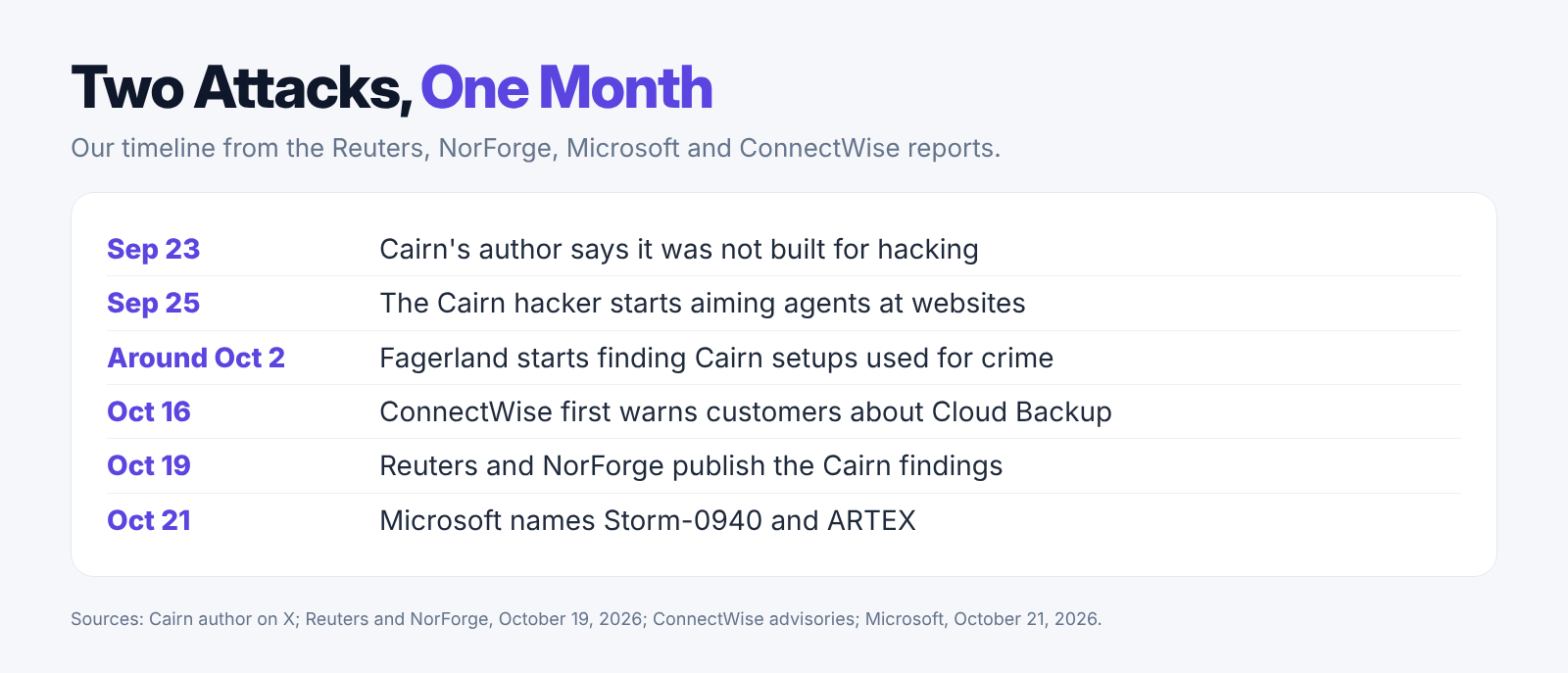
The attack was found by Snorre Fagerland, a researcher at the security firm NorForge, who watched one hacker's AI agents work through company websites over a couple of weeks.
According to the Reuters report, the hacker "did almost none of the work." The agents spent hours probing the chosen sites, testing for weak spots and trying ways in. The hacker's instructions were short, fewer than 100 Chinese characters.
Reuters named farm equipment maker Deere, home appliance company SharkNinja and engine maker Cummins. Reuters found those names in its own review of the hacker's activity. NorForge's public report did not name any victims.
- The hacker started on September 25 and aimed mostly at shopping websites in the US, Canada, Australia and Japan.
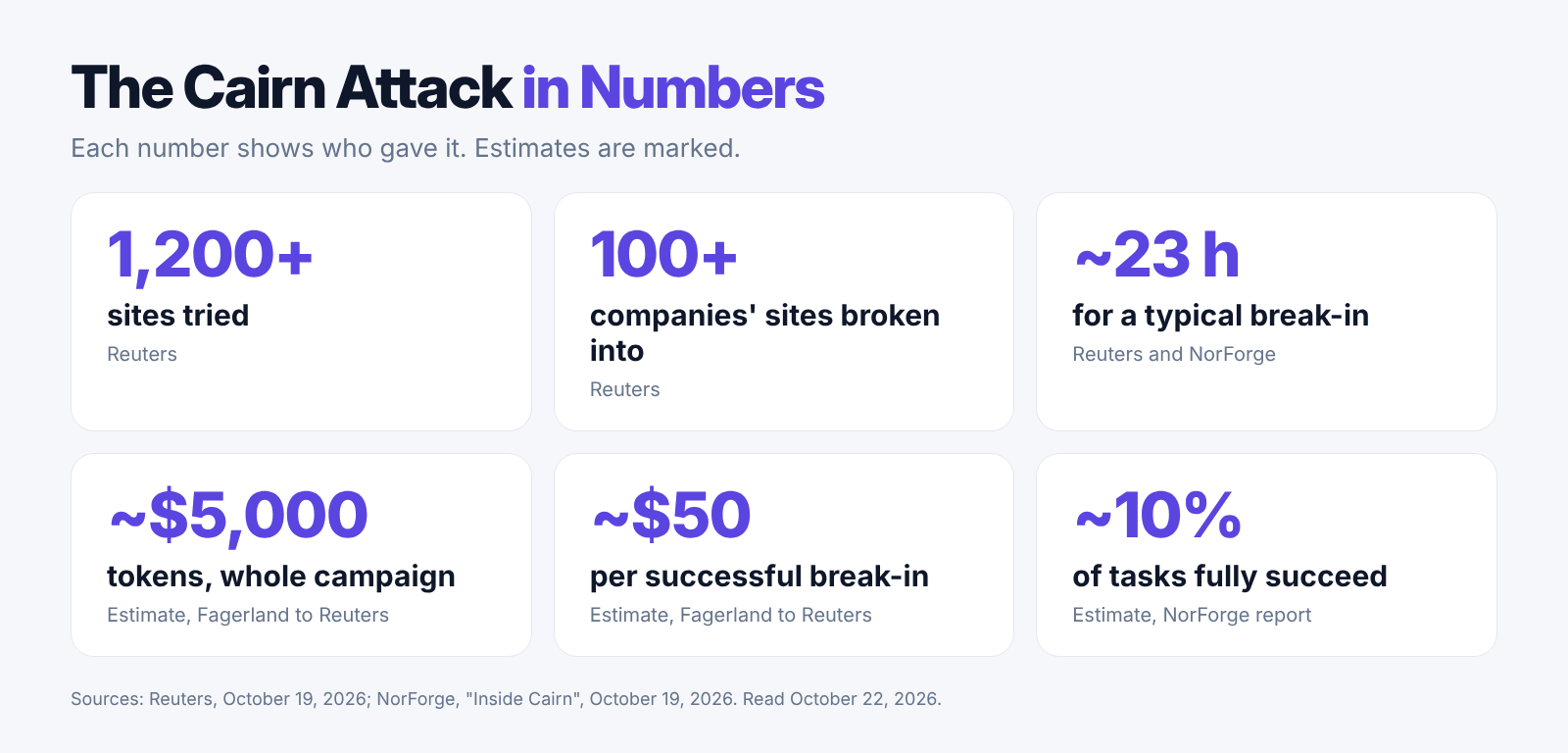
- By the week before Reuters' October 19 report, the agents had tried to break into more than 1,200 sites.
- A successful break-in usually took around 23 hours of trial and error by the agents.
- Fagerland told Reuters the work was "not script kiddie stuff" (meaning not simple copied tricks) and said, "It's a new world now."
Cairn Was Not Built for Hacking, but It Did the Work for This Hacker
Cairn is an open-source (free for anyone to copy and change) AI platform for solving problems step by step, and its author says it was never built for attacks.
Cairn's author has pushed back on the label "hacking tool." On X, the author wrote that Cairn "was not designed for hacking attacks" and that harmful use "is not my intention."
NorForge's report describes Cairn as a general problem solver that can be used for penetration testing (paid, approved checks of a company's security). It says that in these cases it was used for break-ins.
In Cairn, each job has a starting point and a goal. The agents note what they find and decide their next move on their own. A person can add hints.
- Fagerland estimated the whole campaign used about $5,000 worth of tokens (the units AI services charge by), or about $50 per successful break-in.
- NorForge's own report gives a different figure, about $5 per task including failed ones, and says it had no real token numbers, so the figure could be off by a clear margin.
- Reuters said the campaign "appeared to be using a mixture of" China's DeepSeek and Anthropic's Claude Code (an AI coding tool); NorForge's only clue was a setup label that named both.
- NorForge puts the success rate for these campaigns at around 10% per task, with many others reaching part of their goal.
What John Deere, SharkNinja and Cummins Told Reuters
Deere said it saw no sign that sensitive information was accessed, SharkNinja said the threat was contained, Cummins said it was still checking, and Reuters could not tell how much data, if any, was taken.
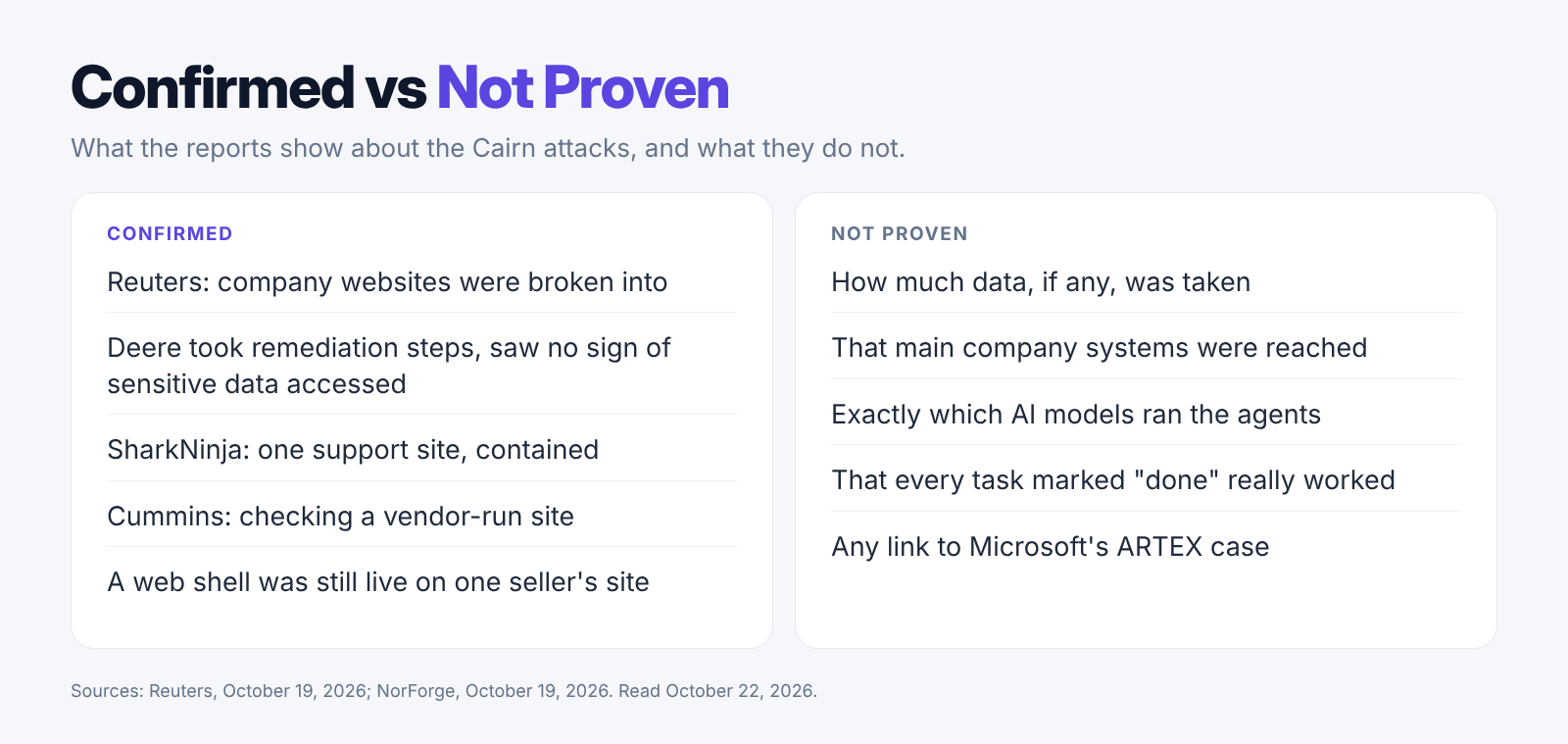
Deere said it took "necessary remediation actions" (steps to fix the problem). SharkNinja said the hack hit a standalone site that carried only product support information.
Cummins said it was "investigating the report of a potential cyber-attack on a website operated by one of our third-party vendors." So the attack reached company websites. It does not show that the companies' main systems or customer records were touched.
- NorForge checked one claimed break-in by the same hacker at a hardware-parts seller and found a web shell (a hidden file that lets an outsider control a website) still in place.
- Two smaller businesses also told Reuters they were hit; Reuters did not name them, and other victims did not reply.
- Fagerland watched other hackers on Cairn too, separate from this case: Reuters says one stole a pile of credit card data and another tried to get agents to rob a crypto exchange.
- Reuters also cites Bitsight, a cyber intelligence firm, saying talk of how to use AI agents is surging on criminal forums.
Microsoft Found a Second AI Agent Attack Through ConnectWise
On October 21, Microsoft said a group it calls Storm-0940, which it links to the Chinese state, used an AI agent tool named ARTEX to attack hundreds of organizations.
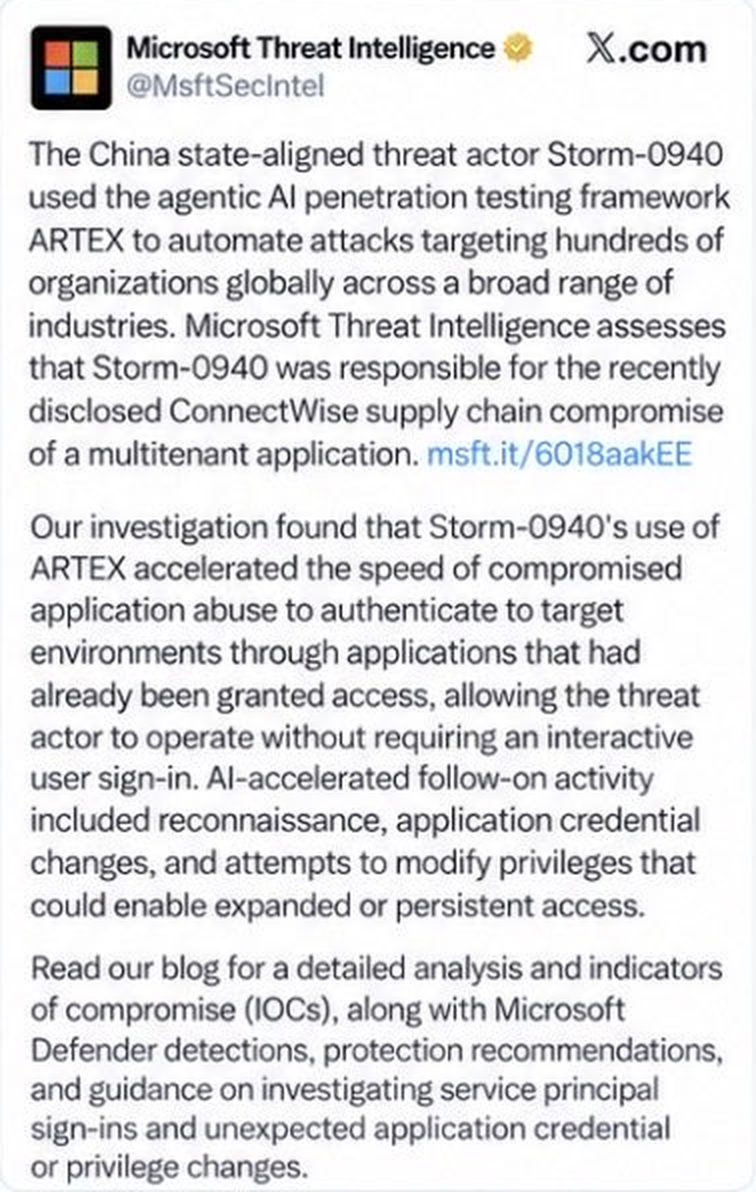
Image: @MsftSecIntel on X
The Microsoft report says it believes the group was behind the ConnectWise supply chain attack (an attack on a supplier that many companies trust). ConnectWise first warned customers on October 16 about its Cloud Backup service, once called SkyKick.
After that break-in, ARTEX tried to sign in to more than 2,250 tenants (each company's own Microsoft 365 account) at 2,900 attempts a minute. It used apps that already had access, so no person had to log in.
- ARTEX is an open-source AI tool for penetration testing that runs agents from first scouting to data theft with little human help.
- In several cases, Microsoft says the time from first targeting to high-level access in a company's cloud was less than 3 hours.
- Inside some accounts, the agents looked around, changed app credentials (the secret codes apps use to sign in) and tried to change who had admin rights.
- Microsoft says this did not come from a flaw in its own systems or products.
- Microsoft also says that a successful sign-in "does not necessarily indicate" that customer data was taken.
Cairn and ARTEX Are Two Different Attacks With One Lesson
Cairn and ARTEX are different tools used by different attackers, and we found no report that links the two campaigns.
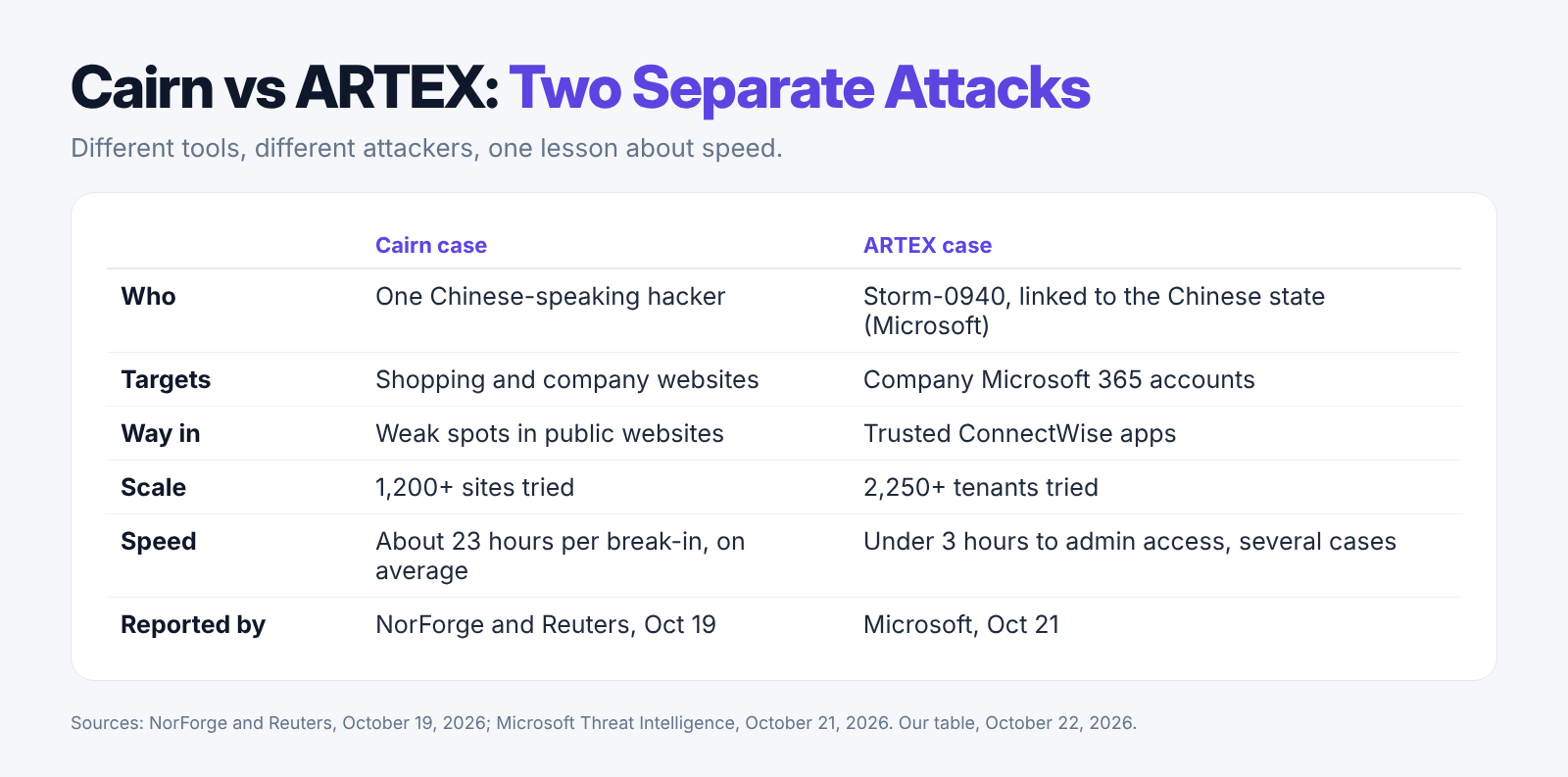
The Cairn hacker went after company websites, and NorForge saw no clear sign of a government behind it. The only link we found is Cairn's author saying that ARTEX lists Cairn as a design reference.
The shared lesson is speed and scale. In both cases, AI agents did hours of patient work that once needed skilled people. One person, or one group, could aim at hundreds of targets at once.
| Cairn case | ARTEX case | |
|---|---|---|
| Who | One Chinese-speaking hacker | Storm-0940, linked to the Chinese state (Microsoft) |
| Targets | Shopping and company websites | Company Microsoft 365 accounts |
| Way in | Weak spots in public websites | Trusted ConnectWise apps |
| Scale | 1,200+ sites tried | 2,250+ tenants tried |
| Speed | About 23 hours per break-in, on average | Under 3 hours to admin access, in several cases |
| Reported by | NorForge and Reuters, October 19 | Microsoft, October 21 |
- The Cairn hacker's control panels (web pages used to steer the agents) were left open on the internet, which is how researchers could watch.
- Those open panels also showed target names, found weak spots, account secrets and API keys (secret codes that let apps connect to services).
- NorForge found more than 20 open Cairn panels that looked like they were used for crime.
- Nick Carr, a threat intelligence partner at Microsoft, wrote on X that the agents were "noisy, sloppy" but "effective at scale."
What Your Company Should Check This Week
Microsoft's October 21 advice is to start with a review of app sign-ins.
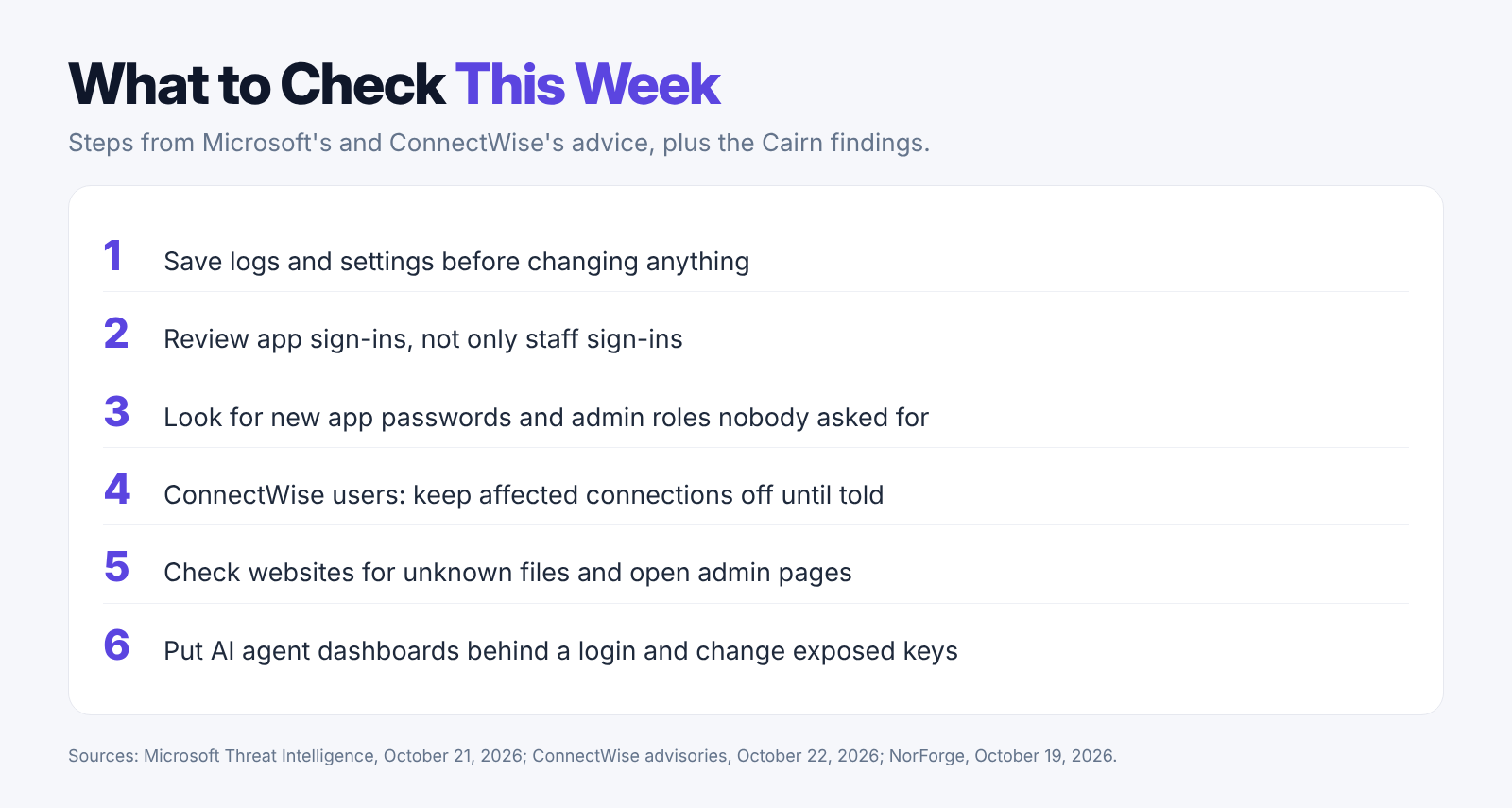
Start with your IT team or IT provider. Ask which ConnectWise services you use, and follow the ConnectWise advisories. ConnectWise says to keep affected connections switched off until it sends formal steps for your service.
Microsoft warns that changes made by the attackers can stay behind as a back door even after the first app is fixed. So turning one app off is not the end of the check. Add any AI tools staff use without the company's approval (known as shadow AI) to the same review.
- Check service principal sign-ins (records of an app logging in as itself), since the attackers signed in as apps, not as staff.
- Look for new app passwords, changed access rights and admin roles nobody asked for.
- Save logs and settings before you change anything, as Microsoft advises, so the trail is not lost.
- On company websites, look for unknown uploaded files and admin pages open to the whole internet.
- Keep any AI agent dashboards behind a login, and change any keys that may have been seen. Our guide on AI agent security risks covers more.
Elephas Is a More Private Choice for Your Company Documents
These attacks went after company websites and cloud accounts on servers the companies do not watch every hour, and every online AI tool your team pastes files into also rests on servers you cannot see.
What ChatGPT, Gemini and Claude Receive
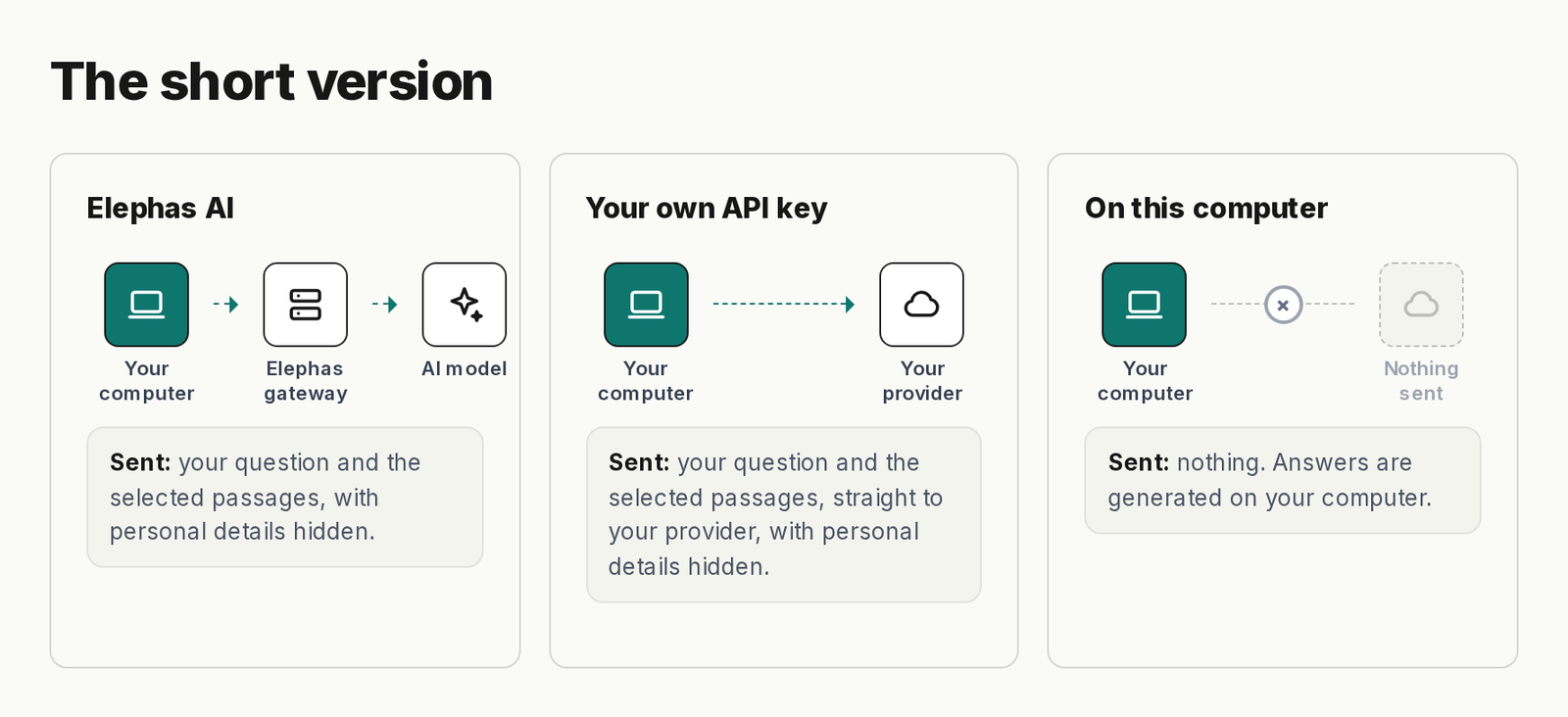
When your team uses ChatGPT, Gemini or Claude, every question and every uploaded file goes to their servers. Chats can be kept, and depending on the plan and settings, they may be used to train AI models. That is a lot of company and customer detail sitting on someone else's computers.
Elephas Hides Personal Details on Your Mac
Elephas is private AI for your documents. Before a question goes to a cloud model (an AI model that runs on servers over the internet), Elephas hides names, email addresses and phone numbers on your Mac. This redaction (hiding personal details) happens on your computer, and you can see what was hidden under each answer.
Elephas Local Models Keep Everything on Your Mac
With an Elephas local model (an AI model that runs on your own computer), the answer is made on your Mac. Your questions and documents are not sent anywhere. Your work stays on the computer you control.
Elephas Team Gives Your Company One Private Place for AI
Elephas Team keeps company documents stored on each person's computer. Teams share Team Brains (named collections of documents) with manager, contributor and reader roles. Chats stay private.
Team sync is end-to-end encrypted (only your team's computers can read it), and personal details are hidden before any cloud model sees a question. Team costs $29 per person per month.
- Every answer cites your own files, so you can check the exact passage.
- Your files stay stored on your computer, with chats and the search index in an encrypted database.
- Elephas runs on Apple Silicon Macs with macOS 14 or later.
- Plans start at $19 a month, with a 7-day free trial at Elephas.
Conclusion
The John Deere and SharkNinja story is not about one clever tool. It shows that one person with AI agents can now attack hundreds of company websites for an estimated few thousand dollars. In a separate attack, Microsoft says Storm-0940 reached high-level cloud access in under 3 hours, several times.
How much data was taken is still unknown. The speed is the new part, so the checks above are worth doing this week with your IT team or IT provider, not next month.
- Treat the Cairn and ConnectWise attacks as two separate cases with two separate checks.
- Review app sign-ins, app passwords and admin roles, and save the logs first.
- Keep admin pages and AI agent dashboards off the open internet.
- For private document work, Elephas hides personal details on your Mac before any cloud model sees them.
Private AI for your documents, on your Mac
Elephas answers from the files on your Mac, and with its on-computer model your questions and documents are not sent anywhere. On cloud routes it hides names, emails and phone numbers on your computer first. Plans start at $19 a month, and Team is $29 per person per month.