What “Private AI” Actually Means (And Why It Matters)
On April 1, 2026, a 135-page class-action complaint landed in the U.S. District Court for the Northern District of California, case 3:26-cv-02803. The Utah plaintiff alleges Perplexity AI embedded “undetectable” trackers that piped user chats to Meta and Google before Perplexity itself saw the data. The class covers every U.S. non-Pro user from December 7, 2022 to February 4, 2026.
Per Bloomberg's April 1, 2026 report, the leak allegedly continued even in Incognito mode. You switched to an AI search engine to step out of ad tracking, and the ad networks allegedly got your prompts first.
So what does “private AI” actually mean, and how would you know if yours was private.
Executive Summary
- Private AI has one test: can anyone other than you see, log, or train on what you type. If the answer is yes, it is not private.
- Public AI is the default for every consumer chatbot shipped today. Most professionals do not know which privacy setting theirs is on.
- Private AI sits on a 5-rung spectrum, from consumer chatbots that train on your chats by default to fully on-device local LLMs that never touch a network.
- A prompt sent to public AI passes through four stages: logging, human review, training inclusion, and subprocessors. Each one is a separate place your words can leak out.
- Five dated incidents between 2024 and 2026 — from the Italian Garante's EUR 15M OpenAI fine to CVE-2024-40594 to the Perplexity class action — prove the risk is not theoretical.
- A 7-point checklist you can run in under five minutes on any AI tool's privacy page tells you whether it is private enough for client work.
- Elephas is the private AI alternative for Mac, starting at $19/month. Runs fully offline with local LLMs, Smart Redaction (beta) masks PII before any prompt reaches a cloud model, and files stay on your Mac by default.
27.4%
of corporate data workers paste into AI tools is sensitive, up from 10.7% a year earlier (Cyberhaven Q2 2024)
EUR 15M
Italian Garante fine against OpenAI for training ChatGPT without an adequate legal basis (Dec 20, 2024)
$4.88M
global average data breach cost, $9.77M for healthcare (IBM Cost of a Data Breach 2024)
233
AI-related incidents logged in 2024, +56.4% YoY (Stanford HAI AI Index 2025)
What Private AI Actually Means (The Definition in Plain English)
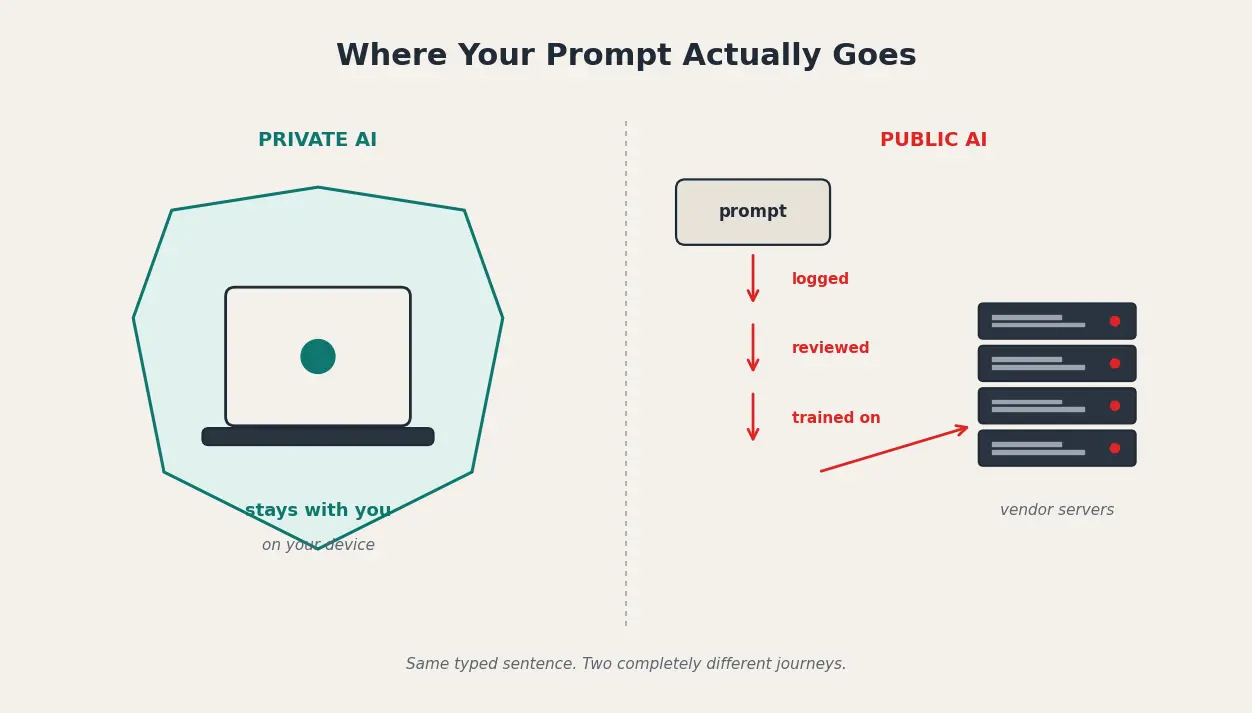
Private AI means the AI model processes your data in an environment only you control, on your own device, inside your company network, or through a vendor contractually blocked from training on your prompts. The defining test is simple. Can anyone other than you see, log, or train on what you type.
Private AI, in one sentence
Private AI is any AI tool where the prompt, the files, and the answers stay inside a boundary you control, so no third party can see, log, or train on what you type.
The term has three competing uses. Enterprise vendors use “private AI” to mean an infrastructure pattern: private cloud, on-premises GPUs, dedicated tenancy. ML teams use it to mean a proprietary model fine-tuned on company data inside a secure environment. Policy people use it to mean a privacy-first lifecycle covering training, inference, retention, and deletion.
All three collapse into one test. If a third party can see your prompt, log it, review it, or feed it back into training data, your AI is not private. Public AI is the default for every consumer chatbot shipped today. Data privacy is effectively a setting on your tool, and most professionals do not know which setting theirs is on. The honest framing is private AI vs public AI, and almost every tool you already use sits on the public side of that line.
Private AI runs on a spectrum from consumer chatbots that train on your chats by default to local large language models (LLMs) that never touch a network. Your job is to place your current tool honestly on that line.
- Infrastructure lens: private cloud, on-premises, dedicated GPUs (the enterprise vendor meaning).
- Model lens: proprietary models fine-tuned inside an isolated tenant environment.
- Lifecycle lens: a privacy-first pipeline covering training, inference, retention, and deletion.
- Reader test: can anyone else see, log, or train on what you type, yes or no.
What Actually Happens to Your Prompt After You Hit Send
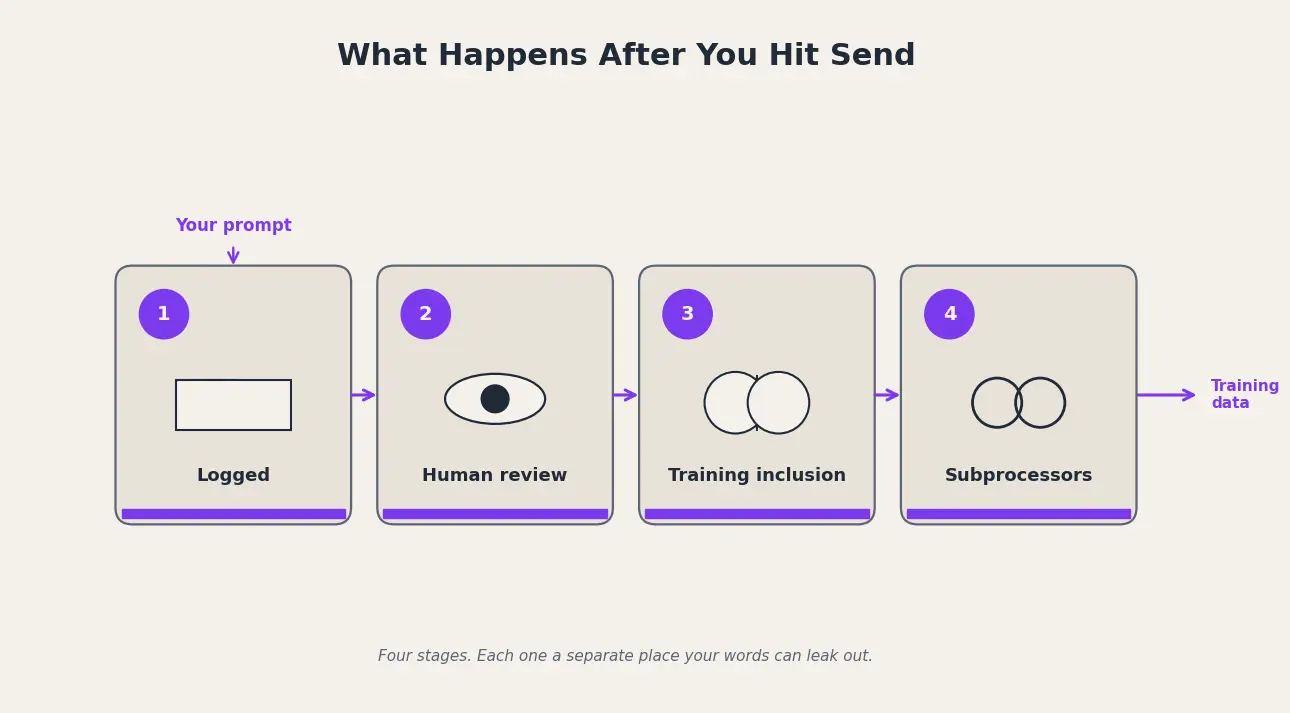
A prompt to public AI does not travel in a private channel between you and the model. It passes through four stages. One, it is logged. Two, a sample gets human review. Three, it may become training data. Four, vendor subprocessors may touch it for storage, analytics, or moderation.
The policy language is not subtle. Per OpenAI's consumer privacy policy, “We collect Personal Data that you provide in the input to our Services, including your prompts and other content you upload.” The same policy adds OpenAI “may use Content you provide us to improve our Services, for example to train the models that power ChatGPT.” That is the generative AI data cycle in the vendor's own words. For a deeper breakdown of what this means when you paste a client document, see is ChatGPT safe for confidential documents.
Google is more direct. Per the Gemini Apps Privacy Hub, “human reviewers read, annotate, and process your Gemini Apps conversations.” The same page tells users not to enter confidential information. Default retention is 18 months tied to your Google Account. Consumer Copilot on a personal Microsoft account trains on conversations by default, opt-out available, per the Microsoft Privacy Statement.
Per Cyberhaven's Q2 2024 report, 27.4% of corporate data employees paste into AI tools qualifies as sensitive data, up from 10.7% a year earlier. Most of that volume flows through tools that reserve the right to train on it.
- Per OpenAI policy: every prompt and file counts as “Personal Data” used “to improve our Services.”
- Per Gemini Privacy Hub: “human reviewers read, annotate, and process your Gemini Apps conversations.”
- Per Gemini Privacy Hub: default retention is 18 months, tied to your Google Account.
- Per Microsoft Privacy Statement: consumer Copilot on a personal account trains by default (opt-out available).
- Per Cyberhaven Q2 2024: 27.4% of data workers' AI paste-ins are sensitive, up from 10.7%.
Five Documented Incidents That Prove the Risk Is Real
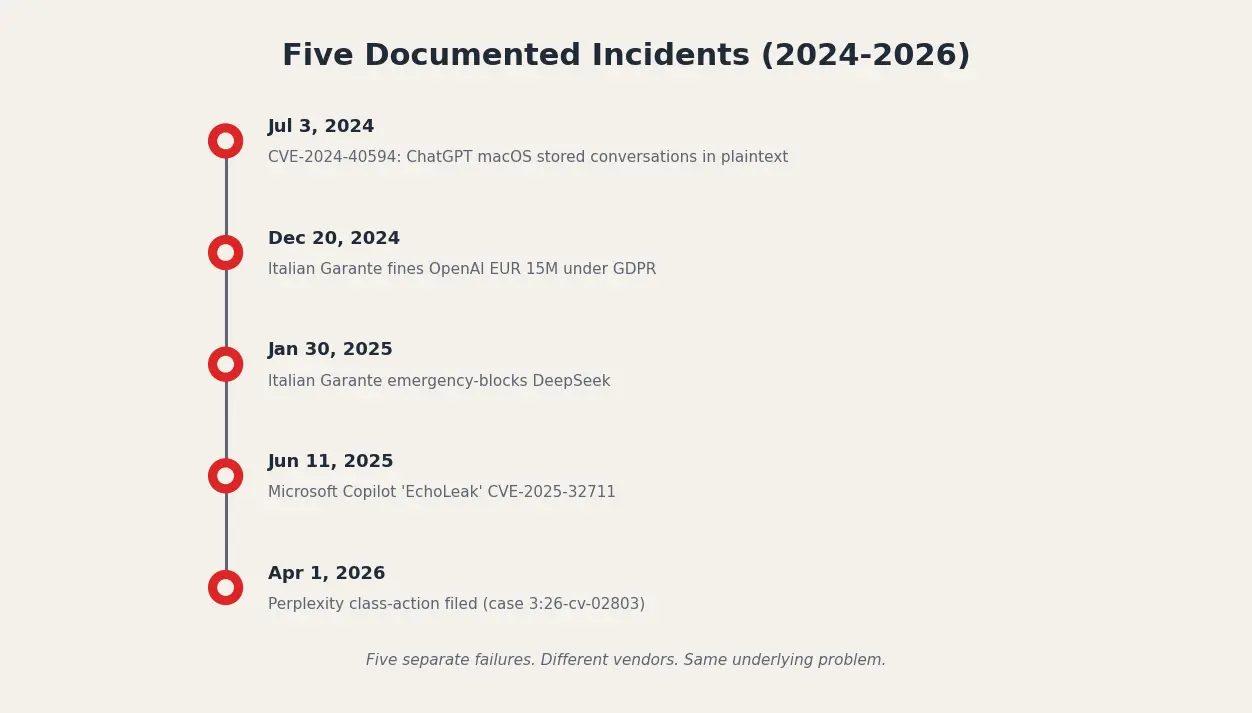
Regulators, CVE databases, and federal court dockets have spent fifteen months turning the flow above into evidence. Per IBM's 2024 Cost of a Data Breach Report, the global average data breach now costs $4.88 million. Healthcare breaches average $9.77 million. Per Stanford HAI's 2025 AI Index, 233 AI-related incidents were logged in 2024, a 56.4% jump over 2023. Here are five dated incidents, in order.
- Italian Garante fines OpenAI EUR 15M on December 20, 2024 for training ChatGPT “without having an adequate legal basis,” per Euronews.
- Italian Garante emergency-blocks DeepSeek on January 30, 2025 after disclosure on Chinese server location was deemed “entirely insufficient,” per Security Affairs and The Record.
- CVE-2024-40594, disclosed July 3, 2024 per 9to5Mac: the ChatGPT macOS app stored every conversation in plaintext outside the sandbox, readable by any other process.
- Microsoft 365 Copilot “EchoLeak,” CVE-2025-32711, disclosed June 2025 per Dark Reading: a zero-click prompt injection silently exfiltrated SharePoint and Outlook data through markdown image URLs.
- Perplexity class-action filed April 1, 2026 per Bloomberg, case 3:26-cv-02803, alleging trackers routed user chats to Meta and Google ad networks before the vendor itself processed them.
Three are privacy failures at the product or policy layer. Two are technical vulnerabilities, one patched in the client, one patched server-side. All five are public record. Data breaches tied to generative AI have stopped being “if” and become “when,” which is the regulatory compliance picture IBM's breach economics price in.
Per the Italian Garante's December 2024 decision, OpenAI was also ordered to run a six-month public awareness campaign in Italian media on top of the EUR 15M fine. The EU AI Act's general-purpose AI obligations became applicable August 2, 2025, with enforcement powers activating August 2, 2026.
The Private AI Spectrum: Where Your Current Tool Really Sits
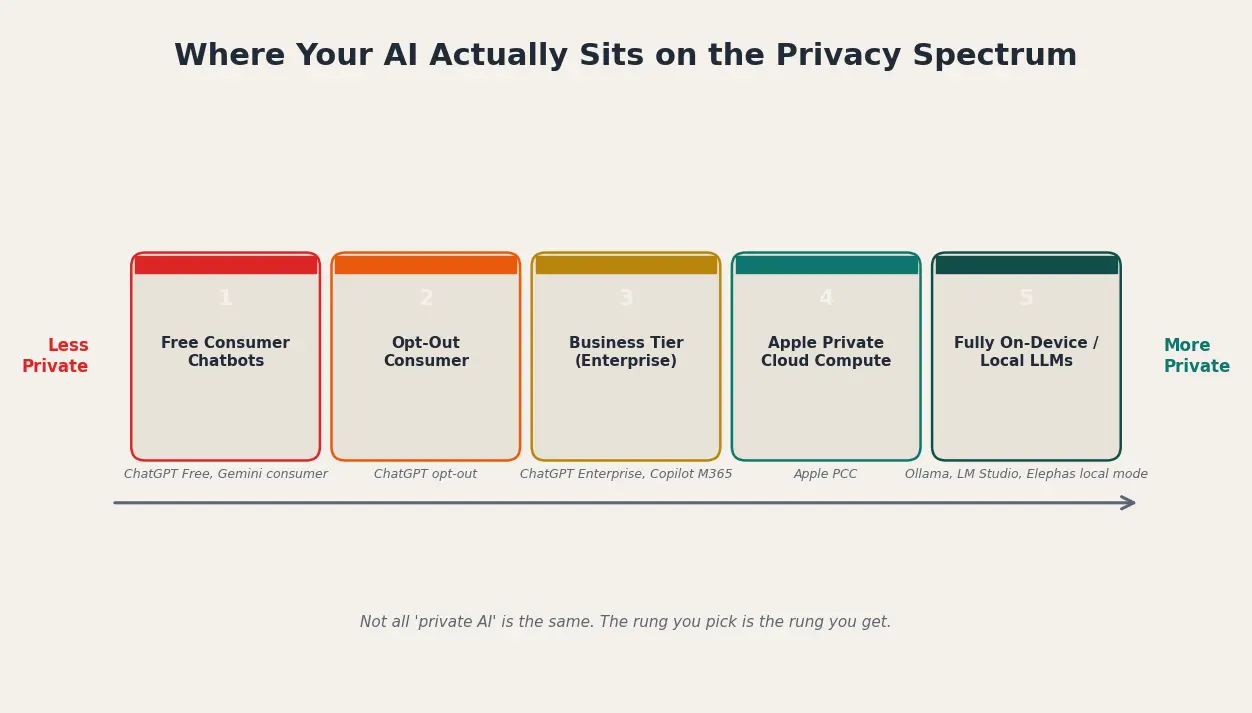
Private AI is not a binary switch. It sits on a ladder of five rungs, and every mainstream AI tool lives somewhere honest on that line.
Rung one is consumer chatbots. ChatGPT Free and Plus, Gemini consumer, Meta AI, and consumer Copilot sit here. Training is the default, human review is possible, retention is long. Rung two is consumer with the training opt-out toggled. Logs are still kept, and per OpenAI's enterprise privacy docs, “API inputs and outputs may be retained for up to 30 days for abuse and misuse monitoring.” No training does not mean no storage.
Rung three is the business tiers. ChatGPT Enterprise and Team, Microsoft 365 Copilot with a work login, and Gemini for Workspace contractually exclude training on tenant data. Per OpenAI, “We do not train our models on inputs and outputs through our API, ChatGPT Team, ChatGPT Enterprise, or ChatGPT Edu.” Your prompt still leaves your device and still lives in the vendor cloud under the vendor's data encryption and data security controls.
Rung four is architecturally private cloud. Apple Private Cloud Compute is the reference implementation. Per Apple Security Research, PCC “isn't accessible to anyone other than the user, not even to Apple.” Rung five is fully on-device, or on-prem in the enterprise sense. Ollama, LM Studio, and Mac-native local LLMs never put your prompt on a network. This is the only rung that passes the reader test without a contract.
- Rung 1, ChatGPT Free/Plus, Gemini consumer, Meta AI: training on by default, human review possible.
- Rung 2, ChatGPT with training opt-out: no training, but logs kept up to 30 days on the API.
- Rung 3, ChatGPT Enterprise, Copilot for M365, Gemini for Workspace: contractual no-training, tenant data processed in vendor cloud.
- Rung 4, Apple Private Cloud Compute: hardware-attested, cryptographically inaccessible even to Apple engineers.
- Rung 5, fully on-device local AI models (Ollama, LM Studio, Mac-native local LLMs): nothing leaves the device.
How to Tell If Your AI Is Actually Private (7-Point Checklist)
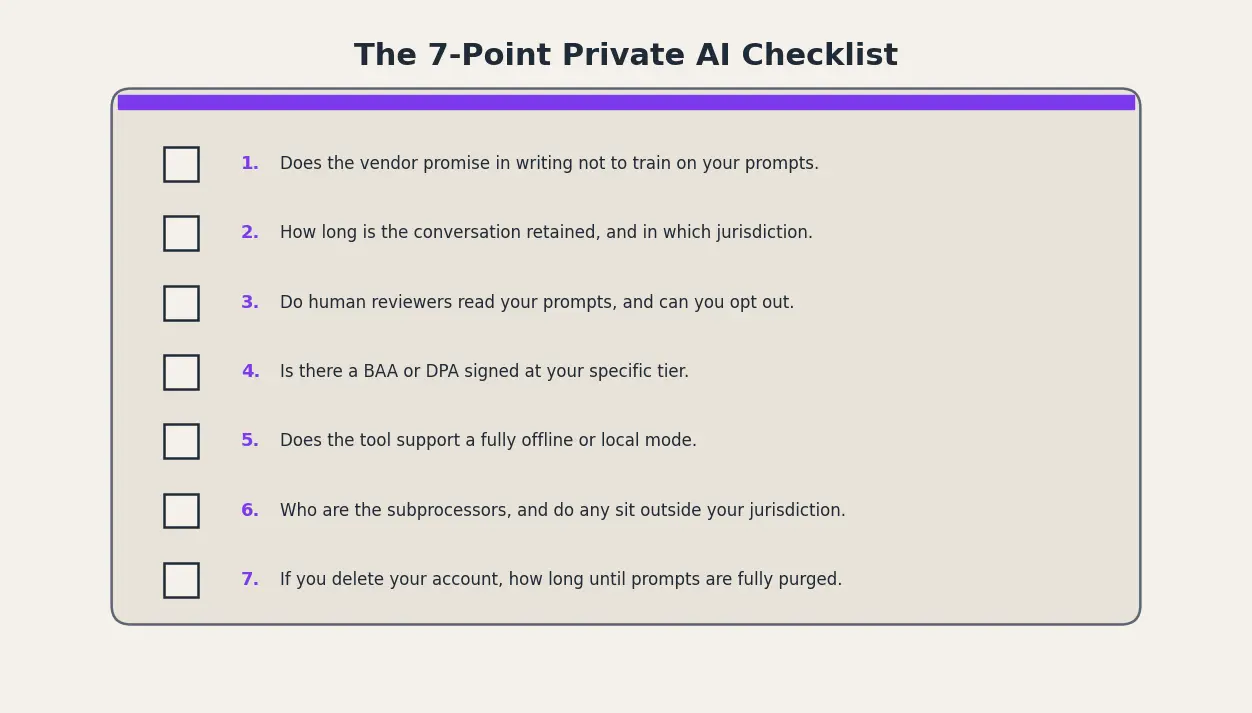
Here are seven yes-or-no questions you can answer in under five minutes about any AI tool you already use. Pull up the vendor's privacy page in one tab and walk the list. A “no” on questions 1, 2, or 4 means the tool is not private enough for client work.
Each question anchors to a specific policy clause or technical control you can verify, not a marketing claim. Use the checklist on every AI tool your team touches, including the ones bundled into existing productivity software.
- Does the vendor promise in writing not to train its AI models on your prompts at your tier.
- How long is the conversation retained, and under whose jurisdiction does the server sit.
- Do human reviewers read your prompts for quality, safety, or abuse monitoring, and can you opt out.
- Is there a Business Associate Agreement or DPA signed at your tier, not just the enterprise SKU.
- Does the tool support a local or fully offline mode where nothing leaves the device.
- Who are the subprocessors, and do any sit outside your regulatory compliance jurisdiction.
- If you delete your account today, how long until your prompts are purged from training pipelines, model checkpoints, embedding stores, and backups.
Question seven is the one most policies bury. Many vendors cannot answer it in one sentence. The ones that can are the ones worth trusting with proprietary data. Most mainstream consumer AI tools fail at least two of the first five questions. That is the honest design of public AI, and it is why the next section matters for anyone who has to put data control first.
A Private AI Built for Professionals: How Elephas Answers the Checklist
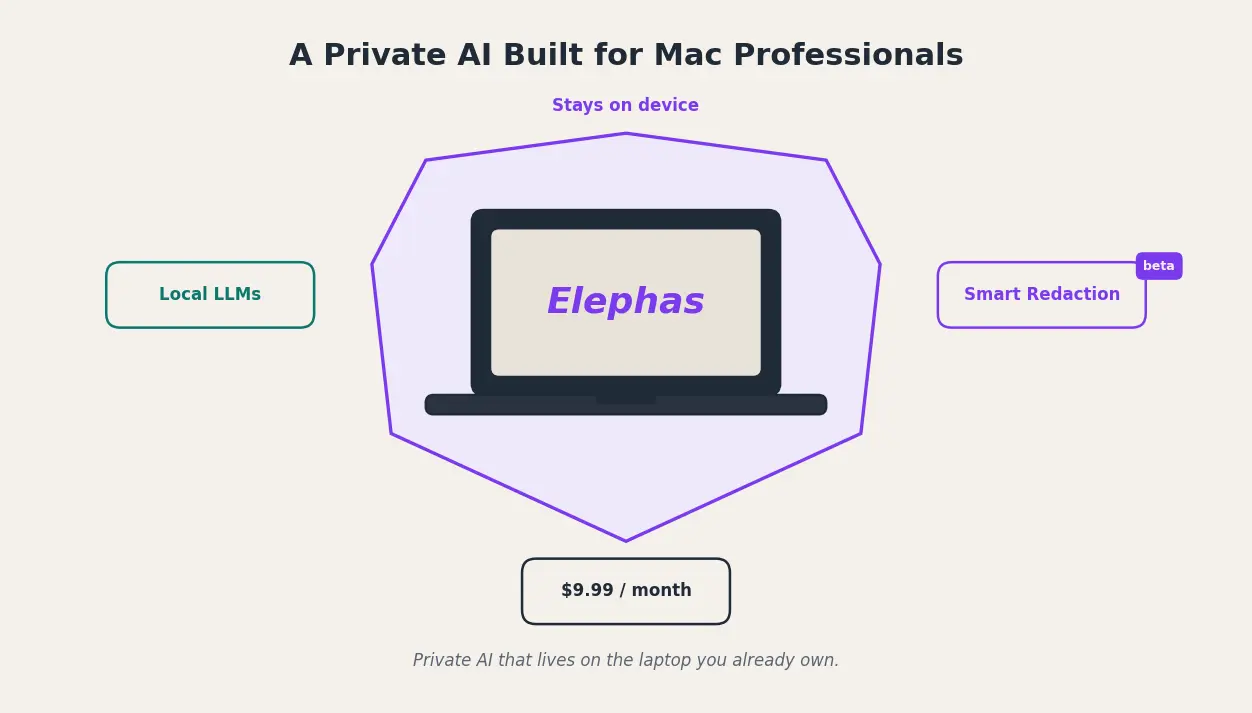
Elephas is a private AI assistant built for Mac, for professionals who cannot paste client data into consumer chatbots. It is an app one person can install this afternoon, and it passes the first five checklist questions by design.
Three features do the work. First, Elephas can run fully offline on Mac with local LLMs (Llama, Mistral, and other quantized AI models), so your prompt, your files, and your answers never touch a network in on-device mode.
Second, files stay on the Mac in local storage by default, with optional encrypted iCloud sync. You can fine-tune which model handles what, from OpenAI and Claude to fully offline models. Third, Smart Redaction (beta) masks personal details and privileged terms before any prompt reaches a cloud model. No training on your data, no human reviewers, no subprocessors reading your documents. Elephas starts at $19/month.
- Runs fully offline on Mac with local LLMs, zero cloud calls in on-device mode.
- Smart Redaction (beta) masks PII before any prompt reaches a cloud AI.
- Files stay on the Mac in local storage by default, with optional encrypted iCloud sync.
- Starts at $19/month.
Your Next Step Toward a Private AI Workflow
Public AI is not private AI by default, and the last fifteen months of court filings and CVEs say the gap is widening. The fix is to know where your tool sits on the spectrum and pick the rung that matches the data you handle.
Open the privacy page of your current AI tool and answer questions 1, 2, and 4 from the checklist. If any answer is no, pilot a local-mode private AI on a non-sensitive document before you move client files onto it. Five minutes of due diligence today is cheaper than a EUR 15M fine, a class action, or a patched CVE.