Trump Signs AI Executive Order Giving Government Early Access to Frontier Models
On June 2, 2026, President Trump signed an executive order titled “Promoting Advanced Artificial Intelligence Innovation and Security.” It gives the federal government up to 30 days of early access to the most powerful AI models, sets new cybersecurity deadlines across federal agencies, and directs prosecutors to go after AI-enabled hacking.
The order frames itself as deregulatory and “America First,” yet it builds a detailed new pipeline for how the government engages with frontier AI developers. Here is what it actually sets up and what critics are already saying.
30 days
Government early access to frontier models
60 days
Deadline for the frontier-model framework
90 → 30
Days the access window was cut from
1,200+
State AI bills introduced in 2025
Executive Summary
- The order signed June 2, 2026 creates a voluntary framework that gives the federal government up to 30 days of early access to “covered frontier models” before developers release them to hand-picked “trusted partners.”
- A classified NSA benchmarking process, not a published rule, decides which models qualify as covered frontier models.
- Federal agencies face 30- and 60-day cybersecurity deadlines, and Treasury will form an AI cybersecurity clearinghouse to coordinate vulnerability scanning.
- Section 4 directs the Attorney General to prioritize criminal enforcement against anyone using AI to illegally access computers, including AI agents.
- The order explicitly disclaims any mandatory licensing requirement, and critics already call the framework “at best, half-built.”
Why This Order Is Bigger Than the Headlines Suggest
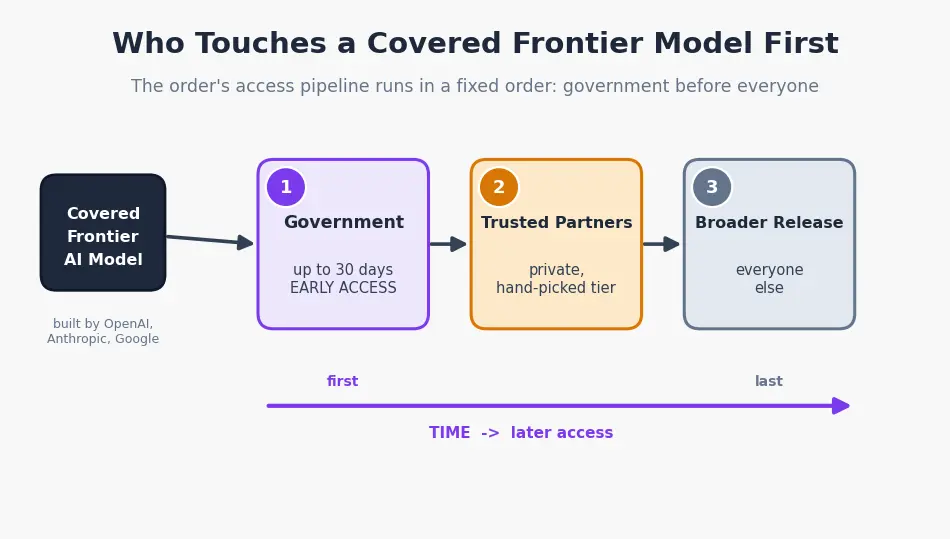
Some coverage filed this under Trump's deregulatory streak, while other outlets called it a step toward federal oversight. The detail that matters either way is the access pipeline it builds. The White House signed an order on June 2 that lets developers hand the government up to 30 days with a covered frontier model before anyone else gets it.
That ordering is the part the headlines skipped. The sequence runs government first, then a private “trusted partners” tier, then broader release. The government becomes the first outside party to touch these models, ahead of even hand-picked private partners.
- The 30-day window was cut down from an earlier 90-day proposal that tech companies and some Trump advisers said ran too long.
- Reporting names the labs in scope by example: OpenAI, Anthropic, and Google.
- The framework is voluntary, so companies can decline and still ship their most powerful models.
- A Treasury-led AI cybersecurity clearinghouse will coordinate vulnerability scanning across agencies and critical infrastructure.
The order describes the government's side of that exchange in unusual detail, from who gets access to how vulnerabilities get shared. It leans on collaboration with industry rather than mandates, which is the throughline of the administration's wider AI agenda.
What the Order Actually Sets Up, in Plain Terms
A few moving parts need naming first. A “covered frontier model” is one whose advanced cyber capabilities cross a threshold the government sets. That threshold comes from a classified NSA benchmarking process, shared with developers only “as appropriate.” That single line decides who falls under the regime.
PBS reported this is a voluntary review, not a mandate, and the order disclaims any mandatory licensing requirement. It binds federal agencies internally and asks labs to opt in. The 30-day government access window recurs per model rather than being a one-time event.
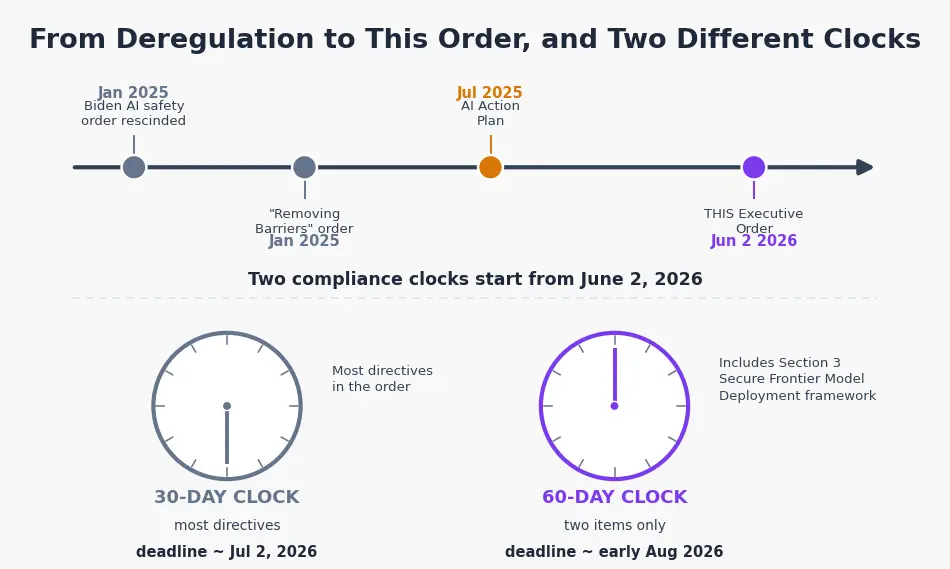
- Two different clocks exist. Most directives carry a 30-day deadline, around July 2, 2026, while two items run on a 60-day deadline into early August 2026, including the Section 3 Secure Frontier Model Deployment framework.
- The NSA Director alone makes the “covered” designation; the National Cyber Director, CISA, and Department of War representatives advise but cannot veto it.
- The order creates no enforceable right, so no member of the public can sue to enforce it.
- It is funding-contingent, with no sunset date and no requirement to report to Congress.
This order sits on a fast-moving deregulatory arc. Trump rescinded Biden's 2023 AI safety order in January 2025, issued the “Removing Barriers” order, then released the July 2025 AI Action Plan. The June 2026 order is the next step, landing against a patchwork of more than 1,200 state AI bills introduced in 2025.
Why Critics Call the Framework Half-Built
The order is detailed about the government and developer side, but several experts say the framework is thin where it counts. It names five “protections” for the access window, confidentiality, cybersecurity, insider-risk, intellectual property, and NDA, without defining or scoping any of them.
Transparency in the industry is moving the other way. Stanford's Foundation Model Transparency Index, a transparency index of what AI developers disclose, hit a multi-year low. Its average score fell from 58 out of 100 in 2024 to about 41 in 2025. That decline lands as the order makes its scope criteria classified.
- The five named protections appear in the text but are never defined, which critics say makes them hard to enforce.
- The order rests on restricted pre-release access tiers, a design whose most recent real-world test failed when Anthropic's “Mythos Preview” reached a group it was never sent to.
- Section 4 pulls autonomous AI agents into the computer-crime frame under 18 U.S.C. 1028, 1030, and 1343, one of the first federal instruments to name agents this way.
- Cato Institute adjunct fellow Kevin Frazier calls the framework “at best, half-built.”
Supporters counter that a voluntary, collaboration-first approach avoids the heavy regulation the administration campaigned against, and that classified benchmarking keeps adversaries from gaming the threshold. Whether the framework stays voluntary is the open question.
What People Are Saying on Reddit
The order drew more than 2,000 upvotes and hundreds of comments on the r/news discussion thread. These are individual opinions, not verified claims, and the upvote counts show how much each reaction resonated with other readers. Two themes dominated: doubt that a voluntary order changes anything, and suspicion about why the government wants a head start.
“I assume this is insider-trading related?”
u/Hrekires · 2.1K upvotes
“So the government is forcing the free market and industry to hand over property to them. If you add on the government getting ownership into certain companies like what happened last year it seems like there isn't really a free market.”
u/kstargate-425 · 333 upvotes
“An execute order ‘asking’? Sounds like an unenforceable EO.” [sic]
u/hashswag00 · 314 upvotes
“I can't imagine many companies being cool with shelling over their in-development product to The Government on a whim, even if it is on a ‘voluntary basis.’ I doubt this one is going to have any tangible result in one direction or the other.”
u/Oseirus · 31 upvotes
“Just to be clear, this is about access to the models so they can use and test them. Doesn't seem to involve the model weights or code.”
u/saltymuffaca · 5 upvotes
“Nothing in this section shall be construed to authorize the creation of a mandatory governmental licensing, preclearance, or permitting requirement... It then asks for access to those models up to 30 days before the companies plan to release them more broadly, and enables the government to help select the ‘trusted partners’ that will receive early access.”
“It's voluntary. Biden's 2023 order used the Defense Production Act to make reporting mandatory. This one explicitly says labs can opt in or out with no penalties. An earlier draft had a 90-day review window... lobbied down to 30 days. The NSA has 60 days to build a classified benchmark defining which models count as ‘frontier.’ The three labs this targets (Anthropic, OpenAI, Google) say they'll cooperate. Whether that holds when the benchmark drops is a different question.”
“Biden admin had instituted a very similar policy that Trump tore up... in a sane world I actually want this oversight on frontier AI models... security mapping model capabilities for cybersecurity protection IMO is a good thing.”
What to Watch Next
A few things are worth tracking. Watch the July and August 2026 agency deadlines, whether the voluntary framework drifts toward mandatory through government procurement, and whether the classified threshold ever gets a public methodology. Each one changes how far the order actually reaches.
The order is the clearest sign yet of how this administration plans to handle frontier AI: fast, industry-led, and security-first. How much of it holds will depend on whether the major labs opt in, and whether Congress or the courts weigh in on a framework built entirely by executive action.