ToqanClaw Brings Private AI to 5 Million Businesses. Here Is the Private AI Assistant for Your Mac.
Prosus launched ToqanClaw, a private AI for 5M businesses. Here is how Elephas gives Mac and iOS users the same private AI assistant, today.
By the numbers
- 5M+ businesses: the restaurants, merchants, and entrepreneurs ToqanClaw is rolling out to.
- 6M+ people: already using Zapia, the consumer assistant Prosus shipped alongside it.
- 20+ AI models: ToqanClaw routes across them to pick the best result for each task.
- $0.40: what it costs to process a 1,700-page PDF in Elephas on your own Mac.
What Happened
- On 23 June 2026, Prosus launched ToqanClaw, a private AI platform built on Toqan, the system it has run internally for its own staff.
- It routes requests across more than twenty models, keeps your data under your control, and never uses it to train third-party models.
- Prosus shipped a consumer assistant called Zapia alongside it, already used by more than six million people.
- It is positioned as a European, GDPR-friendly answer to general-purpose AI agents like OpenClaw, selling data sovereignty to five million businesses that could never negotiate it for themselves.
- That is the same line of protection one person can hold on a Mac.
- Elephas brings that same private AI to your Mac, iPhone, and iPad, with Smart Redaction on every plan and built-in local LLM models for fully offline work. Plans start at $19/month with a free trial.
Prosus just drew the AI privacy line in public
On 23 June 2026, Prosus launched ToqanClaw, a private AI platform it is rolling out to more than five million restaurants, merchants, and entrepreneurs. The interesting part is not the no-code builder.
It is that Prosus paid, in public, to move five million businesses onto the safe side of a line that already runs through every AI tool you touch. On one side, your data is contractually protected. On the other, it trains models and can be retained by court order.
A private AI assistant on your Mac is how one person crosses that line without an enterprise contract.
What Prosus actually launched
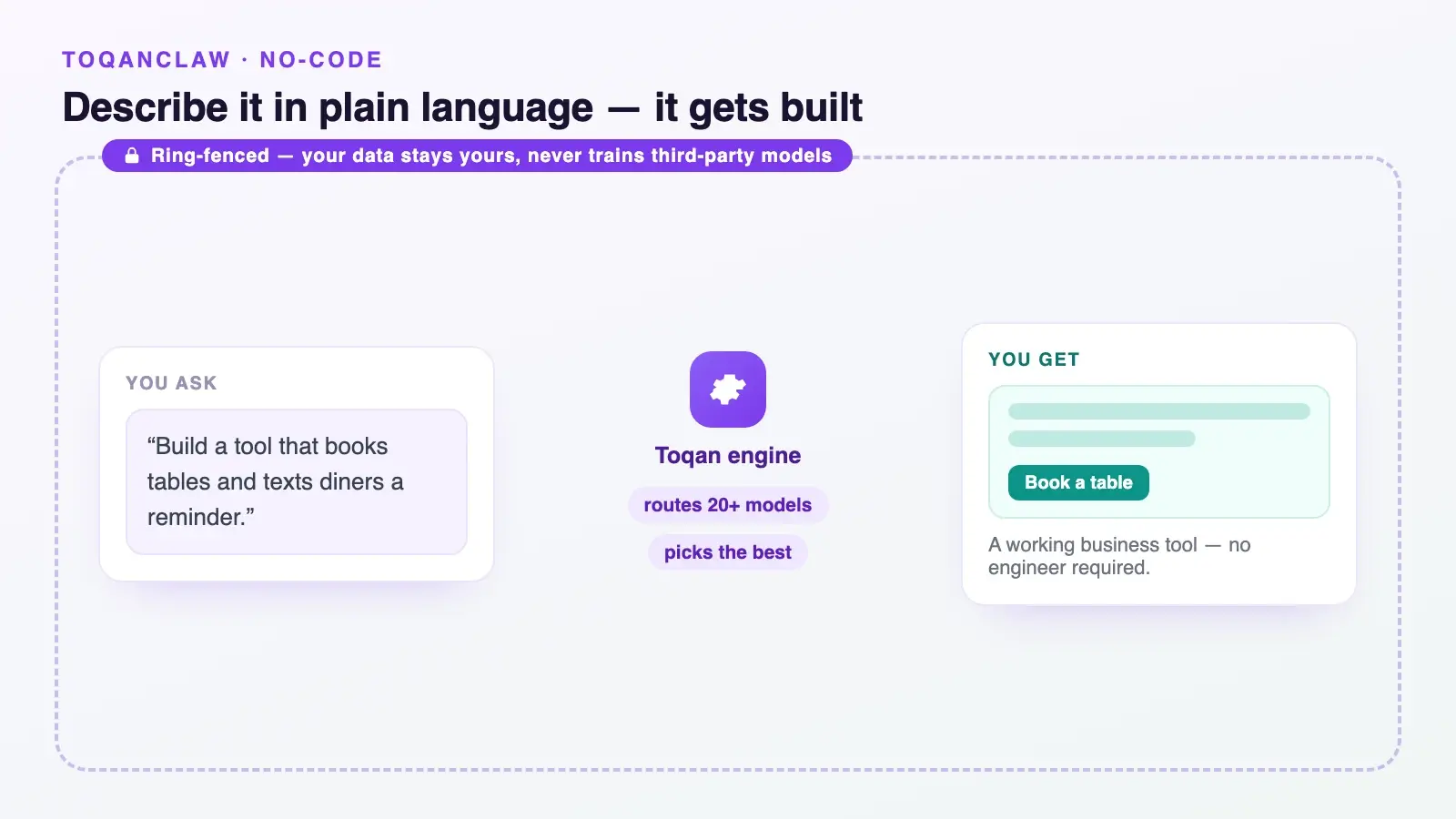
ToqanClaw is built on Toqan, the AI platform Prosus has run internally for its own staff. Coverage of the launch described it plainly: it “brings many of OpenClaw's features into a secure environment, where your data stays under your control and is never used to train third-party models.”
It routes requests across more than twenty models to pick the best result for each task. Prosus shipped a consumer assistant called Zapia alongside it, already used by more than six million people.
Strip away the product detail and the message is about positioning. Positioned as a European, GDPR-friendly answer to general-purpose AI agents like OpenClaw, ToqanClaw sells data sovereignty to people who could never negotiate it for themselves.
- It is a no-code builder for non-technical users: describe what you want in natural language, the way you would tell a colleague, and it gets built.
- The privacy posture is inherited from an in-house platform, not bolted on for the press release.
- The target is the “real economy”: a shop owner, a single-restaurant operator, a solo entrepreneur. That is the same person reading this on a Mac.
You can read the full Prosus announcement for the specifics.
The privacy divide is a contract, not a feature
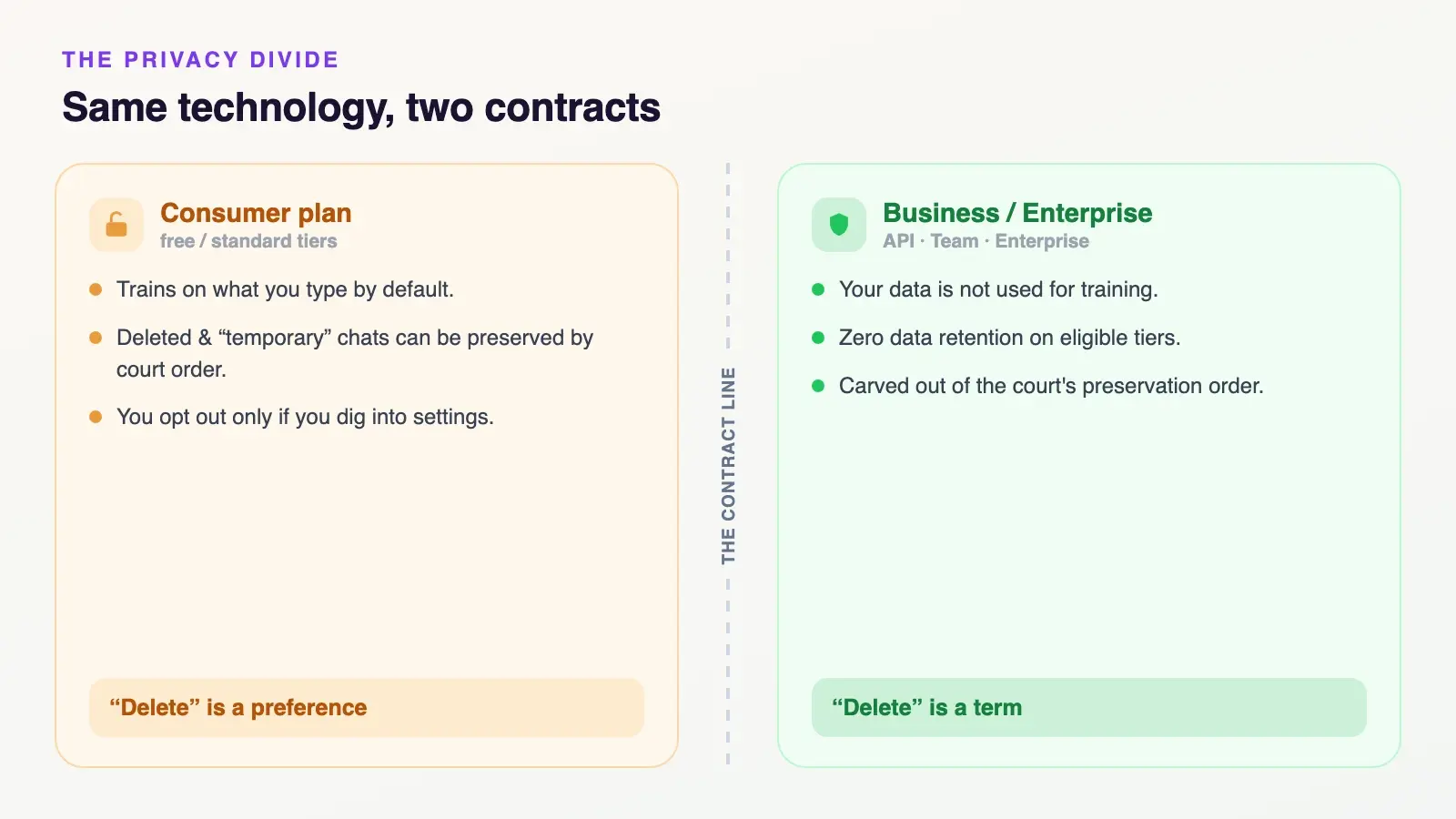
Here is what the ToqanClaw launch quietly admits. The split between AI that respects your data and AI that mines it was never really about technology. It is about which contract you signed.
Consumer AI tools train on what you type by default. On the standard ChatGPT tiers, your chats are used to improve the models unless you dig into settings and opt out.
Business agreements flip that default: data sent through the API, Team, or Enterprise is not used for training, and the strongest tier, zero data retention, is offered only to eligible enterprise customers.
The gap is not theoretical. In May 2025, a court ordered OpenAI to preserve all consumer chat logs in the New York Times case, including chats users had deleted and “temporary” sessions meant to disappear. Enterprise and zero-retention API customers were carved out.
The lesson is blunt: on a consumer plan, “delete” is a preference. On an enterprise contract, it is a term.
For a five-million-merchant network, Prosus closed that gap by building the enterprise side and giving it away. For one person with sensitive documents, buying enterprise infrastructure is not an option. The good news is that you do not need it.
What actually leaks, and what does not
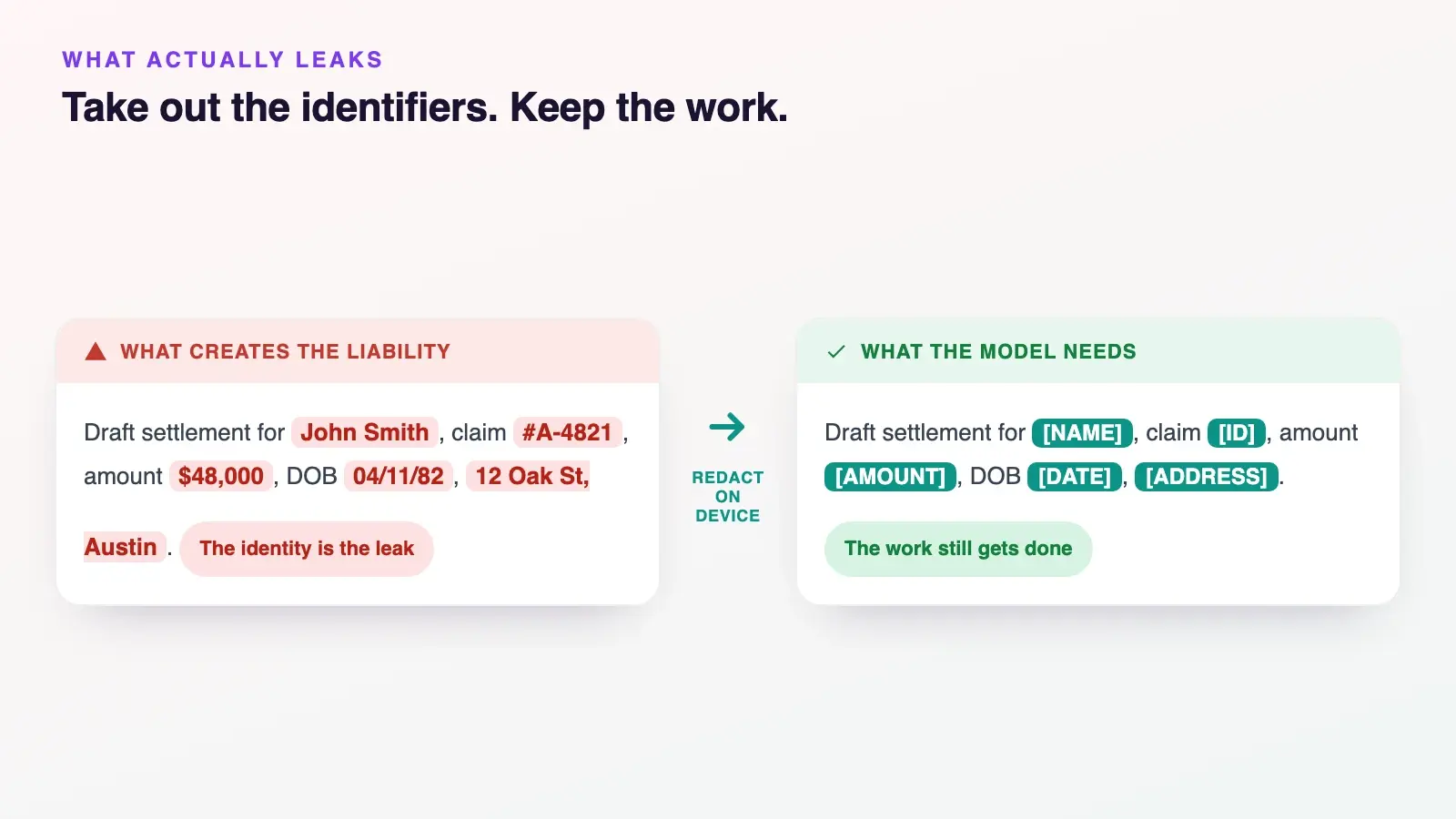
The fear of pasting a sensitive document into AI is usually aimed at the wrong target. The model is not going to steal your argument or your strategy.
The exposure is the identity attached to it: the client's name on the contract, the deal value, the patient's date of birth, the case number, the home address.
That distinction tells you exactly what to remove. Take the identifiers out and what reaches the cloud model is a generic contract, a generic patient summary, a generic deal memo. The work still gets done. The thing that created the liability never left your machine.
It is the same risk in every profession, wearing different clothes:
- A lawyer drafting a brief: the legal reasoning is fine to process; the client name and matter number are not.
- A founder modeling a raise: the formula is generic; the cap table and investor names are the leak.
- A consultant summarizing client research: the framework is reusable; the client and the numbers are confidential.
- A researcher querying unpublished data: the method is shareable; the subject identifiers are not.
This is why “just do not use AI for sensitive work” is the wrong rule. It throws away the whole benefit to avoid a narrow, removable risk.
Elephas: the same posture, without the enterprise contract
Elephas is a privacy friendly AI knowledge assistant for Mac, iPhone, and iPad. It is a private AI workspace a knowledge worker can use for real work, because answers are drawn only from your own documents, so it does not invent citations or facts.
It pairs AI chat and AI search over your own files, the parts of a personal AI assistant that actually touch sensitive data. What it really does is put an individual on the enterprise side of that contract line, by removing what makes data identifiable before any of it is sent.
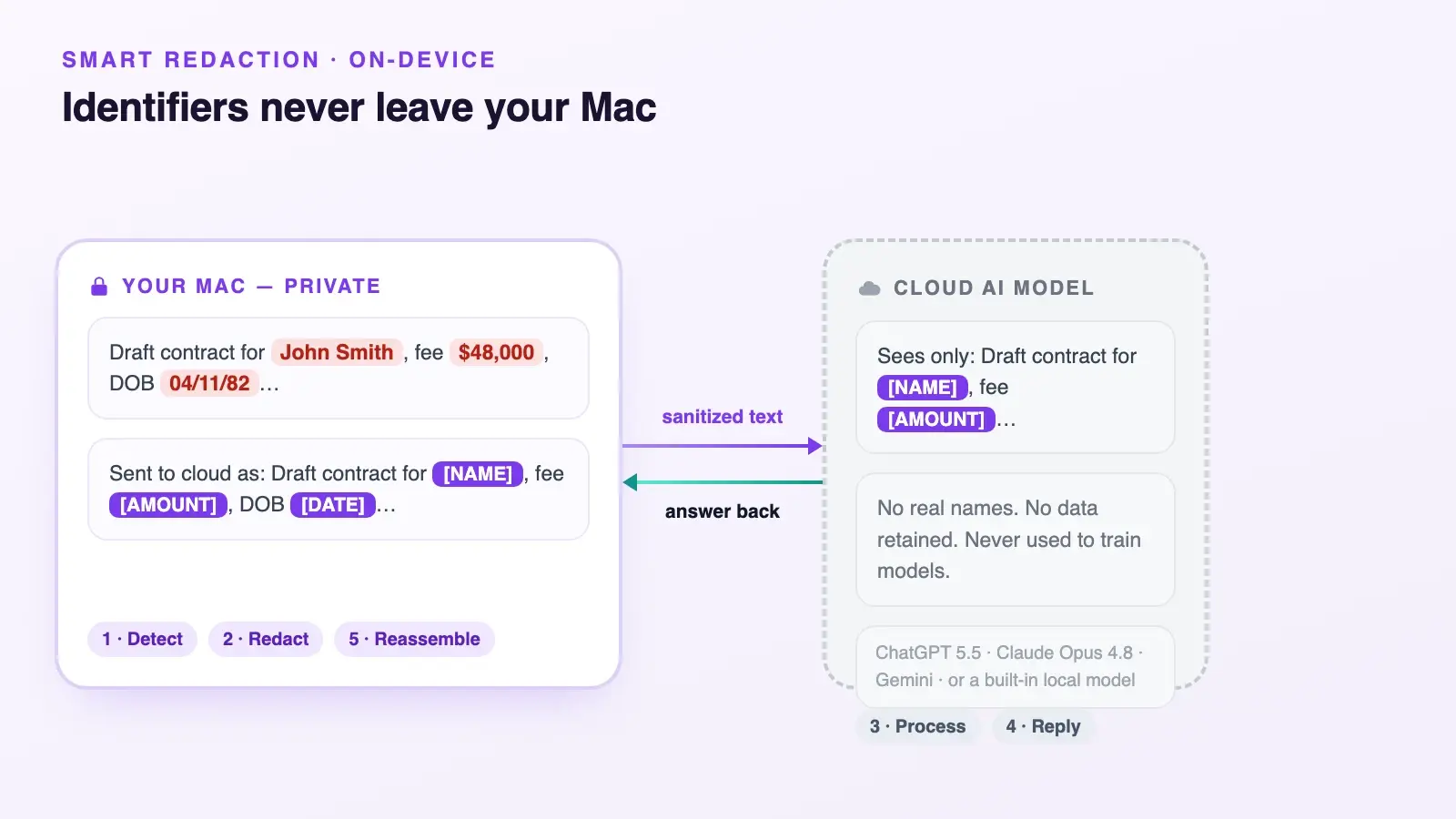
For people who still want a leading cloud model, Elephas adds a second layer through automatic PII redaction. Before a prompt is sent to ChatGPT 5.5, Claude Opus 4.8, Gemini, Grok, Perplexity, or any other cloud model, Elephas strips sensitive names, emails, phone numbers, and identifiers on your Mac.
The cloud model only ever sees the sanitized text. When the answer comes back, the redacted fields are reassembled locally on your machine, so identifiable information never leaves the device.
Elephas pairs this with zero data retention: content never trains AI models, never sits on a vendor's server, and never passes through a third-party reviewer's screen.
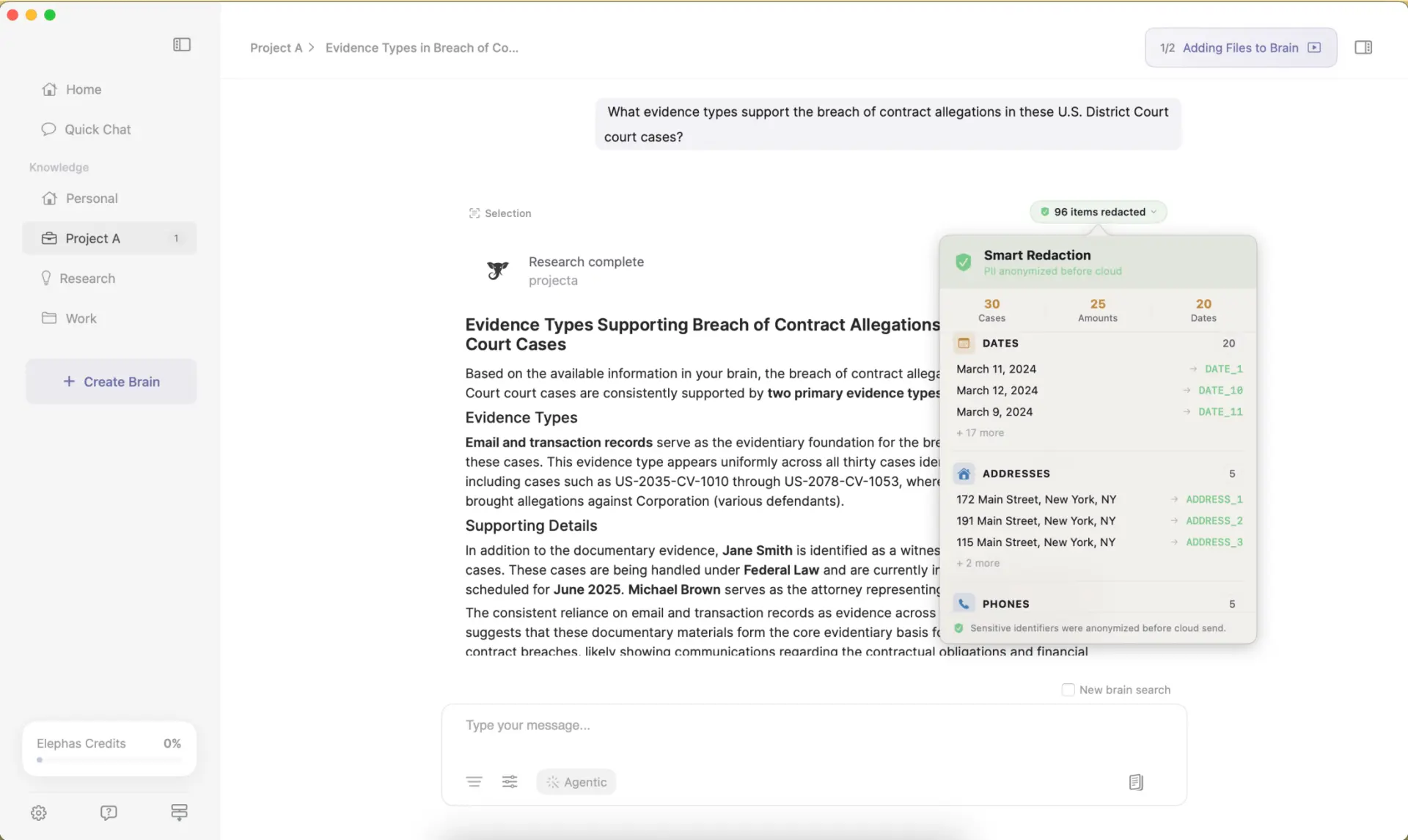
Put simply, sensitive data is automatically detected and redacted before anything reaches a cloud AI model, your content is never used to train AI models, and nothing passes through a third-party reviewer's screen. Smart Redaction is available on every Elephas plan, including the free one.
How Elephas mirrors what enterprises just bought
- Data sovereignty. Like ToqanClaw's ring-fenced setup, your work stays in your control. Files and notes live on your Mac, and Elephas works across the apps you already use through native integration, not on a central server.
- Choose your own model. Bring your own API key from OpenAI or Anthropic, or run a built-in local model. No vendor owns or trains on your work, and there is no lock-in.
- Real document work. Build a Super Brain from your PDFs, notes, and Notion pages, then query it to summarize sources, run deep research, and transcribe recordings, kept in sync across your iPhone and iPad. A 1,700-page PDF processes for about $0.40.
- Everyday productivity. Generate an AI draft, automate repeated steps, and draft and send emails from short hints, right inside your notes app or any Mac window.
- Workflow automation. Turn a repeated task into a saved workflow, so the automation compounds your productivity instead of resetting every Monday.
Where redaction is enough, and where you should stay offline
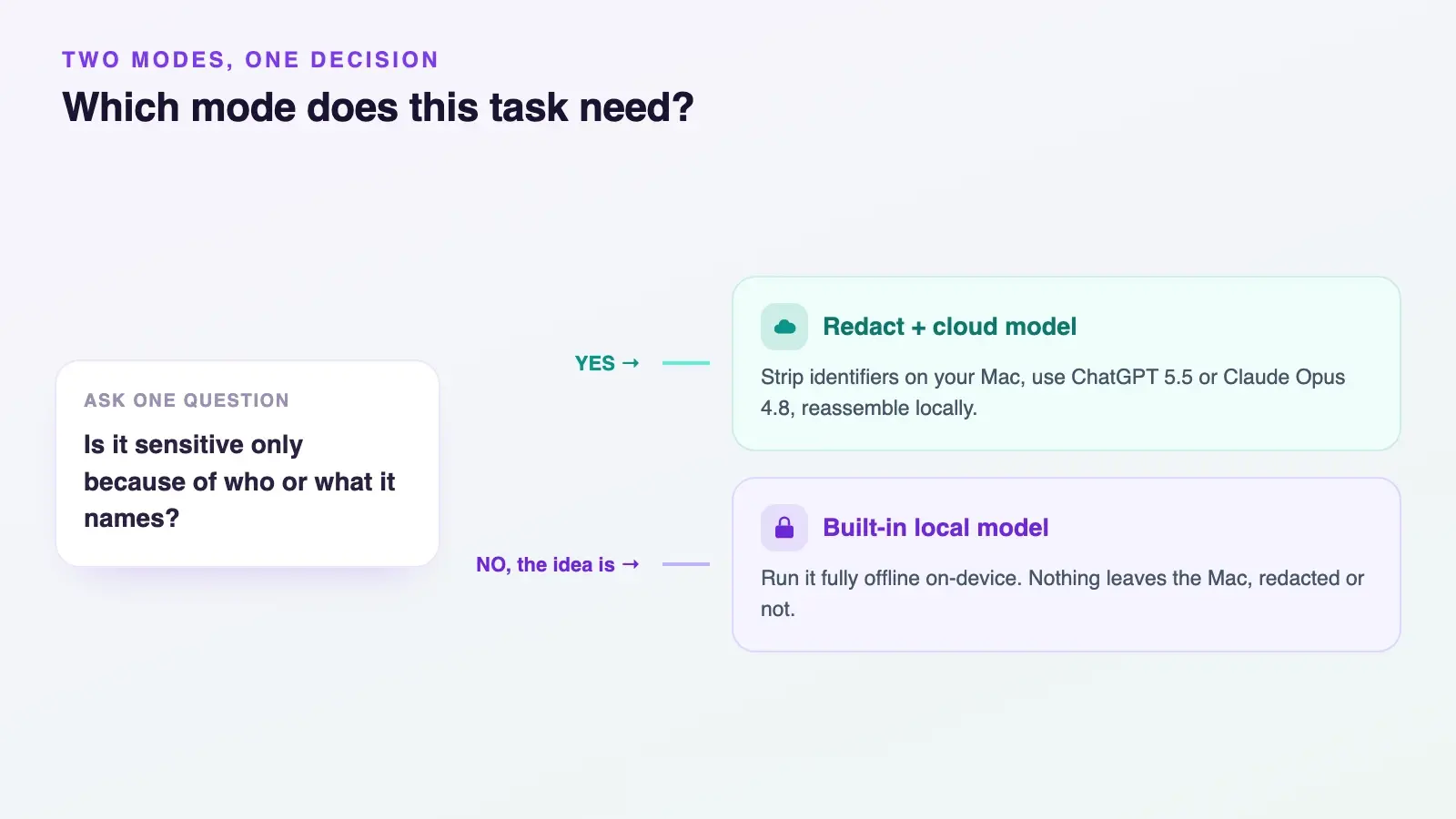
No honest privacy tool should claim one switch covers everything, so here is the line. Redaction is the right tool when a document is sensitive because of who or what it names.
It removes structured identifiers, names, emails, phone numbers, account numbers, before a cloud model ever sees the text, then reassembles them locally in the answer.
Some content is confidential even with every name stripped out. An unreleased product roadmap, a trade-secret process, the intent behind an acquisition: there is nothing to redact, because the idea itself is the secret. For that, sending anything to a third party is the wrong move, redacted or not.
Redaction is enough
When a document is sensitive because of who or what it names.
Use a leading cloud model with redaction before send. Identifiers are stripped on your Mac and reassembled locally in the answer.
Stay fully offline
When the idea itself is the secret: a roadmap, a trade-secret process, an acquisition.
Switch to a built-in local LLM model and run it locally, so nothing leaves the Mac at all.
This is why Elephas runs two ways instead of one. For identity-bearing work, use a leading cloud model with redaction before send. For the rare document that is sensitive without a single identifier, switch to a built-in local LLM model and run it locally, fully offline, so nothing leaves the Mac at all.
Knowing which mode a task needs is the real skill, and a private AI assistant should let you choose rather than decide for you.
How to choose a private AI assistant
Most “best AI personal assistant” lists rank tools on speed, task management, and integrations, and never test the one thing that matters for confidential work. A personal AI for project management is useful, but it is not the same as one you can trust with a contract.
A general-purpose AI assistant optimizes for speed; a private one optimizes for what never leaves your device. Judge a private AI tool on what actually protects you.
- Identity removal before send. Does it strip names, emails, and numbers on your device first, or just promise good intentions?
- A real offline mode. Can it run a model on-device for work that cannot be sent at all?
- Training and retention in writing. Is “we never train on your content” true on every tier, not only the enterprise one?
- Model choice. Can you use ChatGPT 5.5, Claude Opus 4.8, or a local model, with no lock-in?
- Native, not a browser tab. Does it work across your Mac apps, or want everything uploaded first?
ToqanClaw scores well on these because Prosus engineered them in. The point for everyone outside that merchant network is that you can hold the tool on your own machine to the same standard.
Common questions about private AI tools
Is there a private version of ChatGPT for sensitive work documents?
Not from the chat box itself. The practical route is a tool that sits in front of the model. Elephas lets you use ChatGPT 5.5 or Claude Opus 4.8 on your own documents while stripping identifiers before anything is sent, or skip the cloud entirely with a built-in local model.
You keep the quality of the answer and remove the exposure.
Does deleting my ChatGPT history protect my data?
Not reliably. A 2025 court order required even deleted and temporary chats on consumer tiers to be preserved, and those same plans can use your input for training by default. The durable fix is to not send the identifying parts in the first place, which is exactly what redaction before send does.
Do AI tools train on what I paste into them?
Many consumer tiers reserve that right by default, and the policy differs sharply from the business and enterprise contracts most people never see. That asymmetry is the whole story of the ToqanClaw launch. A private AI tool should state, in writing, that your content never trains a model, on every plan.
Get the same private AI on your Mac
Elephas is a privacy friendly AI knowledge assistant for Mac, iPhone, and iPad, with Smart Redaction on every plan and built-in local LLM models for fully offline work. Plans start at $19/month.
Try Elephas for free →