Does Siri Work for the CIA? What Siri Really Does With Your Voice
People keep asking Siri if it works for the CIA, and Siri's deflection, “Who, me?”, never actually settles it. That question has circulated on TikTok, Reddit, and YouTube for almost a decade.
It survives because the fear underneath is real: a device that's always listening, in your pocket, from a company that could be compelled to hand your voice over. Even officers who trust Siri daily joke about it. One r/AskLE commenter joked that “the prosecutor doesn't like it when you say ‘hey siri, play my pursuit playlist’” mid-pursuit, ordinary trust, not a CIA link.
Quick answer
- No, Siri does not work for the CIA.
- The claim traces back to a real 2017 WikiLeaks leak about general iPhone hacking tools, which spread into a viral “ask your assistant” trend. No document from that leak names Siri.
- Apple's real, documented Siri privacy problems are different: a $95 million eavesdropping settlement over accidental recordings, and a separate $250 million settlement over AI features marketed before they existed, neither involving any intelligence agency.
- Simple Siri requests can be handled entirely on your device. Harder ones route to Apple's servers or the newer Private Cloud Compute system, which Apple says is stateless and open to outside security researchers.
- Government access to Siri data is possible through a FISA order, a National Security Letter, or an ordinary warrant, not a CIA partnership, and it can come with a gag order barring Apple from telling you.
- If you're careful about what you say near Siri, apply that same instinct to any AI tool you use for real work.
- Elephas keeps your documents on your Mac and strips sensitive identifiers before any cloud model sees them. It has a free plan and starts at $19/month.
Where the CIA myth actually comes from
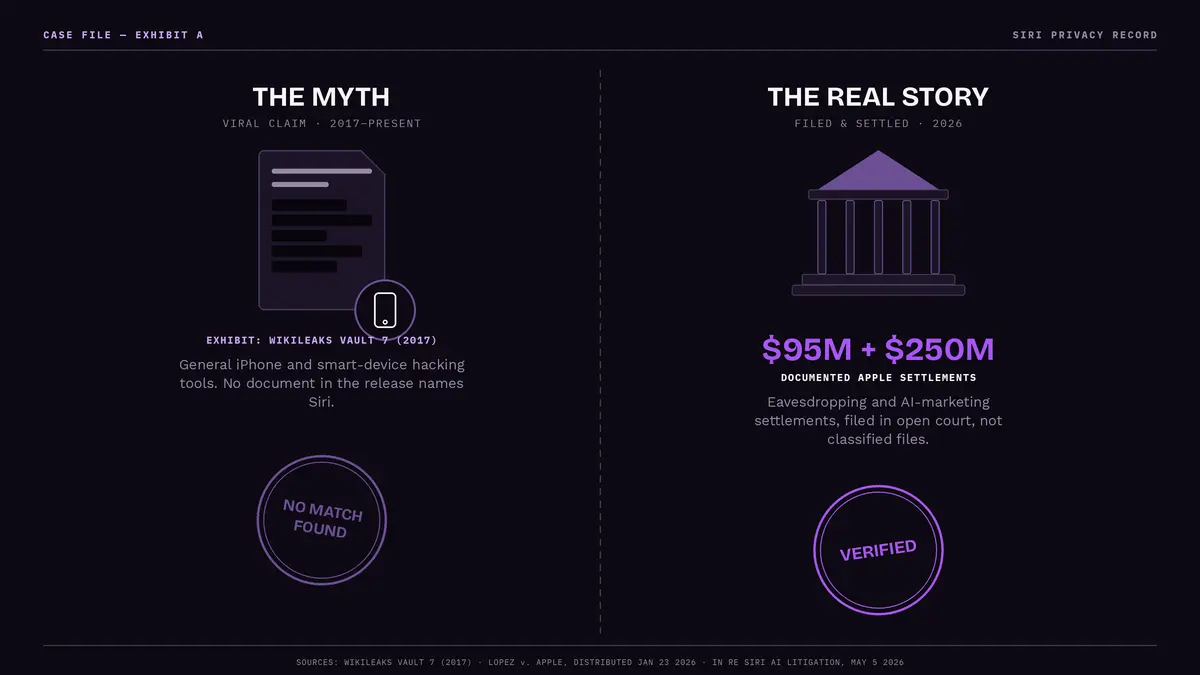
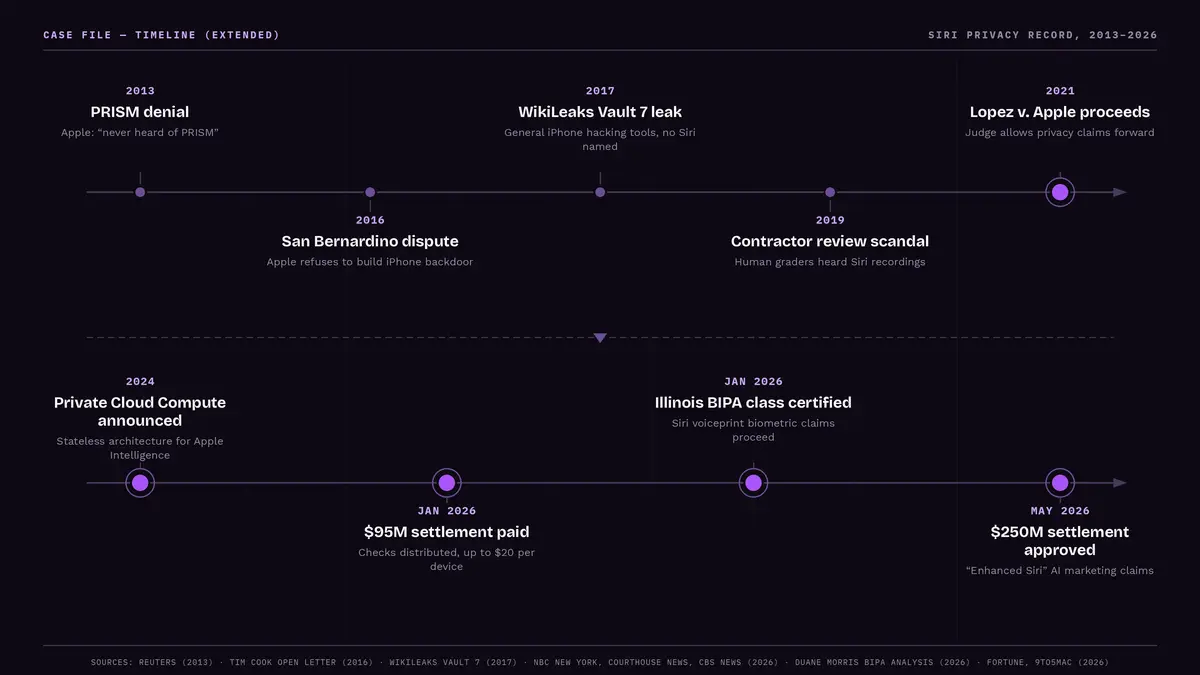
Siri's real government lineage runs through DARPA, not the CIA. It began as SRI International's CALO project, under DARPA's Personalized Assistant that Learns program, spun out in 2007, and Apple acquired it in 2010, before anyone raised a CIA connection.
The narrow root of the CIA myth is a single 2017 WikiLeaks Vault 7 leak, detailing general CIA smartphone hacking tools: iPhone firmware implants, a Samsung TV microphone technique, and similar exploits. No document names Siri or describes any technique for altering its responses.
The leak came from a real prosecution, not internet lore. A DOJ report documented the sentencing: Joshua Schulte, a former CIA engineer, got 40 years in 2024, roughly five-sixths for the Vault 7 theft, the rest unrelated. Nothing in the case mentions Siri.
The conflation happens in real time. On r/AskAnAmerican, one commenter argued “instead of unofficial CIA wire taps we now have Alexa and Siri doing it for them,” folding a decades-old surveillance controversy into a modern assistant.
The PRISM echo
This predates Siri-CIA jokes by four years. When the NSA's PRISM program leaked in June 2013, Apple spokesman Steve Dowling said: “We have never heard of PRISM. We do not provide any government agency with direct access to our servers.” That was about Apple broadly, the same suspicion visible in the earlier r/AskAnAmerican thread cited earlier.
Apple's current privacy notice is more mundane: some Siri speech recognition stays on-device, other requests go to Apple's servers or Private Cloud Compute, and transcripts can be kept under a rotating identifier for up to two years.
That server-side reality already creates legal exposure. In January 2026, an Illinois court certified a class action covering an estimated 3 million Siri voiceprints under the state's biometric privacy law. Gerald L. Maatman Jr. of Duane Morris LLP put it plainly:
Companies of all sizes should view this ruling as a wake-up call regarding the substantial liability that can result from noncompliance with Illinois' biometric privacy laws.
Gerald L. Maatman, Jr., Partner and Class Action Defense Group Chair, Duane Morris LLP (Duane Morris blog, 2026-02-10)
The myth built up in stages, none of them involving the CIA:
- 2007 to 2010: Siri starts as DARPA-funded research, not a CIA project, before Apple buys it.
- 2013: Apple publicly denies giving the NSA's PRISM program direct server access, four years before the CIA-Siri joke exists.
- 2017: A WikiLeaks leak covers general iPhone hacking tools. No document in it names Siri.
- 2024: The leaker, Joshua Schulte, gets 40 years, almost none of it about voice assistants.
- 2026: Apple's real Siri exposure is a certified Illinois biometric-privacy class action, not a spy case.
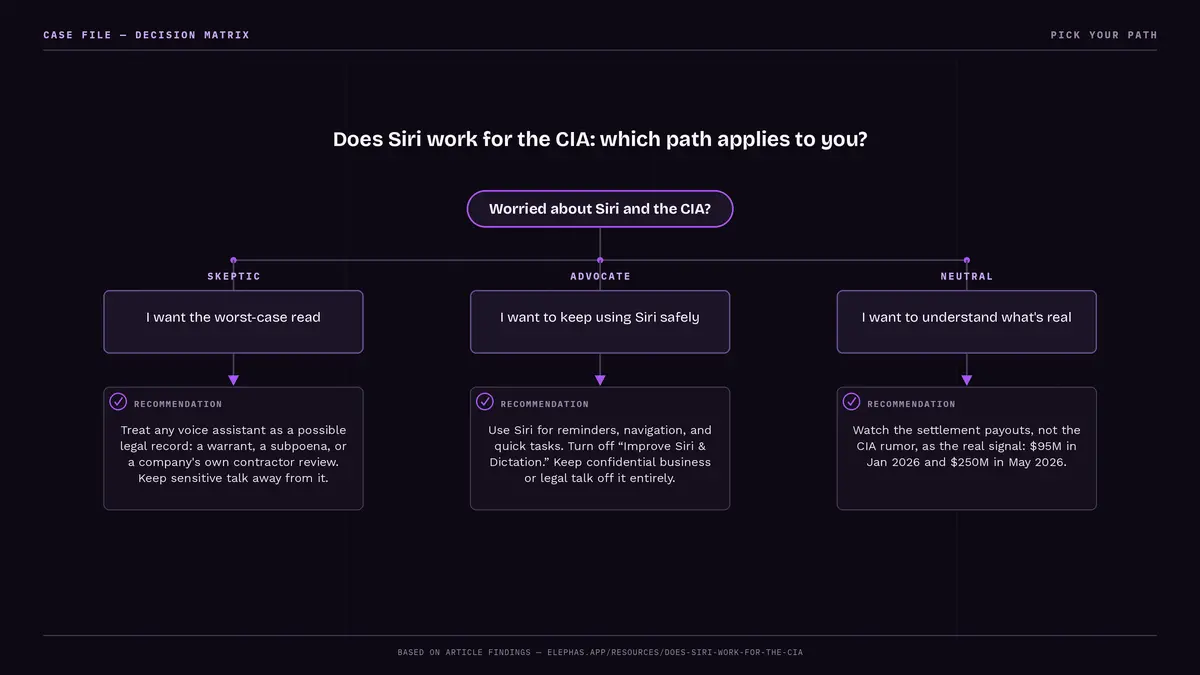
Whether this matters to you depends on which of these you are: worried about the worst case, trying to make this work, or trying to understand the nuance.
How Siri actually works: on-device, servers, and Private Cloud Compute
Before asking where the CIA could get your Siri data, it helps to know where that data actually goes during ordinary use. The path is more specific than “everything is recorded” or “nothing ever leaves your phone.”
Say “Hey Siri,” and a low-power chip listens only for the wake word. That detection happens entirely on the device, and nothing leaves your phone yet. As one r/toronto comment put it, that chip “doesn't process anything, it doesn't send anything anywhere” until the wake word actually triggers it.
Once triggered, your device checks whether it can handle the request on its own, things like setting a timer or opening an app. If the device can answer locally, it does, and the response never touches Apple's servers.
If the request needs more, it goes one of two places. Simpler requests go to standard Apple servers, where a transcript plus some metadata may be kept under a rotating identifier for up to two years. Heavier Apple Intelligence requests route instead to Private Cloud Compute (PCC), Apple's newer, more locked-down cloud system.
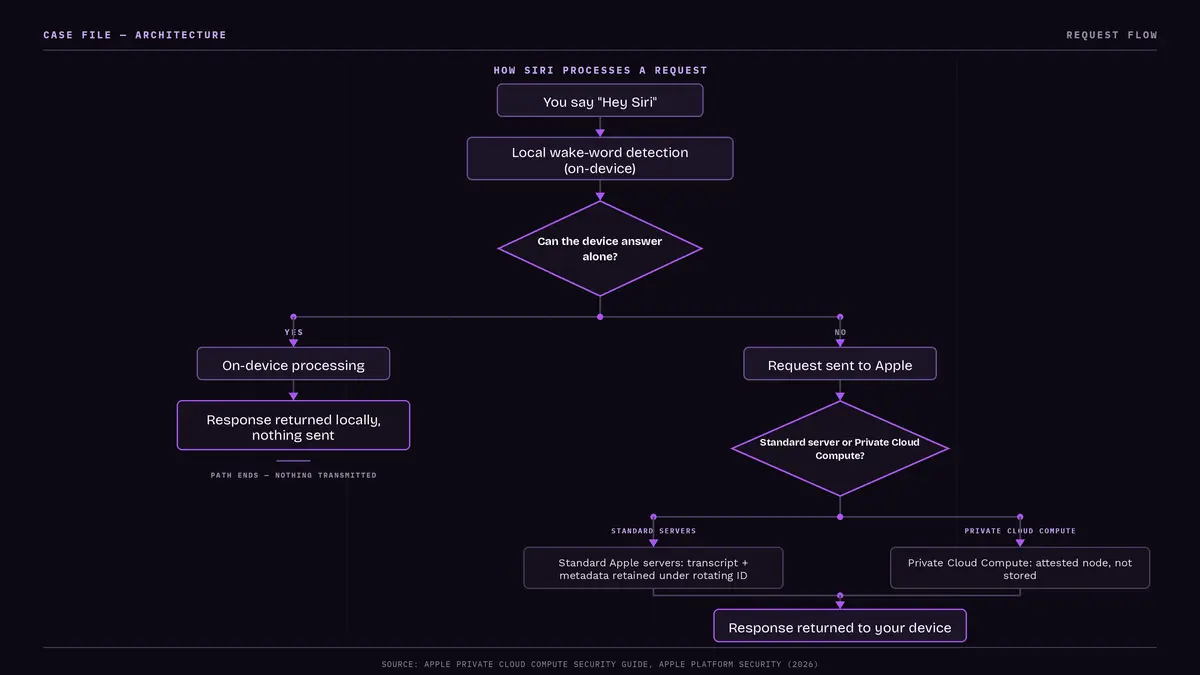
Every Siri request ends up on one of three paths:
- On-device only: timers, app launches, and anything the device can answer alone never reach Apple's servers.
- Standard Apple servers: simpler requests get a transcript plus metadata retained under a rotating identifier for up to two years.
- Private Cloud Compute: heavier Apple Intelligence requests go to stateless, cryptographically attested servers that outside researchers can inspect.
Private Cloud Compute
Apple's strongest privacy claim covers that second, newer path. Apple says PCC is stateless for personal request data, meaning nothing about your request is kept once it answers you, and its own staff have no privileged way to bypass that guarantee.
That last part is checkable, not just promised. Apple's security research reports a Virtual Research Environment that lets outside researchers actually inspect the software running on PCC. That's stronger than a generic privacy policy, though it only covers newer Apple Intelligence requests.
Here's what Apple says it keeps, broken down by data type:
| Data type | Default retention | Notes |
|---|---|---|
| Raw Siri audio | Not stored by default | Only stored if you opt into “Improve Siri & Dictation” |
| Transcripts + request metadata | Up to 2 years | Tied to a rotating identifier, not your Apple Account |
| Contextual metadata (location, contacts, app names, device info) | Same as above | Creates re-identification risk even when audio itself is minimized |
| On-device history | Stays on device | Deleted if you disable Siri, or can be deleted manually |
| Private Cloud Compute request data | Not stored | Deleted after Apple fulfills the request |
One honest caveat: Apple's “rotating identifier” is closer to pseudonymous than fully anonymous. Combine enough metadata, location, timing, app names, and re-linking a request back to a real person becomes possible in principle. The next section covers research showing this correlation isn't just theoretical.
The real Siri privacy story: settlements, not spies
The “proof” behind the CIA claim is almost always the same handful of 2017 videos: someone asks pre-AI Siri about the CIA on camera, gets a scripted joke, and treats the non-answer as confirmation. Siri's deflection, “Who, me? I'm sorry, I'm afraid I cannot answer that,” is a programmed Easter egg, not a tell.
That same Vault 7 leak names no Siri-specific tool; compromising a phone through malware or physical access is not a standing feature of ordinary Siri use. As one r/toronto comment explained, a dedicated low-power chip only listens for the wake word and “doesn't process anything, it doesn't send anything anywhere” until triggered, since streaming audio full-time would drain the battery. That is the real mechanism.
The same distinction separates Alexa's accidental-trigger problems from any claim it “works for” an intelligence agency. Government access is possible, just not through a CIA partnership: encryption stops thieves, not a valid court order. Matthew Green, who teaches cryptography at Johns Hopkins, put the limit plainly:
There is no cryptographic primitive that protects you from ‘upload your search facts to Google’ or ‘report anything suspicious to the government because I programmed you that way.’ That protection, if it exists at all, lives in law and politics and corporate incentives...
Matthew Green, Associate Professor, Information Security Institute, Johns Hopkins University (Cryptographic Engineering blog, 2026-06-09)
The contractor-review program at the center of Apple's real privacy problems is dated, too. When Apple suspended human grading in 2019, its own newsroom report documented that the reviewed sample covered fewer than 0.2% of Siri interactions. Small as a share, but at Siri's scale that still meant real, sometimes accidental, recordings reaching human reviewers.
It depends on who you are
If you're worried about the worst case, the real risk is legal compulsion, not a CIA partnership. A FISA order (a national-security surveillance order reviewed by a special closed court) or a National Security Letter can force Apple to hand over data, under a gag order.
Siri recordings are also discoverable in civil litigation: HR investigations, divorce cases, employment lawsuits. None of that requires the CIA, just a subpoena.
If you're trying to make this work, the fix doesn't require abandoning Siri. Turn off “Improve Siri & Dictation” so Apple's human graders stop reviewing sample audio, and periodically delete your Siri history. Be honest: a FISA request could still reach the data, since no toggle opts you out of a valid legal order.
If you're trying to understand the nuance, the “Siri is CIA property” framing flattens a narrow, technical 2017 leak into a bigger claim than the source supports. Apple's real payouts trace to contractors reviewing accidental recordings, and marketing “Enhanced Siri” features before they existed. A well-sourced r/law comment names the plaintiff, California's Fumiko Lopez, citing The Guardian's report that contractors heard conversations with doctors and other intimate moments, a court filing, not a classified memo. Online retellings inflate it: one r/degoogle post claimed Apple “got fined multiples of billions,” when the real figure was $95 million.
- $95 million: the Lopez v. Apple settlement over accidental Siri recordings reviewed by contractors.
- Under 0.2%: the share of Siri interactions Apple says were ever in the human-review sample.
- $250 million: the separate Enhanced Siri settlement over AI features marketed before they existed.
- $0: any documented link between either settlement and an intelligence agency.
Could the government actually get Siri data? The real legal mechanisms
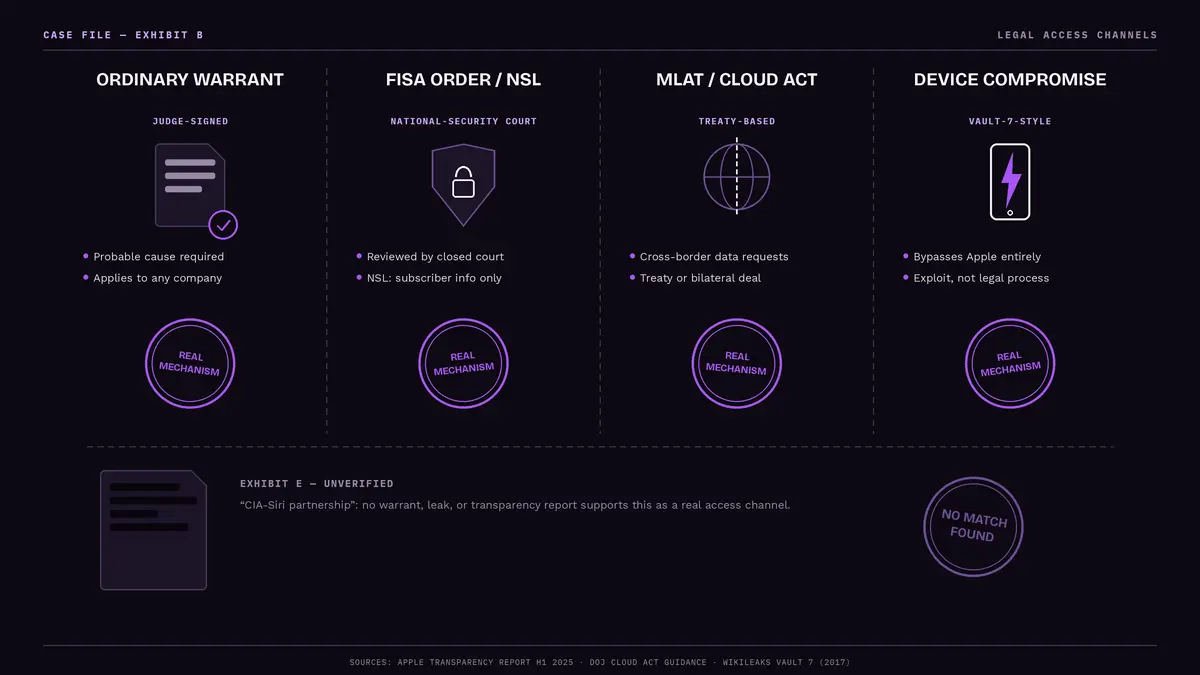
This is the actual answer to “could the CIA get it,” not vague reassurance. The unfounded version of this fear shows up constantly online: one r/conspiracytheories commenter claimed flatly that “the phone you are using is spying or can be used/accessed by the government anytime they want,” with no mechanism attached.
Real mechanisms exist for governments to get Apple-held data. They just aren't a Siri-specific spy pipeline, and they don't work “anytime they want.”
- Ordinary warrant: any company, any agency, judge-approved, works the same for Apple as for anyone else.
- FISA order or National Security Letter: for national-security cases; NSLs are limited to basic subscriber information only.
- MLAT or the CLOUD Act: how a foreign government requests data through the US legally, not directly.
- San Bernardino, 2016: Apple refused to build a backdoor tool for the FBI, and never did.
San Bernardino: the case that actually tested this
In 2016, after a mass shooting in San Bernardino, the FBI wanted more than the data Apple already had. It wanted Apple to build new software that would let investigators break into the shooter's iPhone.
This is the case people are usually half-remembering when they invoke “the government forces tech companies to cooperate,” including in the same r/AskAnAmerican thread cited earlier.
Tim Cook refused, in a public letter. He drew a clear line: Apple hands over data it already holds when legally compelled, same as any company, but it would not build a tool that weakens security for every iPhone owner just to satisfy one request.
Apple never built that tool. The FBI ended up paying a third party to unlock the phone instead, and the underlying demand never reached a court ruling. It's real, it's dated, and it directly rebuts the idea that Apple secretly does whatever any government asks.
Warrants, preservation requests, and what “legally compelled” actually means
For an ordinary US warrant, meaning a judge has reviewed real evidence and signed off, Apple hands over the customer content it holds. That's the same standard used against any company holding your data, nothing specific to Siri or to intelligence agencies.
Apple can also freeze an account under a preservation request: a snapshot held for 90 days, renewable once for another 90. None of this requires the CIA specifically. Any properly issued warrant works the same way, no matter which agency is asking.
FISA orders and National Security Letters, with real numbers
Two more mechanisms exist for national-security cases specifically. A FISA order comes from the Foreign Intelligence Surveillance Act, a body of law covering intelligence-gathering requests that get reviewed by a special, closed court.
A National Security Letter, or NSL, is a faster FBI tool, but it's legally limited to basic subscriber information, never message or transcript content.
Apple's latest transparency report, covering January through June 2025, shows 500 to 999 FISA content requests, affecting 75,500 to 75,999 accounts, plus a separate 0 to 499 NSLs. Apple's reports typically run more than a year behind, so “most recent” means the newest data Apple has released, not this year's number.
Apple states it has never received an order for bulk data. But its reporting groups everything into broad ranges by product category, not a per-app breakdown. There's no public way to know how many of those requests, if any, specifically touched Siri data versus other iCloud data.
Crossing borders: MLAT and the CLOUD Act
Outside the US, a foreign government generally can't just ask Apple directly for data. Except in emergencies, the request goes through a Mutual Legal Assistance Treaty (MLAT, a slow country-to-country legal process) or the CLOUD Act, a 2018 US law letting partner countries request data faster under bilateral agreement.
The UK is the clearest live example. The UK government secretly issued the order in January 2025; it became public in February, when Apple responded by pulling Advanced Data Protection, the setting that end-to-end encrypts iCloud data, for new UK users entirely.
Ten categories of iCloud data lost that extra protection for affected UK users as a result: Photos, iCloud Drive, Backup, Notes, Safari Bookmarks, Reminders, Siri Shortcuts, Voice Memos, Wallet Passes, and Freeform.
Reports say the UK dropped its demand under US pressure around August 2025, but Apple has not restored the setting for UK users. A narrower UK-only order followed that fall, and separate legal challenges from Liberty and Privacy International are still working through the UK's Investigatory Powers Tribunal. This is unresolved, not settled history.
The metadata problem: why “they don't have the audio” isn't the whole answer
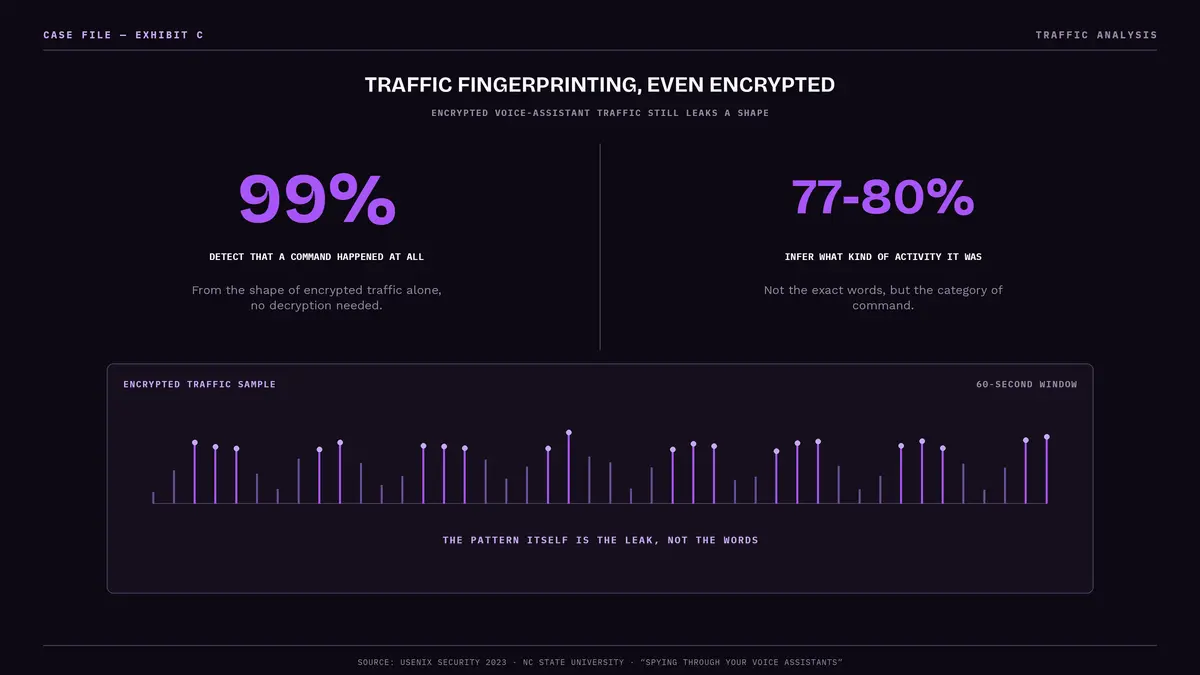
There's a genuinely underexplored angle here, and it's more technical than legal. A 2023 USENIX Security paper found that encrypted voice-assistant traffic still leaks information, even without decrypting a single word. The paper, by researchers at North Carolina State University, is titled “Spying Through Your Voice Assistants: Realistic Voice Command Fingerprinting.”
The paper reports that researchers could tell a voice command had happened at all with about 99% accuracy, just from watching the shape of encrypted network traffic. They could also infer what kind of activity it was, not the exact words, with 77 to 80% accuracy.
- 99% accuracy detecting that a voice command happened at all, from encrypted traffic shape alone.
- 77 to 80% accuracy inferring what kind of activity it was, still without decrypting a single word.
- 0%: how much of the actual spoken content the researchers needed to read to get those numbers.
That changes the real question. It's not “can someone hear what I said,” it's “can someone tell what I was doing and when, from the traffic pattern,” a harder problem than the “always listening” myth implies. Rotating identifiers alone don't solve it, since the pattern itself is the leak.
It's also why the comparison to other assistants matters. One r/NoStupidQuestions commenter noted that “other assistants constantly listen and record your commands and learn from them,” while Siri's architecture is built to minimize exactly that kind of standing data trail, even if metadata correlation remains a separate, real risk.
One more data point: the investigation still open in Europe
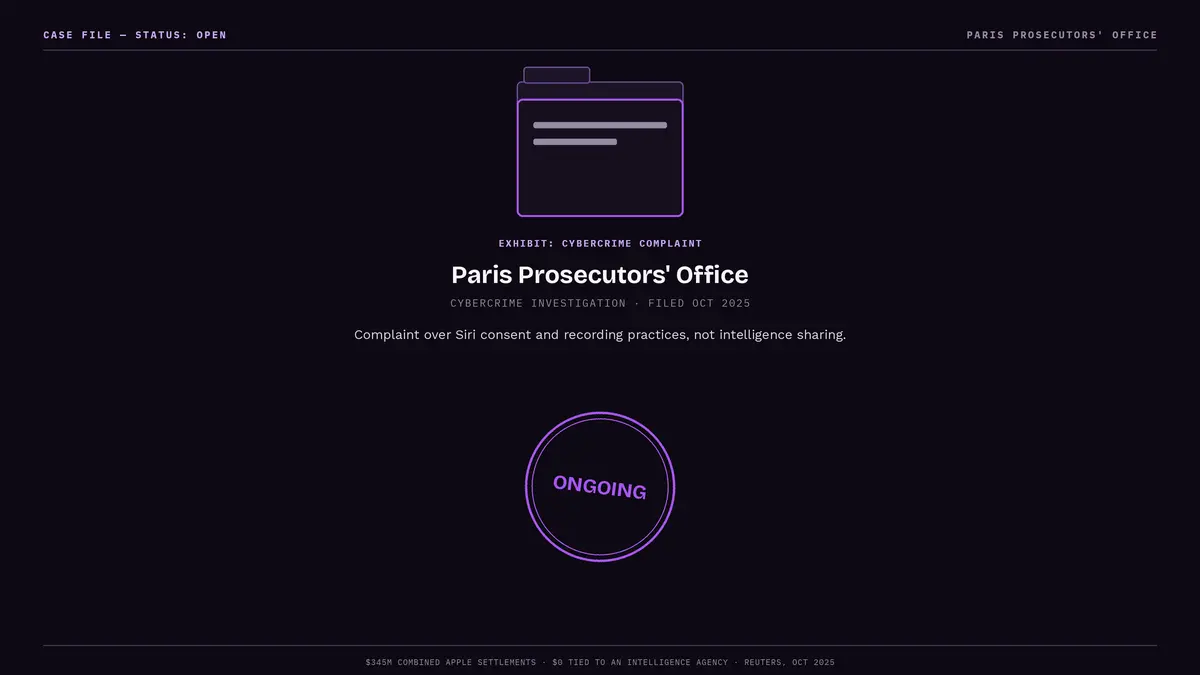
In October 2025, Reuters reported that Paris prosecutors had opened a cybercrime investigation into Siri. The complaint came from Ligue des droits de l'Homme, France's oldest human-rights group, and drew in part on earlier claims from whistleblower Thomas Le Bonniec, the same contractor who went public in 2020 about Apple's Siri grading program.
The complaint is about consent and recording practices, not intelligence sharing. Apple says it strengthened Siri's privacy protections in 2019 and again in 2025, and that Siri conversations have never been shared with marketers or sold to advertisers.
It's worth including here for one reason: the real Siri privacy story keeps developing, in public, through ordinary channels like prosecutors and digital-rights complaints. It never once needed to become a CIA story to stay newsworthy.
- October 2025: Paris prosecutors open a cybercrime investigation into Siri.
- The complainant: Ligue des droits de l'Homme, France's oldest human-rights group.
- The basis: consent and recording practices, explicitly not an intelligence-sharing claim.
- The bigger number: $345 million in combined, court-supervised Apple settlements, still zero tied to spying.
Combined, Apple's $95 million Lopez settlement (finally approved October 2025, checks mailed January 2026) and its $250 million Enhanced Siri settlement reached in 2026 total $345 million in court-supervised payouts, none tied to an intelligence agency. That figure, not a CIA rumor, is the actual scale of Apple's documented Siri privacy exposure.
What this means for how you use Siri (and any AI assistant)
The documented pattern here (accidental activation, human review, marketing that outran the product) is not unique to Siri. It shows up around any voice assistant or AI tool. The real question is what to watch for, not whether Siri works for the CIA.
- For skeptics: any voice assistant could end up in a legal record, a warrant, a subpoena, a contractor review. Keep genuinely sensitive conversations away from it.
- For advocates: use Siri for what it's good at (reminders, navigation, quick tasks), turn off “Improve Siri & Dictation,” and reserve confidential conversations for tools not built to record them.
- For neutral evaluators: watch the settlement payouts, not the CIA rumor. Apple began distributing checks up to $20 per device in its Lopez v. Apple settlement on January 23, 2026. A second $250 million “Enhanced Siri” settlement, paying up to $95 per iPhone, reached preliminary approval on May 5, 2026 (9to5Mac).
Ordinary users reacted to the real lawsuit, not a CIA story. “Didn't they just settle after a lawsuit for siri spying (listening) to conversations as well?” asked one r/dankmemes commenter. A r/samsunggalaxy user asked the same thing. Neither mentioned an intelligence agency, because the settlement never involved one.
If you are already careful about what you say near Siri, that same instinct is worth applying to any AI tool you use for real work.
How Elephas protects a prompt before it reaches the cloud
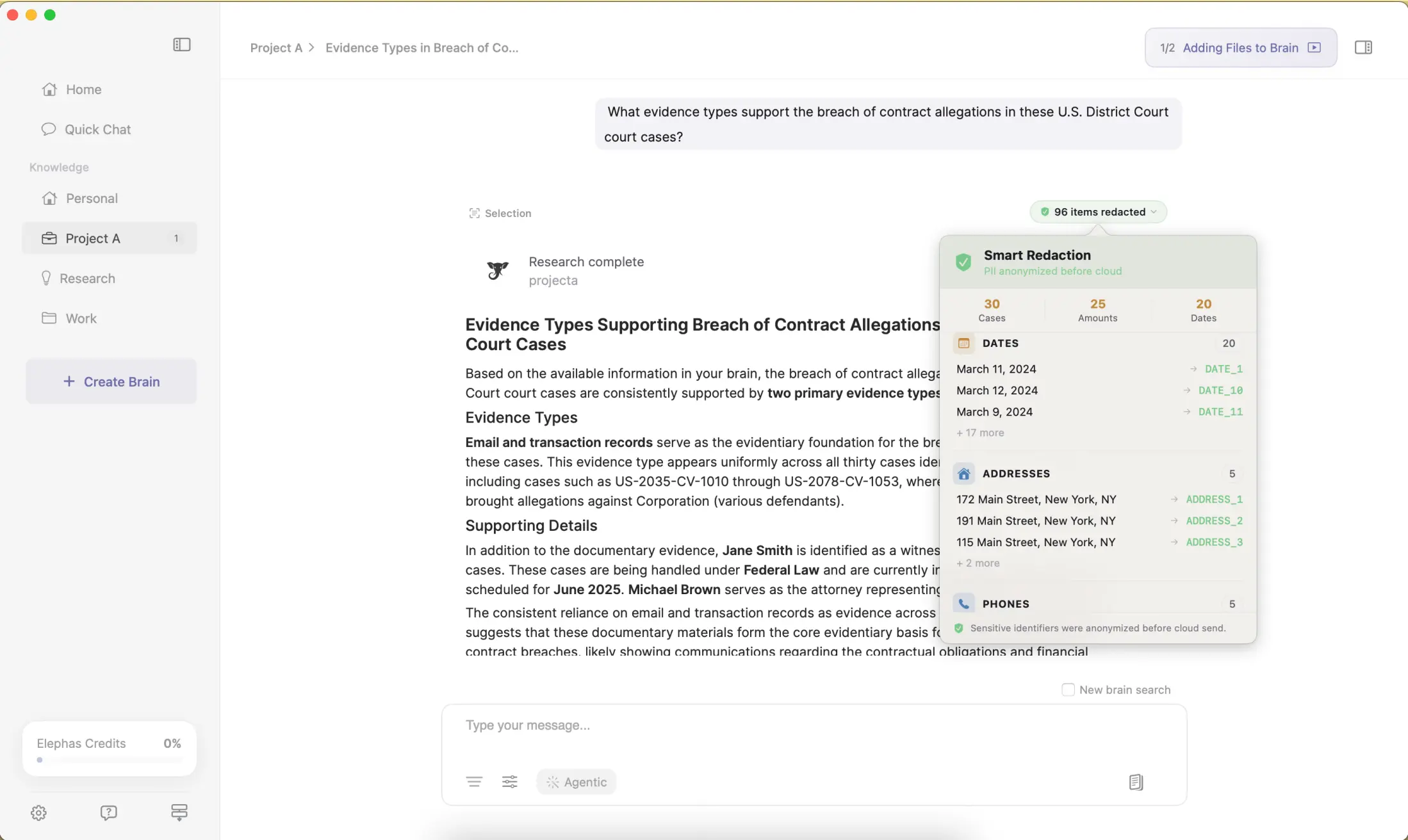
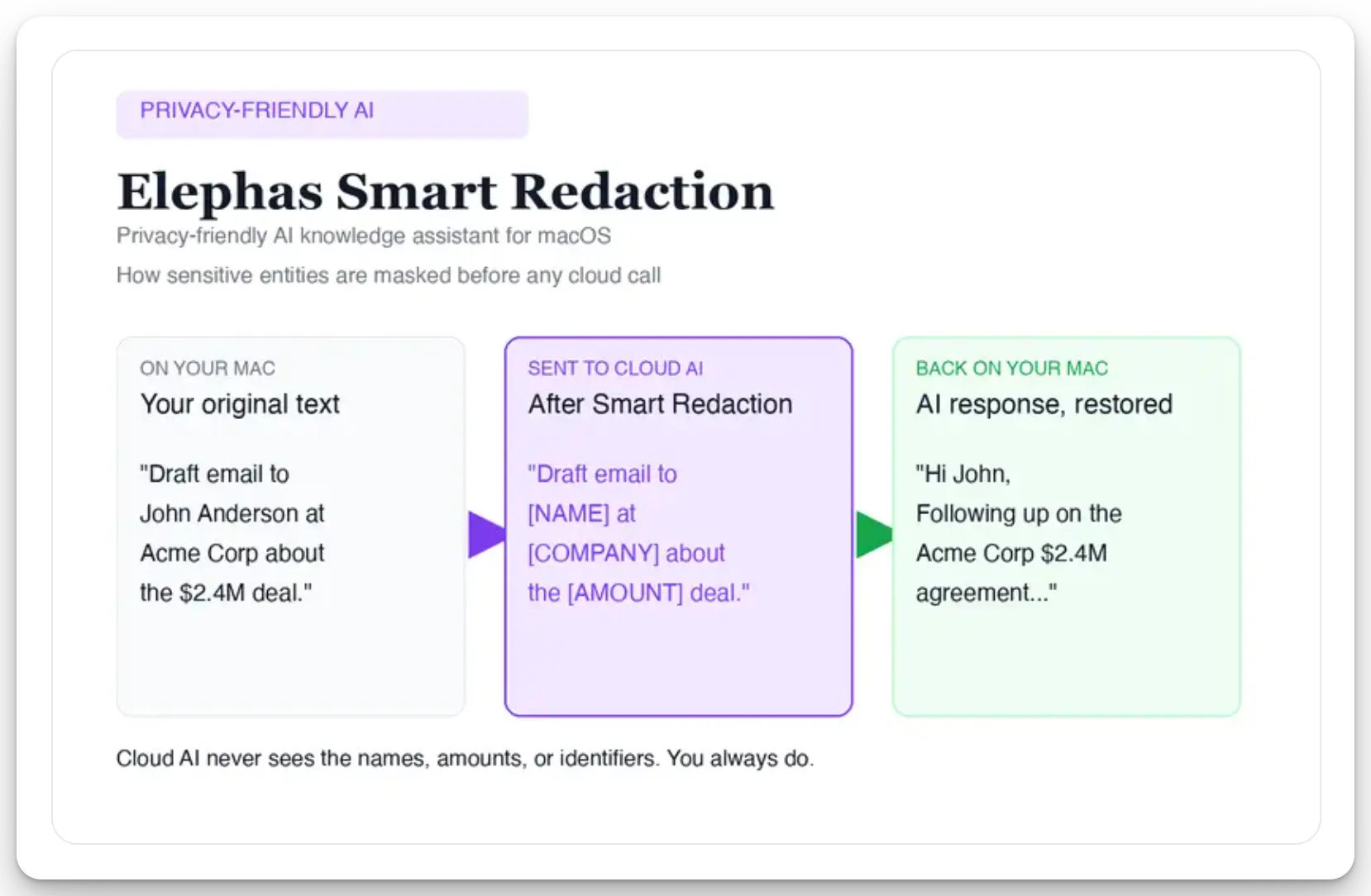
Elephas brings that same protection to whichever cloud AI model you already use. Before a prompt reaches ChatGPT 5.5, Claude Opus 4.8, Gemini, Grok, Perplexity, or any other cloud model, Elephas strips sensitive names, emails, phone numbers, and identifiers on your Mac.
The cloud model only ever sees the sanitized text. When the answer comes back, the redacted fields are reassembled locally on your machine, so identifiable information never leaves the device.
Elephas pairs this with zero data retention: your content never trains AI models, never sits on a vendor's server, and never passes through a third-party reviewer's screen.
Elephas has a free plan and starts at $19/month. Try Elephas for free, or see elephas.app/pricing.
Related questions
Is Siri connected to the CIA?
There's no credible evidence Siri is connected to the CIA. Its lineage is DARPA: Siri grew out of SRI International's CALO project, became independent in 2007, and Apple acquired it in 2010, before any CIA involvement was alleged.
Is Siri's “processed on your device” claim actually true, or does my voice leave the phone before I see a transcript?
Partly true. Some Siri requests stay entirely on-device, while others, plus data like contacts and location, go to Apple's servers or Private Cloud Compute for newer AI features, depending on what you're asking.
Why did Apple pay a $95 million settlement over Siri?
The Lopez v. Apple settlement resolved claims that Siri could activate by accident and record private conversations contractors then reviewed, with payouts up to $20 per device. Apple denied wrongdoing. A separate $250 million “Enhanced Siri” settlement followed in 2026.
Will the CIA come to your house if you ask Siri how to make a bomb?
No. The CIA is a foreign-intelligence agency, not domestic law enforcement, so it doesn't send agents after individual Siri queries. Asking Siri something risky doesn't create a watchlist entry, and no mechanism connects a Siri request to a government response.
What happens if I assume Apple would tell me about a government data request, and I'm wrong?
Under a FISA order, or an accompanying gag order, Apple can be legally barred from ever notifying you. Assuming you'd be told is the riskiest assumption here: in the national-security context, silence is often required by law, not a sign nothing happened.
How do I keep using Siri without leaving my voice on someone else's server?
Turn off “Improve Siri & Dictation” in Settings so Apple's human graders stop reviewing sample recordings, delete your Siri and Dictation history, and reserve sensitive conversations for tools that don't route them through any company's servers. As one r/mac commenter put it, “Siri is still sub-par, but I find it useful for basic requests.”
What is Private Cloud Compute, and can you actually trust it?
Private Cloud Compute is the newer infrastructure behind Apple Intelligence, and it makes a stronger claim than Apple's older Siri servers: requests are stateless, meaning nothing about them is kept after Apple answers you, and every server is cryptographically attested before your device will send it anything. For what the rebuilt assistant behind it actually is, see is Siri an AI.
Apple also lets outside security researchers inspect the actual software through what it calls a Virtual Research Environment, so the claim is checkable, not just a promise.
Can the UK government get your iCloud backups?
Only if you're a new UK user without Advanced Data Protection turned on. Apple withdrew that optional end-to-end encryption setting for new UK users in February 2025 after the UK government demanded a backdoor, and existing users who already had it enabled generally keep it.
Reports say the UK dropped its demand in August 2025, but Apple has not restored the setting for new UK users, so the underlying legal fight is still unresolved as of this writing.

Related Resources
Explore all AI Privacy & Security resourcesApple Intelligence Privacy: What Leaves Your Mac (and What Never Should)
9 min readcomparisonSiri vs Alexa in 2026: Which Assistant Wins After the AI Overhaul?
20 min readarticleWhat Is Apple Intelligence? Features, Devices & Privacy Explained (2026)
15 min readguideApple Intelligence on Mac: The Complete 2026 Guide (Features, Setup, Privacy, and the New Siri)
25 min readSources
- WikiLeaks: Vault 7 primary release
- Wikipedia: Vault 7 overview
- DOJ: Joshua Schulte sentenced for Vault 7 theft
- NBC New York: Apple's $95M Siri settlement
- 9to5Mac: Apple's $250M “Enhanced Siri” settlement
- Duane Morris: Illinois BIPA class certified over Siri voiceprints
- Matthew Green: cryptography vs. legal compulsion
- Apple: Siri & Dictation privacy notice
- Apple Security Research: Private Cloud Compute
- Apple: Tim Cook's customer letter on San Bernardino
- Apple: transparency report, January to June 2025
- SiliconANGLE: Apple pulls Advanced Data Protection in the UK
- IntelligentCISO: UK abandons Apple backdoor demand
- USENIX Security 2023: voice command fingerprinting paper