Americans Are Using AI More Than Ever, and Trusting It Less
Pew Research Center released a new survey on June 17, 2026, drawn from 5,119 U.S. adults polled February 17 to 23. The picture it paints is split in two.
Americans using AI have never been more numerous, and at the same time they have never been more wary of it. About half of adults now report using chatbots, while 71% expect AI to make their personal information less secure.
The same survey shows adoption rising and trust falling in the same breath, often among the very same people.
This piece walks through who actually uses these tools, the divides hiding under the averages, and why the heaviest users tend to be the most uneasy about where AI is headed.
- About half of U.S. adults now use AI chatbots, about a quarter use them daily, and awareness is near-universal, with 96% saying they know at least a little about AI.
- ChatGPT leads at 44% and Claude sits at about 6%, while AI reaches well beyond the chat window: 60% read AI search summaries.
- The averages hide big divides: 63% of adults under 50 use chatbots, men use them more regularly than women, and seven-in-ten Asian adults use them.
- Trust runs the other way: 40% say AI will hurt society over the next 20 years, under-30s are the most skeptical with only 14% positive, and women are about twice as likely as not to expect personal harm.
- The core worry is data: 71% expect AI to make their personal information less secure, and 67% have little to no confidence in the government to regulate it.
- For people who want the tools without the exposure, Elephas is a privacy-friendly AI knowledge assistant for Mac with Smart Redaction and built-in local LLM models.
Americans using AI: half the country is now on chatbots
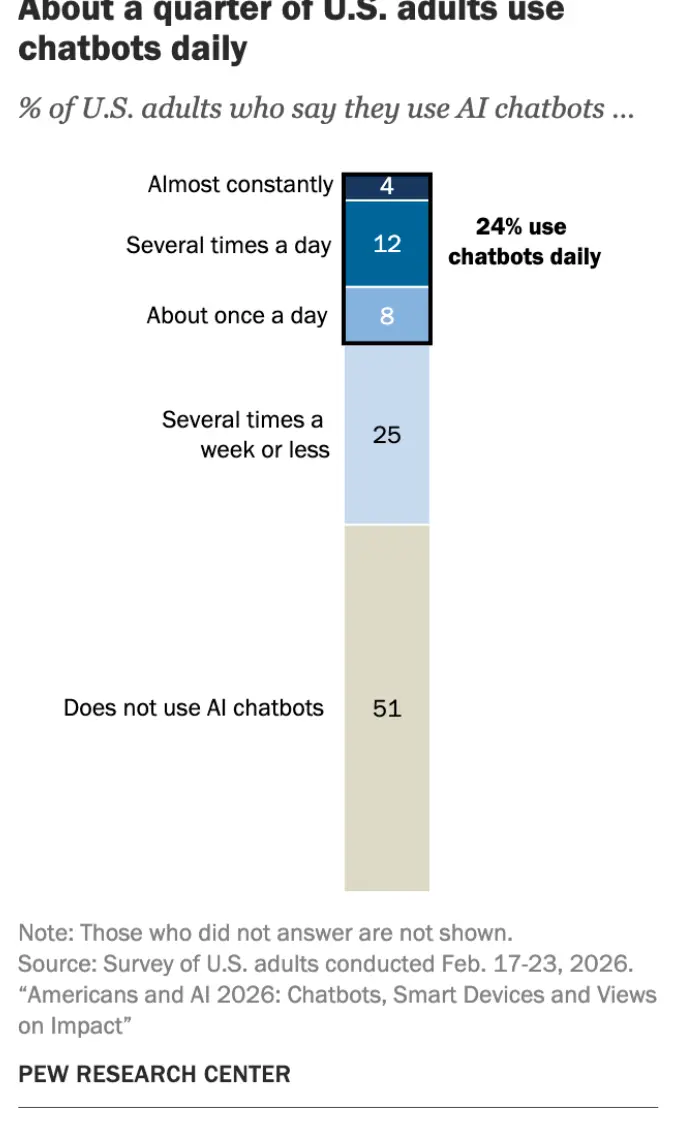
About half of U.S. adults now report using AI chatbots, and about a quarter use them daily. That daily figure includes 12% who say they do so several times a day and 4% who use these tools almost constantly.
Another quarter report several times a week or less, while about half of adults do not use chatbots at all.
Awareness has moved even faster than use. Pew finds 96% of adults say they know at least a little about AI, and the share who have heard "a lot" is now about half, up from 26% in 2022. The gap between hearing about AI and actually using it stays wide.
One caveat sits under the headline growth. The jump from about a third in 2024 to about half in 2026 is partly a change in who was asked.
In 2024 the chatbot-use question went only to people who had already heard at least a little about chatbots; in 2026 it went to all adults. So the rise reflects both real adoption and a broader base of respondents.
The other half tells its own story. About half of adults never use chatbots, and roughly seven-in-ten of those non-users say they are unlikely to start within the next year.
That includes 40% who say they are not at all likely to, and only 5% who think it is highly likely they will start within a year.
This is not a group waiting to be won over so much as one that has looked and walked away.
- About four-in-ten adults use chatbots to search for information, and 38% of employed adults use them for work tasks.
- Among non-users, the top reason for staying away is lack of interest, cited by about six-in-ten, followed by concerns about data privacy and accuracy.
- Getting news draws 13% of adults, and about one-in-ten report using chatbots for emotional support.
- Men are more likely than women to use chatbots daily, 27% versus 20%.
ChatGPT runs the table; Claude barely registers
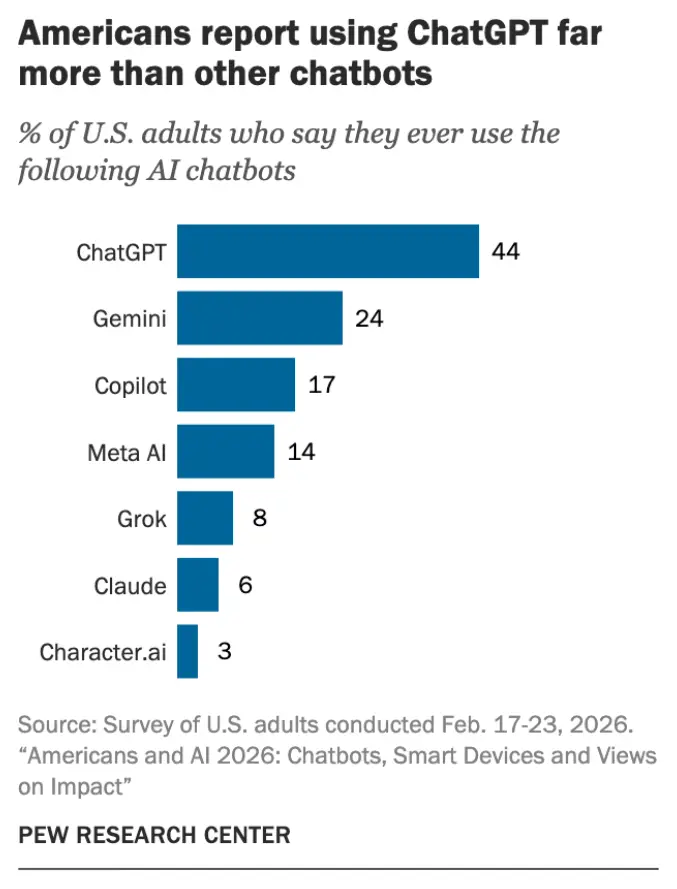
ChatGPT sits far out in front. A little under half of U.S. adults, 44%, now report using it, up from 34% last year and more than double its reach when Pew first asked the question in 2023. No other tool comes close to that kind of public footprint.
Gemini ranks second at about a quarter of adults, with Copilot at 17% and Meta AI at 14% following behind it. Below them the field thins out quickly. About one-in-ten or fewer say they use Grok at 8%, Claude at about 6%, or Character.ai at 3%.
There is an irony worth sitting with. The lab whose models the industry talks about constantly registers with only a small slice of the public. Public adoption and industry attention are not the same map.
The brand picture also tracks the age story. ChatGPT tops the list across every age group, and adults under 30 are the most likely of all to use it. Gemini, Copilot and Meta AI come next for younger adults, while older adults split more evenly between Gemini and Copilot.
- Gemini is the clear number two, well ahead of the rest of the pack.
- Men are more likely than women to use Copilot, 22% versus 13%.
- ChatGPT is used by identical shares of men and women, even where other brands skew male.
- Adults under 50 are about twice as likely as those 50 and older to use ChatGPT, 57% versus 28%.
It is not just the chat window anymore
A lot of AI contact happens without anyone opening a chatbot. Six-in-ten U.S. adults say they read AI search engine summaries, three-in-ten say they do not, and another 10% are not sure whether they have. That reach is wider than chatbot use itself.
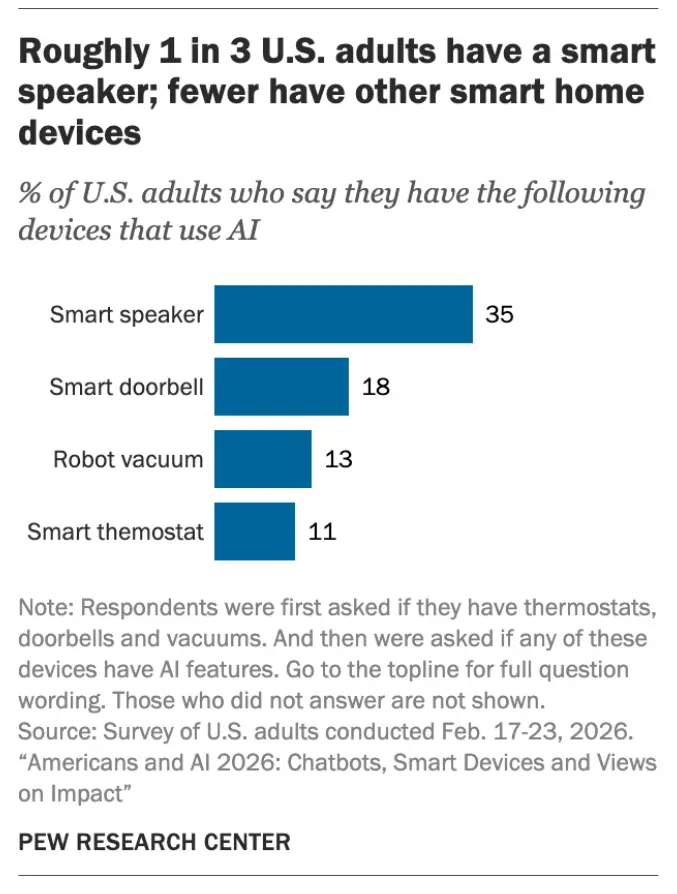
Smart devices extend the footprint further. About four-in-ten adults have a smartwatch, at 37%, and about a third have a smart speaker, at 35%. These are tools people live with daily rather than sit down to use.
One measurement note matters here. Pew first asked whether respondents own a thermostat, doorbell or vacuum, and only then asked whether any of those devices have AI features. The AI-specific shares come out smaller than raw ownership.
The same age pattern from chatbots shows up in the home. Adults in their 30s and 40s are the most likely to own smart speakers, doorbells and thermostats with AI features, and smartwatch ownership is higher under 50.
Older adults read fewer AI search summaries as well, where majorities of those 18 to 64 say they read them but the share drops sharply at 65 and older.
- About one-in-five adults have a smart doorbell, at 18%.
- Roughly 13% have a robot vacuum and about 11% have a smart thermostat with AI features.
- Adults in their 30s and 40s are the most likely to own AI smart-home devices.
- The 60% who read AI search summaries is a wider reach than chatbot use, showing how much AI exposure is passive.
Using it more, trusting it less
People who use chatbots tend to find them useful in narrow ways. About three-in-ten adults say chatbots help how productive they are, and a similar share say they help keep them informed. Only 5% say chatbots hurt either one.
About one-in-five say the tools help their creativity, against 11% who say they hurt it.
On happiness and personal relationships, the most common answer is that chatbots neither help nor hurt. The perceived value is real but limited, concentrated in work and information rather than in life more broadly.
In other words, people see these tools as practical helpers, not as forces that have reshaped how they feel or relate to others.
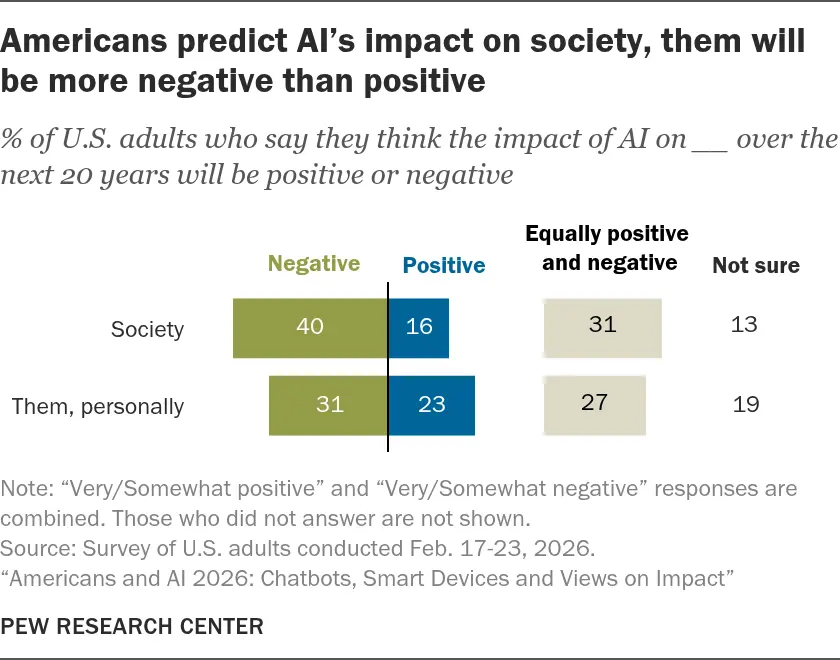
Then the mood turns. Looking 20 years out, 40% of adults say AI will have a negative impact on society, and far fewer, 16%, expect a positive one.
The personal question is separate and reads differently: 31% expect a negative effect on themselves, while about a quarter, 23%, expect a positive one.
The pacing worry sharpens the picture. About two-thirds of Americans say AI is moving too fast, and just 2% say it is advancing too slowly. About one-in-five think it is moving at about the right pace, and a roughly similar share are not sure.
The split between the two impact questions is the heart of the story.
People are more comfortable judging the technology as useful in their own day-to-day work than they are betting it will be good for the country or for them in the long run.
The everyday utility is concrete; the future is where the unease lives.
- 30% say chatbots help their productivity, while only 5% say they hurt it.
- About one-in-five say chatbots help their creativity, versus 11% who say they hurt it.
- About three-in-ten say AI's impact will be equally positive and negative, both for society and for themselves.
- The 16% positive-for-society figure comes from Pew's appendix and topline tables rather than the narrative prose.
The age divide: heaviest users, least convinced
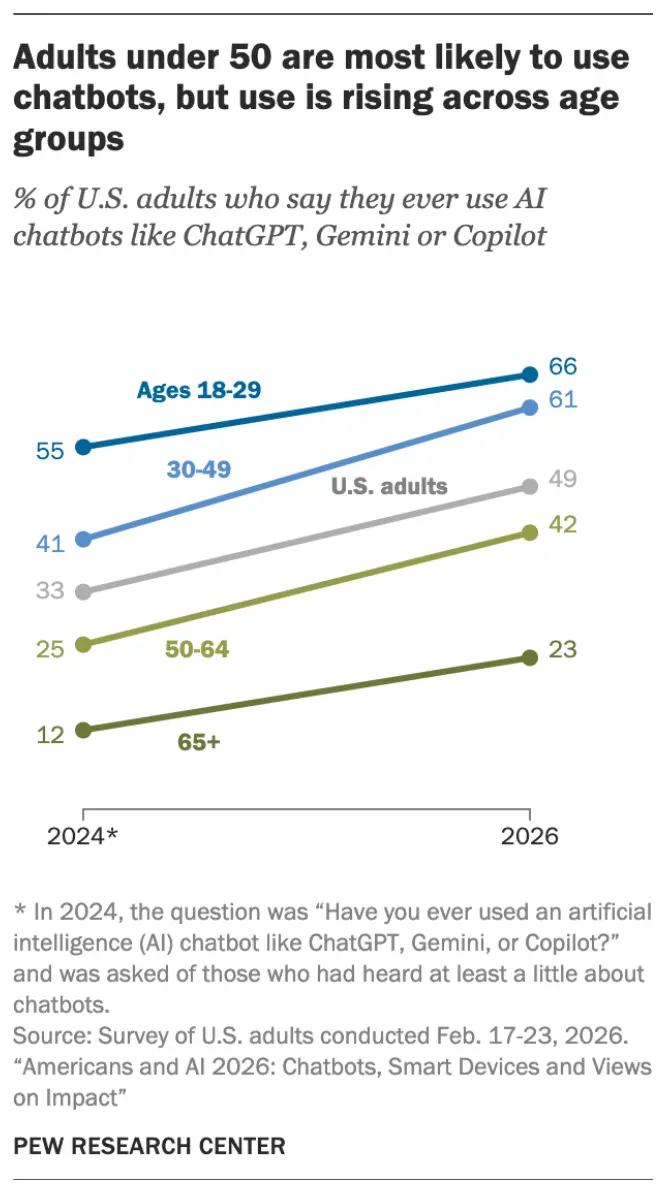
Age is the biggest fault line in the data.
About six-in-ten adults under 50, at 63%, now use chatbots, compared with about four-in-ten of those 50 to 64 and even fewer of those 65 and older, where roughly three-quarters never use them at all.
Adults under 50 are also about twice as likely as older adults to use ChatGPT, 57% versus 28%.
The young use AI the most, yet they trust it the least. Roughly half of adults under 30 say AI will negatively affect society, and only 14% say it will help. That skepticism is sharper than in any older group.
Confidence, though, still rises with youth. About three-in-ten adults under 30 say they are extremely or very confident using chatbots, against just 6% of those 65 and older. Comfort with the tools and faith in their effects pull in opposite directions for this group.
Even creativity, where older groups tend to see chatbots as a help, splits down the middle for the young. A quarter of adults under 30 say chatbots help their creativity, while a similar share, 20%, say the tools hurt it.
The generation most fluent in AI is also the most divided about what it does to them.
- About half of adults 18 to 49 use chatbots to search for information, versus 20% of those 65 and older.
- About one-in-five adults under 30 turn to chatbots for emotional support or advice.
- About four-in-ten adults under 30 expect AI to hurt them personally, more than the roughly three-in-ten in older groups.
- Majorities of every age group say AI is moving too fast, with shares ranging from 61% to 65%.
The gender gap: same tools, different trust
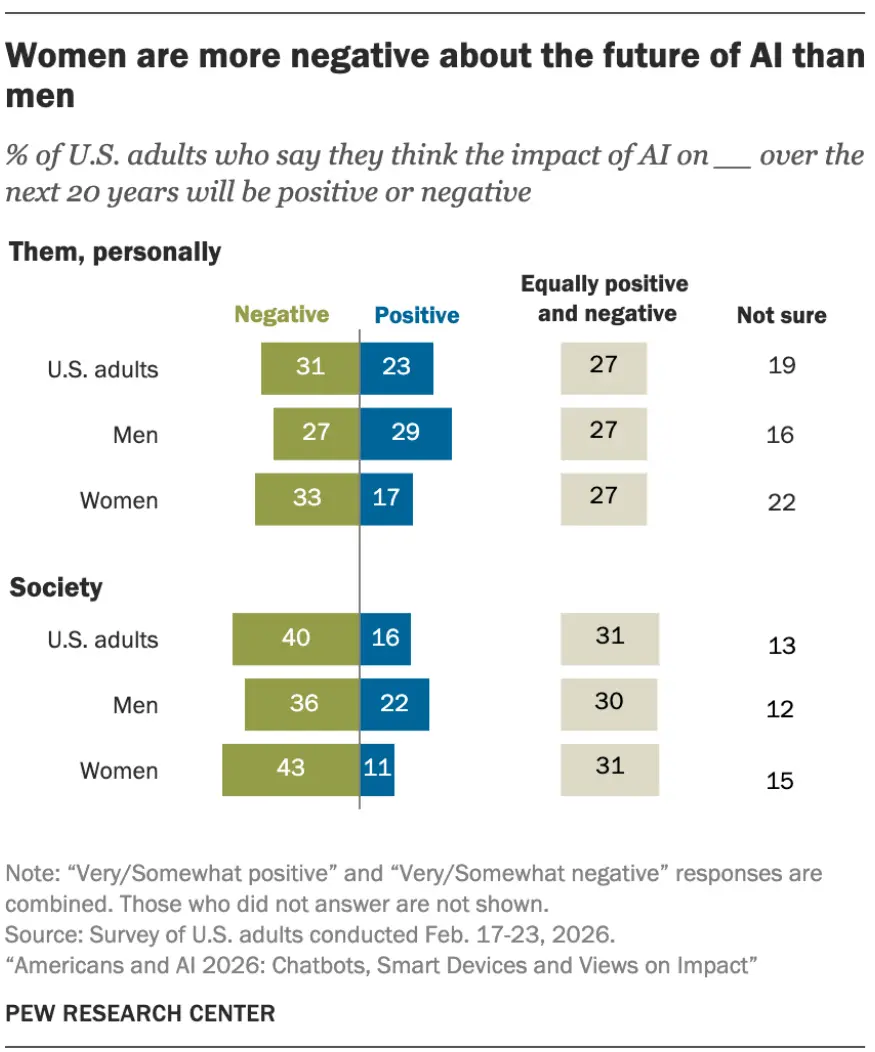
The headline adoption gap has closed. Half of men and 47% of women now report ever using chatbots, a shift from two years ago when men led by 11 percentage points. Where men still pull ahead is regularity: 27% use chatbots daily compared with 20% of women.
The wider gap is in trust, not access. Women are about twice as likely to expect AI to harm them personally as to help them over the next 20 years, 33% negative versus 17% positive. Men split roughly evenly on the same question.
Women are also more likely to say the technology is moving too fast, 68% versus 58% for men. The same pattern shows up in literacy and confidence, where men report more familiarity and more comfort with the tools.
The two sexes reach for chatbots in slightly different ways, too. Men are somewhat more likely to use them for searching, work, fun and news, while women are slightly more likely to use them for emotional support or advice.
On the societal question, 43% of women expect AI to affect society negatively, with men's views tilting negative by a smaller margin.
- Men are more likely to have heard "a lot" about AI, 55% versus 41%, and about chatbots, 48% versus 38%.
- Men are more likely to be extremely or very confident using chatbots, 22% versus 15%.
- Men are more likely to use Copilot, 22% versus 13%, and to say chatbots help their productivity, 35% versus 25%.
- Women are more likely than men to own a smartwatch, 40% versus 34%.
The racial and ethnic divide: Asian adults stand apart
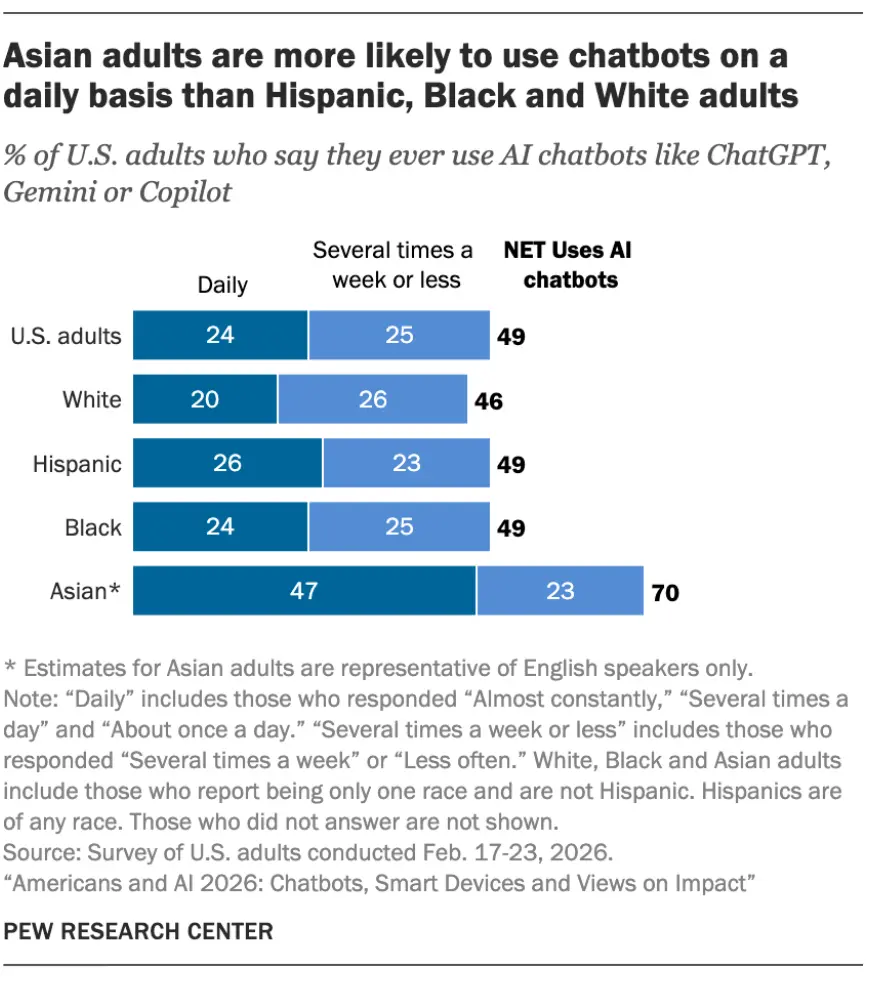
Asian adults use AI the most and view it most positively. Seven-in-ten Asian adults use chatbots, compared with about half or fewer of Hispanic adults at 49%, Black adults at 49% and White adults at 46%.
The same gap shows up in daily use, where about half of Asian adults use chatbots daily versus about a quarter or less of the other groups.
That pattern carries into attitudes. Asian adults are the only group whose view of AI's personal impact tilts positive. They are about twice as likely to expect a positive rather than a negative effect over the next 20 years, 41% versus 20%.
The contrast with other groups stays consistent across the chapter, and Pew notes it holds even after accounting for gender, age, income and education.
The usage gap is just as wide in how the tools get put to work. About two-thirds of Asian adults use chatbots to search for information, against about four-in-ten of other groups, and 60% of employed Asian adults use them for work.
Asian adults are also the most likely to create images or videos, seek medical advice and get news through chatbots.
- About seven-in-ten Asian adults have heard "a lot" about chatbots, compared with under half of other groups.
- About two-thirds of Asian adults use chatbots to search, versus about four-in-ten of other groups.
- 60% of employed Asian adults use chatbots for work tasks, the highest of any group.
- Views on society's future still tilt negative for White, Hispanic and Black adults, and majorities of every group say AI is moving too fast.
The real fear is your data
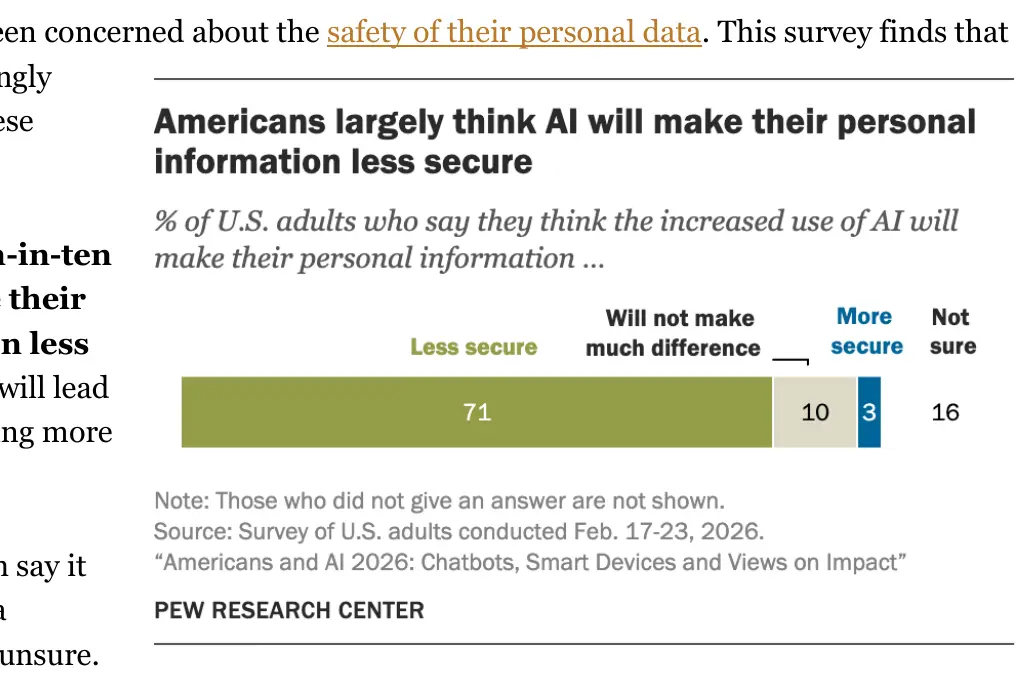
This is the finding the rest of the survey rests on. Roughly seven-in-ten adults, 71%, predict AI will make their personal information less secure. Just 3% say it will make their information more secure, while 16% are unsure and about one-in-ten say it will not make much difference.
That worry is paired with a sense of having no backstop. Confidence in oversight runs thin: 67% of Americans have little to no confidence in the U.S. government to regulate AI effectively, up from 62% in 2024.
About six-in-ten are not confident that U.S. companies will develop and use these tools responsibly.
The picture, then, is of a public that expects its data to get less safe, worries about sending data to the cloud, and does not believe either Washington or the industry will stop that from happening.
The data fear also explains some of the people who stay away entirely. Privacy concern is one of the top reasons non-users give for avoiding chatbots, sitting just behind plain lack of interest.
The politics around regulation have moved in opposite directions since 2024. Republican distrust of the government's ability to regulate AI fell from 70% to 61%, while Democratic distrust climbed about 20 points to 74%.
Two years ago there were no meaningful partisan differences on whether companies could be trusted to develop AI responsibly; now Democrats are more skeptical than Republicans there too.
- Only 3% expect AI to make their personal information more secure.
- About six-in-ten distrust companies to develop and use AI responsibly.
- The partisan picture has shifted: Republican distrust of government regulation fell from 70% in 2024 to 61%, while Democratic distrust rose about 20 points, leaving Democrats at 74% versus Republicans at 61%.
- Data-privacy worry remains a top reason non-users avoid chatbots at all.
What an individual can actually control
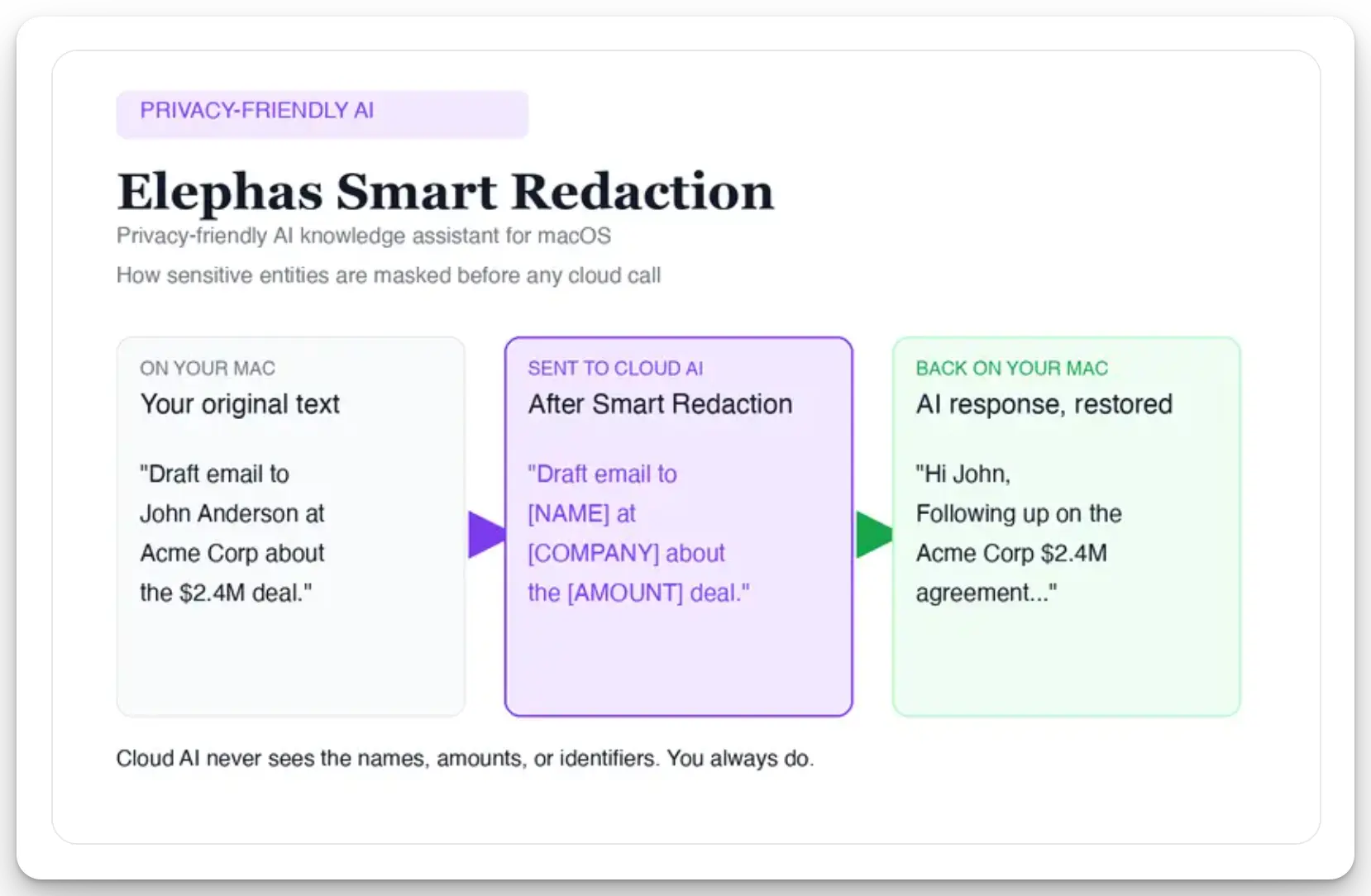
You cannot fix regulation, and you cannot make a company more responsible on your own. What you can change is what leaves your machine in the first place. That is the gap Elephas is built for: a privacy-friendly AI knowledge assistant for Mac that keeps sensitive material under your control.
Smart Redaction strips sensitive details such as names, card numbers and dates before your prompt is sent to a cloud model, and it is available in the free plan too. The point is simple. The model still helps you, but the private parts of your text never make the trip.
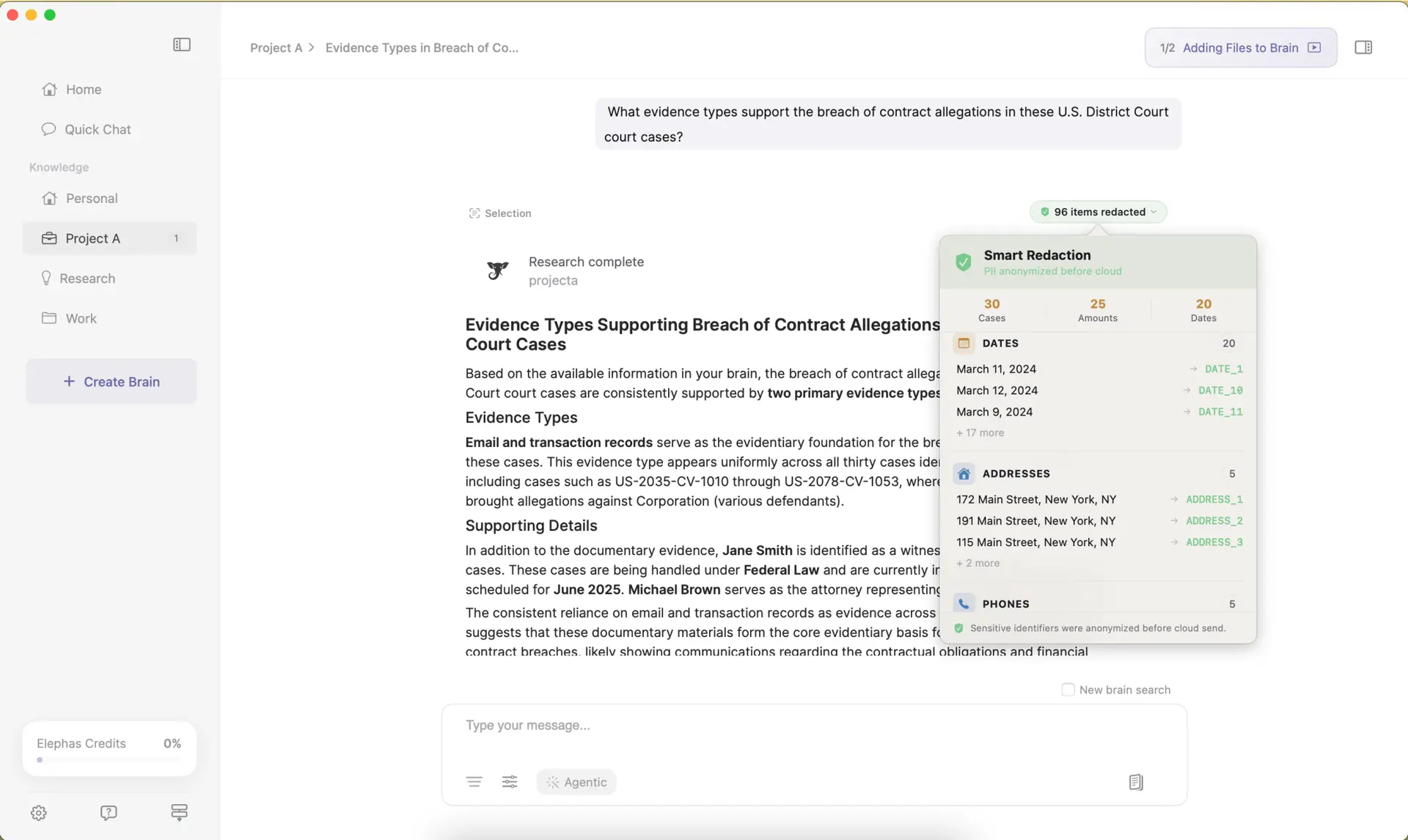
For work you want to keep fully offline, built-in local LLM models run AI directly on your Mac, so the data never leaves the device at all. There is no cloud round-trip to worry about.
The approach matches the shape of the worry Pew measured.
The 71% who expect AI to erode their data security are not asking for less capable tools; they are asking for tools that do not hand their information to systems they cannot see or control.
Cutting what gets sent, or keeping it local entirely, is the part of that equation an individual can actually act on today.
- Redaction happens before the prompt leaves the device, not after it has already been sent.
- Local mode means no cloud round-trip and no copy of your text sitting on someone else's server.
- It is model-agnostic, working across Claude, ChatGPT, Gemini, Grok and Perplexity.
- It is built for exactly the people Pew found most worried, the heavy users young and old across every group, who want the tools without the exposure.
Where this leaves us
The Pew numbers describe people who use these tools enough to have read the fine print, and the more they use them the more clearly they see the costs. Adoption keeps climbing. Trust does not climb with it.
The divides across age, gender and race show this is not one public reacting to AI but several, each standing at a different point on the same curve and arriving at different conclusions about what the technology is worth.
Regulation moves slowly, corporate responsibility moves slowly, and in the public's eyes neither one is reliable. Two-thirds of Americans say the technology is moving too fast, and most do not expect the institutions around them to catch up in time.
What remains is individual choice about how these tools get used and what they are fed.
- Adoption is rising while trust is not, and the survey suggests the two will keep diverging.
- The age, gender and racial divides mean there is no single AI public to design for.
- Most Americans do not expect government or companies to protect their data.
- For the individual who wants the upside without handing over the private details, Elephas keeps sensitive data off the cloud with Smart Redaction and built-in local LLM models.