Apple vs OpenAI Trade Secrets Lawsuit: New Evidence
Apple says the Apple OpenAI trade secrets lawsuit is no longer a familiar dispute about departing employees. OpenAI says that is exactly what it is.
Apple’s August 31 filing alleges that former engineer Chang Liu used a confidential power-converter schematic in OpenAI work, put it into circuit-simulation software, had an AI agent run simulations, and, after learning of Apple’s internal investigation, sent instructions for destroying evidence to a colleague.
OpenAI’s August 31 opposition says Apple failed to shut off Liu’s access, encouraged personal-account use for work, and waited too long to show urgency. It says files on Liu’s personal Mac Mini were zero bytes. This report separates the allegations from the defence and explains the procedural stakes.
Executive Summary
- Apple’s August 31 brief alleges Liu used an Apple power-converter schematic in LTspice and directed an AI agent to run simulations on it.
- OpenAI’s filed opposition says the post-employment access was Apple’s offboarding failure, not an authentication exploit, and says the Mac Mini documents were zero-byte files.
- The case is Apple Inc. v. Chang Liu et al., No. 5:26-cv-07078-EJD, in the Northern District of California, San Jose Division, against five defendants.
- Behind the case sits a question no court has answered: whether confidential material fed into an AI system can lose trade-secret protection. Nothing in the current motions asks Judge Davila to decide it.
- Apple argues that learning by an AI agent or model can create irreversible and continually propagating uses of a secret. The technical difference between an agent driving software and model training remains relevant; Elephas addresses the everyday prompt-risk question by redacting identifiers first.
What Apple’s August 31 filing alleges about Liu’s work at OpenAI
Apple’s August 31 evidence brief says Liu did more than download confidential material after leaving the company. Apple alleges that he used an advanced power-converter circuit schematic in OpenAI-related work, uploaded it to LTspice, and deployed an AI agent to autonomously run simulations.
Apple's complaint and motions are public; the five-page supplemental brief filed on August 31 sits as an exhibit, so Apple's language from it is quoted here as reported. Much of the public material is redacted, so the record does not reveal every technical detail Apple says it found.
- New evidence: Apple says the material was an advanced power-converter circuit schematic, rather than referring only to confidential material generally.
- New evidence: Apple places the schematic in OpenAI-related work and says it was uploaded to LTspice.
- New evidence: Apple says an AI agent autonomously ran simulations, rather than alleging only that Liu retained or downloaded files after leaving.
- New evidence: Apple cites a March message it says shows an AI agent being used with the simulation software, adding a claimed use sequence to its earlier access allegations.
Apple describes the forensic finding this way: “The ongoing forensic inspection of this MacBook has uncovered forensic evidence showing that this computer contains Apple trade secret information, including at least one specific '.asc' file, and that this file has been used while Mr. Liu has been employed by OpenAI.”
An .asc file is an LTspice schematic file. Apple also says its “forensic investigation is not complete.”
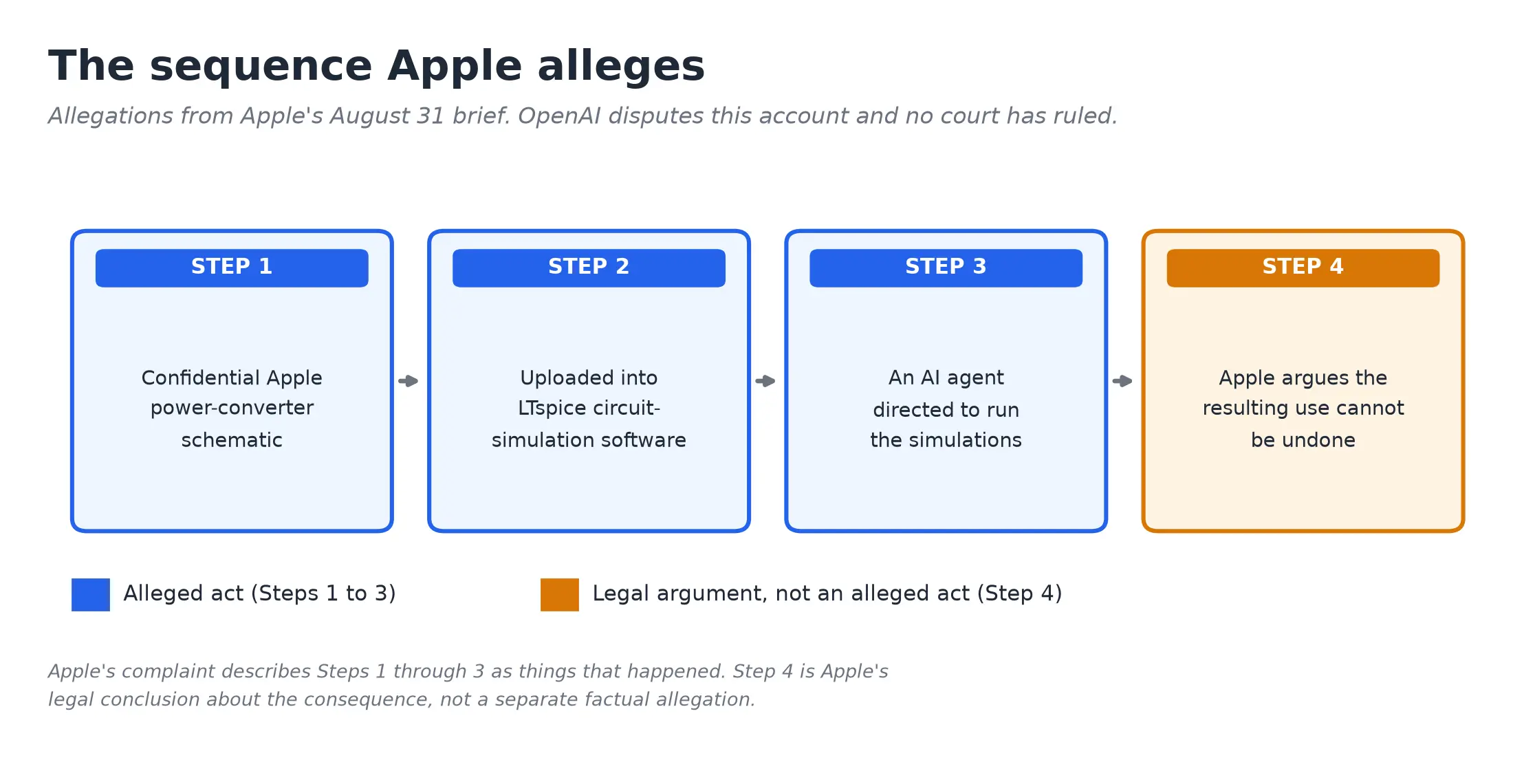
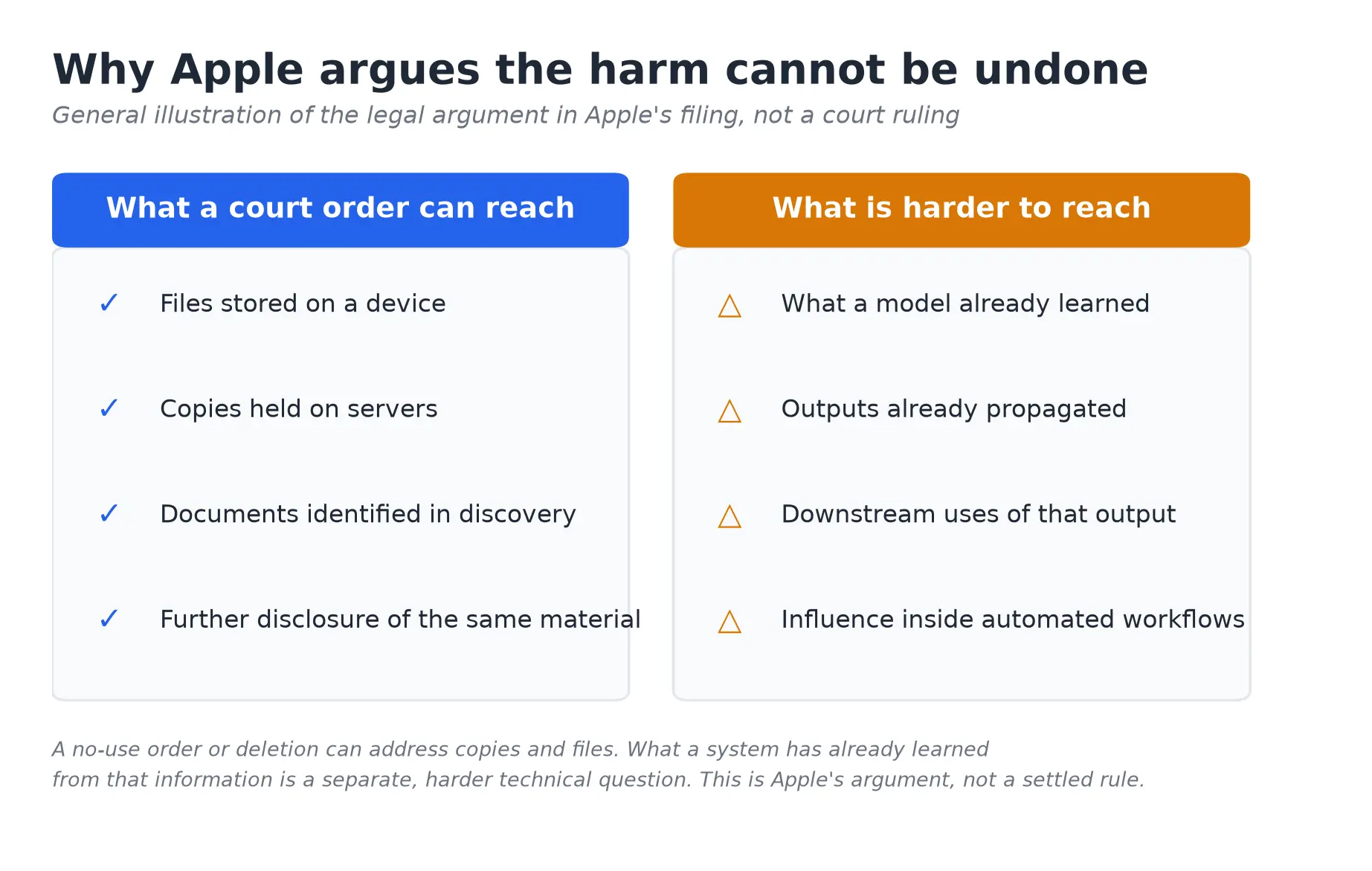
The filing’s wider argument is about lasting technical effects, not only one schematic. Apple writes that where trade-secret information is fed into an AI agent or model that learns from it, the learning “may create irreversible and continually propagating uses” of the secret.
That is Apple’s litigation position, not a judicial finding. TechCrunch’s report covered the new-evidence brief the same day it was filed.
Where trade secret information is fed into an AI agent or model that "learns" from it, such "learning" may create irreversible and continually propagating uses of the trade secret.
Apple's August 31 brief
What the messages show, and what each side makes of them
The filing places the allegation alongside Liu’s messages about AI-heavy work after joining OpenAI. In a February 14, 2026 message published by OpenAI, Liu wrote: “This place is crazy... hahahah we use Ai all over the place.”
Apple’s brief, as reported by outlets covering it, quotes Liu writing that “[i]n the past hour,” his AI “agent learned how to run LTspice, look at result, tune compensation parameter.”
The alleged agent use describes an agent driving a desktop application, which is technically different from training a model on the file. Apple's quoted legal argument separately covers an AI agent or model that learns from trade-secret information.
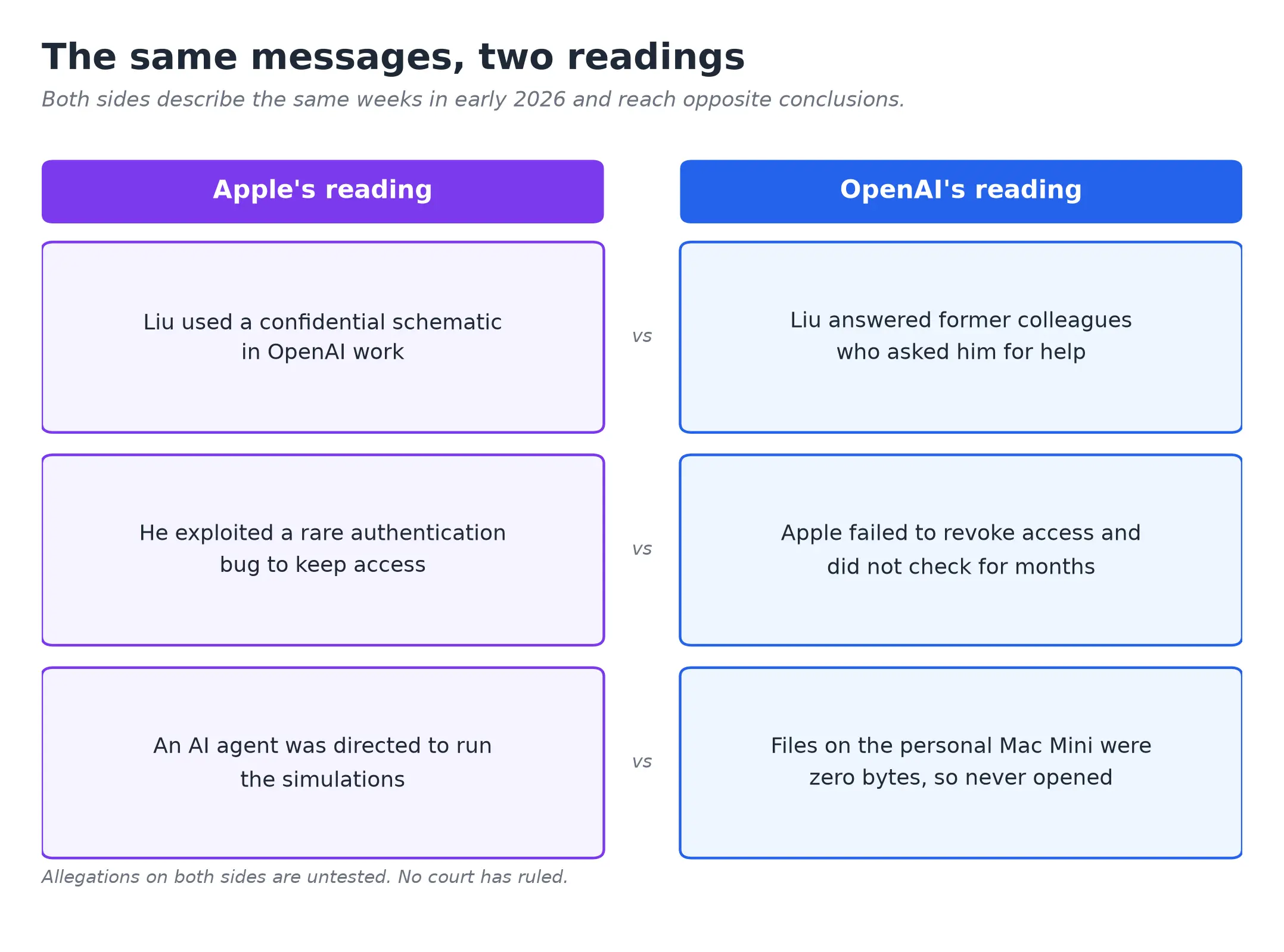
OpenAI's opposition gives the same weeks a different shape. It says an Apple employee asked Liu on March 4 how to improve in power electronics, and that Liu pointed him to public videos and suggested he run his own simulations and compare them with Liu's earlier ones.
It says that on March 7 Liu checked a folder titled Archive Simulations to see whether it held files that employee could use, and that on March 11 he set up his personal Mac Mini using Apple's Migration Assistant, which it says likely moved data across automatically. Both sides describe the same period and draw opposite conclusions.
Apple and OpenAI also give different accounts of Liu’s retained access after his departure:
- Apple’s account: reporting on the complaint quoted Liu as saying he could access Apple network storage.
- OpenAI’s account: Apple employees contacted Liu after his departure for help locating Apple information, according to messages OpenAI published.
What the August forensic examination is said to have found
The evidence surfaced after Liu’s counsel produced material for forensic examination on August 21. Apple says the examination exposed records supporting its claims of continued access and use of confidential engineering files. Its brief describes a rare, previously unknown authentication bug that Liu allegedly exploited to keep reaching internal documents after he left.
OpenAI’s opposition gives a fundamentally different account. It says the access “was nothing of the sort,” calling it Apple’s failure to remove access and check whether it had done so. It says Apple’s iCloud policies allowed residual access and argues that continued access by former employees is “a feature of Apple’s practices, not a ‘bug.’”
The filings directly disagree on the device and access story:
- Access: Apple calls it exploitation of a rare authentication bug; OpenAI calls it Apple’s failure to remove access and check whether it had done so.
- iCloud: Apple says Liu kept reaching internal documents after he left; OpenAI says Apple’s iCloud policies allowed residual access.
- Device: Apple’s examination is reported as involving an Apple-issued MacBook; OpenAI places the findings it addresses on Liu’s personal Mac Mini.
- Files: Apple says the examination supported continued access and use; OpenAI says the Mac Mini documents were zero bytes and may have arrived through Migration Assistant.
One correction is material. Liu returned both Apple work MacBook Pros on January 22, 2026, according to OpenAI’s filing. His manager walked him out that evening, and they agreed he would not sign out of his personal iCloud or factory-reset it while Apple downloaded files.
The public record is not consistent about which device was produced for examination on August 21. Some reporting describes it as an Apple-issued MacBook.
OpenAI's opposition places the forensic findings it addresses on Liu's personal Mac Mini and says both Apple MacBook Pros went back to Apple in January. This article does not resolve that conflict, and neither has the court.
OpenAI says documents recovered from that Mac Mini had a file size of zero bytes. Its filing says that strongly suggests the files were never opened, copied, or interacted with on the machine and could have arrived through Migration Assistant without Liu’s knowledge. Apple’s allegations and OpenAI’s zero-byte explanation remain unresolved.
The evidence-destruction allegation, and why it matters legally
Apple alleges that, after learning of its internal investigation in June, Liu discussed destroying types of forensic data Apple needed with Yu-Ting Alyssa Peng. Apple's brief also alleges that Slack messages were deleted and data was erased from devices.
Liu, Peng and Tan have not made public statements to this publication about the specific allegations described here; the accounts attributed to them come from declarations filed in the case.
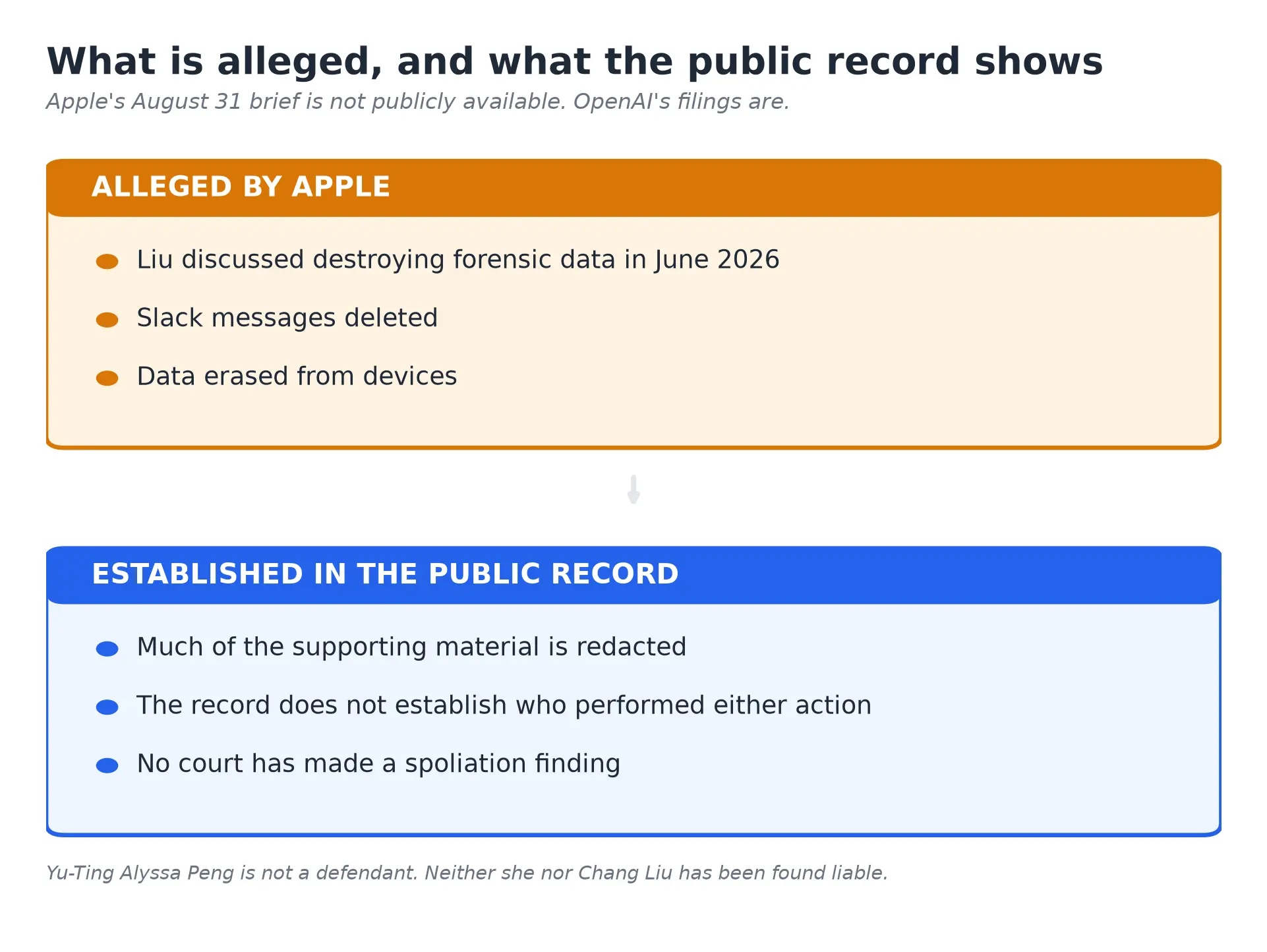
The public record does not establish who performed either action, and much of the underlying material is redacted.
The public record establishes the following:
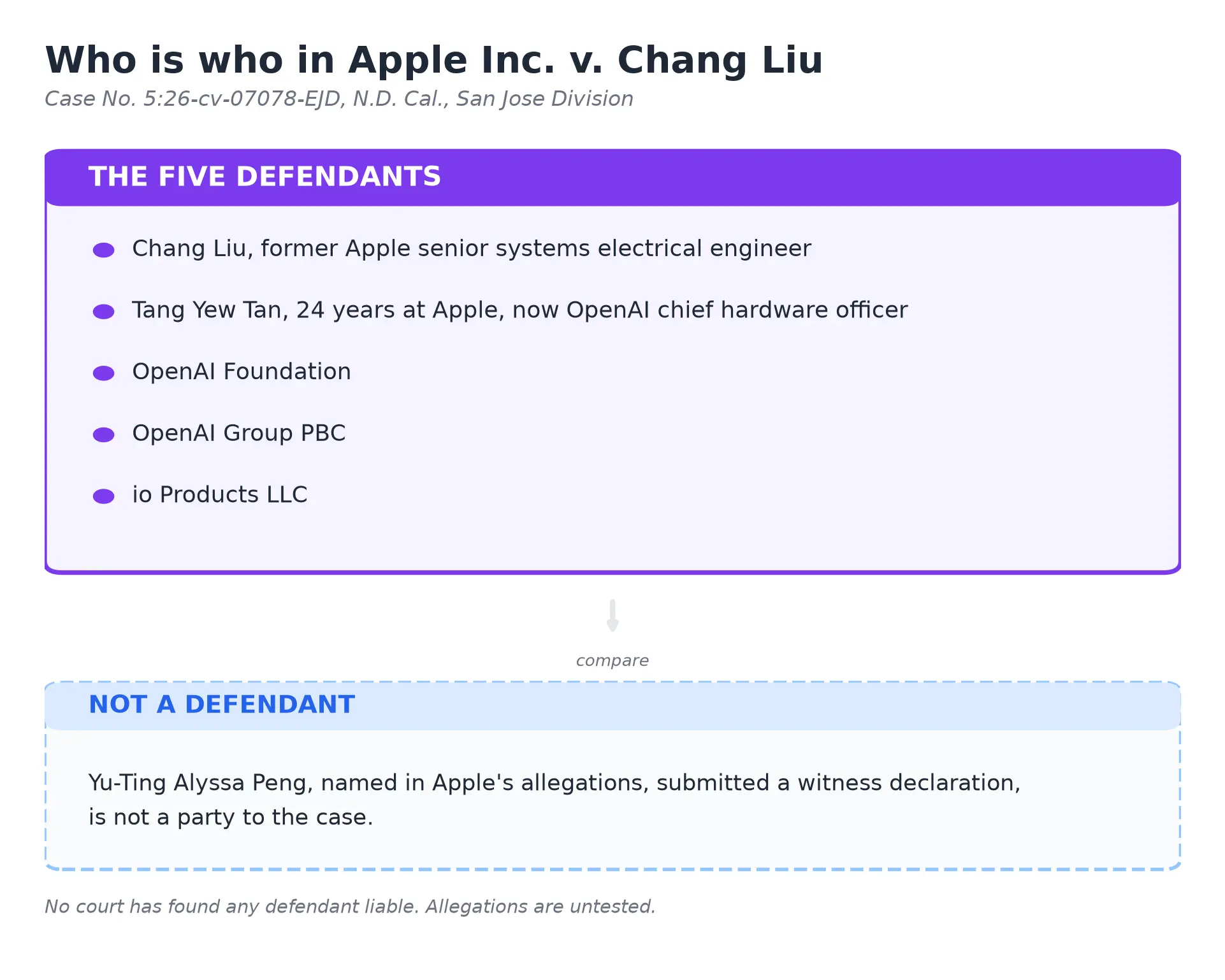
- Peng is not a defendant; the five defendants are Liu, Tang Yew Tan, OpenAI Foundation, OpenAI Group PBC and io Products.
- Neither Liu nor Peng has been found liable of anything.
- At the January and March events at issue, Peng was Liu’s Apple colleague who had taken over many of his responsibilities. The public record reviewed for this article does not establish where Peng was employed in June 2026, the period covered by Apple's evidence-destruction allegation. Apple's filing describes her as an OpenAI colleague.
- Much of the supporting material in the public filing is redacted.
OpenAI's opposition addresses a separate allegation about January and March 2026, denying that Liu coached Peng on any scheme to bypass Apple security and saying he helped her locate documents she was already authorized to access. The public filings reviewed for this article do not contain a response to Apple's separate June evidence-destruction allegation.
How Rule 37(e) decides whether lost evidence carries a penalty
Federal Rule of Civil Procedure 37(e) is why the destruction allegation matters. Losing digital evidence does not automatically carry a penalty: the rule sets a gate, then two levels of consequence. The tougher level requires a finding that a party acted with intent to deprive another party of the information's use in litigation.
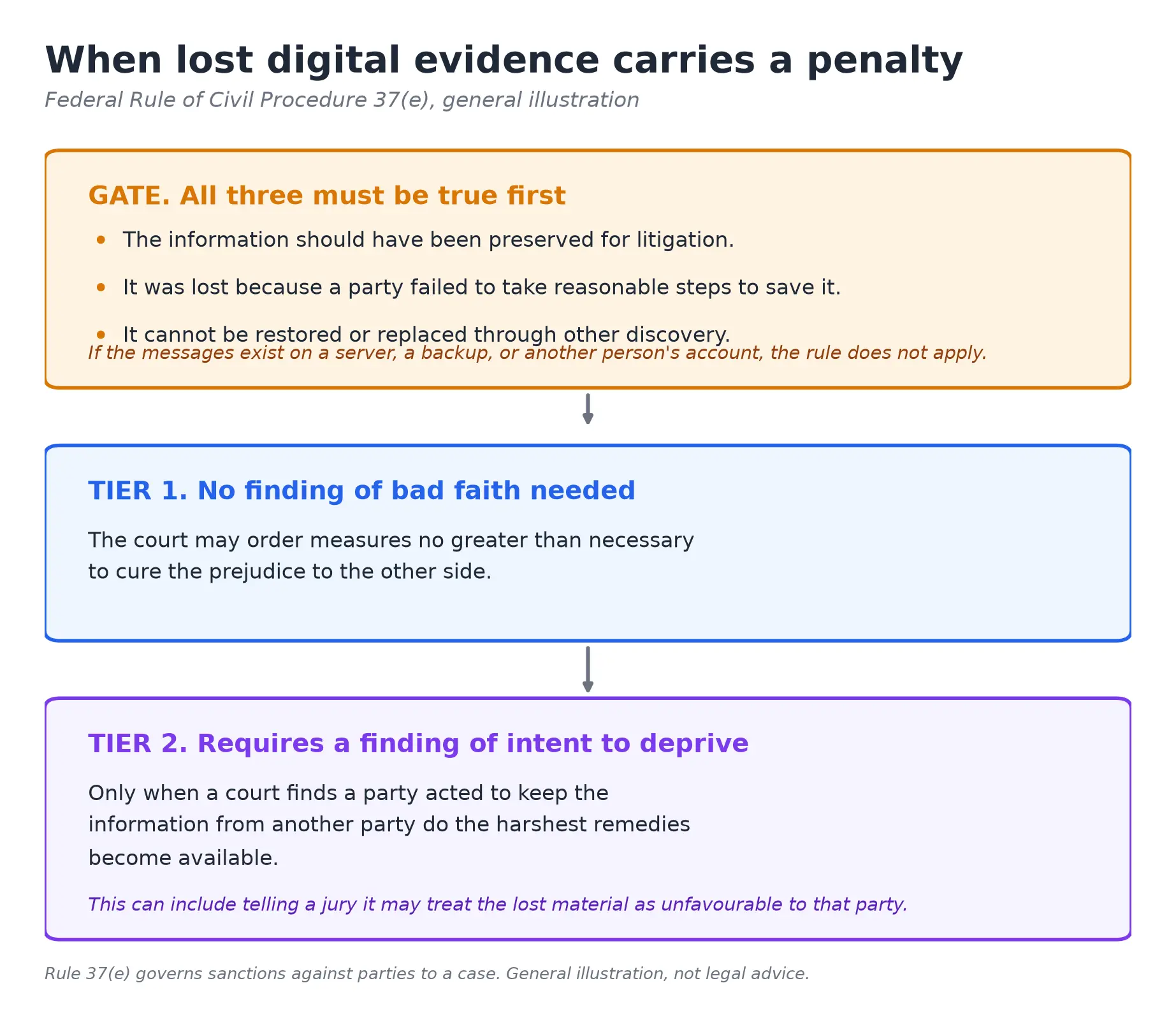
- Gate: the rule applies only where electronically stored information that should have been preserved is lost because a party failed to take reasonable steps to preserve it, and cannot be restored or replaced through additional discovery.
- Slack messages and device data can often be recovered from a server, a backup, or another participant's account; where they can be, the rule does not apply at all.
- First level: past that gate, a court may order measures no greater than necessary to cure prejudice.
- Tougher level: the harshest remedies become available only after a finding that a party acted with intent to deprive another party of the information's use in litigation, including an instruction permitting a jury to treat lost material as unfavourable.
Rule 37(e) governs sanctions against parties, and Peng is not a party to this case.
What Apple is asking the court to do
Apple seeks expedited discovery, including early document production, forensic imaging of devices and accounts, and depositions. It also seeks a preliminary injunction barring use or disclosure of the alleged Apple secrets while the case proceeds. The requested relief concerns alleged confidential information and the evidence needed to investigate it.
There is no verified basis to say Apple asked the court to order a redesign of an unreleased Jony Ive device. That claim has circulated in commentary, but the verified relief is narrower: discovery, imaging, depositions, and a bar on use or disclosure of the alleged material.
OpenAI says an injunction would do far more than preserve the status quo. Its opposition says it would disrupt hundreds of employees developing OpenAI products, cause leakage of OpenAI confidential information to Apple, and create uncertainty for business partners that affects product operations. Those are OpenAI’s stated predictions, not the court’s assessment.
The preliminary-injunction fight turns on urgency as well as the merits. OpenAI says Apple knew of the conduct since at least February 2026 and waited more than five months to move. Citing Oakland Tribune, it argues that such delays “impl[y] a lack of urgency and irreparable harm.”
Apple answers that its counsel received Liu's MacBook from Liu's counsel on Friday, August 21. Apple's forensic expert began reporting preliminary findings on August 26, Apple notified defendants on August 27, and the parties met and conferred on August 28. Apple says defendants then agreed not to oppose its motion.
OpenAI’s defence, in its own words
OpenAI begins its opposition: “This dispute is a mess of Apple’s own making, and it is trying to blame everyone else.” It says Apple encouraged employees to use personal accounts for work, then failed to remove access when workers left. Its filing calls Liu’s residual access a consequence of Apple’s own access management, not a scheme by Liu.
| Issue | Apple's position | OpenAI's position |
|---|---|---|
| The February letter | Apple says it identified suspected theft and got no response. | Apple emailed the wrong person, withdrew a claimed call, and then went silent for five months. |
| Post-employment access | Liu retained access to Apple information. | Apple failed to revoke residual access. |
| The March simulation messages | They describe use of Apple material with an AI agent. | Liu helped a former colleague find material and run comparisons. |
| Tang Tan's departure conduct | Apple alleges Tan directed candidates to bring actual Apple parts. | The parts were old or public demonstrative aids; Tan returned prototypes and launched io Products in late March 2024, after leaving. |
| The trade secret itself | Apple identifies protectable confidential information. | Apple does not identify a protectable trade secret with sufficient particularity. |
| Urgency | Apple says Liu's counsel produced the MacBook on August 21, preliminary findings began on August 26, Apple notified defendants on August 27, and the parties met on August 28. | Apple waited more than five months after knowing of the conduct. |
Apple's positions in this table draw on Apple's public filings and reported quotations from its supplemental brief. OpenAI's positions are quoted from its filed opposition. Apple is represented by Weil, Gotshal & Manges and Desmarais LLP; the defendants are represented by Quinn Emanuel Urquhart & Sullivan.
“If ever a case illustrated the maxim that ‘no good deed goes unpunished,’ this is it.”
OpenAI argues that former workers tried to complete transfers and help former colleagues after being escorted out, and that Apple is blaming them for its offboarding process.
“It is no wonder 400 of them chose new employment,” OpenAI writes, referring to former Apple employees it says left for new jobs.
OpenAI argues that “Apple does not assert any protectable trade secret.” Trade-secret law, its filing says, requires a plaintiff to “describe the subject matter of the trade secret with sufficient particularity to separate it from matters of general knowledge in the trade,” and a party seeking an injunction must show likely success “for at least one, specifically defined, trade secret.”
It challenges reasonable secrecy measures, unauthorized use, causation, contract claims, irreparable harm, and the balance of equities. Its Document 97 opposition also cites Apple Inc. v. Rivos, a 2023 Northern District of California case, against Apple’s attempt to impute alleged individual misconduct to OpenAI.
Where Apple and OpenAI disagree about the facts
- Apple's complaint alleges that Tan directed job candidates still working at Apple to bring actual parts to their interviews for show-and-tell sessions.
- Tan's declaration says he decided to leave Apple in late 2023, that his last day in the office was February 2, 2024, that he first met OpenAI on March 8, 2024, and that he launched io Products in late March 2024 with Jonathan Ive, Scott Cannon and Evans Hankey.
- OpenAI says the parts were old or publicly available demonstrative aids and that this is ordinary engineering-interview practice.
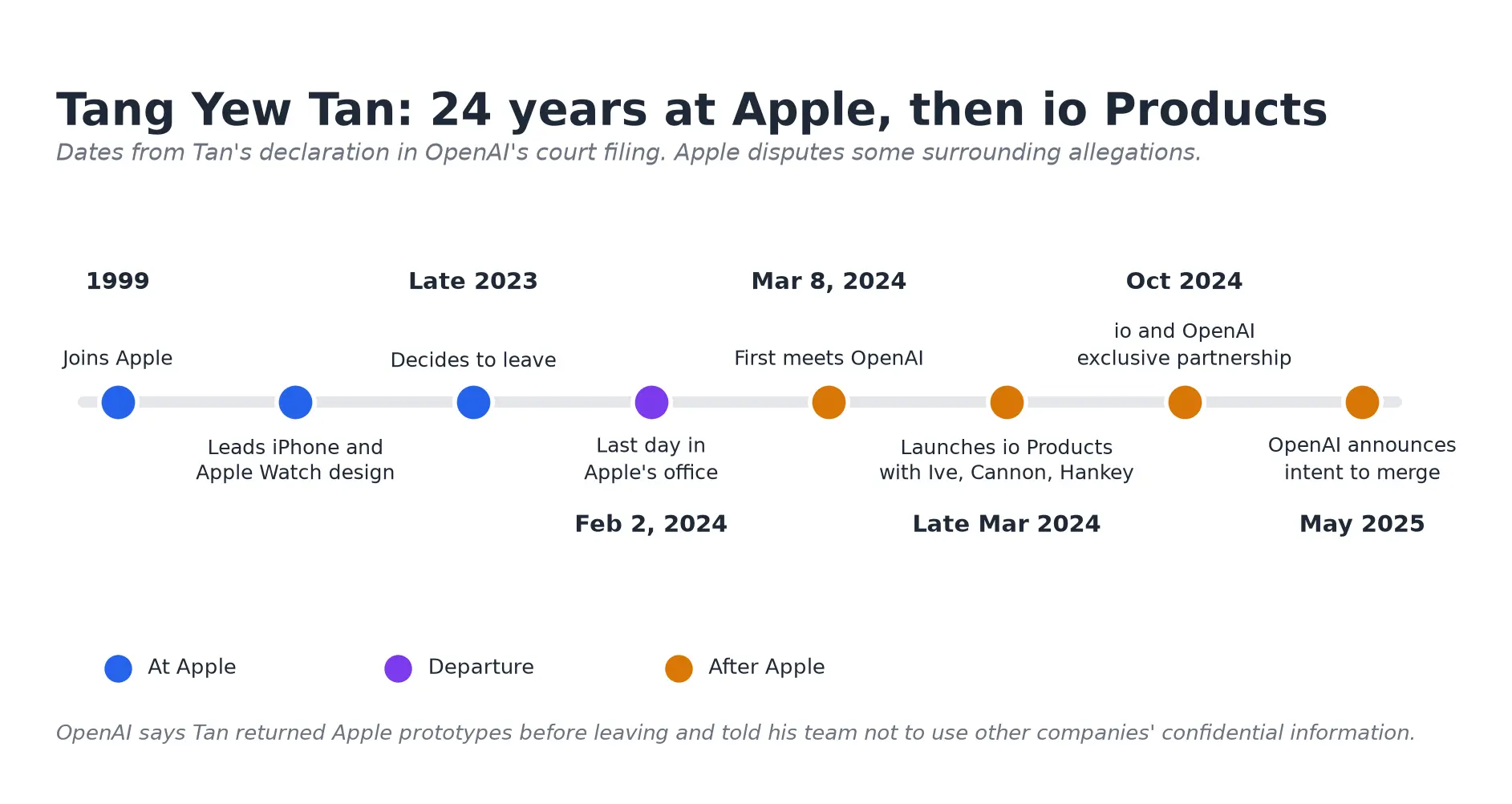
Tang Tan’s account is also part of the defence. Tan spent 24 years at Apple, most recently as Vice President of Product Design, with work on the iPhone and Apple Watch. His last office day was February 2, 2024.
His declaration says he worked to return the Apple prototypes in his possession and sent only non-confidential documents to his personal email; OpenAI says he repeatedly told the team it must not use confidential information from other companies.
The February letter is disputed too. Apple says it sent a letter identifying suspected theft and received no response. OpenAI published emails saying Apple’s outside counsel first emailed the wrong person after confusing similar last names, that Apple conceded a claimed call with OpenAI’s general counsel never happened, and that Apple’s counsel wrote they were “resolving any issues.”
OpenAI says it then heard nothing for five months. OpenAI’s response presents that exchange and the company’s public position.
Apple vs OpenAI timeline: how partners became opponents
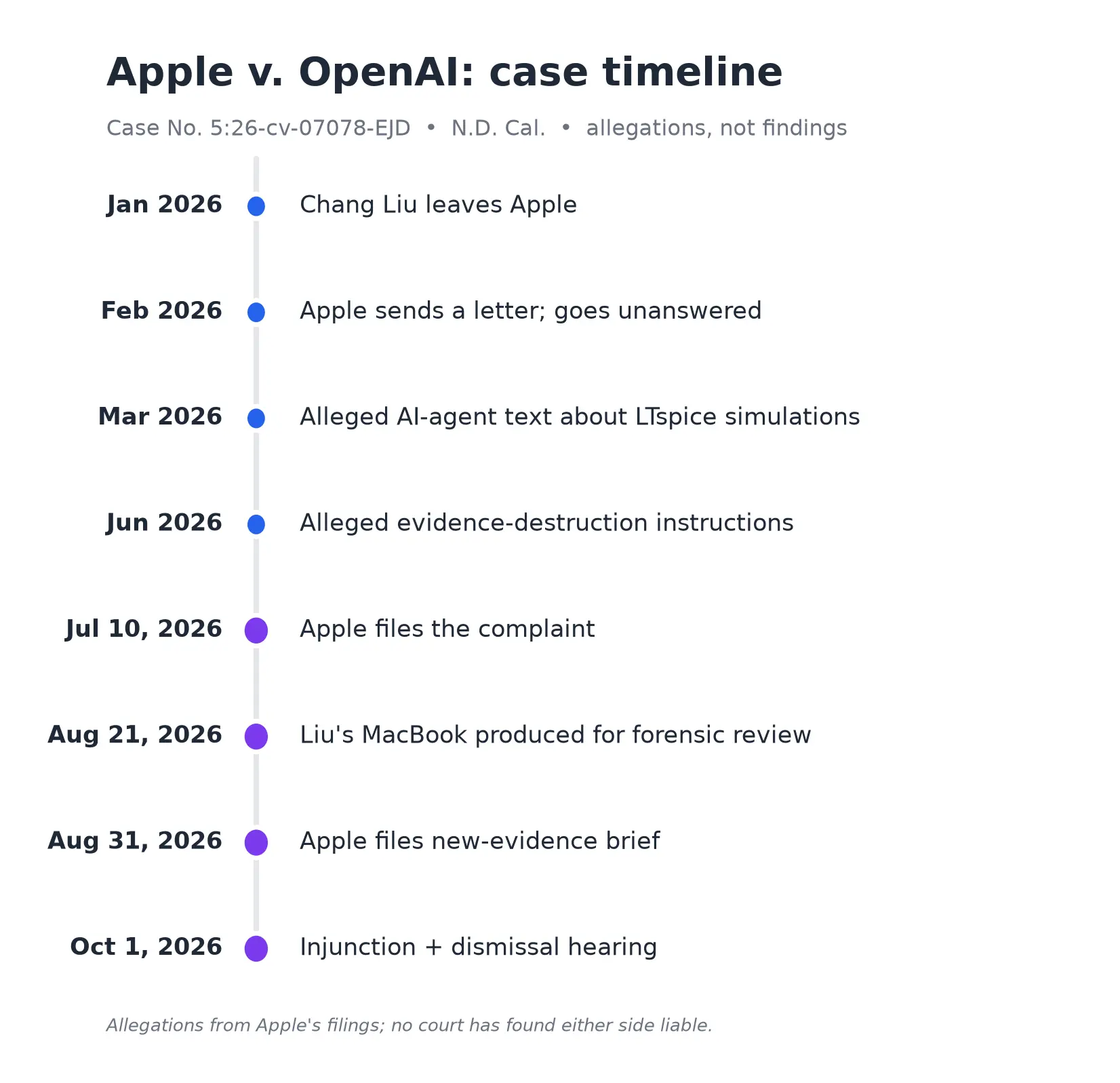
January 12, 2026: Apple announced a Gemini arrangement for the next Siri, changing the commercial backdrop for an earlier Apple Intelligence relationship with ChatGPT. Reports said future iOS choices could include third-party AI backends.
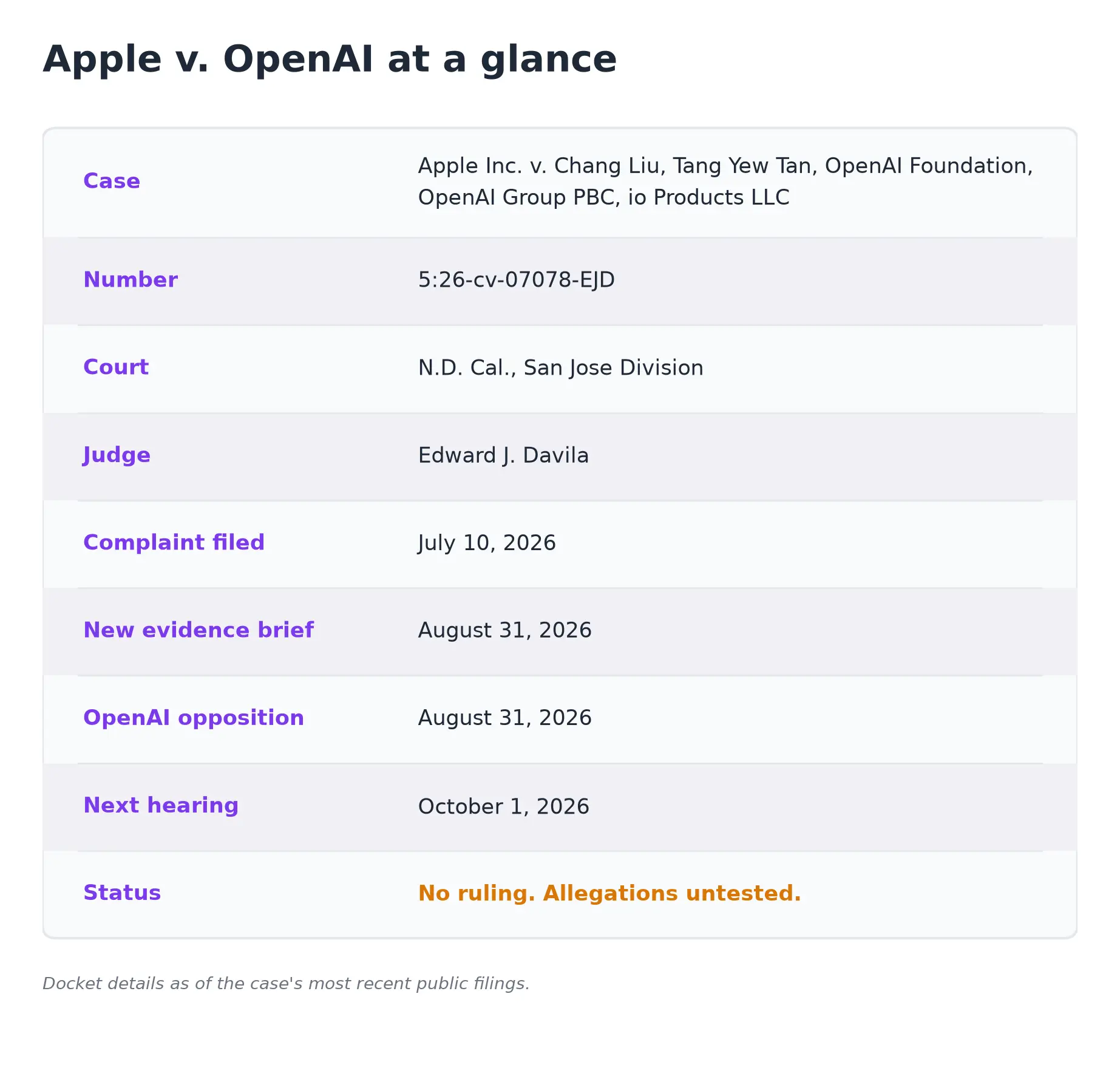
July 10: Apple filed suit. The correct caption is Apple Inc. v. Chang Liu et al., naming Liu, Tang Yew Tan, OpenAI Foundation, OpenAI Group PBC, and io Products. The case is before Judge Edward J. Davila in San Jose.
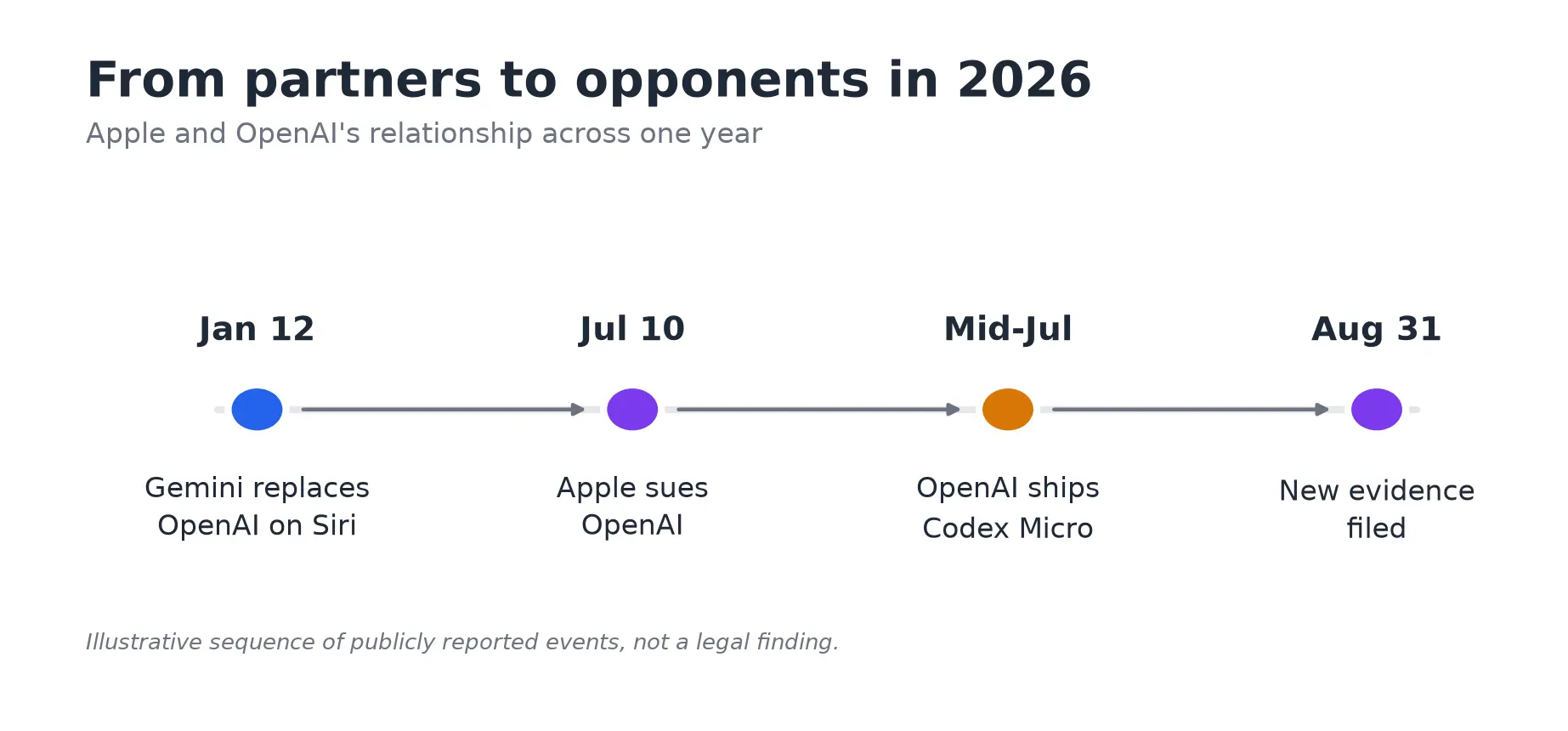
August 31: Apple publicly filed a motion for leave to file a five-page supplemental brief, with the brief as an exhibit. Defendants did not oppose the motion.
The parties' stipulation allowed defendants to file a five-page response by September 4. OpenAI also filed Document 97, its opposition to Apple’s preliminary-injunction motion. An October 1 hearing is scheduled on the pending disputes.
This is distinct from xAI’s earlier antitrust case against Apple and OpenAI over the ChatGPT and Siri arrangement. That Texas case concerns competition allegations, not Apple’s claimed hardware trade secrets.
What the law actually says about trade secrets and AI systems
The Defend Trade Secrets Act sets the test at 18 U.S.C. 1839(3). That test is why a company's own security practices become part of the argument.
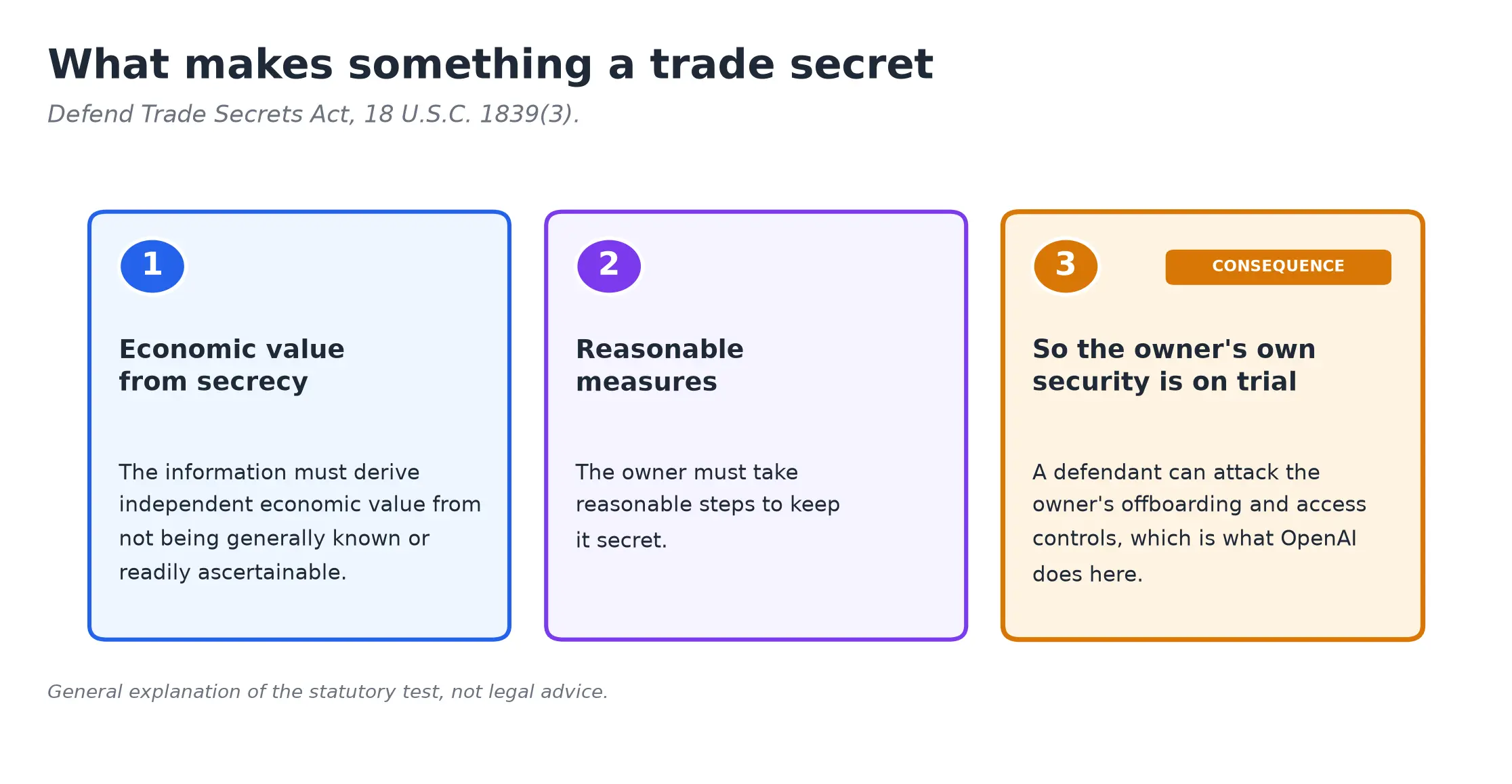
- The information must derive independent economic value from not being generally known or readily ascertainable by others.
- The owner must take reasonable measures to keep it secret.
- Because of that second element, a defendant can attack the owner's security practices, exactly as OpenAI does with Apple's offboarding and iCloud policies.
One possible route to losing trade-secret protection goes beyond simple disclosure. Material sent to a system whose terms permit training may become available through outputs or influence broadly usable model weights, which can bear on secrecy and economic value. Disclosure to a party under no confidentiality obligation can itself defeat secrecy measures.
The mechanics matter. An agent driving simulation software does not change any model's weights; it reads a file and issues commands. What happens is that the file's contents pass through the AI provider's systems, and what the provider may retain or train on is set by the terms of the account being used.
That is one route by which a confidential file may lose protection, and it is analogous to pasting text into a chat window. Apple's factual allegation here concerns an agent running simulations. Its quoted legal position is broader: it covers an AI agent or model that learns from trade-secret information.
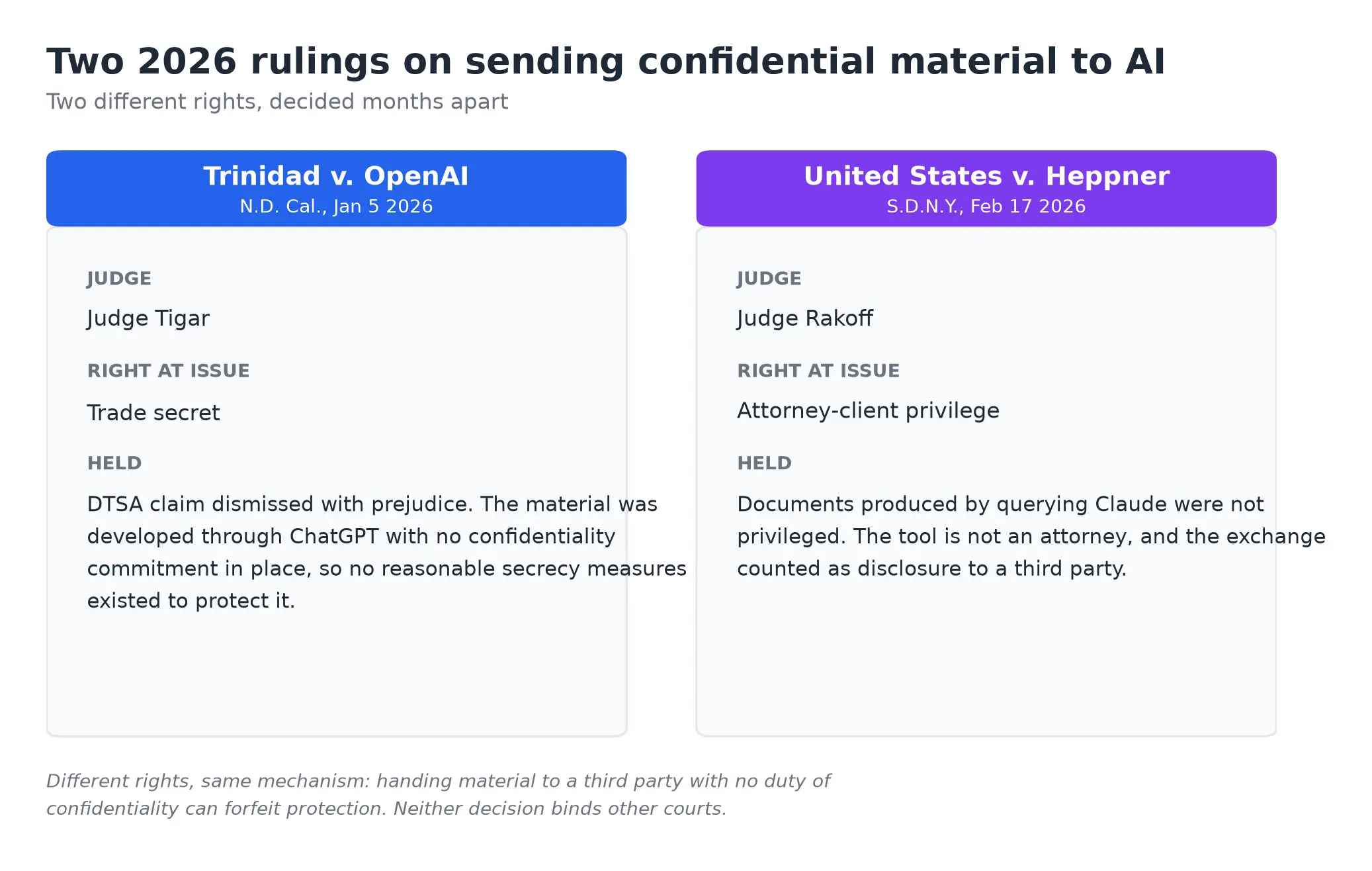
Two 2026 rulings on sending confidential material to AI
Two 2026 rulings show this is not theoretical. In Trinidad v. OpenAI, No. 4:25-cv-06328-JST, Judge Tigar in the Northern District of California dismissed a DTSA claim with prejudice on January 5, 2026.
The plaintiff had developed the claimed material through ChatGPT without any confidentiality commitment, so no reasonable secrecy measures existed to protect. That decision is a district court ruling and does not bind other courts.
In United States v. Heppner, No. 1:25-cr-00503-JSR, Judge Rakoff in the Southern District of New York ruled from the bench on February 10, 2026, with a written opinion following on February 17.
The court found that privilege was waived for documents a defendant produced by querying Anthropic's Claude. It found that the tool is not an attorney and reasoned that sharing with the provider defeated confidentiality.
The two cases protect different rights, yet both turn on the same point: sending confidential material to an AI service can forfeit the protection that depended on keeping it private.
Courts do not presume irreparable harm in trade-secret cases, so a plaintiff seeking an injunction has to prove it.
OpenAI's opposition relies on Caribbean Marine Services Co. v. Baldrige, 844 F.2d 668, 674 (9th Cir. 1988), for the rule that a plaintiff must demonstrate immediate threatened injury as a prerequisite to preliminary injunctive relief, and argues Apple's claimed harm is speculative.
Apple's irreversible-learning language is aimed squarely at that requirement. Courts elsewhere have reached the same conclusion on the presumption, including the Tenth Circuit in First Western Capital Management Co. v. Malamed, 874 F.3d 1136 (10th Cir. 2017), though that decision does not bind the court here.
Could a court undo it? What disgorgement and unlearning can and cannot do
The practical reach of a court order has limits:
- A court can order expedited discovery, forensic imaging, depositions, and a bar on use or disclosure of alleged material, which are the remedies Apple seeks here.
- A preliminary injunction still requires proof of immediate threatened injury; courts do not presume irreparable harm in trade-secret cases.
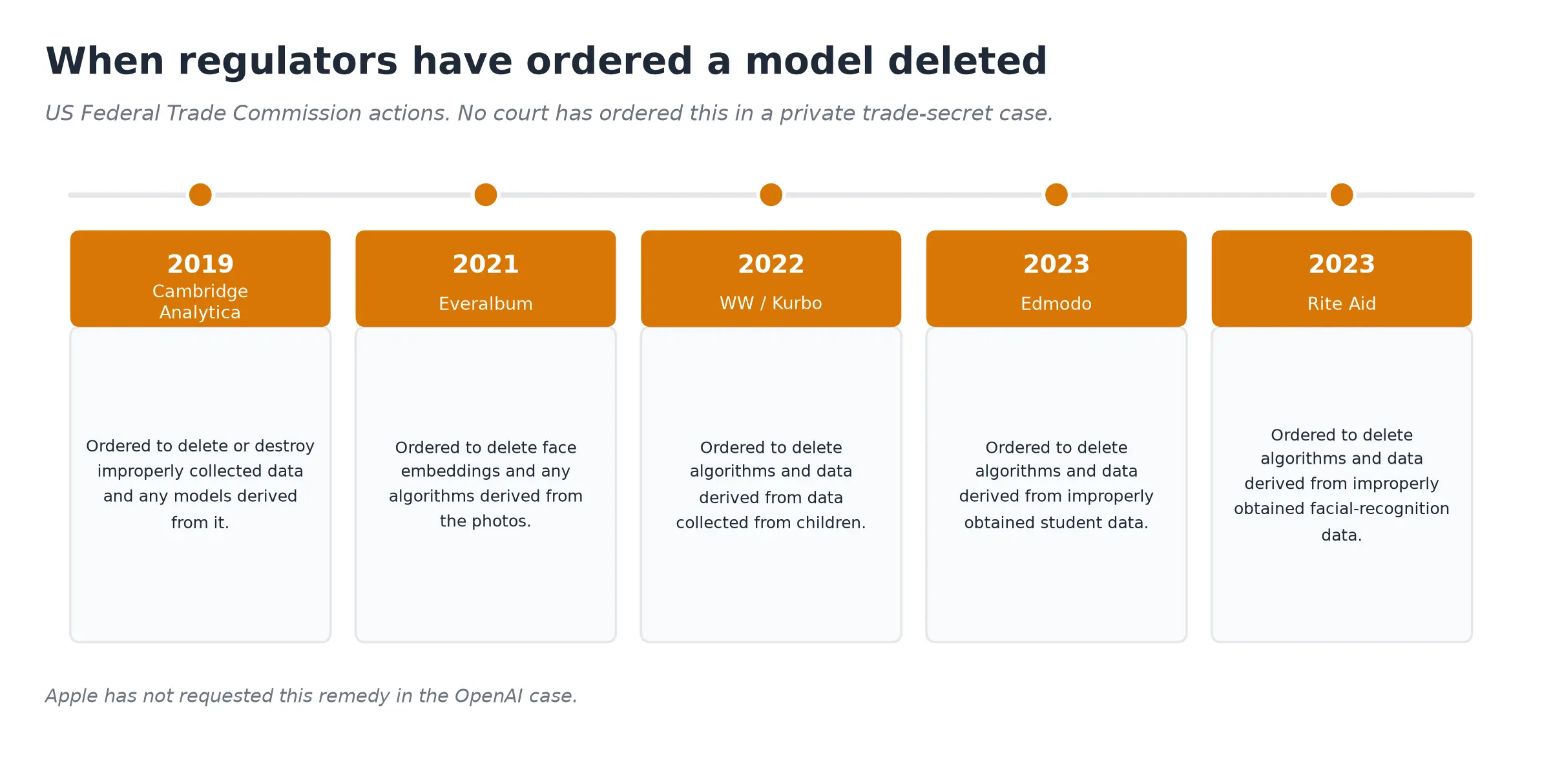
- Consumer-protection orders have required destruction of data-derived models, algorithms, or work product in FTC matters.
- No court has ordered model destruction or machine unlearning in a private trade-secret suit, and Apple has asked for neither remedy in this case.
Algorithmic disgorgement has appeared in FTC matters, including Cambridge Analytica in 2019, Everalbum in 2021, WW/Kurbo in 2022, Edmodo in 2023, and Rite Aid in 2023. Those consumer-protection matters required destruction of data-derived models, algorithms, or work product.
No court has ordered model destruction or machine unlearning in a private trade-secret suit. Apple has asked for neither remedy in this case. Its requested relief is expedited discovery, forensic imaging, depositions, and an order barring use or disclosure of the alleged material.
Machine unlearning is the attempt to selectively remove the influence of specific training data from a trained model. IBM Research says the gold standard, a mathematical guarantee that a data point's influence is gone, typically requires retraining the model from scratch, which is the very cost unlearning exists to avoid.
Faster approximate methods reduce an influence without guaranteeing removal, and aggressive ones can degrade performance on unrelated tasks. That gap is why deleting a source file does not necessarily settle a dispute over an AI system.
What the Apple OpenAI trade secrets lawsuit means for everyday AI use
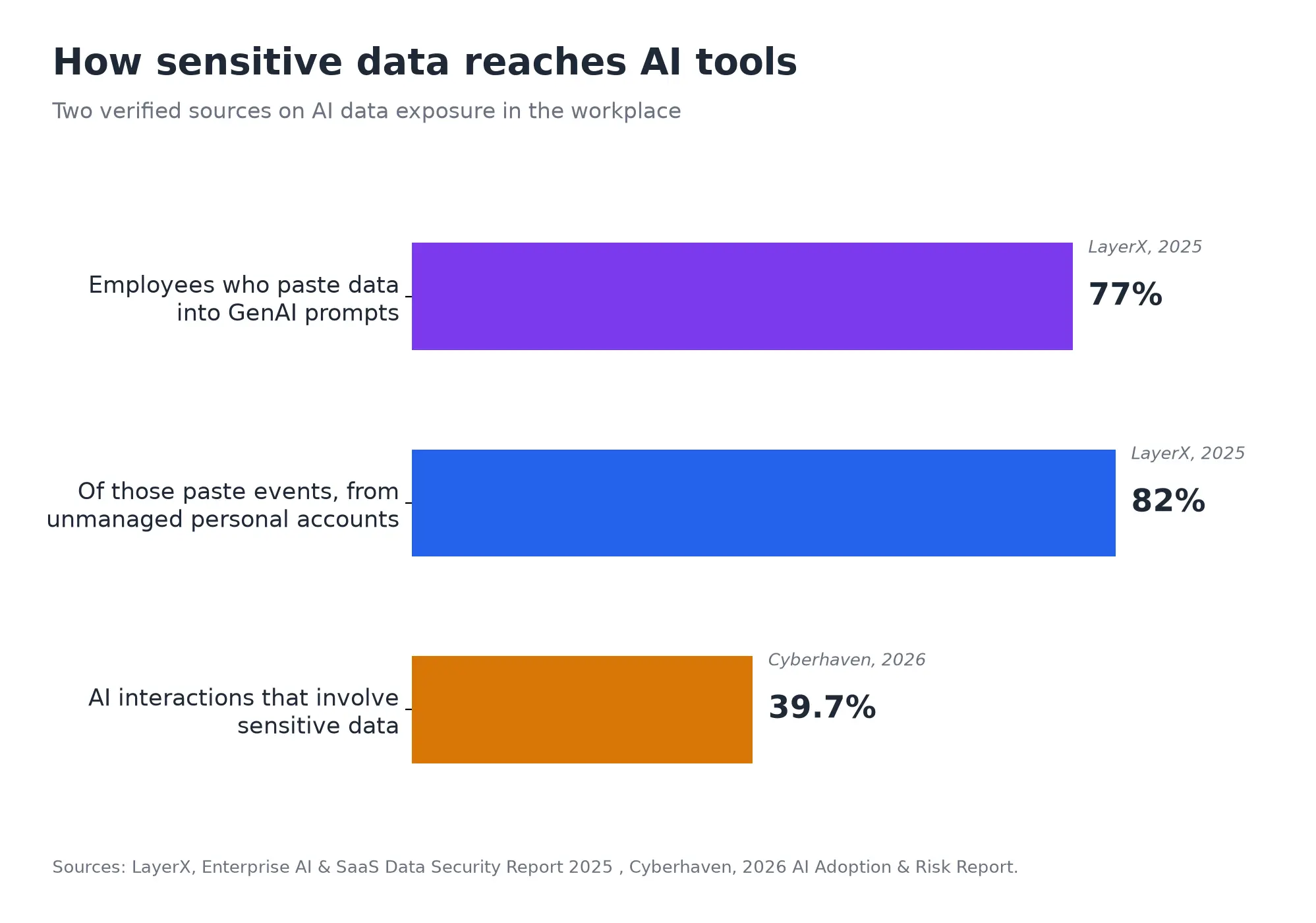
The case is about contested conduct by named people, but the data-handling problem is widespread. LayerX reported in 2025 that 77% of employees paste data into GenAI prompts and that 82% of those pastes come from personal accounts.
Its report does not mean every prompt is sensitive, but it shows how often work moves outside formal controls. LayerX’s findings describe that pattern.
Cyberhaven reported in 2026 that 39.7% of AI interactions involve sensitive data, including prompts, copy-and-paste actions, and uploads. Vendor research should be read with its methodology in mind, yet the figure points to a familiar operational gap: an employee can share a useful work artifact with a public tool before a security team sees it.
The Ponemon Institute and DTEX reported in February 2026 that the average annual insider-risk cost was $19.5 million, up from $17.4 million. Their report said only 18% of organizations had fully integrated AI governance into insider-risk management, and only 19% treated AI agents as insider-risk equivalents.
Readers can apply four checks from the dispute:
- Review access when people leave, including any residual personal-account or iCloud access.
- Know which account tier a tool is on and what its terms say about retention or training.
- Treat the provider’s terms of service as the control over what may happen after a prompt reaches cloud AI.
- Redact identifiers before sending sensitive material to a cloud service.
Professional rules are moving in the same direction. ABA Formal Opinion 512, issued July 29, 2024, says lawyers using generative AI must protect client confidentiality. ABA guidance sits alongside Florida Bar Opinion 24-1 of January 19, 2024 and Texas Opinion 705 of February 2025, both of which require attention to confidentiality and tool policies.
How to protect confidential information before it reaches cloud AI
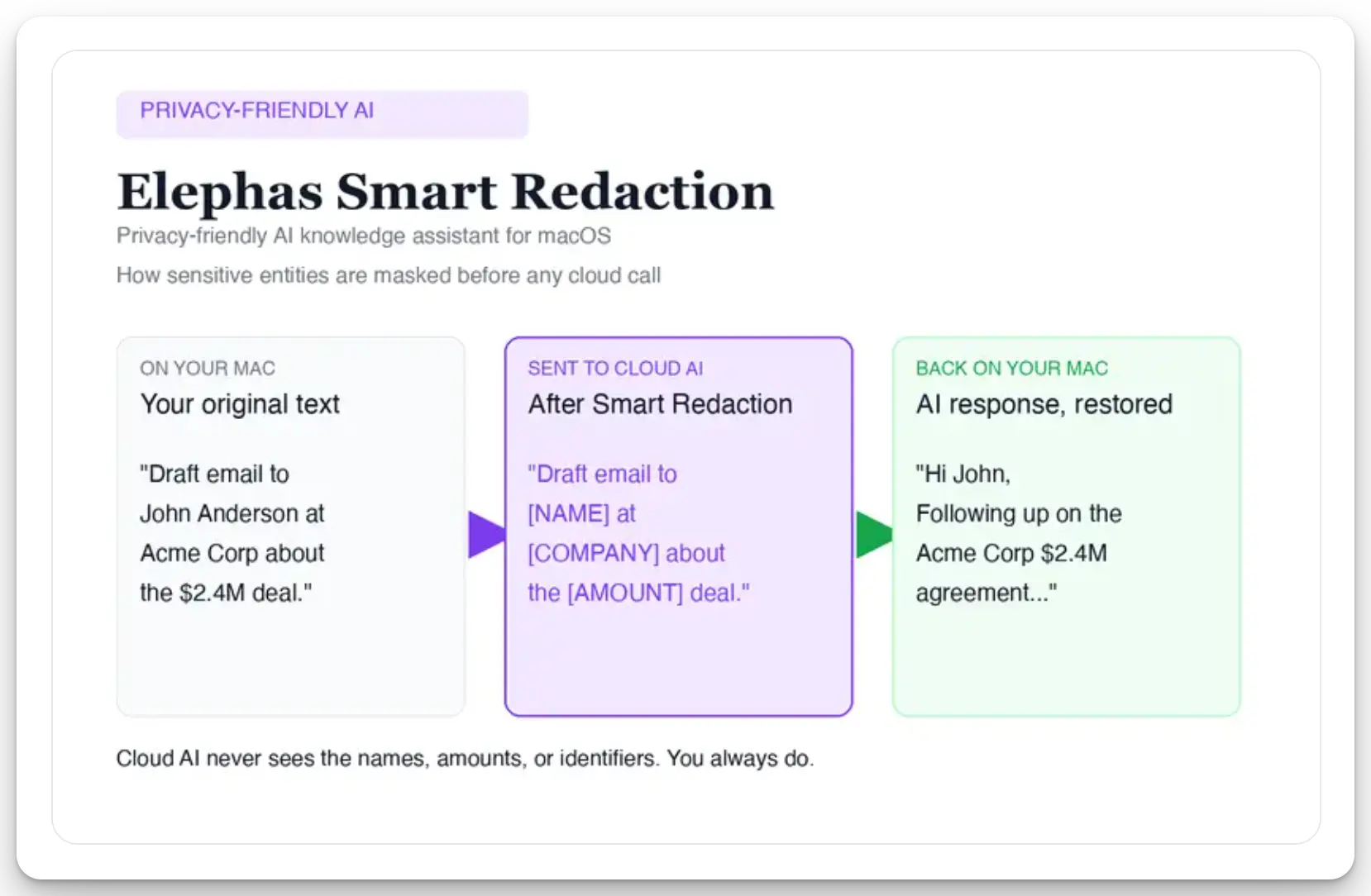
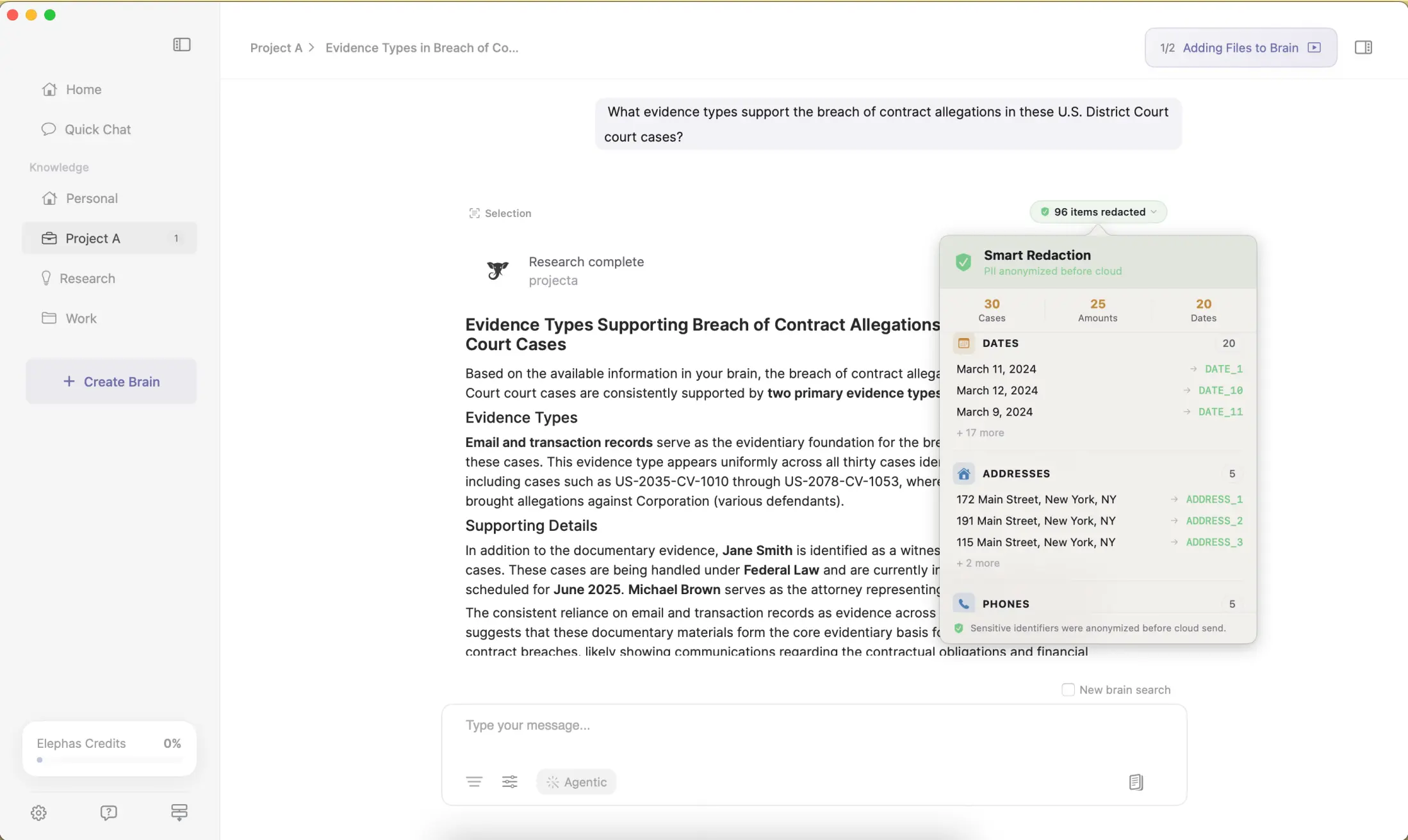
The most practical control happens before a prompt leaves the device. Elephas works with ChatGPT, Claude, Gemini, Grok, Perplexity, or another service: on a local Mac, Smart Redaction removes names, emails, phone numbers, identifiers, and other sensitive text; the redacted prompt goes to cloud AI; the answer returns; and the local app reassembles the result.
For Elephas, the identifying details Smart Redaction removes before sending do not train AI models, remain on the user's Mac rather than a vendor's server, and do not pass through a third-party reviewer's screen.
Smart Redaction has four practical limits and conditions:
- It removes names, emails, phone numbers, identifiers, and other sensitive text before sending.
- It is included on every plan, including Free.
- The redacted prompt is still processed by whichever cloud service the user picks, under that service's own terms.
- It uses automated pattern matching and is not guaranteed to catch every identifier.
Material that must not leave the device should use the local model option. Apple Intelligence context is useful background for Mac users comparing where AI processing occurs.
This does not stop deliberate insider misappropriation of someone else’s files. It protects a user’s own sensitive information before it reaches a cloud model. Elephas starts at $19/month and offers a free trial; its sensitive-data guide covers the same decision from a Mac privacy perspective.
Frequently asked questions
What is the legal name of the Apple case against OpenAI?
The caption is Apple Inc. v. Chang Liu et al. It names five defendants: Liu, Tang Yew Tan, OpenAI Foundation, OpenAI Group PBC, and io Products. It is No. 5:26-cv-07078-EJD in the Northern District of California’s San Jose Division, rather than a case formally captioned only Apple v. OpenAI.
Did Liu keep an Apple work laptop after leaving?
OpenAI’s opposition says no. It says Liu returned both Apple-issued MacBook Pros on January 22, 2026, before leaving Apple. The litigation instead includes disputes about his personal iCloud account, a personal Mac Mini, and whether post-departure access to Apple materials reflected misconduct or failed offboarding.
What does zero-byte evidence mean in this case?
OpenAI says files recovered on Liu’s personal Mac Mini had a reported size of zero bytes. It argues that this supports an inference that they were never opened, copied, or used on that computer and may have transferred during Migration Assistant. Apple has not accepted that explanation, so its weight remains for the court to assess.
Does an AI agent automatically destroy a trade secret?
No. The answer depends on the system, its terms, who can access outputs, and whether the owner still took reasonable secrecy measures. Apple’s brief describes a possible irreversible effect from AI learning, but the case has not produced a ruling that Liu’s alleged use caused a trade secret to lose legal protection.
What are the penalties for deleting evidence in federal court?
A court can tailor measures to cure prejudice from lost electronic evidence. The most serious Rule 37(e) measures require intent to deprive another party of the information’s litigation use. Possible outcomes can include a jury instruction permitting an unfavorable inference, but the rule does not impose that result automatically.
Have Liu or Peng been found liable?
No. Neither Liu nor Peng has been found liable. Apple has made allegations in a civil case. OpenAI and the two individual defendants, Chang Liu and Tang Yew Tan, dispute key facts and legal theories.
Peng is not a defendant and has not filed a response, and Apple's allegations about her conduct are untested. The scheduled proceedings concern discovery, a preliminary injunction, and dismissal arguments rather than a final liability verdict.
What happens next in the Apple OpenAI lawsuit
The October 1 hearing covers Apple's pending motion for expedited discovery. OpenAI's motion to dismiss and Apple's preliminary-injunction motion are also before the court. A ruling for Apple could give it faster access to devices, accounts, and testimony. A ruling for OpenAI could leave Apple with a higher burden to particularize its claimed secrets and show immediate harm.
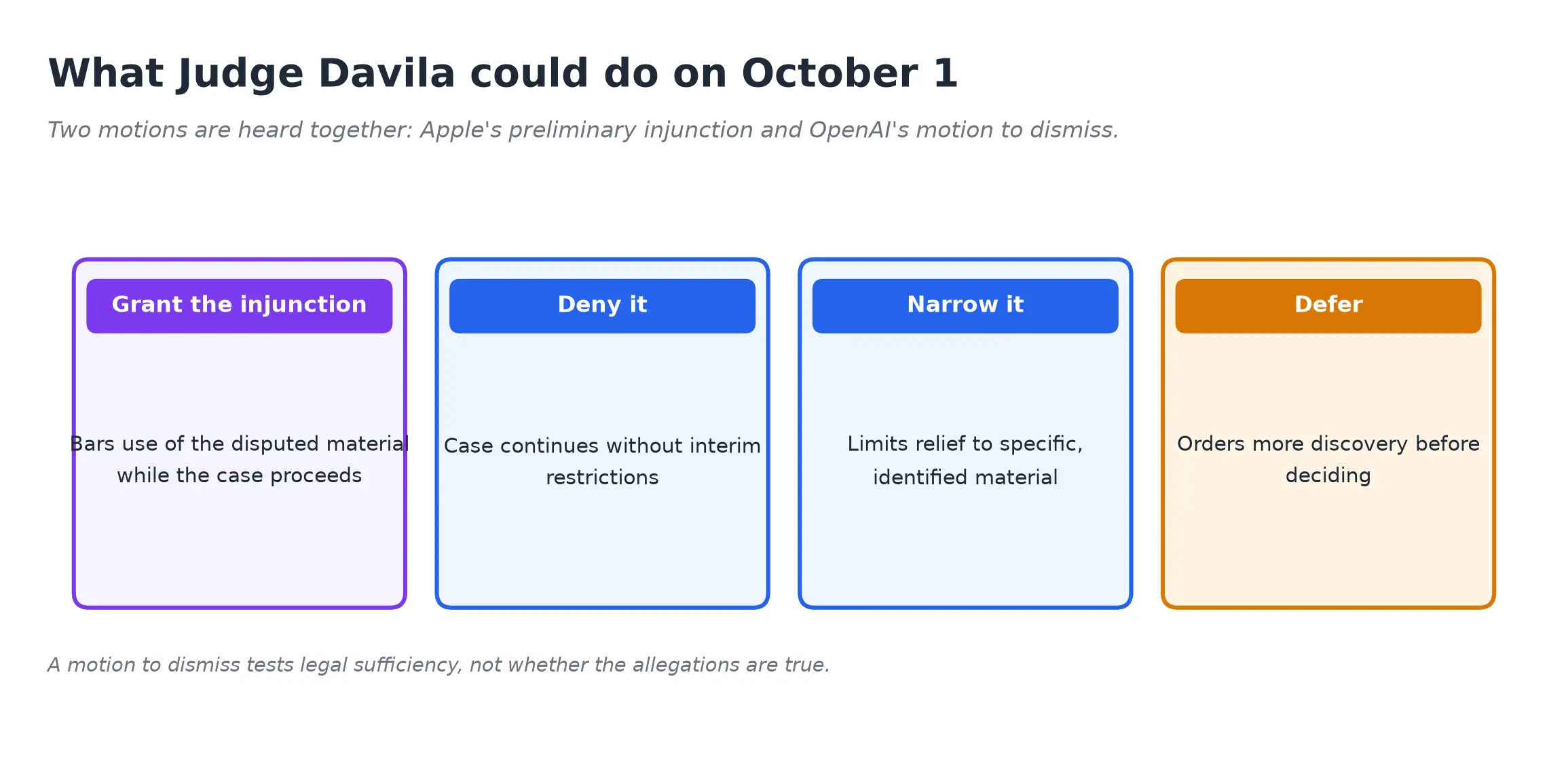
The eventual outcome will not answer every question about AI and confidential information. It may, though, show how a court evaluates technical proof, offboarding controls, and the claimed persistence of data in an AI-assisted workflow.
- The court still has to decide whether Apple’s allegations are supported by evidence that meets the preliminary-injunction standard.
- OpenAI’s filing makes the access-control dispute central, placing Apple’s own secrecy measures under scrutiny.
- Once confidential material reaches a third-party AI service, what happens next is set by that service's terms, not by deleting a local copy.
- For people using cloud AI at work, Elephas offers a Mac-based redact-before-send step for sensitive prompts.

Sources
- Apple Inc. v. Chang Liu et al., No. 5:26-cv-07078-EJD, Document 97 (Defendants' opposition to preliminary injunction, filed Aug 31, 2026)
- Apple Inc. v. Chang Liu et al., Document 59 (OpenAI's motion to dismiss, Aug 6, 2026)
- Apple Inc. v. Chang Liu et al., Document 1 (Apple's complaint, July 10, 2026)
- Apple Inc. v. Chang Liu et al., Document 94 (Apple's motion for leave to file a supplemental brief, Aug 31, 2026)
- OpenAI, “Apple is getting this wrong” (Aug 3, 2026, updated Sept 1, 2026)
- TechCrunch, “Apple shares ‘shocking evidence’ against former employee accused of stealing company data for OpenAI” (Aug 31, 2026)
- MacRumors, “Apple Says Former Engineer Used Stolen Trade Secrets at OpenAI, Taught AI Agent to Run Them” (Aug 31, 2026)
- American Bar Association, Formal Opinion 512 on generative AI (July 29, 2024)
- LayerX, Enterprise AI & SaaS Data Security Report 2025