The Apple Intelligence Lawsuit Explained
Apple sold the iPhone 16 on the promise of a smarter, more personal Siri powered by Apple Intelligence. A lot of that Siri did not arrive on time, and that gap has now turned into a reported $250 million settlement. Here is the part most headlines skip: there is no single Apple Intelligence lawsuit. There are two very different fights, plus a separate question about your privacy, and people keep mixing them up. This article sorts them out, shows whether you can actually get money, and explains what any of it means for your data.
Executive summary
- There is no single Apple Intelligence lawsuit: a marketing or false-advertising case, separate AI training-data suits, and a distinct privacy question.
- The main case, Landsheft v. Apple, is a reported $250M settlement over a more personal Siri that was advertised but delayed.
- Eligible U.S. buyers of iPhone 16 and 15 Pro models (June 10, 2024 to March 29, 2025) may claim a reported ~$25 per device, up to about $95.
- A preliminary approval hearing was reported for June 17, 2026, and the official claim site was not live yet.
- The training-data suits (over the OpenELM model and the pirated Books3 dataset) are about how the AI was built, not consumer refunds, and Apple disputes the link.
- Whatever AI you use, tools like Elephas keep personal data on your Mac and redact it before anything reaches the cloud.
So what is the Apple Intelligence lawsuit, exactly?
When people search for the Apple Intelligence lawsuit, they are usually pointing at one of three separate things. Keeping them apart is the whole trick to understanding the news.
- The marketing case: a consumer class action saying Apple advertised Apple Intelligence features, mainly the upgraded Siri, that shipped late or not at all. This is the one with the $250 million settlement.
- The training-data cases: authors and creators saying Apple built its AI using their work without permission. These are about how the AI was made, not about your phone.
- The privacy question: a worry, not really a lawsuit, about whether your personal data was used. Apple says it was not.
Only the first one might put money in a regular owner's pocket. The rest are worth understanding, but they are different stories.
What Apple promised vs what actually shipped
At its June 2024 developer conference, Apple showed a Siri that could see what was on your screen, understand personal context, and take action across your apps. Apple leaned on that vision again to sell the iPhone 16 in September 2024. The problem was timing. Some Apple Intelligence tools shipped on schedule, but the headline Siri kept slipping, and in early 2025 Apple confirmed the most personal parts were delayed.
- Shipped roughly on time: writing tools, notification summaries, the cleanup photo tool, and Genmoji.
- Delayed well past launch: the context-aware, on-screen-aware more personal Siri that was central to the marketing.
- Why it slipped: Apple has said the more personal Siri needed more time to meet its quality bar, and reporting suggests it was harder to make reliable than the demos implied.
- The frustration online: a common complaint is that buyers paid for a phone sold on features that were not ready, and that the new Siri people were promised still is not the Siri they have.
The main case: false advertising over a Siri that ran late
The lead lawsuit is the Apple Intelligence Siri lawsuit, a consumer class action called Landsheft v. Apple Inc. (case no. 5:25-cv-02668) in the Northern District of California. The core claim is that Apple ran an Apple false advertising risk by marketing Apple Intelligence capabilities, especially the smarter Siri, that it did not deliver as shown. In May 2026, reporting said Apple agreed to a $250 million settlement to resolve the claims.
- It is about marketing, not stolen data. The complaint is that the advertising oversold what the iPhone 16 could actually do at launch.
- What buyers want: money back for paying a premium for AI features that were promised but missing or late.
- Apple denies wrongdoing. Like most settlements, Apple is paying to close the matter without admitting fault.
- A settlement is not a verdict. A court still has to approve it, and a preliminary approval hearing was reported for June 17, 2026.
"Am I owed money?" Who can claim from the settlement
The first question most people have about the Apple Intelligence settlement is whether they qualify. Based on the reported terms, eligibility is tied to specific devices and a specific purchase window, not to whether you personally used Siri.
- Who qualifies: U.S. residents who bought an iPhone 16, 16e, 16 Plus, 16 Pro, 16 Pro Max, 15 Pro, or 15 Pro Max between June 10, 2024 and March 29, 2025, and not for resale.
- How much: about $25 per eligible device, reportedly up to around $95, with the exact amount depending on how many people file.
- How to claim: an official claim site was not live yet as of late June 2026. When it opens, use only the official notice from the court or Apple.
- If you returned or traded in the phone: you may still qualify, since eligibility is tied to the purchase, not to whether you still own the device.
Watch for scams. Never hand over a card number, Social Security number, or Apple password to a site that guarantees your payout. The real claim process will not ask for payment, and you can verify it against Apple's own notices first.
The other lawsuits people mix this up with: AI training data
Search results blur the marketing case together with a very different group of cases. The Apple AI training-data lawsuit is not about your refund at all. It is about how Apple built its models. Authors filed suits in 2025 saying Apple used pirated books to train AI, pointing at Apple's OpenELM model and the Books3 dataset, a known collection of pirated titles. Apple's response is that OpenELM is a small research model and is not what powers the Apple Intelligence features on your phone.
| Marketing case | Training-data cases | Privacy question | |
|---|---|---|---|
| What it is about | Late or undelivered Apple Intelligence features | Copyrighted books used to train AI | Whether your personal data was used |
| Who is suing | iPhone buyers (class action) | Authors and creators | No suit, mostly a public concern |
| Could it pay you | Yes, the $250M settlement | No, not consumers | No |
| Apple's position | Denies wrongdoing, settling | Disputes the link to its shipping AI | Says it does not train on your data |
- Apple is not alone. Similar pirated-data claims have been filed against other large AI companies too, often over the same Books3 collection. Anthropic, for example, reportedly agreed to a roughly $1.5 billion author settlement.
- It does not create a consumer payout. Even if authors win, that money goes to rights holders, not to people who bought an iPhone.
What the Apple Intelligence lawsuit means for your data
Underneath all of this sits the question people really care about: is Apple Intelligencesafe to use, and was my personal information fed into an AI? On Apple's own account, the marketing case is not about your data being taken, and Apple says it does not use your personal content or iCloud data to train Apple Intelligence. Apple also runs much of its AI on your device, and routes heavier requests through Private Cloud Compute, which it says does not store your data or expose it to Apple.
The bigger lesson is about cloud AI in general, not just Apple. The moment you paste something into any cloud assistant, that text can leave your machine. That is the part you control, and it is where a tool like Elephas helps.
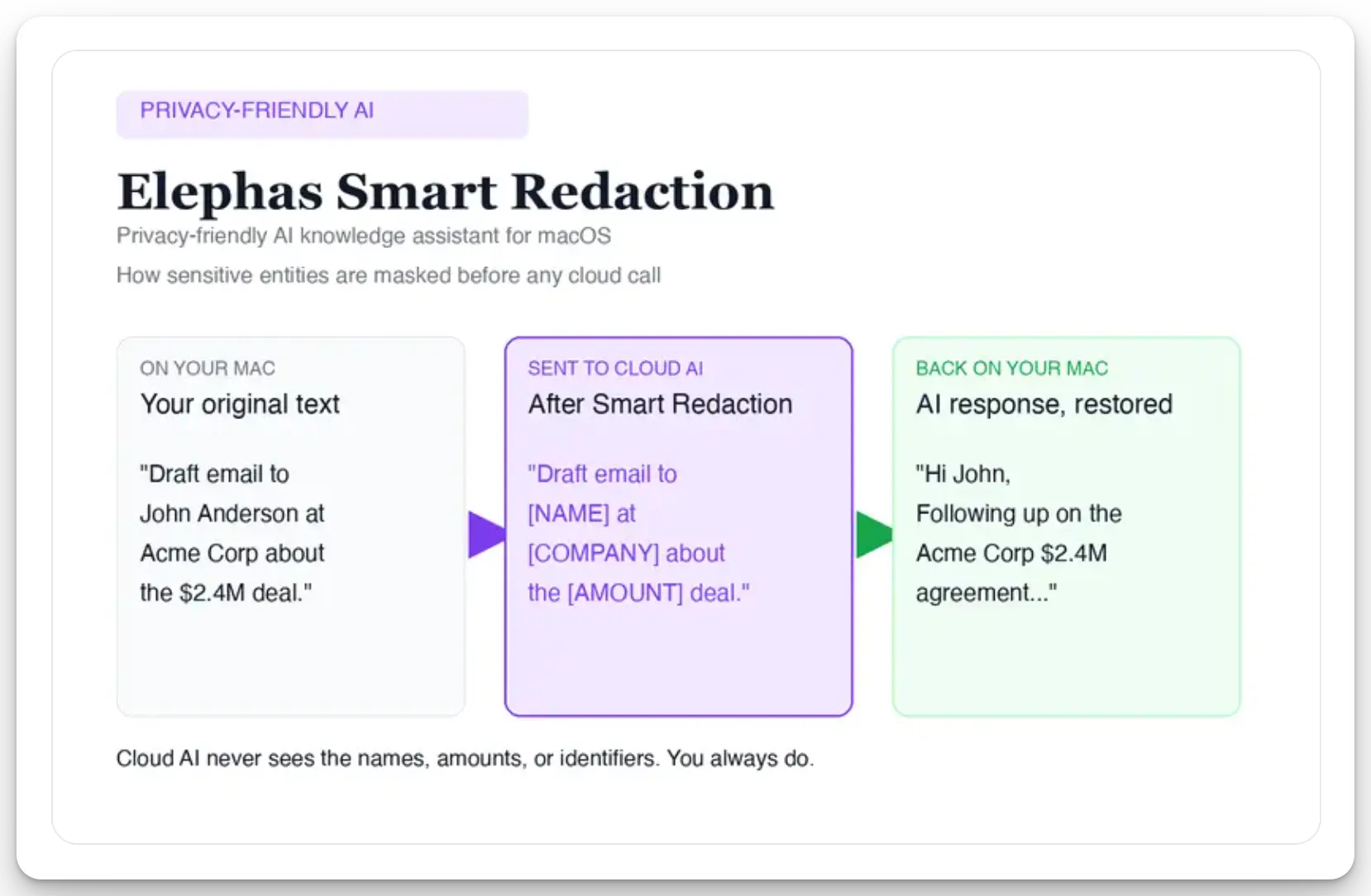
- It runs on your Mac. Elephas works across your everyday Mac apps, so your notes, drafts, and documents stay where they already live.
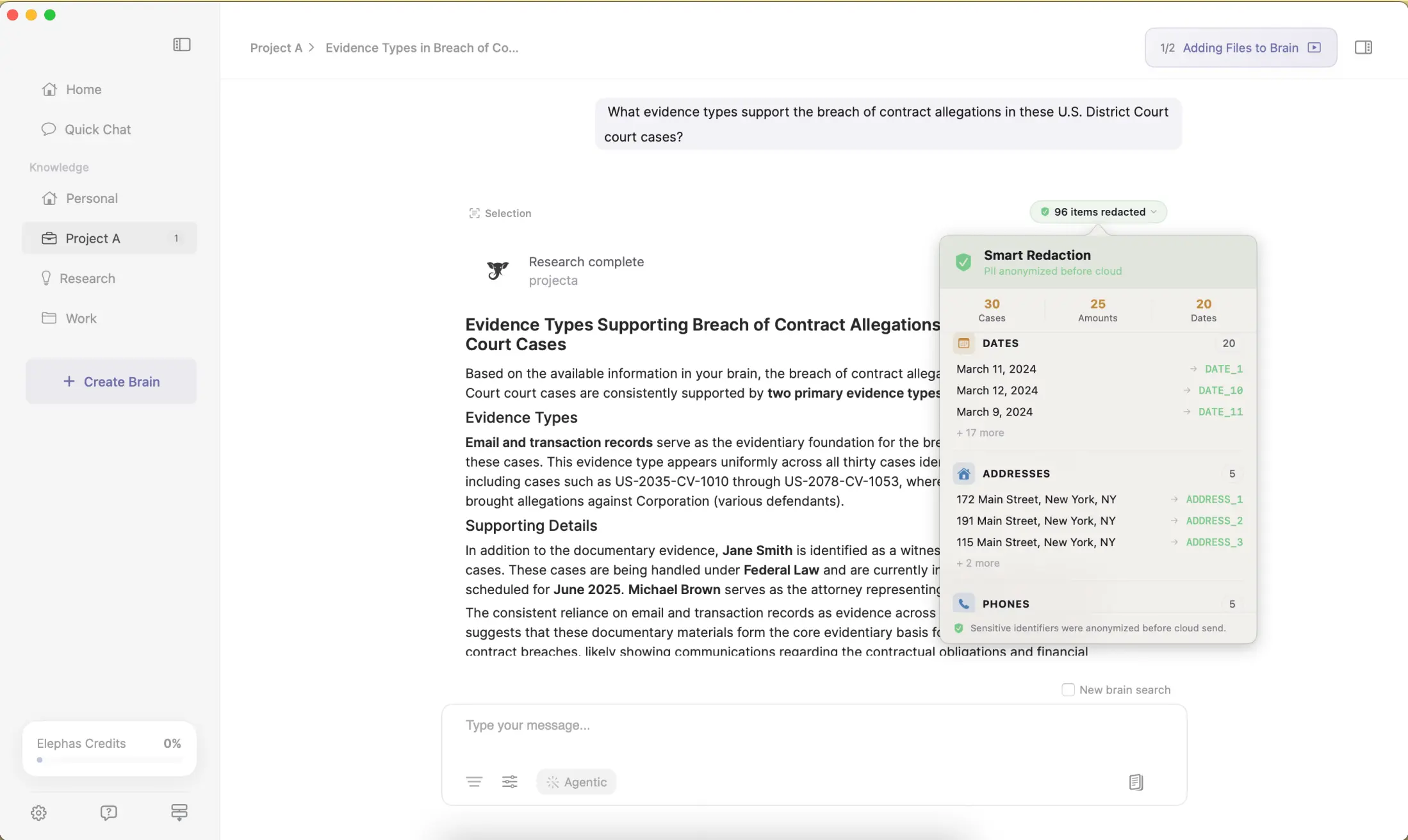
- It redacts before the cloud. With Smart Redaction, Elephas masks personal details like names, emails, and numbers before any text is sent to a cloud model, then restores them locally in the answer, so sensitive data does not travel with your request.
- It is built around privacy and accuracy. Answers can be grounded in your own documents and cited, and you can pair Elephas with the AI models you already use rather than replacing them.
- You stay in control of the basics too. Whatever AI you use, it is worth checking your Apple Intelligence and Siri settings and being deliberate about what you paste into any cloud assistant in the first place.
If keeping control of what leaves your Mac matters to you, Elephas starts from $19/month, and you can try Elephas for free first.
The bottom line: which lawsuit actually affects you
If you bought a qualifying iPhone, the marketing settlement is the one to watch, because it is the only track that might send you a small payment once the court signs off. The training-data cases are real and serious, but they are about how AI gets built and pay authors, not buyers. And the privacy worry, by Apple's account, is a separate matter from both. As for whether you should still trust Apple Intelligence, the honest answer is that the features which shipped still work as they do today. The lawsuit is mostly a lesson about believing demos before they ship, and about knowing where your data goes when you use any AI.
Sources
- TechCrunch — Apple to pay $250M to settle lawsuit over Siri's delayed AI features
- MacRumors — Apple class action Siri lawsuit settlement
- Fortune — Smarter Siri $95 class-action refund
- AppleInsider — Authors sue over pirated books for Apple Intelligence training
- Apple — Apple Intelligence and Private Cloud Compute