Best AI for Accountants in 2026: A Privacy-First Ranking
Every other list of the best AI tools for accountants ranks each accounting tool on features, G2 stars, and auto-categorization accuracy. This ranking scores them on client-data handling across real accounting workflows, which is what AICPA Rule 1.700 and IRC § 7216 actually care about.
The ten AI tools for accounting below span the full accounting tech stack, document work, close management, lease accounting, practice management, autonomous AP, AI-native general ledger, and journal-entry drafting. Automation and financial reporting power matter, but the privacy question separates the best AI accounting tool options more than the feature question ever will.
47
commenters in one r/Accounting thread debated whether a pasted client email counts as confidential data after a same-day firing
$825B
of pooled real-world transactions train one of these tools’ global AI model
4 of 10
tools (Vic.ai, Stampli, Digits, Intuit) train AI on customer-derived data with no clean opt-out, the question feature comparisons never ask
10
tools tested across 6 privacy criteria, and only 1 holds ISO/IEC 42001
Executive Summary
Ten tools, ranked on one axis: where your client’s data goes, and whether the vendor trains its AI on it. Every other list orders these tools by features and G2 stars. This one orders them by client-data handling, which is what AICPA Rule 1.700 and IRC § 7216 actually police.
- Local-first winner, #1 Elephas. The only tool where source files never leave the Mac. Documents index locally, automatic PII redaction (beta) ships on every plan including Free, and nothing is ever uploaded to train a cloud model.
- Cloud, contractually no training, #2 to #4. FloQast (enterprise close management), Trullion (lease accounting and audit), and Karbon (practice management). Client data lives in the cloud but stays isolated, backed by a written commitment not to train AI on it.
- The mixed middle, #5 to #7. Vic.ai trains a global model on derived header data across customers. Truewind leaves customer-specific training open but ships a rare PII-redaction layer. Stampli’s Billy bot learns across $150 billion in cross-customer spend with no tenant-isolation guarantee.
- Bottom on privacy, #8 to #10. Booke.ai makes a strong promise but offers thin verification. Digits pools transaction patterns at its $825 billion global tier. Intuit Assist reserves the right to train its own AI on client books.
- Elephas is the pair, not the replacement. It owns the document and memo side alongside whichever platform a firm already runs; it does not replace the close, AP, or ledger tools above.
Why You Need a Privacy-First Ranking, Not a Feature Ranking
AICPA Rule 1.700 forbids disclosure of confidential client information without consent. AICPA SSTS § 1.4.2, effective January 1, 2024, explicitly names AI as a regulated tool. IRC § 7216 treats unauthorized disclosure or use of tax-return information as a federal misdemeanor, with the FTC Safeguards Rule layered on top under Gramm-Leach-Bliley.
Each cloud AI vendor is a third-party recipient under every one of those rules. The variable separating a compliant workflow from a § 7216 referral is whether client data left the firm’s control, and under what terms. That split is exactly where local AI and cloud AI diverge on data safety.
Here is what that looks like at ground level. In February 2026, a tax-firm accountant pasted one client email into ChatGPT to soften the tone, IT flagged it, and the firm terminated employment the same day. The r/Accounting thread that followed pulled in 47 comments and almost no sympathy.
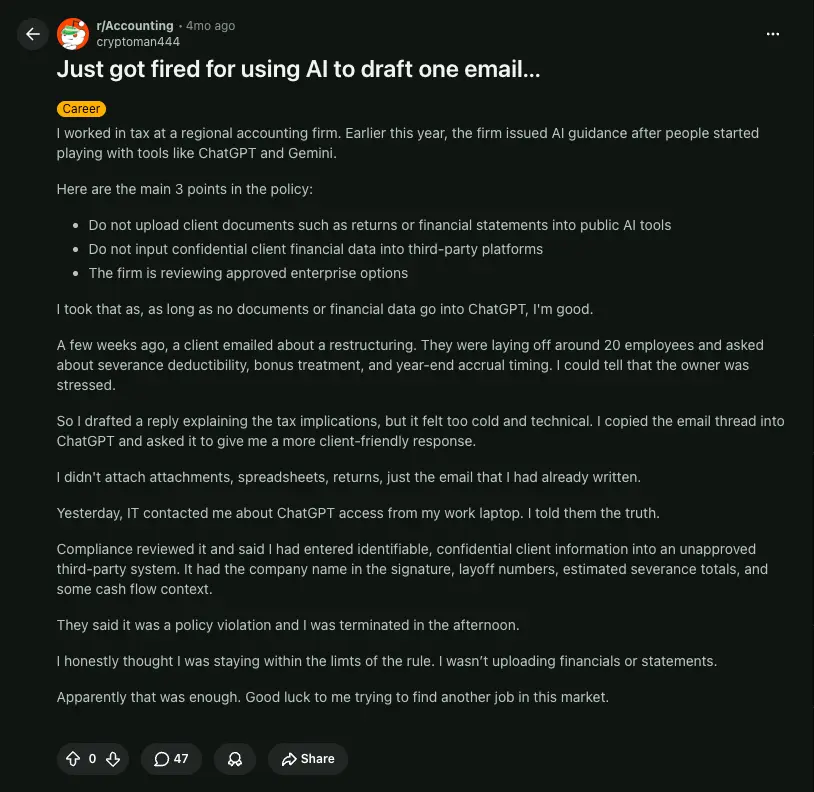
“Gonna sound harsh, but severance totals, layoff numbers, and cash flow are client data. Just because it's not in a spreadsheet doesn't mean it's not data.”
Most commenters sided with the firm. The client’s name in the email signature was already a confidentiality breach before any numbers were factored in. One previous favorite, Botkeeper, shut down February 7, 2026; Xendoo acquired only the “Infinite” technology. The category is moving fast, which is why client-data handling is the question to ask first.
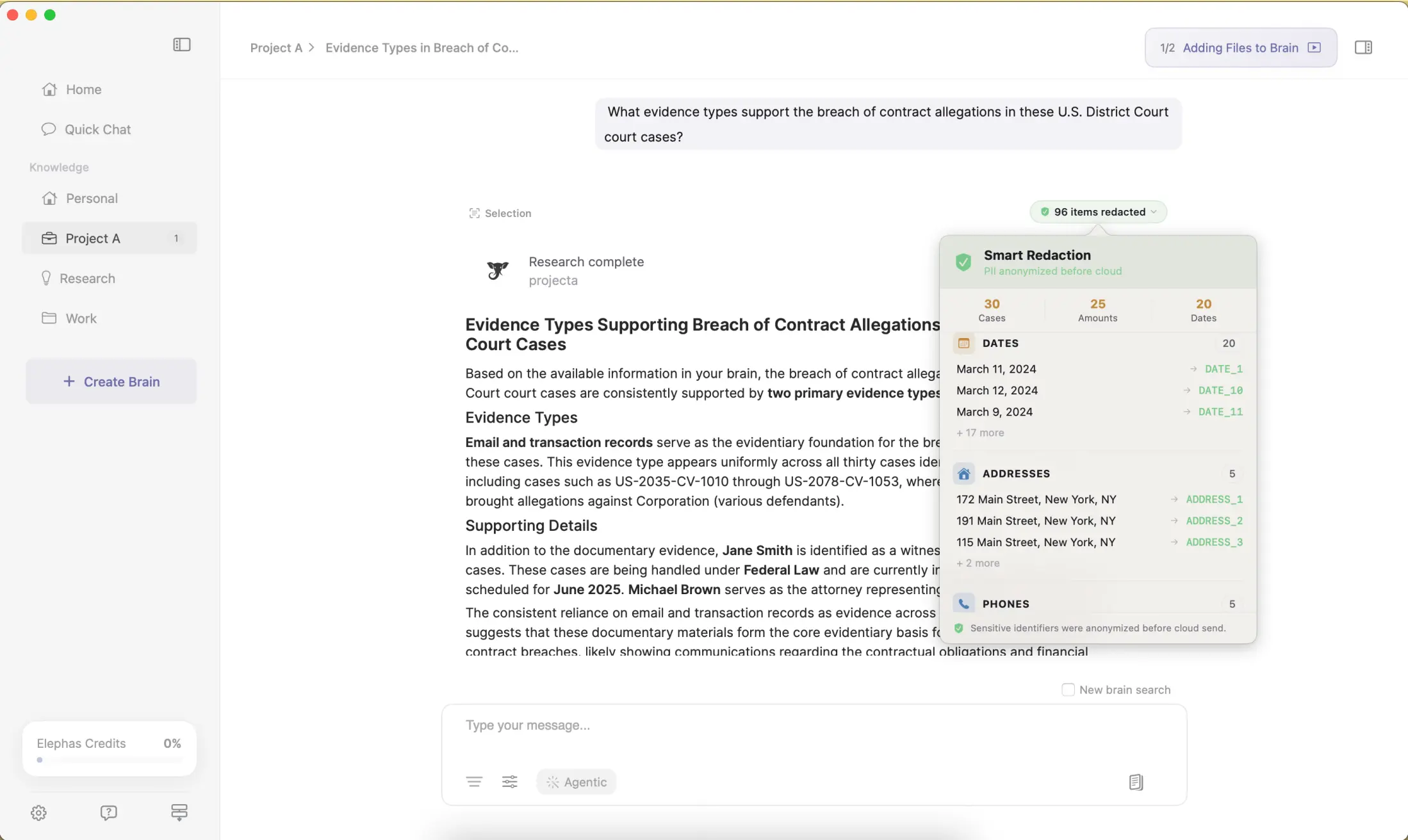
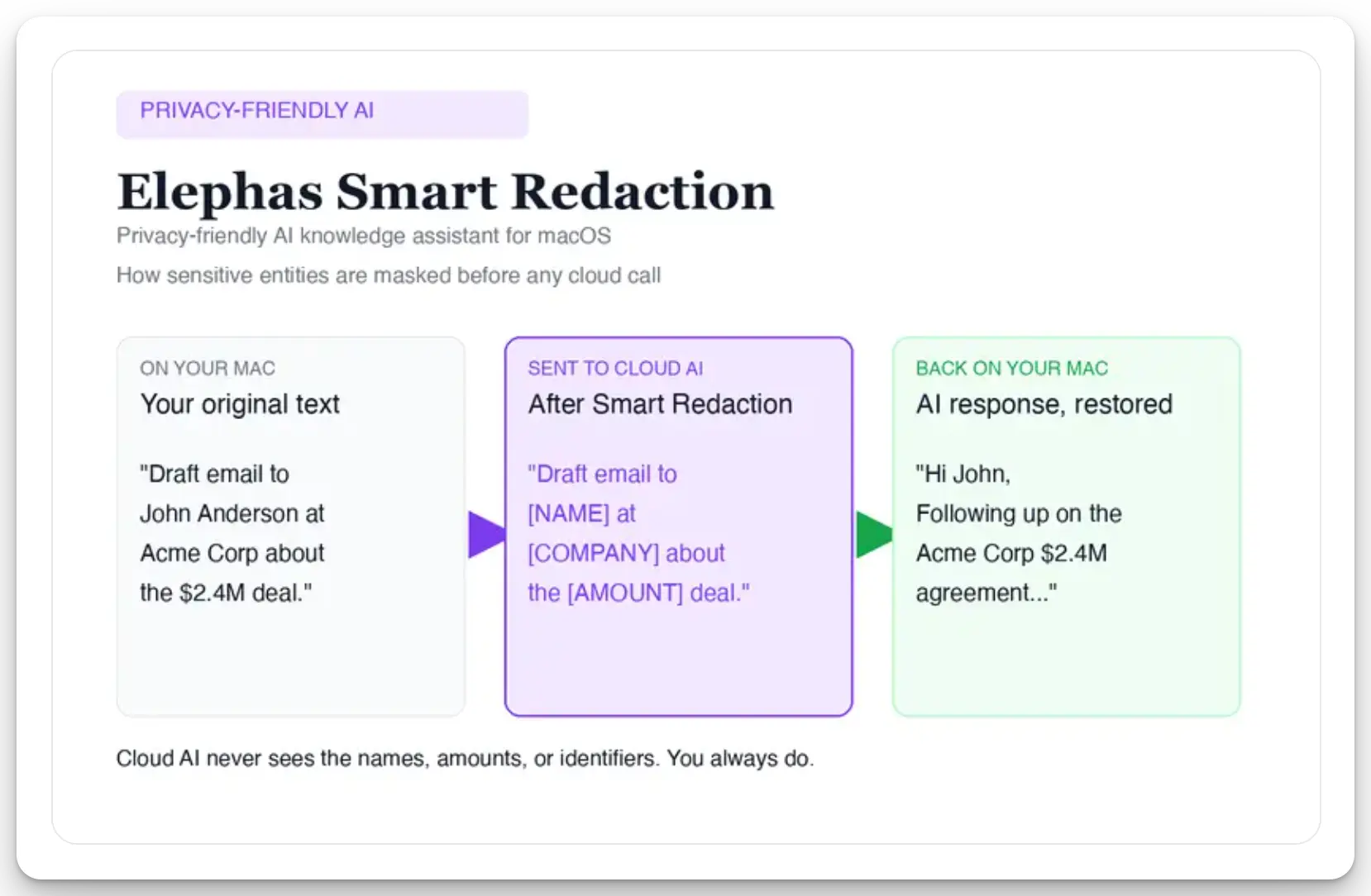
For accountants who still want a leading cloud model, Elephas adds a second layer through automatic PII redaction (beta). Before a prompt is sent to ChatGPT 5.5, Claude Opus 4.7, Gemini, Grok, Perplexity, or any other cloud model, Elephas strips sensitive names, emails, phone numbers, and identifiers on your Mac. The cloud model only ever sees the sanitized text. When the answer comes back, the redacted fields are reassembled locally on your machine, so identifiable information never leaves the device. Elephas pairs this with zero data retention: content never trains AI models, never sits on a vendor’s server, and never passes through a third-party reviewer’s screen.
Elephas, Best Privacy-First AI for Client Memos, Tax Research, and Engagement Files
Best for accounting professionals who need to draft client memos, query a tax-research library, and work on engagement files without uploading source documents to a cloud model.
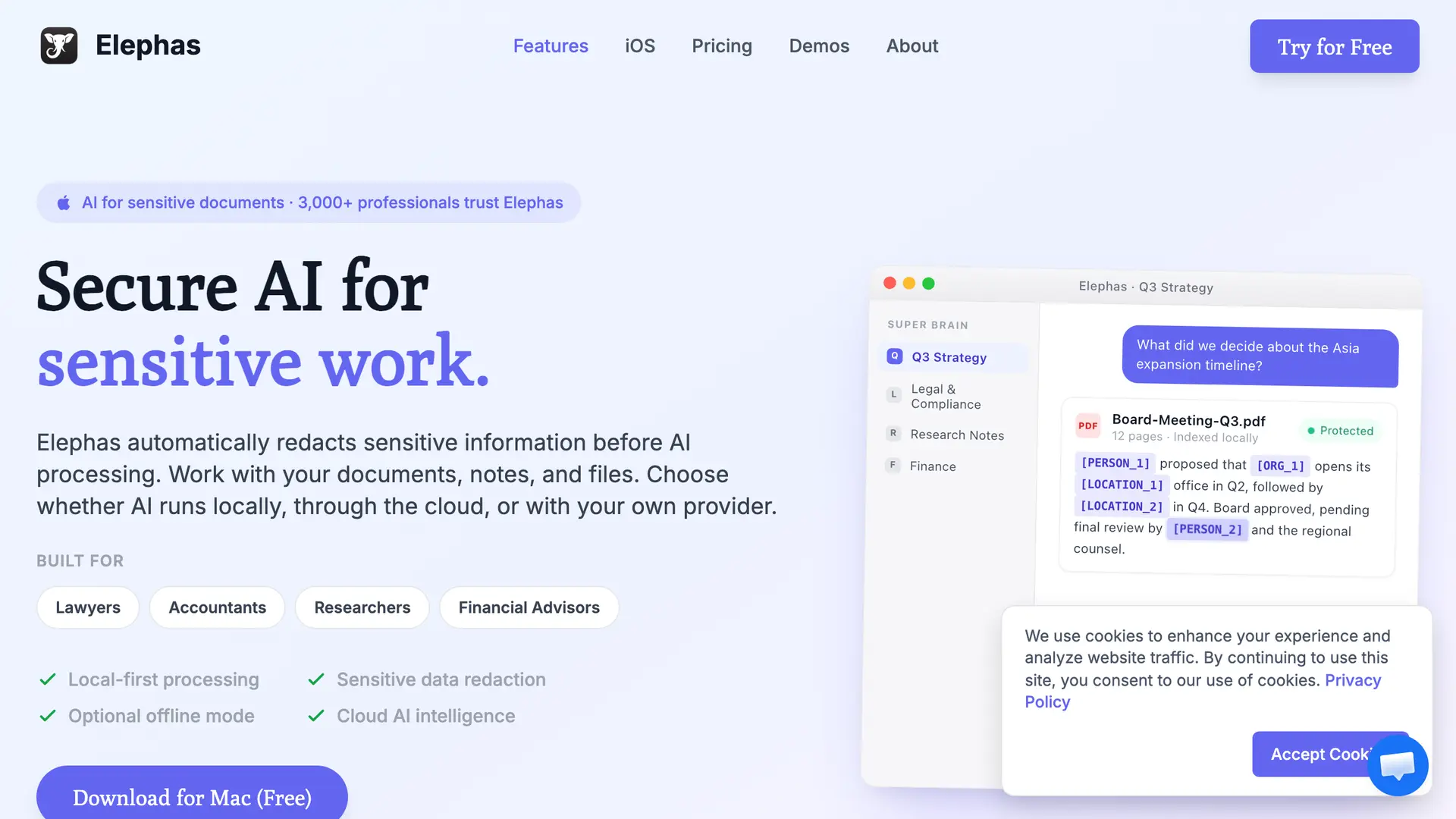
Elephas is a Mac-native AI knowledge assistant for accountants whose source files cannot be uploaded to a cloud model. Engagement letters, prior-year workpapers, IRS notices, and AICPA guidance PDFs sit on the Mac, indexed locally, queryable through chat, and writable through every Mac app.
Super Brain is the engine. It builds a searchable AI brain from 20+ file formats, including PDF, Word, Excel, Markdown, Apple Notes, Notion, Obsidian, and audio transcripts, with multiple brains keeping “Client A engagement” separate from “Tax research” separate from “Firm SOPs.”
A 1,700-page PDF indexes for around $0.40. Super Chat then answers questions against those documents with source citations and no hallucinations, the answers come only from the indexed material.
The privacy posture is the differentiator. Source documents never upload to Elephas servers; iCloud sync is optional and encrypted. Automatic PII redaction (beta) handles the perimeter on every plan including Free, routing cloud calls to ChatGPT 5.5, Claude Opus 4.7, Gemini, Grok, Perplexity, or any other cloud model the accountant picks.
Key Capabilities
Pricing. Free plan available; paid plans start at $19/month. See elephas.app/pricing for the full plan list.
Why we picked Elephas
“Sensitive data is automatically detected and redacted before anything reaches a cloud AI model, your content is never used to train AI models, and nothing passes through a third-party reviewer’s screen.”
Positive feedback. “The biggest advantage of Elephas is that my files remain stored locally, I don't need to upload them to the cloud to use its features.” Ahmed F., Capterra, December 29, 2025
Positive feedback. “I've been using Elephas since the beginning. It is one of the few apps that last. I still use it every day. The best feature for me has been the brains. I have a few trained up on specific topics, and they honestly speed up all content creation, programming, and editing I do throughout the week.” Gregg Housh, Product Hunt
FloQast, Best for Enterprise Close Management with a No-Train AI Architecture
Best for corporate and enterprise controllers who need structured month-end close, transaction matching, and audit-readiness from a vendor that does not pool client books into a cross-customer model.
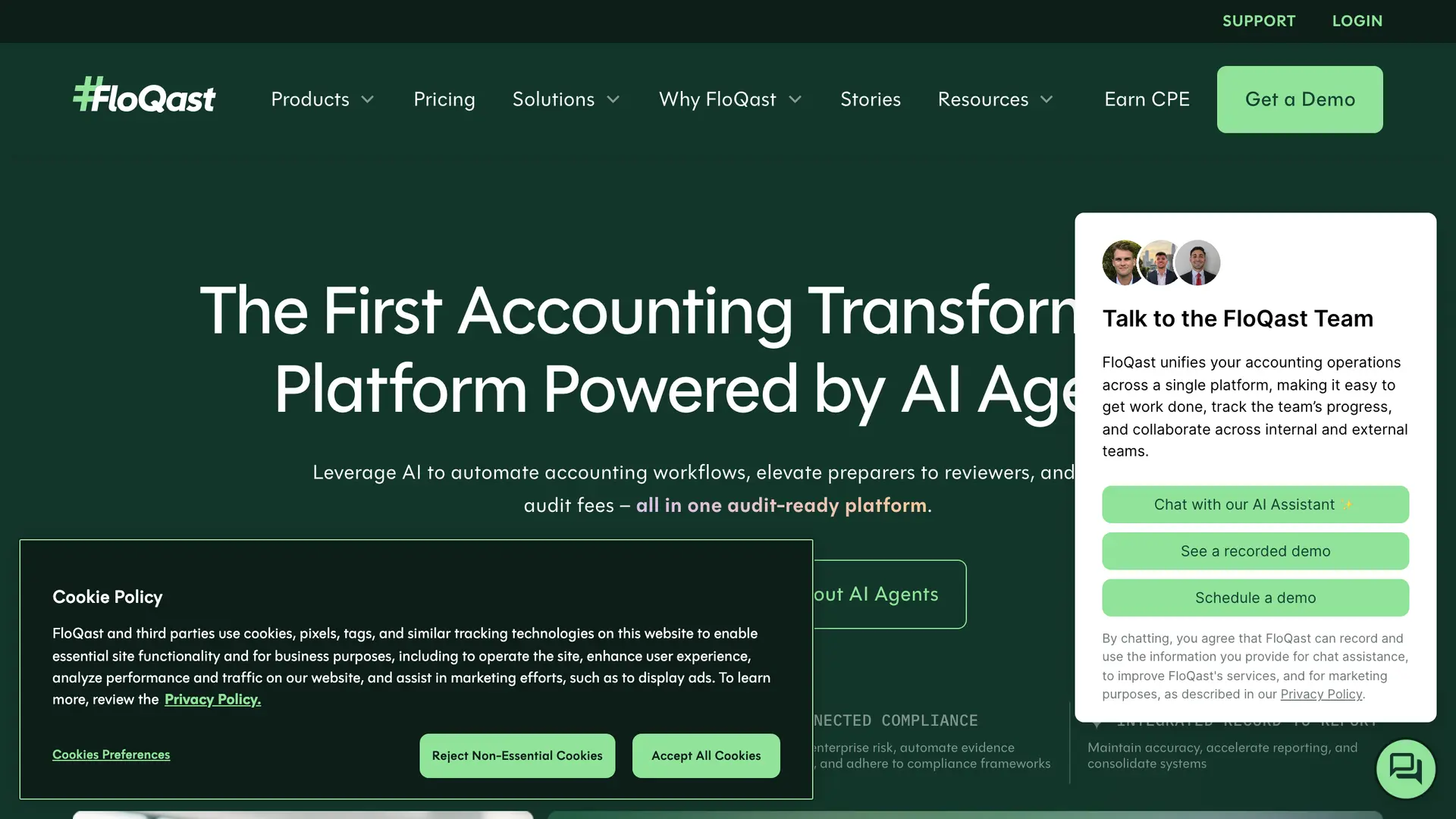
FloQast is an AI close-management and reconciliation platform for corporate and enterprise controllers, trusted by 3,500+ companies including Lululemon and DoorDash. Its lane is the structured month-end close and audit-readiness, checklist orchestration, transaction matching, variance analysis, and AI Detections that flag GL errors before the close.
The privacy detail that matters most is the model architecture. FloQast runs Anthropic’s Claude on Amazon Bedrock as a RAG consumer, not by fine-tuning, so under Bedrock’s contractual guarantee client data is “never shared with model providers or used to train foundation models.” There is no cross-customer shared model pooling client books.
The cert stack is the strongest in this ranking, SOC 2 Type 2 with zero exceptions, SOC 3, ISO 27001, ISO 27701, and the rare ISO/IEC 42001 AI-governance standard, plus EU, UK, and Swiss Data Privacy Framework. The honest gaps are transparency, not posture, no first-party “we don’t train” clause, no public subprocessor list, no PII redaction, and request-gated residency documents.
Key Capabilities
Pricing. Quote-only, annual contracts with no monthly plan; FloQast does not publish pricing on its own site. Third-party estimates put entry pricing around $12,000 per year, with mid-market and enterprise deployments commonly cited at $60,000 to $120,000+ per year, plus a separate implementation fee of roughly $5,000 to $50,000. Sources: Numeric, Coefficient.
Why we picked FloQast
FloQast clears the no-cross-customer-training bar that most AI accounting tools fail, running Claude on Bedrock with RAG instead of fine-tuning, and it carries the deepest certification stack here including ISO 42001. The trade-off is honest, the operative no-training guarantee is inferred from the Bedrock architecture rather than a first-party clause a CPA can cite, and the subprocessor list, residency region, and retention window all sit behind “ask your account rep.”
Positive feedback. “centralizes and automates the month-end close process, with checklists, task tracking, and automated reconciliations making it easy to see exactly where the close is at any time, it's intuitive, collaborative, and eliminates the chaos of managing the close through spreadsheets and emails.” G2 reviewer, G2 FloQast reviews
Negative feedback. “FQ is extremely expensive for what you get, not worth it.” Reddit r/Accounting commenter; G2 reviewers separately cite slow refreshes among the cons, via Numeric's FloQast reviews aggregation
Trullion, Best for Lease Accounting and Audit Teams That Need an Auditable Trail
Best for lease accounting, revenue, and audit teams under ASC 842, IFRS 16, and GASB 87 who need a source-backed, auditable AI trail and the strongest verbatim no-train stance in this set.
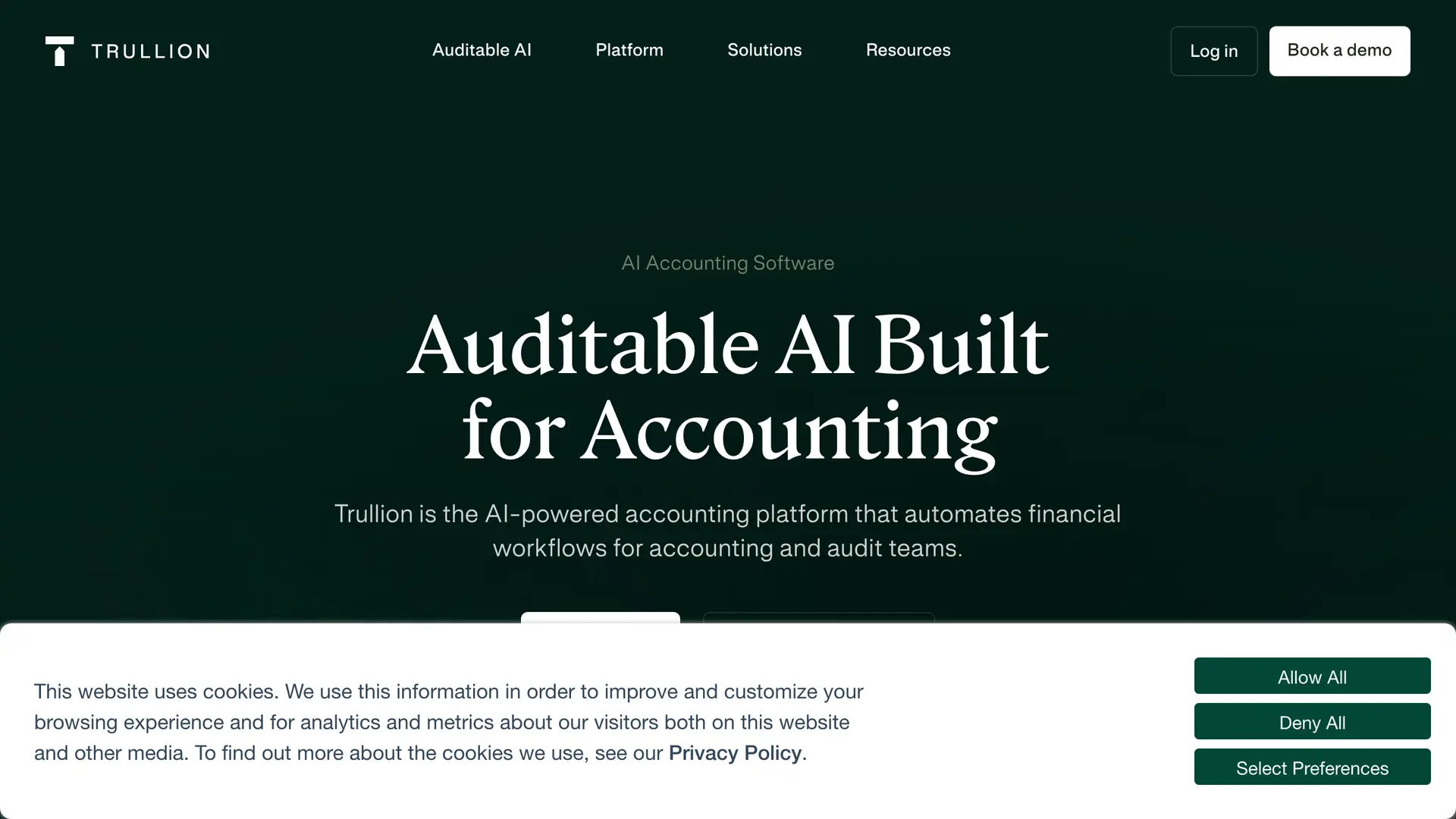
Trullion is a vertical-AI platform for lease accounting under ASC 842, IFRS 16, and GASB 87, plus revenue recognition, audit testing, and document extraction. Its tagline is “Auditable AI Built for Accounting,” and its Trulli agentic assistant, launched May 2025, answers questions on your data with source-backed outputs across the Lease, Revenue, and Audit modules.
The privacy detail that matters most is the strongest verbatim no-train stance in this ranking. Trullion states it “does not train any AI models on client data, your data stays private and belongs only to you,” with stateless processing where “nothing is retained within the AI after it’s done.” That is the opposite of pooled-by-default designs.
The honest gaps are about proof, not stance. The LLM that powers Trulli is never named on any public page, the single biggest gap for verifying a zero-retention subprocessor, and there is no named cloud region.
On attestations, Trullion states it is SOC 1 and SOC 2 (KPMG) compliant and displays GDPR and HIPAA badges, but publishes no ISO 27001 certification, and asserts these on marketing pages rather than a dedicated trust portal. It does not advertise a PII-redaction layer, and its dedicated security and pricing pages return 404.
Key Capabilities
Pricing. Quote-only, no published per-seat price. Third-party estimates put mid-market annual contracts in the $15,000 to $50,000+ per year range depending on lease volume and seats. The pricing page returns 404, so no official figure can be cited. Source: Capterra Trullion listing.
Why we picked Trullion
Trullion is best-in-class on the question this ranking cares about most, it states plainly that it does not train any AI model on client data and processes statelessly so nothing is retained after a request. The catch is thin public documentation, the third-party LLM that actually touches client data is never named, so a firm can read the no-training promise but cannot self-verify which model sees the data or under what retention terms.
Positive feedback. “I really enjoyed the automation and AI aspects of smrt's software, it scans your contracts for you and extracts key data for reports.” Moshe F., Capterra, April 17, 2020
Negative feedback. “If you have many variables in your lease, the reporting takes time to process.” Suzanna F., Capterra, August 4, 2021
Karbon AI, Best Privacy-Aware Practice Management for Small-to-Mid Firms
Best for small-to-mid accounting firms that want AI inside practice management tools, with Azure OpenAI under the hood and a published no-training commitment.
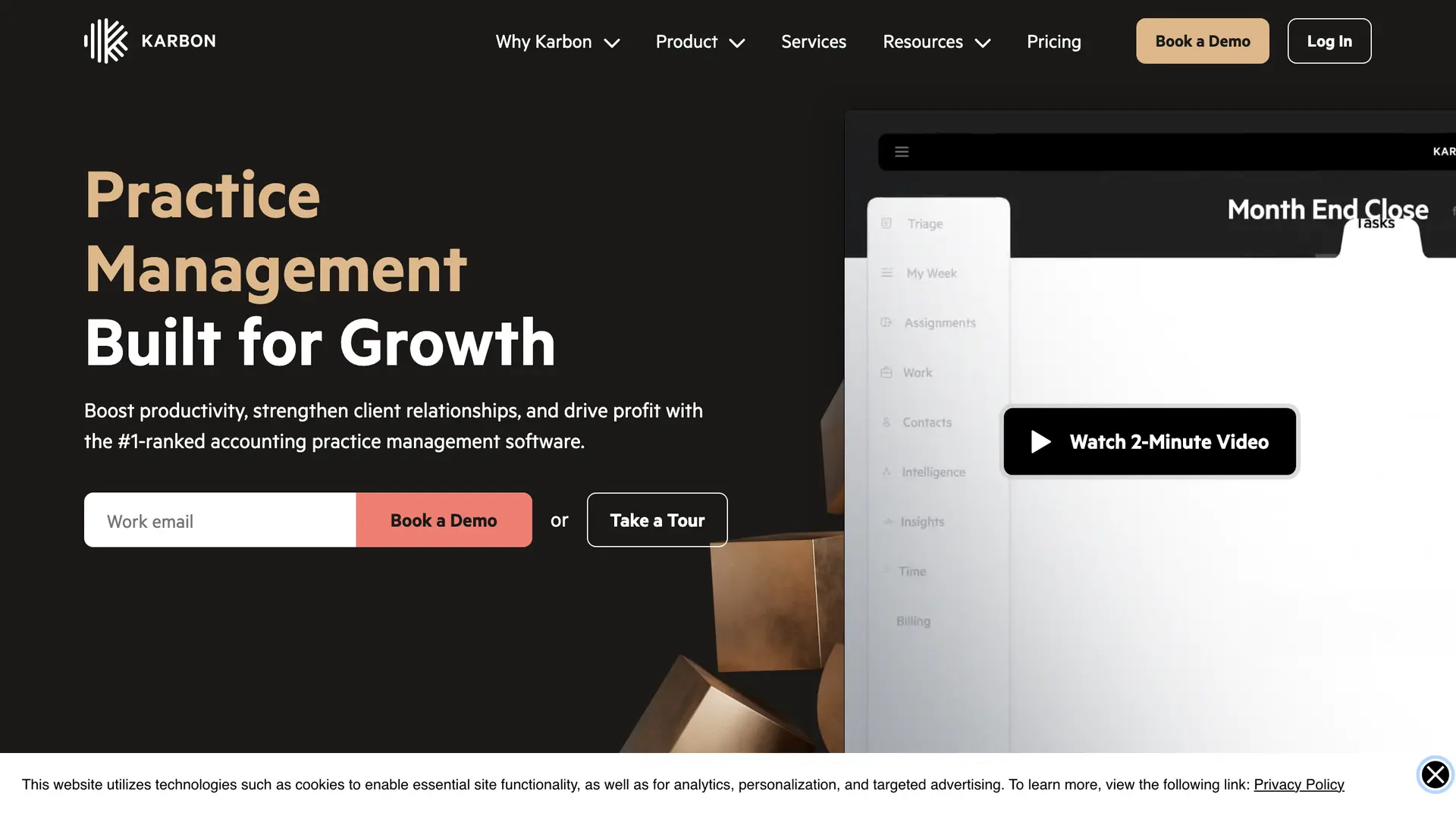
Karbon is an AI-powered platform that helps accountants run a small or mid-size practice end to end. It bundles Smart Inbox, email triage, Compose and Refine, time tracking, billing, and a client portal with a built-in AI assistant, sitting in the practice management layer. Configurable agents are launching early 2026 under an “Ask Karbon” orchestrator.
The privacy detail that matters most is what powers Karbon’s AI assistance. Karbon runs on Microsoft Azure OpenAI Service, not the public OpenAI API, and publishes a clear no-training commitment: Karbon does not use your firm’s data to train AI models, and no data is shared with third parties or used to inform any other customer’s experience.
Data residency is in-region, UK data stays in the UK. Compliance baseline is SOC 2 Type 2 since 2021 with a GDPR program and a designated DPO.
The honest gaps are equally clear. No native PII-redaction layer is documented, and content is processed via Azure OpenAI Service. No subprocessor list appears on its public security pages, and no post-offboarding deletion window is published. Karbon's ISMS follows ISO 27001 but is not independently certified.
Key Capabilities
Pricing. Team $79/user/month, Business $99/user/month paid monthly; annual billing brings Team to $59/user/month and Business to $89/user/month. Enterprise is custom. Source: karbonhq.com/pricing.
“We demoed Karbon and it didn't seem as intuitive as TaxDome, Canopy seemed to work well, but was expensive.”
u/Frankwillie87 is a small-firm tax pro reporting back from a Karbon demo in a 1,000+ return shop’s switch-evaluation thread on April 20, 2026. The broader thread piles on with complaints about add-on pricing for integrations and reports.
Why we picked Karbon AI
Karbon is one of the rare practice-management platforms that names its LLM stack, Azure OpenAI, and publishes a hard no-training commitment in plain language. The vendor has been integrating AI into reporting tools and inbox triage for finance and accounting firms since 2023. For a firm where AI inside the workflow is the priority and the threat model accepts trusting Microsoft Azure, this is the right tier.
Positive feedback. “like outlook on steroids - not only does it mirror outlook inbox, but emails can be tagged to each specific client and are then visible on each client's timeline.” G2 reviewer, G2 Karbon reviews
Negative feedback. “Not able to save documents to a portal that clients need to submit for bookkeeping and accounting for record keeping.” Tai S., Capterra, January 1, 2026
Vic.ai, Best Autonomous AP for Mid-Market and Enterprise Finance Teams
Best for mid-market and enterprise finance teams processing 500+ vendor bills a month who need SOC 1 and SOC 2 certifications plus a transparent two-model training architecture.
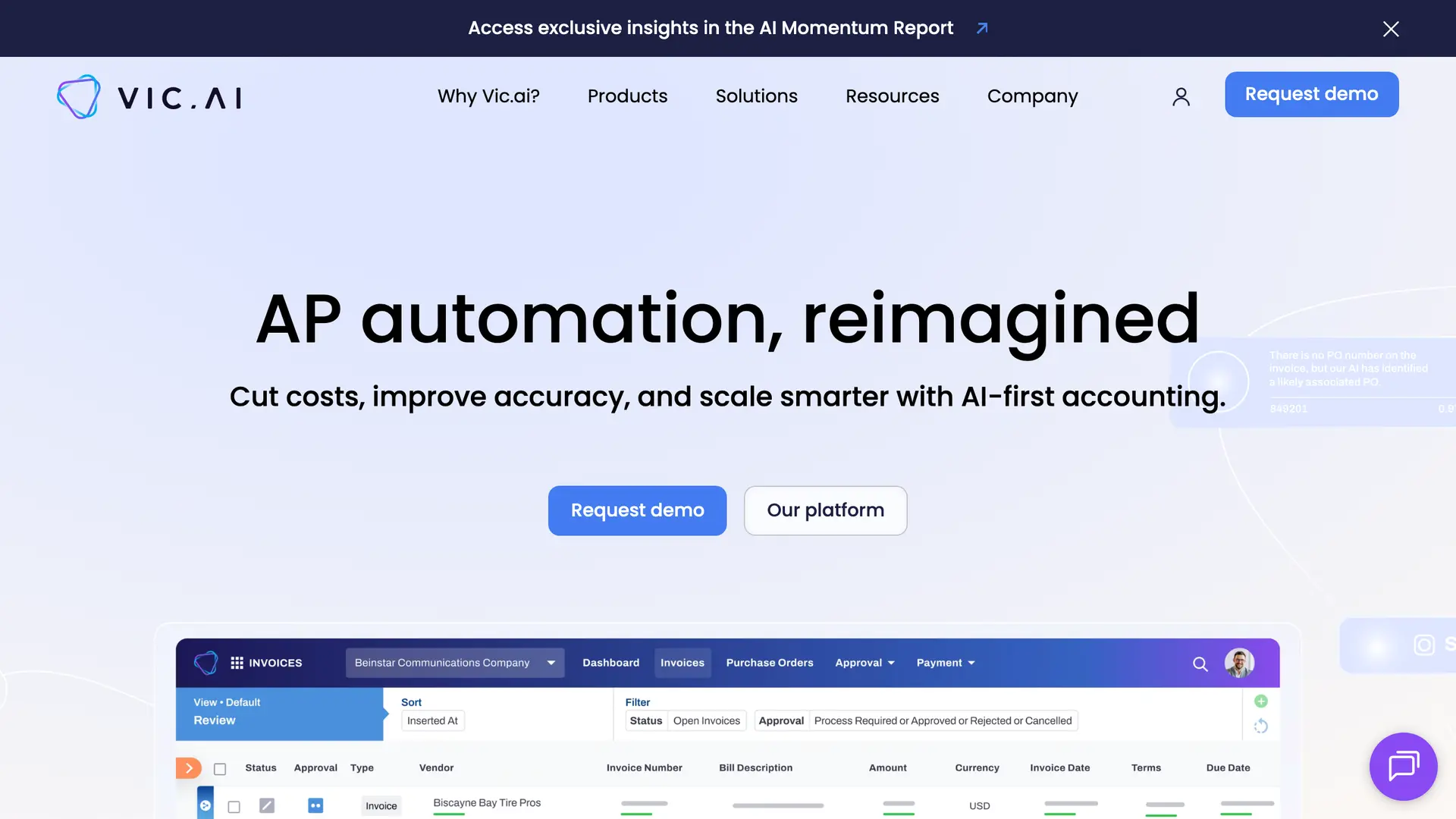
Vic.ai is the AI-first accounts payable platform for finance teams that process serious volume. The marketing line, “85% No-touch rate by month 6,” tracks with the operational claim of 97% out-of-the-box capture accuracy that improves to 99% over time. Invoice Autonomy, PO matching, VicPay, VicCard, and VicAgents cover the workflow end to end, with VicInbox shipping to the Outlook marketplace in Q1 2026.
The privacy detail to flag is the two-model architecture. Global Models train on header fields, document number, date, total, currency, where Vic.ai’s documentation states the model uses “derived data... a derivative of the data at scale” that “does not contain identifiable data.”
Local Models handle line-level GL coding, location, and department, and there “learning is not shared across clients.” Translation: header data feeds an aggregated cross-customer model, line-level GL coding stays per-tenant, and there is no documented customer opt-out from the Global Model.
Compliance is the strongest in the field on paper, SOC 1 Type II and SOC 2 Type II certifications, plus alignment with an ISO 27001 framework (Vic.ai follows the framework but is not ISO 27001 certified), with AWS multi-region storage, AES-256 at rest, and TLS in transit. The gaps mirror the rest of the category, no PII redaction layer, no public subprocessor list, no specific post-offboarding deletion window, no on-prem option.
Key Capabilities
Pricing. Not published, quote-only enterprise model. Customer case studies report labor cost per AP document dropping from $3.30 to $0.53, an 84% reduction, with documented annual savings starting near $250,000 in year one and growing to $600,000 by year five. ROI is strongest at high payable volume, typically 500+ invoices per month. Source: Vic.ai pricing request page.
Why we picked Vic.ai
Vic.ai earns its place on this list with SOC 1 and SOC 2 certifications plus an ISO 27001 framework, alongside the most transparent two-model architecture in this category among specialized tools using AI in financial workflows. The platform’s AI continuously learns from header data across the customer base, with line-level GL coding staying per-tenant. The catch is that every customer is opted-in to the Global Model on header fields, with no published opt-out. That is the right trade for high-volume AP teams, it is not the right trade for firms where “never trains a model that touches another client” is a hard rule.
Negative feedback. “Best suited for high-volume invoice processing. May be overkill for businesses with simple AP needs.” AccountingAITools, January 3, 2026
Truewind, Best for AI-Drafted Journal Entries on Top of QuickBooks or Sage
Best for firms and lean finance teams that keep QuickBooks Online or Sage Intacct as the source of truth and want AI-drafted journal entries with a rare PII-redaction layer.
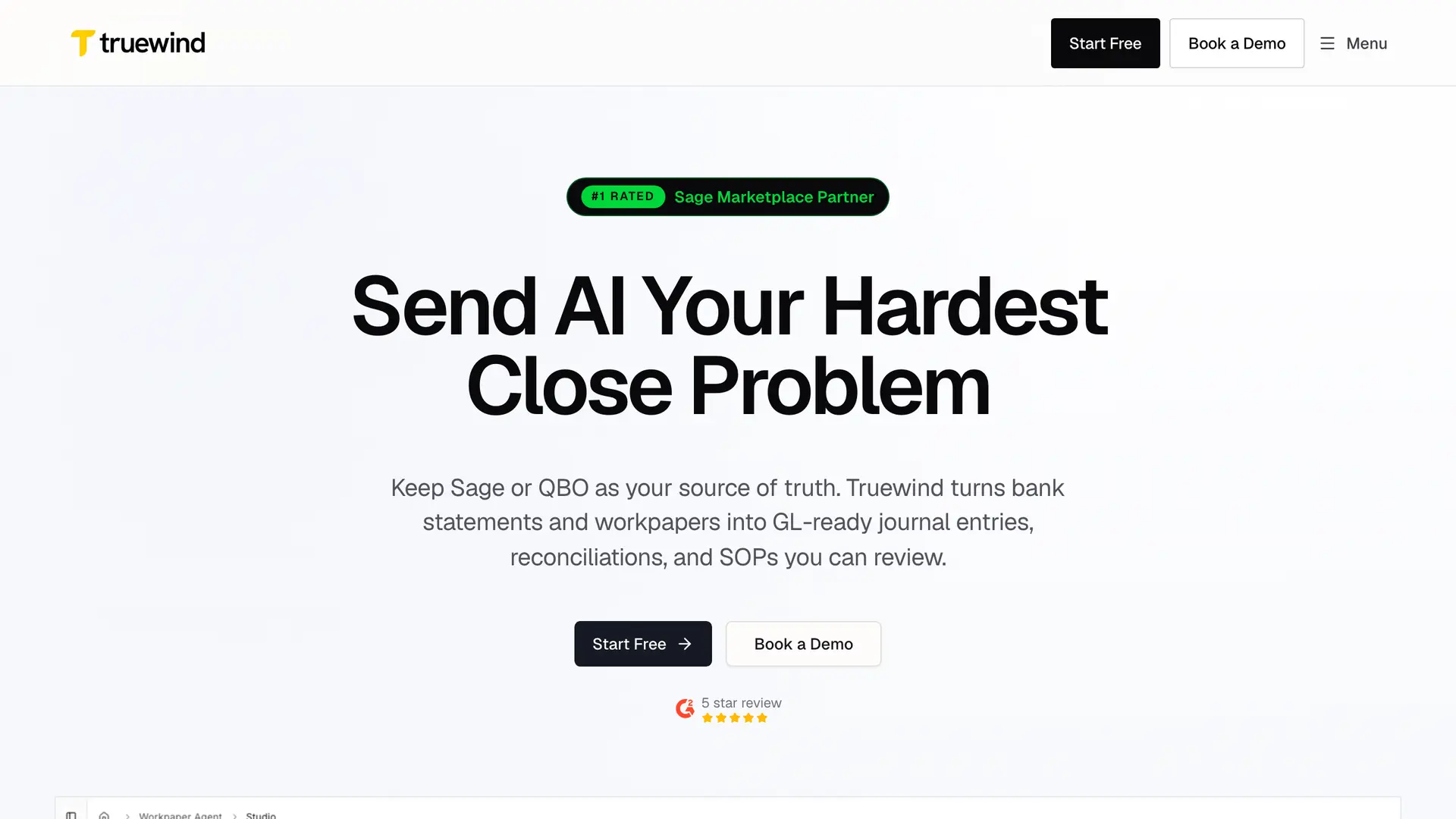
Truewind is a “digital staff accountant,” a YC W23 company that turns bank statements and workpapers into GL-ready journal entries, reconciliations, and flux analysis on top of QuickBooks Online or Sage Intacct. Its tagline is “Send AI Your Hardest Close Problem,” and it sells to firms and lean finance teams that keep their existing ledger as the source of truth.
The privacy detail that matters most is a genuine differentiator, Truewind advertises an explicit PII-redaction layer, stating it “redacts all personally identifiable information,” and adds that it does not sell personal data. It is SOC 2 certified. That redaction commitment is rarer than most peers in this set offer.
The important gap is the training position, among the weakest documented. The only commitment is scoped to Google-API data and forbids only “generalized or non-customer-specific” models, leaving customer-specific training on client books open. The LLM is OpenAI per a third-party case study, not Truewind’s own disclosure, with no zero-retention agreement.
Key Capabilities
Pricing. Quote-only, no live pricing page. An unofficial aggregator lists indicative tiers from about $300 per month to $1,250 per month by transaction volume and integrations, a third-party estimate, not a Truewind figure. Source: SaaSworthy Truewind pricing.
Why we picked Truewind
The advertised PII-redaction layer is rare and real, which is why Truewind earns a mid-list spot over tools with no masking at all. The honest catch is that its training position is one of the weakest documented here, the only commitment covers Google data and bars only non-customer-specific models, so a firm needs a custom DPA spelling out OpenAI zero-retention before trusting it with client books.
Positive feedback. “Satisfied customer of almost 2 years! The team is incredibly tech-forward...” Kelvin O., G2, September 11, 2025, via Tooliverse
Negative feedback. “Solid platform, but the custom pricing can be a bit of a hurdle...” Bootstrapped_CEO, Reddit, October 5, 2025, via Tooliverse
Stampli, Best for Collaborative AP Where the Team Stays in the Loop
Best for mid-market and SMB teams that want AP automation with humans in the loop, where every communication, document, and approval lives on the invoice itself.
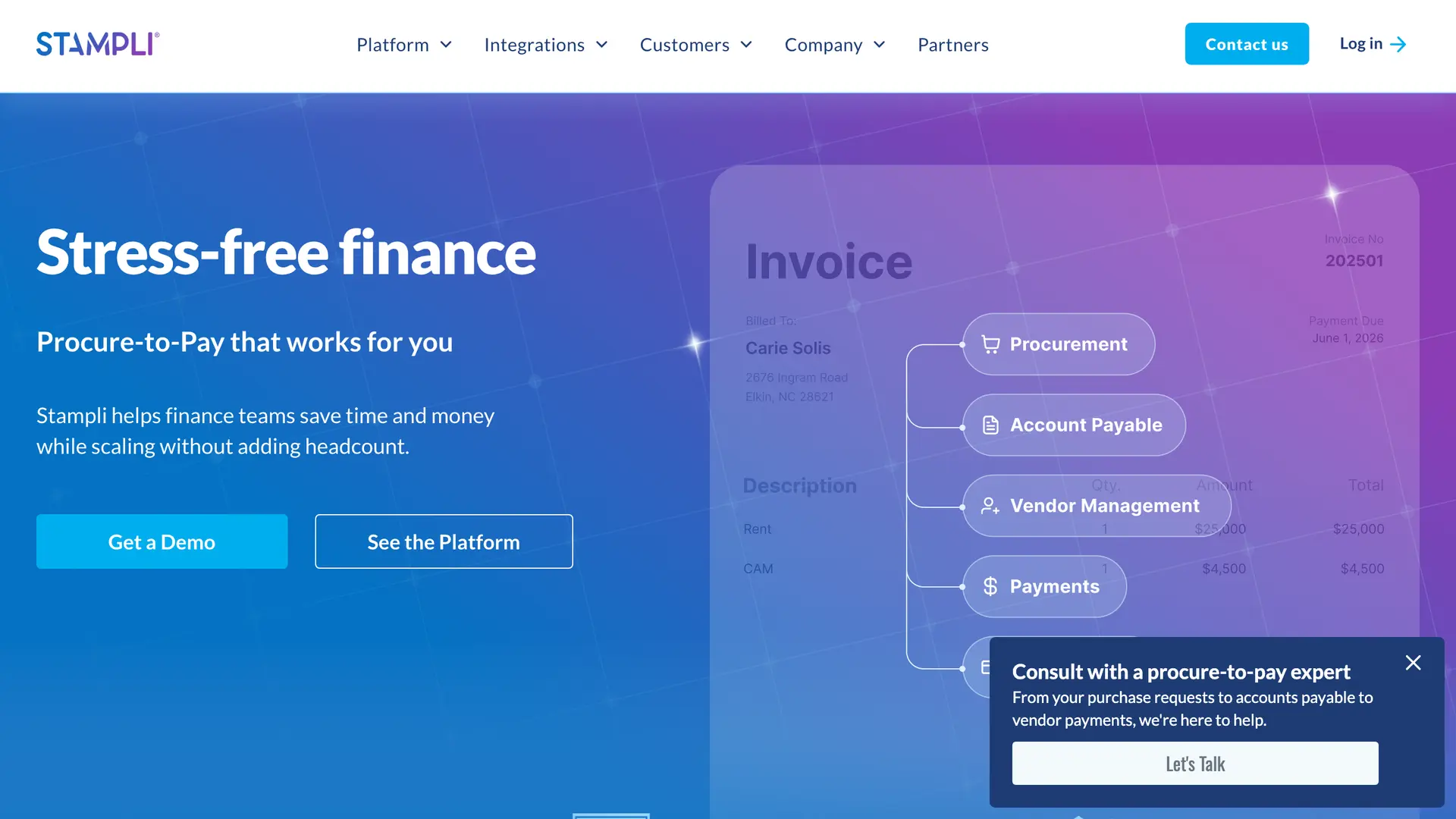
Stampli is an AP automation platform centered on collaboration, where every communication, document, and approval lives on the invoice itself, with “Billy the Bot” handling the AI coding. It serves mid-market and SMB teams, the latter through Stampli Edge, launched July 2025. Where Vic.ai removes the AP team from the loop, Stampli keeps humans in it.
The privacy detail that matters most cuts both ways. Stampli itself holds SOC 1, SOC 2, and SOC 3 plus PCI DSS, encrypts data with AES-256, and adds a separate-key AES-256 layer for SSNs and bank accounts, a genuine strength, alongside a customer-accessible audit log, VPC isolation, and annual pen tests.
The important gap is the training language. Billy is marketed as “Trained on $150B+ in annual spend across 70+ ERPs,” clearly cross-customer aggregate, with no tenant-isolation guarantee and no equivalent to Vic.ai’s “learning is not shared across clients.” Data is hosted in Ireland on AWS eu-west-1, not the US, a residency flag for US firms, plus no PII redaction and no named LLM.
Key Capabilities
Pricing. Quote-only, no published per-seat price. Independent 2026 estimates put a small team around $500 per month, a third-party figure, not a Stampli number. Source: Stampli pricing page.
Why we picked Stampli
Stampli is well-certified and the separate-key encryption for SSNs and bank accounts is a real strength most peers skip. The friction points are the cross-customer training language with no isolation guarantee, Billy openly learns across $150 billion in spend, and AWS Ireland hosting, so a US firm with a strict residency or no-shared-model rule cannot clear that bar on public documentation alone.
Positive feedback. “Approving invoices is super easy because I can see the invoice, review contracts and then ensure that invoices line up with expectations.” Jared K., Capterra, December 17, 2024
Negative feedback. “You cannot limit the GL accounts in Stampli, so users have access to accounts they should not use, which can increase the review time.” Skylar B., Capterra, September 5, 2025
Booke.ai, Best Budget AI Bookkeeper, With Caveats
Best for small bookkeeping firms and solo bookkeepers who want cheap per-client automation on QuickBooks Online or Xero and can accept unverified vendor credentials.
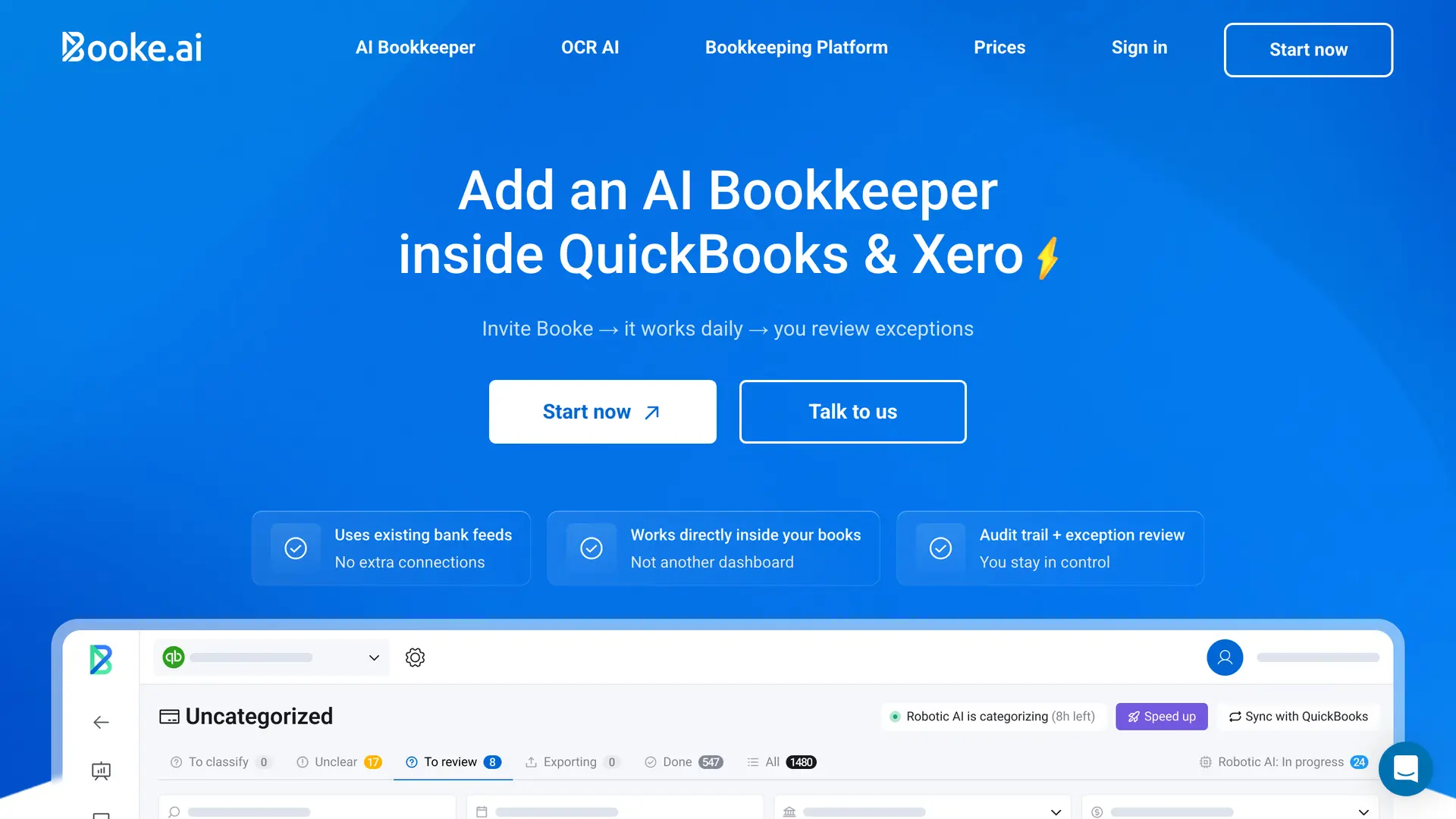
Booke.ai is an RPA plus GPT-4 “Robotic AI Bookkeeper” that logs into QuickBooks Online or Xero, pulls the bank feed, auto-categorizes transactions, matches documents, and reconciles before the workday begins. It targets small bookkeeping firms and solo bookkeepers with cheap per-client automation. It is a seed-stage, Delaware-registered company.
The privacy detail that matters most is the strongest verbatim no-train claim in this ranking. Booke states “Your data trains YOUR AI Brain only,” promises “Zero cross-customer learning or data sharing” that is “technically impossible in our architecture,” gives each client an encrypted AI Brain, and documents 30-day deletion after cancellation.
The gap is buyer-beware, because the credentials behind that promise are unverified. Booke is GPT-4-powered but never names OpenAI as a subprocessor or documents a zero-retention DPA, so the isolated AI Brain protects Booke’s store, not what GPT-4 receives.
It claims only “SOC 2 hosting,” not its own SOC 2 report, still cites the defunct Privacy Shield, and raises an IRC § 7216 flag, a Delaware shell with Eastern-European founders and undisclosed staff means a US preparer cannot confirm whether non-US personnel touch client books.
Key Capabilities
Pricing. $129 per business per month for the AI Bookkeeper, with firm pricing by request (Source: booke.ai/pricing). Per-client plans are reported at $20/client/month (Data Entry Automation Hub) and $50/client/month (Robotic AI Bookkeeper) via third-party reviews, as Booke no longer lists them on its public pricing page.
Why we picked Booke.ai
Booke.ai is the cheapest per-client automation here and carries the strongest no-train promise on paper, an encrypted per-client AI Brain with “zero cross-customer learning.” The honest catch is that the credentials are unverified, no own SOC 2 report, no named LLM DPA, no published subprocessor list, and an unanswered § 7216 staff-location question, so it is fine for low-sensitivity books on faith, not for a rigorous due-diligence pass.
Negative feedback. “The auto categorize feature is the core and it doesn't work.” G2 reviewer, G2 Booke AI reviews
Digits, Best AI-Native General Ledger for Modern US Firms
Best for modern US firms that want an AI-native general ledger built for accounting from the schema up, with outcome-based pricing, AI close agents, and a free read-only MCP server connecting Claude and Cursor.
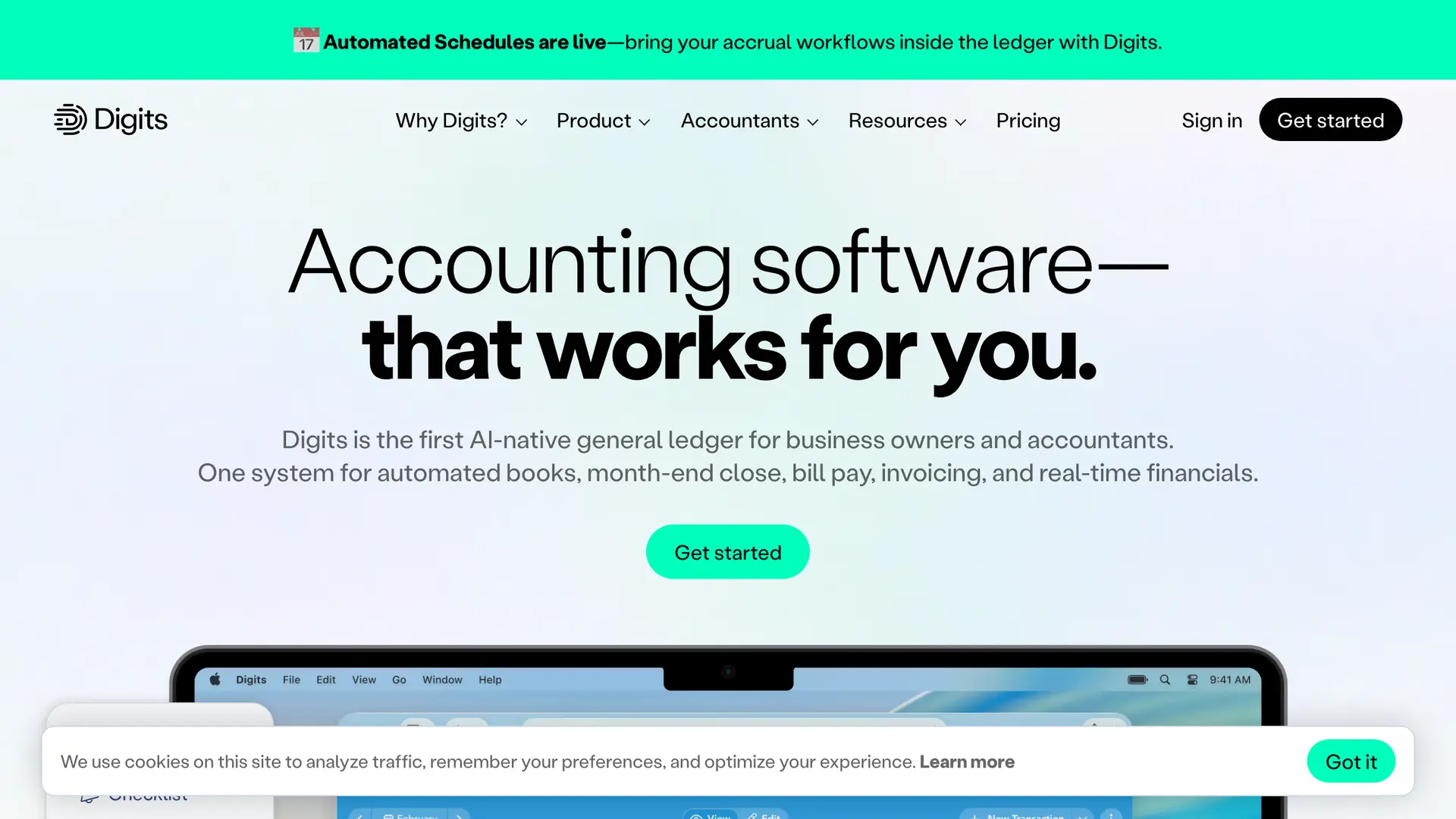
Digits is the first AI-native general ledger built for accounting from the schema up, the Agentic General Ledger (AGL), with AI-categorized double-entry coding at 95%+ zero human touch. Digits Schedules launched May 7, 2026, joining an existing agent suite: AI Bill Pay (April 2024) and AI close and bank-reconciliation agents rolled out through 2025. The free Digits MCP Server (April 2026) exposes firm data read-only to Claude, ChatGPT, and Cursor via Model Context Protocol.
The privacy detail to flag is the three-tier training architecture, Company, Firm, Global. The Company model trains only on each individual business’s transactions. The Firm model is uniquely created for the firm but shares pattern data across that firm’s client base, not isolated per client.
The Global model trains on over $825 billion in real-world business transactions pooled from across the customer base. No published opt-out from the Global tier. Digits’ counter-claim is that external-LLM calls use only “anonymized and obfuscated customer identifiers,” but the de-identification layer has no public technical paper or third-party audit.
The compliance side is thinner than Vic.ai’s. SOC 2 Type II, US-only Google Cloud and Vertex AI, AES-256 with per-secret envelope encryption. Direct fetches of digits.com/privacy and digits.com/terms returned 404 at research time. No public subprocessor list, no SOC 1, no ISO 27001 attestation found, no GDPR DPA, no PII redaction layer.
Key Capabilities
Pricing. Essentials $65/month, Core $100/month, Pro $250/month with contact-sales, Full-Service about $350/month with a US-based accountant performing the close. Accounting-firm pricing is quote-only and outcome-based, firms pay only on clients where Digits hits 95% or higher zero-touch. Source: digits.com/pricing.
Why we picked Digits
Digits is the most credible AI-native ledger we tested, with outcome-based pricing for firms, a free read-only MCP server, AI close agents, and AI-drafted schedules. The privacy ceiling is the three-tier training architecture, a client’s transaction patterns feed a global model trained on $825 billion of pooled data, with no opt-out. Right tool for firms comfortable with pooled pattern-learning under SOC 2 controls, wrong tool for firms where “client data never trains anything that touches another customer” is the rule.
Positive feedback. “The AI makes closing the books so much faster and eliminates the hassle I experience with QuickBooks.” Shelby Parker, Product Hunt
Negative feedback. “wish export was easier to find.” G2 reviewer, via Beancount.io, August 9, 2025
Intuit Assist (QuickBooks), The Incumbent Everyone Uses, and the One That Trains on Your Books
Best for accountants who already run QuickBooks Online and want generative AI inside it, with real enterprise compliance but a written reservation to train Intuit's own AI on customer books.

Intuit Assist is the generative-AI assistant inside QuickBooks Online, built on Intuit’s GenOS, and it is the default for most accountants. It handles transaction categorization, reporting questions in plain language, invoice and estimate generation, receipt extraction, AR follow-up, and the 2025-26 suite of AI agents. It is US-only.
The privacy detail that matters most is the contrast. Intuit brings real enterprise compliance, SOC 2 Type II, ISO 27001, PCI DSS, and US data residency, plus a genuine guardrail that partner LLMs from OpenAI and Anthropic cannot train on customer data, “our agreements explicitly prohibit the use of customer data for model training.”
The decisive gap is that Intuit reserves the right to train its own AI on customer financial data. Its Global Privacy Statement says it processes data by “training our artificial intelligence models and other machine learning models,” and the Responsible AI Governance page confirms “We train our AI with Intuit’s proprietary data, for example... customer data.”
There is no clean opt-out for QuickBooks ledger data, the only carve-out covers Google Workspace API data, and there is no documented PII-redaction layer for the assistant, which accountants cannot fully disable.
Key Capabilities
Pricing. Bundled into QuickBooks Online with no standalone price, Simple Start $38/month, Essentials $75/month, Plus $115/month, and Advanced $275/month, with AI capability gated by tier. Source: NerdWallet QuickBooks pricing 2026.
Why we picked Intuit Assist
Intuit Assist is the convenient incumbent that scores lowest on the one axis this ranking measures, the tool most accountants already feed client books to, with the least say over whether that data trains the vendor’s models. It is the foil this article exists to contrast against, real compliance and a third-party training bar, but a written reservation to train Intuit’s own AI on your clients’ financial data with no clean opt-out.
Positive feedback. “AI enabled tool automates your work, with auto-categorization and matching that saves time for low-complexity books.” General G2 sentiment, G2 Intuit QuickBooks reviews
Negative feedback. “This new IA assistant it a waste of my time and it never gets it even close to correct, in a thread titled How do I permanently opt out of the AI assistant idiocy?” Accountants, QuickBooks Community, early 2026
How We Ranked These Tools
Six dimensions, all of which the typical SERP roundup of best AI tools ignores, and all of which trace back to what private AI actually means. Every tool above was scored against this same checklist before lane fit, pricing, or feature depth entered the conversation.
AI cannot replace accountants on judgment calls around accounting standards, complex accounting questions, or real-world accounting disputes, so the right AI is the one that slots into accounting workflows without creating a new disclosure risk. The tools win on different lanes. Pair them, do not replace one with the other.
The six dimensions we weighed
- Where client data is stored. Cloud-only, hybrid, or local-first. The structural answer to whether the firm controls its own files.
- Training on customer data. Explicit “we don’t train” commitment, opt-out, or pooled-by-default across the vendor’s customer base.
- PII redaction layer. Does the tool strip SSNs, EINs, account numbers, and names before anything leaves the firm.
- Compliance attestations. SOC 2 Type II as the baseline; SOC 1, ISO 27001, and GDPR DPF as differentiators.
- Subprocessor disclosure plus data residency. Published list, named cloud and LLM providers, US-only vs. global routing of the data.
- Retention after offboarding. Explicit deletion window vs. “as needed,” which is the difference between a clean exit and an open exposure.
Side-by-Side Comparison
All pricing verified as of May 2026. Confirm current plans on each tool's official site.
Related Reading
Conclusion
The verdict is not “Elephas replaces your accounting software.” It is the opposite. Most of these ten tools are cloud-native accounting platforms that own real automation lanes, FloQast on the close, Stampli and Vic.ai on AP, Digits and Intuit on the general ledger, Trullion on leases, Karbon on practice management, and Truewind and Booke.ai on journal entries.
AI cannot replace accountants on the judgment side of the accounting practice, from technical accounting calls under specific accounting standards to lease accounting memos and complex accounting reviews where the profession still demands a human signature. The right AI tool is the one that helps accountants do less manual data entry and leaves more time for that judgment work.
The privacy question is what separates these platforms, FloQast, Trullion, and Karbon contractually do not train on client data, the mixed middle of Vic.ai, Truewind, and Stampli leaves some cross-customer learning open, and Booke.ai, Digits, and Intuit train on or cannot prove they do not train on customer books. Pick the platform whose lane and threat model fit your firm.
Elephas is the privacy-first layer for the document and memo work that sits outside those automated workflows, on the Mac, with automatic PII redaction (beta) when a cloud model is in the loop. It pairs with whichever platform a firm runs. Ten tools, one privacy axis, and one principle: the right AI for accounting is the one that puts AI to work without leaking client data.
Frequently Asked Questions
Is it safe to paste client data into ChatGPT?
Not on the free or consumer tier. Free consumer LLM sessions can be used to train future models and there is no contractual carve-out for client confidentiality, which puts the accountant on the wrong side of AICPA Rule 1.700 and potentially IRC § 7216.
Enterprise tenancies with zero-data-retention add-ons are materially safer, and on-device PII redaction adds a second layer before any prompt reaches the cloud model.
Does the AICPA allow accountants to use AI for client work?
Yes, with conditions. AICPA SSTS § 1.4.2, effective January 1, 2024, explicitly names AI as a regulated tool the practitioner can rely on, while still holding the practitioner accountable for accuracy, confidentiality, and due care.
The standard does not bless any specific vendor, it puts the burden on the accountant to evaluate the AI technology and its data handling against the firm’s confidentiality obligations. In practice, that means accounting AI is allowed for accounting workflows, but accountants spend a real share of the engagement reviewing what the tool did before it gets relied on.
What does IRC § 7216 say about AI vendors?
IRC § 7216 makes the unauthorized disclosure or use of tax-return information a federal misdemeanor for tax-return preparers, with civil penalties under § 6713.
An AI vendor that ingests tax-return data is a third-party recipient under the statute, so the accountant either needs a signed taxpayer consent or has to keep the data inside an arrangement that the IRS does not treat as a disclosure, which is exactly the case for tools that process the data locally or strip identifying fields before the prompt leaves the firm.
Does Elephas replace QuickBooks, Karbon, or Digits?
No. Elephas is the privacy-first layer for the document and memo side of the firm, drafting client memos, summarizing engagement files, querying a tax-research library, redacting PII before a cloud-model call.
It pairs with a cloud accounting system inside the broader accounting tech stack, it does not replace one. The ranking on this page is built around that pairing, not a swap.
What is the best AI for tax research without uploading client documents?
For research that touches client files, a local-first tool is the structurally cleanest answer. Elephas indexes tax-research libraries, IRS notices, and prior-year workpapers on the Mac, and Super Chat answers questions over those documents with source citations.
When a cloud model is needed for a broader query, automatic PII redaction (beta) strips identifiers before the prompt leaves the device and reassembles them on the answer locally, so the AI support layer for tax research never sends financial data unprotected.

The Privacy-First AI for Your Accounting Firm
Elephas keeps engagement files, prior workpapers, and tax research on your own Mac, with built-in local LLM models, an offline mode, and automatic PII redaction (beta) before any cloud-model call.
Try Elephas FreeBuilt-in local LLM models. Offline mode included.
Related Resources
Is ChatGPT Safe for Confidential Documents?
What actually happens when you paste a client email, contract, or workpaper into ChatGPT, and the safer setups for confidential work.
Can You Upload Contracts to AI?
The training, retention, and disclosure risks of uploading client contracts to cloud AI, with safer privacy-first alternatives.
What Happens to Your Data When You Use AI Tools
Where your prompts and uploads actually go, who can see them, and how to keep client data inside the firm.
Sources
This guide was built from primary-source research against AICPA, IRS, and FTC publications, vendor security and pricing pages, and user feedback on Trustpilot, Capterra, G2, Product Hunt, and Reddit. All pricing verified as of May 2026.
- AICPA Code of Professional Conduct § 1.700
- AICPA SSTS § 1.4, Reliance on Tools, The Tax Adviser, September 2025
- IRS Publication 4557, Safeguarding Taxpayer Data
- FTC Safeguards Rule
- IRC § 7216 Information Center
- Journal of Accountancy, Generative AI and Risks to CPA Firms, October 2023
- The Tax Adviser, Tax Ethics and Use of Generative AI Systems, February 2024
- r/Accounting, Just got fired for using AI to draft one email, February 2026
- FloQast pricing page
- Numeric, FloQast reviews aggregation
- Capterra Trullion listing
- Karbon AI assistant feature page
- Karbon assistant launch announcement
- Vic.ai Trust page
- SaaSworthy Truewind pricing
- Stampli pricing page
- Booke.ai pricing page
- Digits Security page
- Digits Firm AI Models, Accounting Today
- Digits MCP Server, CPA Practice Advisor, April 2026
- NerdWallet QuickBooks pricing 2026
- Elephas product homepage
- Elephas pricing