Elephas vs Claude for Lawyers: Get Claude's Intelligence Without the Cloud
Claude is one of the best AI models for legal reasoning. But using it directly means your documents land on Anthropic's servers. Elephas lets you use Claude's model while keeping your case files local—the best of both worlds.
Quick verdict
Claude is exceptional at legal reasoning—arguably the best general-purpose AI for nuanced legal analysis. The problem isn't the model; it's the delivery mechanism. Using Claude directly sends your documents to Anthropic's cloud. Elephas solves this by letting you access Claude's intelligence while keeping your case files, client documents, and work product stored locally on your Mac. You get Claude's brain with Elephas's privacy architecture.
The Best of Both Worlds Argument
This comparison is different from a typical “Product A vs Product B” page. Claude isn't just a competitor to Elephas—it's actually one of the AI models you can use through Elephas. Here's why that distinction matters for lawyers:
Claude is outstanding for legal reasoning
Anthropic's Claude model excels at nuanced analysis, careful argumentation, and identifying counterarguments—exactly what lawyers need. Claude tends to be more cautious about uncertainty and more thorough in its reasoning than competing models. Many legal professionals consider it the best general-purpose AI for legal work.
But using Claude directly means cloud exposure
When you use Claude through claude.ai or Anthropic's apps, every document you upload and every query you type is transmitted to Anthropic's servers (hosted on AWS). This is a third-party disclosure—the same fundamental privilege risk as any cloud AI tool. Your case strategy, client communications, and work product all leave your control.
Elephas lets you use Claude while keeping documents local
Elephas connects to Claude's API as one of its supported cloud models. The critical difference: your Super Brain documents—case files, contracts, depositions, research—remain stored and processed locally on your Mac. Only your specific query is sent to Claude's API. Your underlying document library never leaves your device.
For a deeper analysis of how AI tools create privilege risk, see our guide on how AI can waive attorney-client privilege.
The Privacy Problem with Using Claude Directly
Let's be clear: Claude is a well-designed, safety-conscious AI model. Anthropic takes privacy more seriously than many competitors. But the architecture of using Claude directly still creates real risks for legal professionals:
Documents Transmitted to Anthropic/AWS Servers
Every document you upload to Claude's web interface or apps is transmitted to Anthropic's infrastructure, hosted on Amazon Web Services. While Anthropic's data handling practices are more conservative than some competitors, the fundamental reality is the same: your privileged documents leave your device and are processed on third-party servers. This constitutes a third-party disclosure under privilege law.
No Persistent Case Knowledge
Claude has a generous context window, but each conversation starts fresh. There's no way to build a permanent knowledge base for a case or client. You re-upload the same documents, re-explain the same context, and re-establish the same background every time. For complex litigation with hundreds of documents, this limitation is a significant productivity drain.
Internet Required for Every Interaction
Claude is entirely cloud-dependent. No internet means no AI assistance. This creates real problems for lawyers who need to work in courtrooms, secure facilities, during travel, or anywhere with unreliable connectivity. There is no offline fallback—Claude simply stops working without a connection.
Limited File Format Support and No Mac Integration
Claude's web interface accepts a limited range of file uploads, and the experience is browser-based. There's no native Mac integration, no system-wide access from any application, and no ability to process documents directly from your desktop workflow. Lawyers must context-switch between their work environment and a browser tab.
How Elephas Gives You Claude's Brain with Local Privacy
Elephas is a Mac-native AI assistant that supports multiple AI models—including Claude. Here's how it addresses every limitation of using Claude directly, while preserving access to Claude's outstanding reasoning capabilities.
Local Document Storage with Cloud Intelligence
When you use Claude through Elephas, your documents remain in a local Super Brain on your Mac. Elephas processes your files locally, then sends only the specific query (with relevant context snippets) to Claude's API. Your full document library — contracts, depositions, case strategies — never leaves your device. You get Claude's reasoning applied to your documents without the cloud exposure.
Super Brain = Persistent Case Knowledge
Build permanent knowledge bases per case, per client, or per practice area. Upload hundreds of documents and query across all of them — statutes, case law, contracts, correspondence, expert reports. Unlike Claude's fresh-start conversations, your Super Brain remembers everything and grows with your case.
Source Citations Grounded in Your Documents
When you query a Super Brain, answers come with citations pointing to specific passages in your uploaded files. The AI references exact pages, paragraphs, and sections from documents you've verified. This eliminates hallucination risk because every claim is anchored to your actual source material.
Offline Mode with Local AI Models
For maximum privacy, switch to Elephas's fully local AI models. Zero data leaves your Mac — not even a query. Work offline in courtrooms, secure facilities, or on planes. When you need Claude's specific reasoning quality, switch back to the cloud model. Elephas gives you both options.
Native Mac Integration Across All Apps
Access Elephas system-wide from any Mac application — your word processor, email client, PDF viewer, or browser. No context-switching to a separate browser tab. Highlight text in any app, invoke Elephas, and get AI assistance inline. This is how legal AI should work: embedded in your workflow, not bolted on top.
Feature Comparison: Claude Direct vs Elephas (with Claude)
When Using Claude Directly Makes Sense
To be fair, there are scenarios where Claude's direct interface works fine for lawyers:
Claude is genuinely excellent at these tasks. If no privileged or confidential information is involved, using Claude directly is perfectly reasonable. The problem arises when real client data enters the picture.
When Elephas + Claude Makes Sense
For the majority of a lawyer's AI-assisted work—the work that involves actual case files, client communications, and legal strategy—Elephas is the better delivery mechanism:
Explore our full breakdown of how Elephas works for legal professionals to see detailed workflows for each scenario.
Verdict
This isn't about which AI is smarter. Claude's legal reasoning is outstanding—and you can use it through Elephas. The question is how you access that intelligence:
Use Claude directly for general legal research and brainstorming where no privileged, confidential, or client-specific information is involved. Claude's conversational interface is excellent for learning and exploring legal concepts. Just keep sensitive documents out of it.
Use Elephas (with Claude) for any work involving real case files, client documents, or privileged communications. You get the same Claude reasoning quality, plus persistent Super Brain knowledge bases, source citations from your files, offline mode, native Mac integration, and—most importantly—your documents never leave your device.
The bottom line: Elephas doesn't replace Claude—it gives you a better, more private way to use Claude for legal work. For a comprehensive overview of privacy-first options, see our guide to the best private AI tools for lawyers.
Frequently Asked Questions
Can I actually use Claude's AI model through Elephas?
Yes. Elephas supports Claude as one of its cloud AI model options. When you use Claude through Elephas, your query is sent to Anthropic's API for processing — but your Super Brain documents, case files, and knowledge bases remain stored and processed locally on your Mac. Only the specific query leaves your device, not your entire document library.
How is using Claude through Elephas different from using Claude directly?
When you use Claude directly (via claude.ai or the Claude app), you paste or upload documents into Anthropic's cloud. Those documents are transmitted to and processed on Anthropic's servers. With Elephas, your documents stay on your Mac in a local Super Brain. Elephas sends only your targeted query to Claude's API — your underlying case files, client documents, and research never leave your device.
Is Claude better than ChatGPT for legal reasoning?
Many legal professionals find Claude's reasoning more nuanced and careful than ChatGPT's, particularly for tasks requiring close textual analysis, logical argumentation, and identifying counterarguments. Claude also tends to be more forthright about uncertainty. However, both models share the same fundamental privacy limitation when used directly: your data goes to their cloud servers.
Does Elephas work offline for lawyers who need air-gapped environments?
Yes. Elephas supports fully local AI models that run entirely on your Mac with zero internet connection. This is critical for lawyers working in secure facilities, courtrooms, or any environment where cloud transmission is prohibited. When using local models, no data leaves your device under any circumstances.
What file formats does Elephas support for legal documents?
Elephas supports over 20 file formats including PDF, DOCX, TXT, RTF, HTML, CSV, and many more. You can upload contracts, briefs, depositions, case law PDFs, spreadsheets, and correspondence directly into a Super Brain. Claude's web interface, by comparison, has more limited upload support and no persistent document storage.
How does Elephas prevent hallucinated case citations?
Elephas's Super Brain feature grounds AI responses in your actual uploaded documents. When you query a Super Brain, the AI references specific passages from your files — statutes, case law, contracts, and depositions that you've uploaded and verified. This eliminates the hallucination problem because answers are anchored to real source material, not generated from training data patterns.

Related Resources
Explore all AI for Lawyers resourcesSiri vs ChatGPT for Confidential Work
15 min readarticleCan You Upload Contracts to AI? Privacy Risks, Vendor Workflow, and Safer Alternatives for AI Contract Management
11 min readarticleAI for Sensitive Data: A Complete Guide to Using AI Tools Without Exposing Sensitive Company Information (2026 Edition)
10 min readarticleIs ChatGPT Attorney-Client Privilege Protected? The Heppner Ruling and Generative AI in Litigation
11 min readUse Claude Through Elephas — Privacy Preserved
Get Claude's outstanding legal reasoning without sending your documents to the cloud. Elephas keeps your case files local, adds persistent knowledge bases, and works offline. The best of both worlds.
Try Elephas Free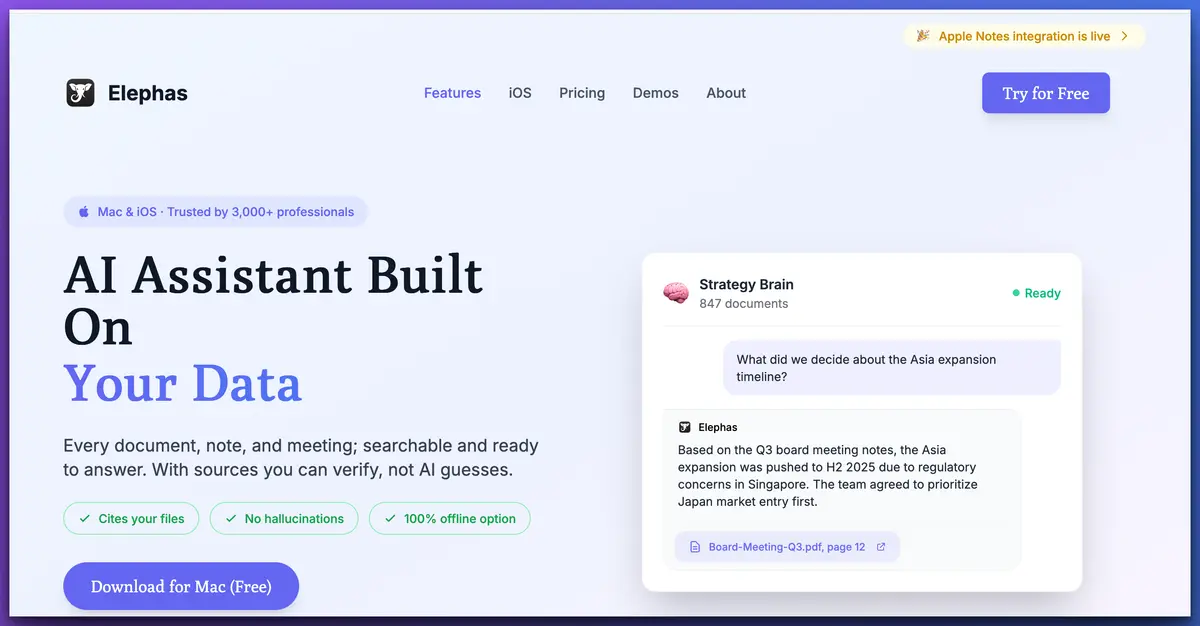
No credit card required. Use Claude or fully local AI — your choice.