How to Enable AI Search in Apple Notes Without Switching Apps
Apple Notes supports AI features through three methods: native Apple Intelligence for text editing and basic search, Elephas for semantic AI search, and Siri/ChatGPT extensions for prompts. While Apple Intelligence offers powerful writing tools, it relies on keyword-based search through Spotlight. For true semantic search with natural language queries like “What notes mention budget planning last month?” you'll need Elephas, which offers natural language queries without leaving your Notes workflow.
Free
Apple Intelligence pricing
7GB
Required storage for AI models
100%
Privacy with offline AI
20+
File formats supported
Quick Summary
- Apple Intelligence provides free on-device text editing and audio summaries but only keyword search
- Elephas adds true semantic search with natural language queries across your knowledge base
- Both can work together: Apple Intelligence for editing, Elephas for search and retrieval
- Offline AI options available through Elephas with Ollama for complete privacy
- Elephas connects Apple Notes with Obsidian, Notion, LogSeq, and 20+ file formats
- Setup takes 5-10 minutes with automatic syncing to keep your knowledge base current
What Is Apple Intelligence in Apple Notes?

Apple Intelligence brings on-device AI capabilities directly to Apple Notes, changing how you write, edit, and summarize content. Launched with iOS 18.1, iPadOS 18.1, and macOS Sequoia 15.1, this free built-in feature works exclusively on Apple's latest hardware.
System Requirements
- iPhone 15 Pro, iPhone 15 Pro Max, or any iPhone 16 series device
- For iPads and Macs, you need M1 or newer Apple Silicon chips
- iOS 18.1+ or later with approximately 7GB of free storage space
Apple Intelligence introduces Writing Tools that work across your device, in Notes, Mail, Messages, Pages, and third-party apps. These tools include Proofread for grammar and spelling checks, Rewrite with tone adjustments (Friendly, Professional, Concise, or Balanced), and Summarize options that present content as paragraphs, bulleted key points, tables, or lists.
For audio notes, Apple Intelligence provides automatic transcription summaries. Record directly in Notes, and when finished, tap the recording to generate a summary highlighting key points from your transcript. This feature supports English, French, German, Japanese, Korean, Portuguese (Brazil), Spanish, and Chinese.
The Search Limitation
The search capability, however, remains keyword-based through Spotlight. While Apple Intelligence processes text beautifully, it doesn't enable semantic search. You still need exact word matches to find your notes. This limitation becomes clear when you try asking, “What did I write about project budgets?” and get no results unless you used those exact words.
Apple Intelligence is completely free and processes most requests on-device for privacy. No subscription is needed, and your data stays on your hardware, aligning with Apple's privacy-first approach.
How to Set Up Native Apple Intelligence (Step-by-Step)
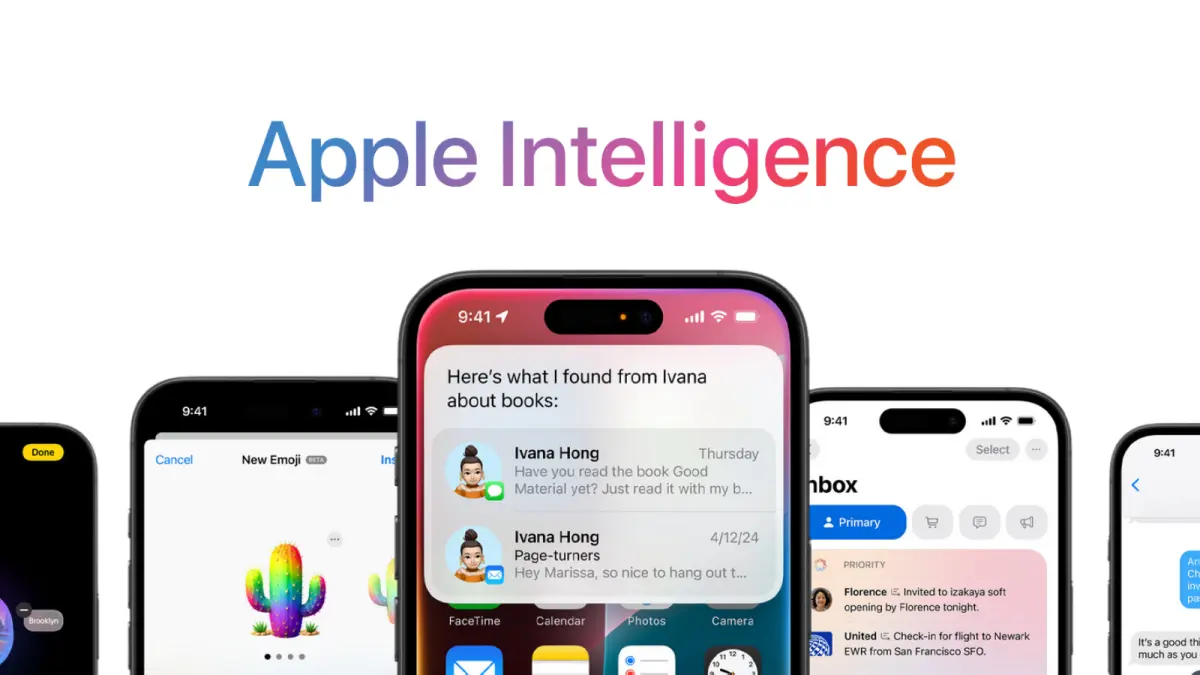
Setting up Apple Intelligence takes just a few minutes once you verify your device meets the requirements.
Step 1: Check Compatibility
Go to Settings > General > About. Verify you're running iOS 18.1 or later (update via Settings > General > Software Update if needed). Confirm your device is an iPhone 15 Pro series or iPhone 16 series.
Step 2: Enable Apple Intelligence
Open Settings > Apple Intelligence & Siri. Toggle on “Apple Intelligence.” Your device will download approximately 7GB of AI models. This happens once and requires a Wi-Fi connection. The download time varies based on your internet speed, typically 10 to 30 minutes.
Step 3: Access Writing Tools
Open any note and select text. You'll see the AI sparkle icon appear on your keyboard. Alternatively, select text and tap the three-dot menu, then choose “Writing Tools.” The menu presents options: Proofread, Rewrite, or Summarize.
Step 4: Create Audio Summaries
Tap the microphone icon in Notes to record. After stopping, tap the recording thumbnail, then select “Create Summary.” Apple Intelligence generates a transcript overview highlighting the main points.
The interface integrates seamlessly with your existing Notes workflow. Writing Tools appear contextually when you need them, and all processing happens on-device within seconds.
The Search Problem: What Apple Intelligence Cannot Do
Apple Intelligence excels at editing text but falls short on search capabilities. The core limitation is that Apple Intelligence only performs keyword search, not natural language queries.
Keyword-Only Search Limitations
- Ask “What did I write about project budgets last month?” and the search returns nothing, unless you literally typed “project budgets” in a note
- The AI doesn't understand the meaning behind your query or related concepts like “funding,” “expenses,” or “financial planning”
- Apple Notes search returns either no results or a list of notes with the keyword somewhere in the body, but with no context or precision
This keyword-only approach misses context and meaning entirely. If you wrote “allocated funds for the initiative” in one note, searching “project budget” won't find it, even though they're semantically identical. The AI can't connect synonyms, related concepts, or contextual meaning.
There's no cross-note semantic search capability. You can't ask, “Which notes discuss similar topics to this one?” or “Find all notes related to this project across different folders.” Each search is isolated, requiring you to remember exact phrases. For knowledge workers accumulating hundreds or thousands of notes, this limitation turns Notes from a productivity tool into a digital filing cabinet you rarely want to open.
What Is Elephas?
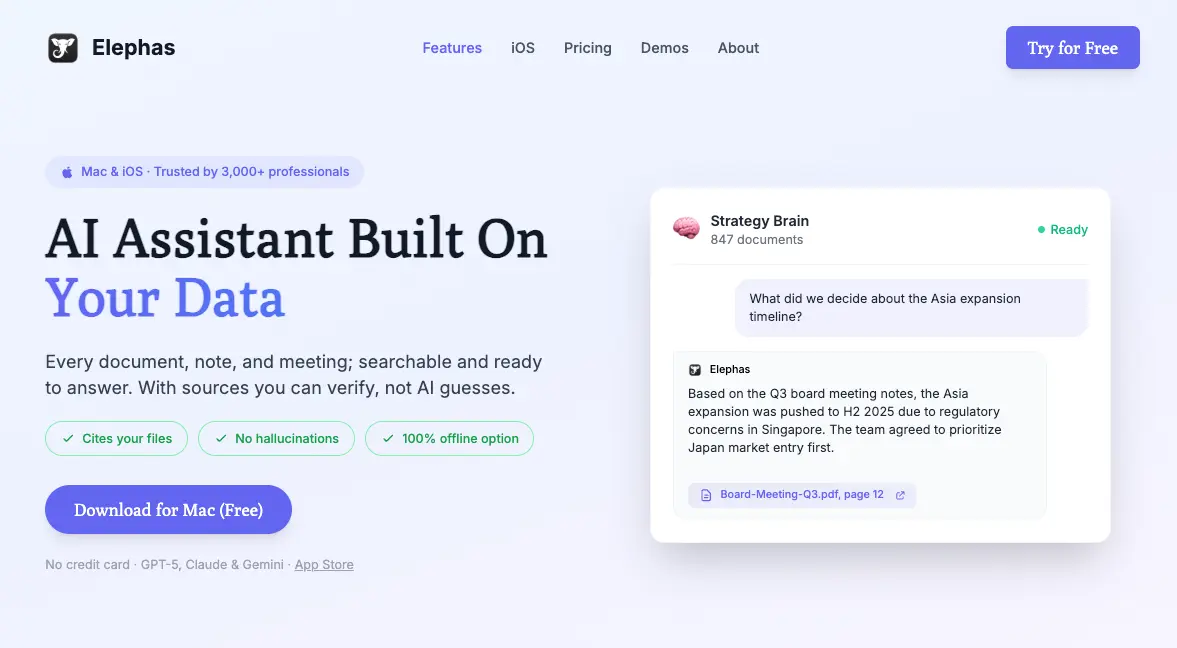
Elephas is a Mac and iOS app designed to solve Apple Notes' search limitations by adding true AI-powered semantic search to your notes ecosystem.
The app creates “Super Brain” knowledge bases that index your Apple Notes using AI embeddings, allowing you to query your notes using natural language. Instead of searching for exact keywords, you can ask questions like “What did I write about client feedback?” and Elephas finds relevant notes based on meaning and context.
Positioned as the search solution Apple Intelligence lacks, Elephas integrates directly with your Apple Notes workflow. You don't need to export notes, switch apps, or change your existing system. Elephas connects to your Notes folders and builds a searchable knowledge base in the background.
Elephas works with both offline AI models and cloud APIs, giving you complete control over privacy. Choose local models like Ollama to keep everything on your Mac, or use cloud services like ChatGPT, Claude, Gemini, or Perplexity for more advanced capabilities.
How Elephas Solves Apple Notes Search Limitations
Elephas and Apple Intelligence take fundamentally different approaches to search.
Understanding vs. Matching
Apple Intelligence searches keywords only. If you search “budget planning,” it finds only notes containing those exact words. Elephas understands meaning and context, so searching “budget planning” also finds notes about “financial forecasts,” “spending allocations,” or “Q4 funding.”
Exact Words vs. Related Concepts
Apple Intelligence requires exact word matches, failing when you don't remember your precise phrasing. Elephas finds related concepts, so searching “team collaboration” surfaces notes about “group projects,” “cross-functional meetings,” and “partnership initiatives.”
Single Notes vs. Knowledge Base
Apple Intelligence cannot query across notes. Each search is isolated. Elephas searches your entire knowledge base, connecting information across hundreds or thousands of notes, folders, and even other apps like Obsidian, Notion, LogSeq, and Roam Research.
Separate App vs. Integrated Workflow
Apple Intelligence searches in Spotlight require you to leave Notes, scan results, and manually open each note. Elephas integrates with Notes workflow through a hotkey-activated sidebar or Super Chat interface. Query your notes and get answers with citations back to the original sources, all without leaving your context.
Setup takes 5 to 10 minutes. Download Elephas, create a Super Brain, select your Apple Notes folders to index, and choose an AI model. The app syncs automatically (with optional auto-sync every 4 hours), keeping your knowledge base current as you add new notes.
Privacy and Offline Options Apple Intelligence Doesn't Offer
While both prioritize privacy, they offer different levels of control.
On-Device vs. Model Choice
Apple Intelligence processes most requests on-device but gives you no choice in which AI models to use. You're locked into Apple's models. Elephas lets you choose: built-in local AI models that never send data anywhere, or cloud APIs from ChatGPT, Claude, Gemini, Perplexity, or Grok if you prefer their capabilities.
Offline Mode with Complete Control
Apple Intelligence requires an internet connection for initial setup and some features. Elephas offers true offline mode with Ollama, keeping all data on your Mac with zero cloud communication. Install Ollama, select a local model like Qwen or Llama, and your entire knowledge base (indexing, search, and queries) runs locally. Your data never leaves your machine.
Multiple AI Options
Beyond privacy, model choice affects capabilities. ChatGPT excels at creative tasks, Claude at analysis and reasoning, Gemini at multimodal understanding, Perplexity at research-backed answers. Elephas supports them all, plus local models like Llama 3.3 that match GPT-4 quality while running entirely offline.
Features Beyond Search That Apple Intelligence Lacks
Apple Intelligence focuses narrowly on text editing within Apple's ecosystem. Elephas offers broader capabilities.
- Text Editing vs. Workflows: Apple Intelligence edits text (proofread, rewrite, summarize). Elephas creates workflows and automations, building AI agents for multi-step tasks
- Single App vs. Multi-Platform: Apple Intelligence works in Notes only. Elephas connects Apple Notes, Obsidian, Notion, LogSeq, and Roam Research into a unified knowledge base
- Audio Summaries vs. Comprehensive Processing: Apple Intelligence summarizes audio recorded in Notes. Elephas processes Zoom transcripts, PDFs, Word documents, Excel files, websites, YouTube videos, and 20+ file formats
- Apple-Only vs. Sync Across Devices: Apple Intelligence requires iPhone 15 Pro or M-series chips. Elephas syncs across Mac, iPhone, and iPad via iCloud with true native apps optimized for each platform
- Basic Features vs. Advanced Capabilities: Elephas adds knowledge graphs revealing connections between notes, web clipper for saving articles, voice notes with AI transcription, quick capture from any iOS app, and system-wide keyboard shortcuts
Step-by-Step: Setting Up Elephas for Apple Notes
Here's how to set up Elephas to add semantic AI search to your Apple Notes.
Watch the video tutorial
https://youtu.be/jFbyp86lpV4Step 1: Download and Install
Visit elephas.app and download the Mac app. Pricing starts at $19/month. A 7-day free trial is available with no credit card required.
Step 2: Create Your First Super Brain
Launch Elephas and click the “+” icon to create a new Super Brain. Name it (e.g., “Personal Notes” or “Work Knowledge”). Select an embedding model (OpenAI for cloud processing or local models for privacy). Click “Create.”
Step 3: Connect to Apple Notes
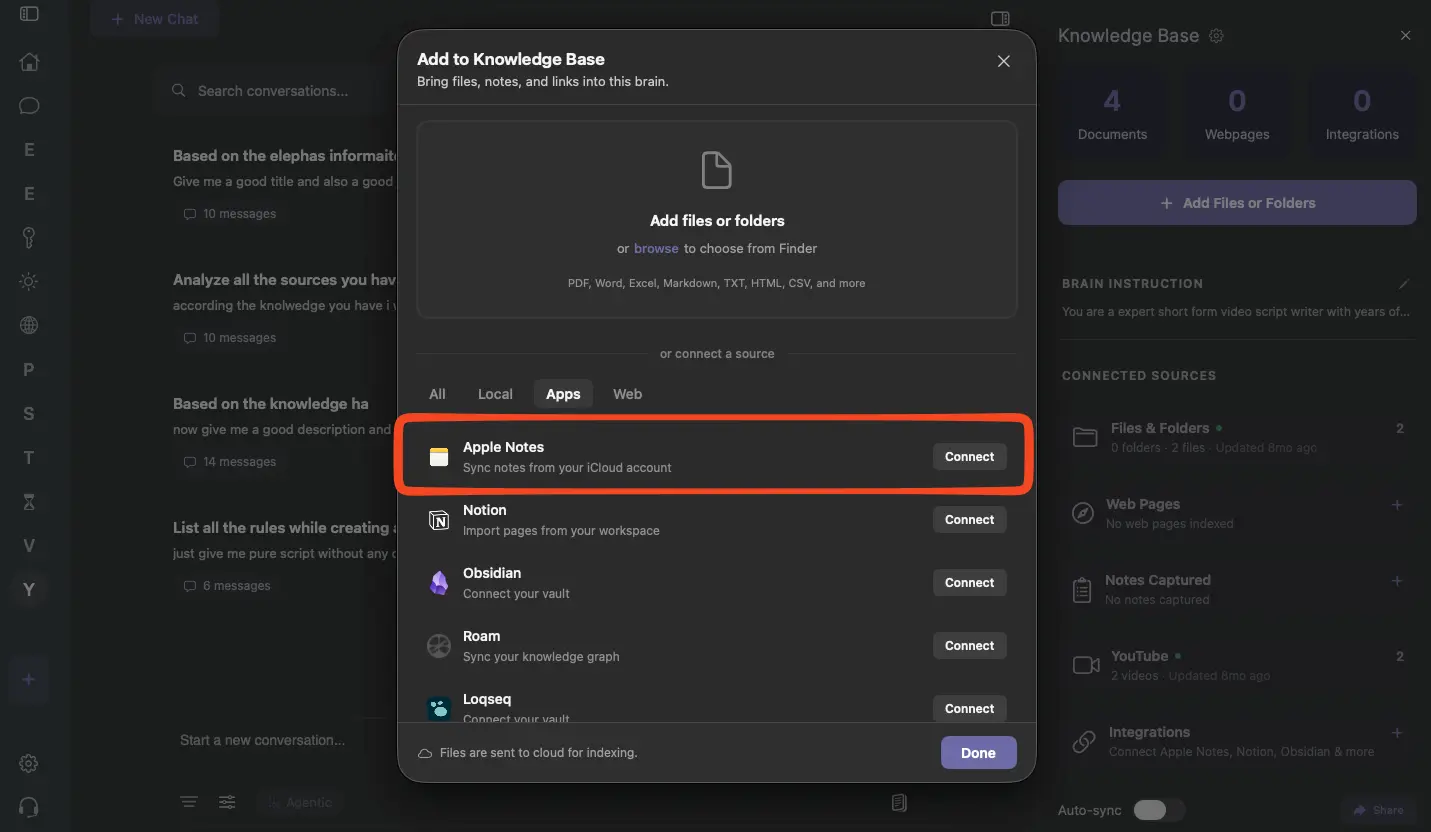
In your Super Brain settings, navigate to the “Knowledge Base” tab. Click “Add Files/Folders,” then select the “Apps” tab. Click “Connect Apple Notes.” A file picker appears. Select the Notes folders you want to index. You can choose individual folders or your entire Notes library.
Step 4: Choose Your AI Model
Go to Preferences > AI Models. Select your preferred model: Cloud APIs (ChatGPT, Claude, Gemini, Perplexity, or Grok) or Offline (select “Offline AI” and choose a local model).
Step 5: Index Your Notes
Click “Index” in your Super Brain. Elephas processes your selected Notes folders, creating semantic embeddings. Indexing time varies based on note count, typically 1 to 5 minutes for a few hundred notes. Enable “Auto-sync every 4 hours” to keep your knowledge base current automatically.
Step 6: Query with Super Chat
Open Super Chat (Cmd+Shift+Space by default) and ask natural language questions: “What notes mention budget planning?” “Summarize my ideas about the marketing campaign.” “Find everything related to client feedback from last quarter.” Elephas returns relevant excerpts with citations linking directly to your original notes.
Apple Intelligence vs Elephas: Side-by-Side Comparison
| Feature | Apple Intelligence | Elephas |
|---|---|---|
| Text editing/rewriting | Yes | No (focused on search) |
| Semantic AI search | No (keywords only) | Yes (natural language) |
| Offline AI models | Partial (on-device) | Yes (Ollama/local LLMs) |
| Cross-note queries | No | Yes |
| Data storage | Apple servers | Your Mac only |
| Integrations | Apple Notes only | Apple Notes, Obsidian, Notion, more |
| Pricing | Free | From $19/mo |
| AI model choice | Apple's only | ChatGPT, Claude, Gemini, local |
| Workflow automation | No | Yes (AI agents) |
| Platform | iPhone 15 Pro+, M-series | Mac, iPhone, iPad |
| File format support | Text only | 20+ formats (PDF, Word, Excel) |
| Knowledge graph | No | Yes |
| Source citations | N/A | Yes (links to original notes) |
Summary: Apple Intelligence handles editing tasks while Elephas handles search and knowledge management across your entire notes system. They complement each other rather than compete.
Which One Should You Choose?
Your choice depends on what you need from AI in Apple Notes.
Choose Apple Intelligence if:
- You only need text editing, proofreading, tone changes, and audio summaries
- Basic keyword search through Spotlight works for you
- You already have compatible devices (iPhone 15 Pro or M-series Mac/iPad)
- You want a completely free solution with zero setup beyond toggling a setting
- Privacy is important and you're comfortable with Apple's on-device processing
- You rarely need to find old notes and mostly work with recent content
Choose Elephas if:
- You need to find information across many notes using natural language queries
- Keyword search frustrates you because you can't remember exact phrases
- You want complete privacy with 100% offline AI processing (via Ollama)
- You use other note apps beyond Apple Notes (Obsidian, Notion, LogSeq, Roam)
- You need workflow automation and AI agents for complex tasks
- You want to choose your AI models based on task requirements
- You have hundreds or thousands of notes and need semantic search
- You frequently reference past information and need fast retrieval
Choose Both (Most Powerful Setup):
Most users benefit from using Apple Intelligence for editing and Elephas for search. They serve different purposes:
- Use Apple Intelligence's Writing Tools to proofread, rewrite, and summarize text as you write
- Use Elephas's semantic search to find and retrieve information across your knowledge base
- Use Apple Intelligence's audio summaries for meeting transcripts
- Use Elephas's cross-platform integration to query notes across all your apps
This combination gives you the best of both worlds: free on-device editing from Apple Intelligence and powerful semantic search from Elephas, all without switching apps or disrupting your workflow.

Related Resources
Explore all AI Productivity resourcesFinal Thoughts
Apple Intelligence brings valuable AI capabilities to Apple Notes. Intelligent text editing, tone adjustments, and audio summaries work seamlessly on compatible devices. But its keyword-only search leaves a significant gap for anyone managing extensive notes.
Elephas fills that gap with true semantic search, allowing natural language queries, cross-note discovery, and complete privacy through offline AI options. Whether you choose cloud models for advanced reasoning or local models for absolute privacy, Elephas changes Apple Notes from a simple note-taking app into a genuine knowledge management system.
The good news? You don't have to choose one or the other. Use Apple Intelligence for editing and Elephas for search. No app switching needed for either solution.
Try Elephas Free for 7 Days