Best AI for Deep Research: 6 Tools Compared by Privacy
Every other list of the best AI for deep research tools ranks them on accuracy, speed, and citation quality. This one ranks the six leading deep research tools by privacy first, then capability, which is what matters when your research touches confidential or unpublished material.
A single prompt to one of these tools can read hundreds of sources and hand back a cited report in minutes. The speed is real. The privacy cost, whether the tool trains on your data, how long it keeps it, and whether it can run offline, is the part almost no comparison puts in the table.
Nearly half
of security and privacy professionals admit to entering non-public company data into public AI tools (Cisco 2025)
64%
still worry about leaking sensitive information to those same tools
3 of 6
tools train on your data by default and ship the opt-out toggle switched off
1 of 6
tools, Elephas, can run a full deep research workflow with no internet connection at all
Executive Summary
Six tools, ranked on one axis the rest of the market ignores: where your research data goes, and whether the vendor trains its AI on it. Capability still counts, but privacy comes first.
- Local-first winner, #1 Elephas. The only tool here that runs deep research on your Mac with built-in local LLM models, or redacts sensitive data before it reaches any cloud model. Never trains on your data.
- Deepest cloud agents, #2 and #3. ChatGPT Deep Research writes the longest cited reports; Perplexity is the fastest with clickable footnotes. Both cost $20/month and both train on consumer data by default.
- Broad public-web scans, #4 Gemini. Strong for market and industry overviews, but the consumer plan trains by default, uses human reviewers, and warns you on screen not to enter confidential text.
- Specialists, #5 and #6. Elicit is the strongest tool for systematic literature reviews and does not train on your data. NotebookLM answers only from documents you upload and does not train on them by default. Both are cloud-only.
- The privacy gap is real. The three open-web agents train on consumer data by default; only Elephas keeps the entire workflow on your own machine.
Why Deep Research Needs a Privacy-First Ranking
A deep research tool is only as safe as what you feed it. These tools send your prompt, and often your uploaded files, to a cloud model that reads, reasons, and writes a report. The better the question, the more sensitive the input tends to be. A lawyer pastes a draft argument, an analyst uploads a client's numbers, a PhD student feeds in unpublished data.
The risk is that the input does not stay private. On most consumer plans, your prompts can be used to train the next model, retained for months, and in some cases sampled by human reviewers. In the Cisco 2025 study, nearly half of security and privacy professionals admitted to entering non-public company data into public AI tools, even though 64% still worried about leaking it.
“In the span of 2-3 years, all business folks I know went from 'this is confidential business information. Please never upload to ChatGPT and only email it to me' to 'just put everything on ChatGPT and see what it tells you.'”
That casual shift is the exact failure this ranking is built to prevent. For confidential work, the question to ask first is not which tool writes the best report, but where your research data goes once you hit enter. The answer turns on local versus cloud AI.
For researchers who still want a leading cloud model, Elephas adds a second layer through automatic PII redaction. Before a prompt is sent to ChatGPT 5.5, Claude Opus 4.8, Gemini, Grok, Perplexity, or any other cloud model, Elephas strips sensitive names, emails, phone numbers, and identifiers on your Mac.
The cloud model only ever sees the sanitized text. When the answer comes back, the redacted fields are reassembled locally on your machine, so identifiable information never leaves the device. Elephas pairs this with zero data retention: content never trains AI models, never sits on a vendor’s server, and never passes through a third-party reviewer’s screen.
Privacy Comparison: All Six Tools Side by Side
Here is the whole field on one screen, ordered by how well each tool protects your research data. The deep dive on each tool follows below.
One column needs a plain definition. Zero data retention, or ZDR, means the vendor uses your prompt to produce the answer and then keeps nothing. Your text is not stored on their servers, not saved in logs, and not used to train future models.
Most consumer plans do the opposite. They hold your prompts for days or months and may train on them. ZDR is usually limited to enterprise or API plans, so on a confidential project it matters whose account runs the research.
All pricing and privacy settings verified as of June 2026. Settings change often; confirm the current data controls on each tool's site before trusting it with sensitive material.
Elephas, Best Privacy-First AI for Deep Research on Confidential Material
Best for mac users who need deep research on confidential or unpublished material that never leaves their device.
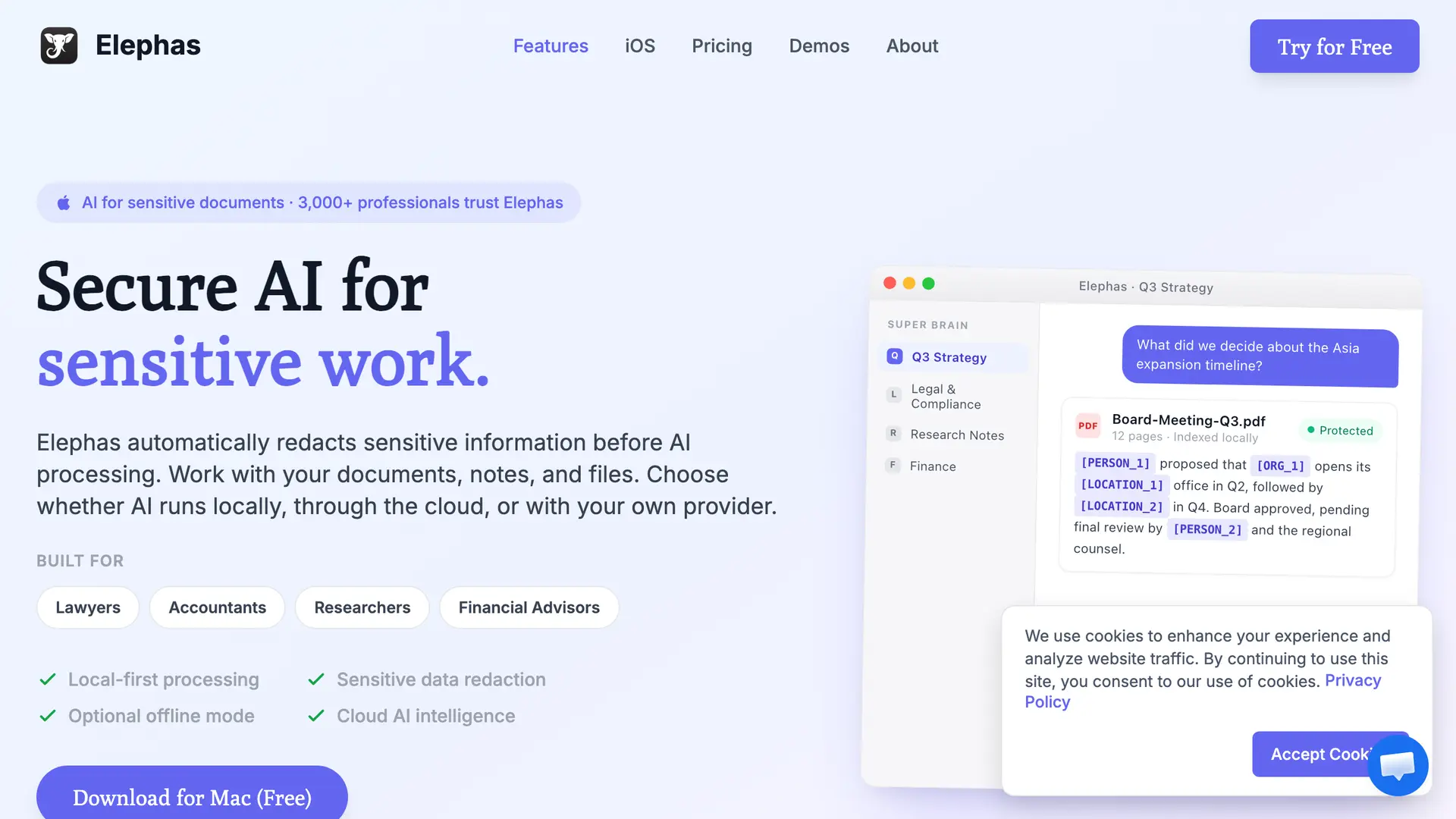
Elephas is a Mac-native AI knowledge assistant that turns your own PDFs, notes, and files into a searchable second brain you can question in plain language. Its Super Brain feature answers only from the documents you add, with citations, so it does not invent sources the way an open-web chatbot can.
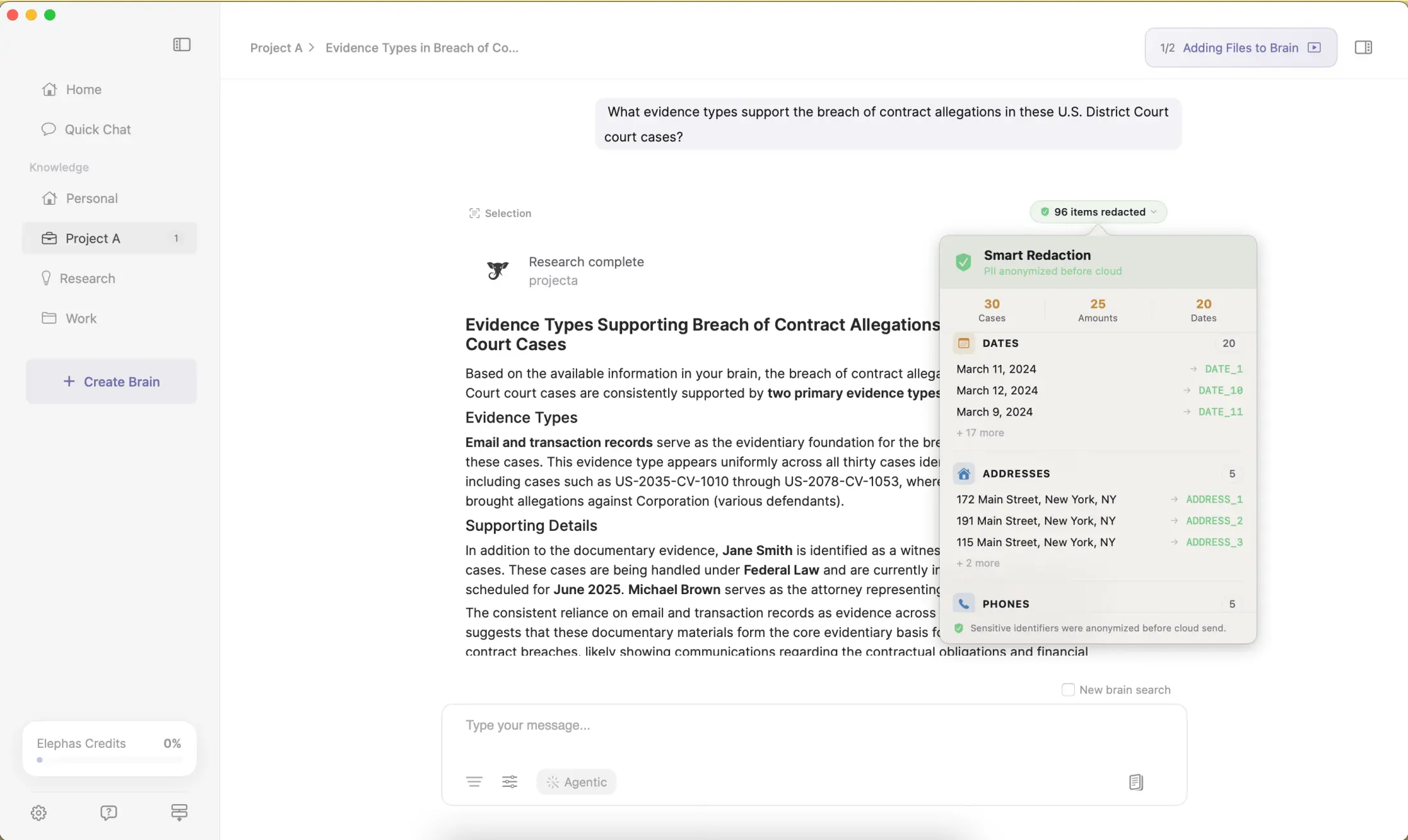
What sets Elephas apart for deep research is choice of model with privacy built in. You can run fully offline with built-in local LLM models on a Mac, so nothing ever leaves your computer. Or you can bring your own cloud key and let Elephas redact sensitive data before it is sent.
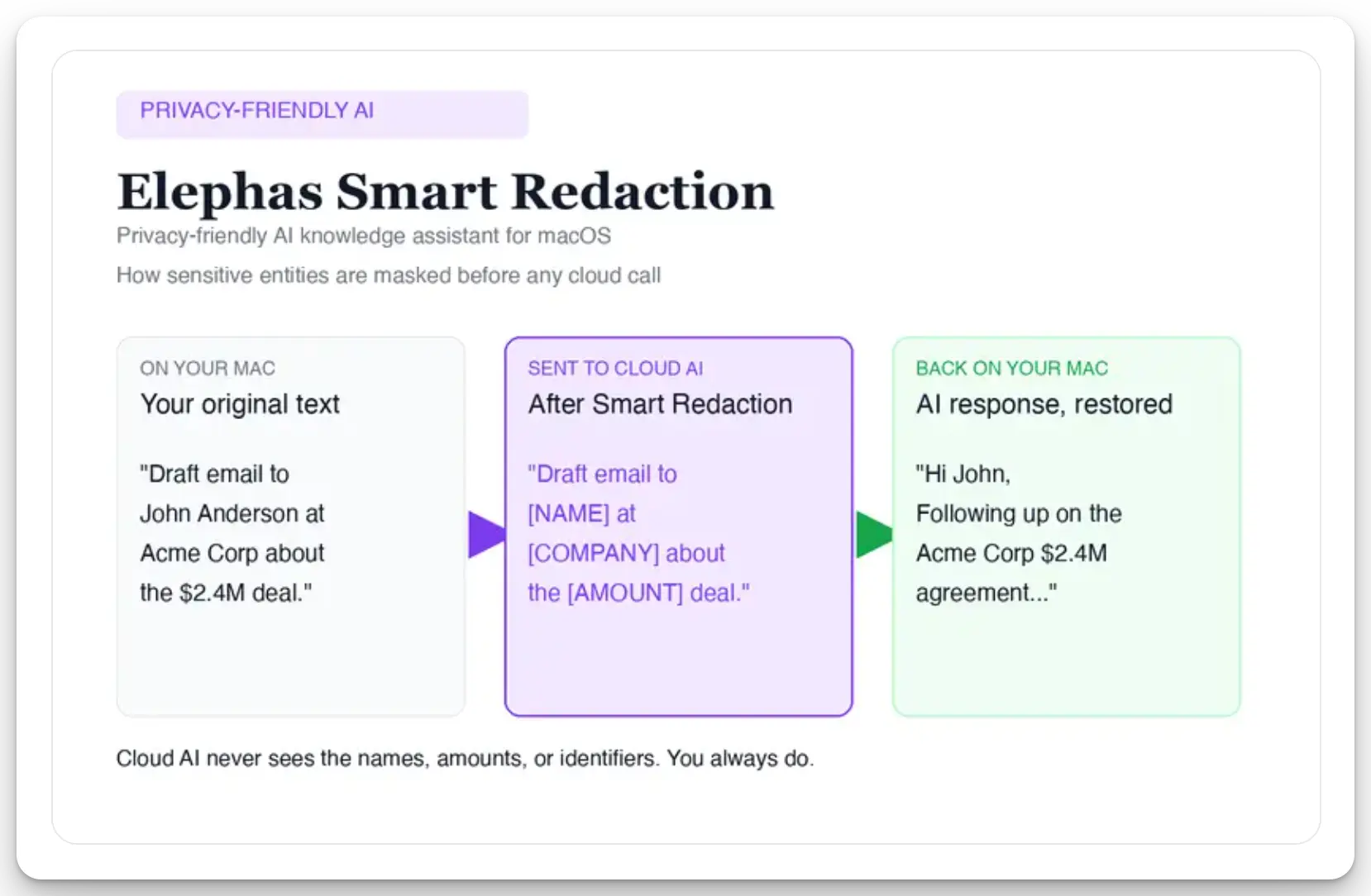
For researchers who still want a leading cloud model, Elephas adds a second layer through automatic PII redaction. Before a prompt is sent to ChatGPT 5.5, Claude Opus 4.8, Gemini, Grok, Perplexity, or any other cloud model, Elephas strips sensitive names, emails, phone numbers, and identifiers on your Mac.
The cloud model only ever sees the sanitized text. When the answer comes back, the redacted fields are reassembled locally on your machine, so identifiable information never leaves the device. Elephas pairs this with zero data retention: content never trains AI models, never sits on a vendor's server, and never passes through a third-party reviewer's screen.
Key Capabilities
Pricing. Free plan available; paid plans start at $19/month. See elephas.app/pricing for the full plan list.
Why we picked Elephas
“Sensitive data is automatically detected and redacted before anything reaches a cloud AI model, your content is never used to train AI models, and nothing passes through a third-party reviewer's screen.”
Positive feedback. “My experience is very good with Elephas regarding article writing, chat with super brain, presentation maker.” Glory, Capterra, 2025
Positive feedback. “It has an ability to manage documents, retrieve data accurately, and has flexibility to handle various file types to its offline mode for privacy.” Capterra, 2024
ChatGPT Deep Research, Best for the Deepest, Longest Cited Reports
Best for analysts and consultants who want the deepest, longest cited reports and already live in the ChatGPT ecosystem.
ChatGPT Deep Research is OpenAI's autonomous research agent. From a single prompt, it browses the web for roughly 5 to 30 minutes, reads hundreds of sources, and writes a long, structured report at the level of a research analyst. Every claim carries an inline citation you can click to verify.
For deep research work, it is the most thorough of the mainstream agents. It often proposes an editable research plan first, then pivots its searches as it learns, and you can connect apps like Google Drive, SharePoint, Slack, and Notion as sources. Reports export to Markdown, Word, or PDF.
On privacy, the consumer plans are the catch. For Free, Plus, and Pro accounts, OpenAI may use your conversations to improve its models by default, and the opt-out in Data Controls is off until you turn it on. Even deleted and temporary chats are retained for about 30 days. Business, Enterprise, and the API do not train on your data by default and can be configured for zero data retention. There is no local or offline option.
Key Capabilities
Pricing. $20/month for ChatGPT Plus includes Deep Research. The free tier includes a small number of lighter runs, and ChatGPT Pro is $200/month for the highest quotas. Source: openai.com/chatgpt/pricing.
Why we picked ChatGPT Deep Research
ChatGPT Deep Research is the best choice when report depth is the priority and the source material is not confidential. The reasoning and depth are strong, but privacy-conscious users have to opt out of training manually or move to an Enterprise plan to keep research data out of the model.
Positive feedback. “I've been planning vacations with ChatGPT's Deep Research since it became available. Absolutely brilliant!” Hacker News, 2026
Negative feedback. “It's like wikipedia except it spits out incorrect information at an alarming rate and has no references.” Hacker News, 2025
Perplexity Deep Research, Best for Fast, Heavily Footnoted Answers
Best for researchers who want fast, heavily cited reports with clickable footnotes for quick fact-checking.
Perplexity Deep Research breaks your question into parts, runs dozens of searches in parallel, reads hundreds of sources, and returns a cited report in about 2 to 4 minutes. Citations are clickable numbered footnotes attached to each claim, which makes fact-checking quick.
It is the fastest of the agentic tools, and unlike ChatGPT, Perplexity includes Deep Research on its free tier with daily caps. The output leads with an executive summary and keeps source metadata visible, so you can scan the trail behind each answer.
On privacy, the Free, Pro, and Max plans have the AI data retention setting on by default, so your searches can be used to improve the service unless you turn the toggle off, and that opt-out applies to future data only. Perplexity says enterprise data is never used for training, and its Sonar developer API carries a strict zero data retention policy. There is no local or offline option.
Key Capabilities
Pricing. $20/month for Perplexity Pro includes a high daily Deep Research allowance. The free tier includes Deep Research at roughly 3 to 5 queries per day. Source: perplexity.ai/pro.
Why we picked Perplexity Deep Research
Perplexity is the best choice for fast, footnoted research where you value speed and easy source-checking. For sensitive work, the default-on data retention is the catch, and the zero-retention guarantee sits on the developer API rather than the consumer chat product.
Positive feedback. “I like perplexity's deep research model which is based on deepseek i think. I use that for most kind of writing, discussion, research, etc. where I need some kind of feedback.” Hacker News, 2025
Negative feedback. “Oh, sure, it hallucinates a lot, and in dangerous ways, but even if I have to manually corroborate all the citations, I'm still saving time.” Hacker News, 2025
Google Gemini Deep Research, Best for Broad, Cited Scans of the Public Web
Best for researchers doing fast, broad, cited scans of the public web inside Google Workspace.
Google Gemini Deep Research is the agentic research mode in the Gemini app, included with Google AI Pro. You give it a question, it writes an editable research plan, and then it browses hundreds of sites and returns a long, citation-backed report in minutes. It runs on Gemini 3.1 Pro with a 1M-token context window.
It is strong for market scans, competitive intelligence, and industry overviews drawn from the public web. Reports export to Google Docs, and Gemini can turn a report into an Audio Overview you listen to like a podcast.
On privacy, the consumer Gemini app uses your activity to improve Google's services by default, and a subset of chats is reviewed by human reviewers. Google even warns on screen not to enter anything confidential you would not want a reviewer to see. Activity auto-deletes after 18 months, but chats picked for human review are kept up to 3 years and are not removed when you delete your activity. The no-training protections apply to Google Workspace, a separate enterprise product. There is no local or offline option.
Key Capabilities
Pricing. $19.99/month for Google AI Pro (formerly Gemini Advanced) includes the full Deep Research feature. The free tier caps it at roughly 5 reports per month. Source: gemini.google/subscriptions.
Why we picked Google Gemini Deep Research
Gemini Deep Research is the best choice for fast, broad scans of public information when you already work in Google Workspace. The on-screen warning about confidential input is the clearest signal in this roundup that the consumer plan is not built for private material.
Positive feedback. “Gemini and Gemini deep research are awesome... The export to google docs in Gemini deep research is tough to beat too.” Hacker News, 2026
Elicit, Best for Academic Researchers Running Systematic Literature Reviews
Best for academic researchers and PhD students running systematic literature reviews and structured evidence extraction.
Elicit is an AI research assistant built specifically for academic literature review and evidence synthesis. It searches a corpus of more than 125 million papers, and its Research Agent runs systematic-review-style workflows: finding papers, screening them against your criteria, and extracting structured data into comparison tables with sentence-level citations.
For a PhD student or evidence analyst, this is closer to a research methodology tool than a chatbot. It can screen thousands of papers and pull columns like method, sample size, and outcomes into a spreadsheet view, which keeps the citation trail tight.
On privacy, Elicit states it does not train on user data, and it holds agreements with its third-party model providers that prevent them from training on your inputs and bind them to zero data retention. The product holds SOC 2 Type II with a clean opinion, and encrypts data in transit and at rest. There is no local or offline option, since Elicit runs in the cloud.
Key Capabilities
Pricing. A free Basic plan includes 2 automated reports per month. Elicit Pro is $49/month per user and adds the systematic review workflow across up to 5,000 papers. Source: elicit.com/pricing.
Why we picked Elicit
Elicit is the best choice for structured, citation-grounded literature reviews where you need to compare many papers at once. Its privacy posture is strong for a cloud tool, though an independent study found its search sensitivity is too low to fully replace a traditional literature search.
Negative feedback. “The sensitivity of Elicit was poor, averaging 39.5% compared to 94.5% in the original reviews; it did not search with high enough sensitivity to replace traditional literature searching.” Peer-reviewed study, 2025
NotebookLM, Best for Trustworthy Answers Drawn Only From Your Own Documents
Best for researchers and students who need citation-backed answers from a fixed set of their own documents.
NotebookLM is Google's source-grounded research tool. It answers questions only from the documents, links, and videos you upload, and never reaches out to the open web. That grounding keeps every answer tied to your own sources, and it is a privacy-relevant design because the model works inside the material you provide.
For researchers, the appeal is trust. Every answer carries an inline citation to the exact passage in your source, and if the answer is not in your documents, NotebookLM says so instead of inventing one. It can also turn your sources into study guides, timelines, and an Audio Overview.
On privacy, Google states that content in NotebookLM is not used to directly train its foundational AI models, unless you choose to submit feedback. Human review happens only when you give thumbs up or down, and that feedback is disconnected from your account before a reviewer sees it, then retained for up to 3 years. Workspace and education accounts add stronger no-review guarantees. There is no local or offline option.
Key Capabilities
Pricing. NotebookLM is free with usage limits. NotebookLM Plus comes through Google AI Plus, which dropped to $4.99/month in June 2026 and raises the limits on notebooks, sources, and Audio Overviews. Source: gemini.google/subscriptions.
Why we picked NotebookLM
NotebookLM is the best choice when you want answers from a fixed set of your own documents rather than the open web. It does not train on your content by default, which is a meaningful step up from the consumer chatbots, but it still runs entirely in Google's cloud with no offline mode.
Positive feedback. “The coolest thing in NotebookLM is the podcast-episode-generator. Each one sounds like two people having a conversation.” Hacker News, 2026
Negative feedback. “I gave NotebookLM a much shorter text, one of my own blog posts, and it mixed in accurate statements with a noticeable quantity of made-up statements.” Hacker News, 2024
How We Ranked These Tools
Five dimensions, all of which the typical roundup of the best AI for deep research ignores. We evaluated the leading tools against the needs of people who research sensitive material for a living: lawyers, analysts, consultants, and academic researchers. Capability matters, but for this audience the data trail matters just as much.
We weighted privacy first because it is the factor the rest of the market ignores, and it is the core of what private AI means. Every tool was checked against its official pricing and privacy pages in June 2026, and we read user reviews across G2, Trustpilot, and Capterra, plus one peer-reviewed evaluation.
The five factors we weighed
- Privacy by default. Whether the tool trains on your data out of the box, and how hard the opt-out is to find.
- Data retention. How long prompts and reports are stored, and whether deletion is real.
- Local control. Whether any version can run offline, with no data leaving your device.
- Research depth. Quality of sources, citations, and synthesis in the final report.
- Real user feedback. Verified reviews and independent evaluations, not marketing claims.
Conclusion
The best deep research tool is not just the one that writes the longest report. It is the one that does the work without putting your sources at risk. ChatGPT Deep Research and Perplexity lead on depth and speed, Gemini is strong for public-web scans, and Elicit and NotebookLM are excellent for academic and document-grounded work.
Each of those five, though, sends your research into the cloud, and most train on it by default. For non-confidential topics that is a fine trade. For confidential, client, or unpublished material, it is the whole problem.
Elephas is the tool that closes that gap. It runs deep research on your Mac with built-in local LLM models, or redacts sensitive data before it reaches any cloud model, so your work stays yours. Six tools, one privacy axis, and one principle: the best AI for deep research is the one that does the research without leaking your data.
Frequently Asked Questions
What is the best AI for deep research?
It depends on your data. ChatGPT Deep Research and Perplexity give the deepest and fastest cited reports, while Elephas is the best choice for confidential research because it runs locally on a Mac and redacts sensitive data before any cloud model sees it.
For academic literature reviews, Elicit is the strongest specialist; for answers grounded only in your own documents, NotebookLM fits best.
Is ChatGPT Deep Research free?
A limited version is free. The full ChatGPT Deep Research feature, with longer reports and higher limits, requires ChatGPT Plus at $20/month.
The free tier offers only a small number of lighter runs each month, so heavy research use pushes you to a paid plan.
Which AI does not train on your data for research?
Elicit and NotebookLM do not train on your content by default, and Elephas never trains on your data at all.
ChatGPT, Perplexity, and Gemini train on consumer data by default unless you turn off the opt-out toggle, which ships in the off position.
Is it safe to use AI for research with confidential data?
Only with the right tool. Most cloud deep research tools retain prompts and may use them for training, so confidential work needs a tool with a local mode or automatic redaction, such as Elephas, or an enterprise plan with zero data retention.
On a standard consumer plan, pasting unpublished or client material into a cloud research agent is the risk this guide is built to help you avoid.
Which is better for deep research, Perplexity or ChatGPT?
ChatGPT Deep Research is more thorough and produces longer reports, taking 5 to 30 minutes per run. Perplexity is faster, at about 2 to 4 minutes, with clickable footnotes that make source-checking quick.
Both cost $20/month and both train on consumer data by default, so the privacy trade-off is the same.

Keep Your Deep Research Private
Elephas runs deep research on your own Mac with built-in local LLM models, an offline mode, and automatic PII redaction before any cloud-model call.
Try Elephas FreeBuilt-in local LLM models. Offline mode included.
Related Resources
Elephas for research
How to build a private, searchable AI brain from your own documents and notes, with built-in local LLM models on Mac.
Private AI for academics
Elicit alternatives and privacy-first research tools for systematic literature review and evidence work.
ChatGPT and confidential files
What actually happens when you paste confidential material into ChatGPT, and the safer setups for sensitive work.
AI for solo professionals
Choosing a research assistant that keeps client and case data private for lawyers, consultants, and analysts.
Sources
This guide was built from primary-source research against each tool's official pricing and privacy pages, plus user feedback on G2, Trustpilot, Capterra, and a peer-reviewed evaluation. All pricing and privacy settings verified as of June 2026.
- Cisco 2025 Data Privacy Benchmark Study
- Harmonic Security, What 22 Million Enterprise AI Prompts Reveal About Shadow AI in 2025 (full-year 2025 study of 22.4M prompts)
- OpenAI, Introducing Deep Research
- OpenAI Enterprise Privacy
- Perplexity Pro
- Perplexity privacy and security docs
- Google Gemini Deep Research overview
- Google privacy policy
- Elicit pricing
- Elicit SOC 2 announcement
- NotebookLM
- medRxiv / PMC, Elicit search sensitivity evaluation
- Hacker News, confidential data and ChatGPT discussion
- Elephas product homepage
- Elephas pricing