Elephas vs ChatGPT for Lawyers: Privacy, Privilege & Features Compared
ChatGPT is fundamentally incompatible with attorney-client privilege. Here's a detailed comparison with Elephas—including the privilege problem, hallucination risk, and which tool actually protects your practice.
Quick verdict
ChatGPT sends your data to OpenAI's servers, hallucinates case law, and has no privilege protection (per its own CEO). Elephas processes documents locally on your Mac, cites your actual uploaded files, and works fully offline. For any legal work involving client information, Elephas is the clear choice. For general-purpose Q&A with no privileged data, ChatGPT remains useful.
The Privilege Problem with ChatGPT
ChatGPT's architecture is fundamentally incompatible with attorney-client privilege. Every interaction involves transmitting data to OpenAI's servers—a third-party disclosure that creates privilege waiver risk. Here's the evidence:
Sam Altman's Admission
OpenAI's own CEO has publicly acknowledged that ChatGPT provides no attorney-client privilege protection. This isn't a technical limitation that could be fixed with an update—it's an architectural reality. ChatGPT requires transmitting data to cloud servers, which creates the third-party disclosure that undermines privilege.
Court-Ordered Log Retention
Courts have already ordered OpenAI to retain and produce user interaction logs during litigation. Your “private” ChatGPT conversations are discoverable. Any client information you've entered into ChatGPT could potentially surface in opposing counsel's discovery requests.
Data Used for Training (Opt-Out Is Not Enough)
On consumer plans, your inputs may be used to train future models. Even if you opt out, the data is still transmitted to, processed on, and temporarily stored on OpenAI's servers. Opting out of training doesn't eliminate the third-party disclosure—it just limits one use of that disclosure.
Mata v. Avianca: Hallucinated Case Citations
In 2023, a lawyer used ChatGPT for legal research and submitted a brief containing multiple case citations that were entirely fabricated. The cases didn't exist. The attorney and firm were sanctioned. This is not an edge case—ChatGPT has no access to verified legal databases and routinely generates plausible-sounding but fake legal authority.
For a deeper analysis, see our guide on how AI tools can waive attorney-client privilege.
The Elephas Advantage for Legal Work
Elephas addresses every one of ChatGPT's critical weaknesses for legal professionals. The difference is architectural—not just a better privacy policy, but a fundamentally different approach to data handling.
Local Processing = No Third-Party Disclosure
When you use Elephas with local AI models, all document processing happens on your Mac. Your case files, client communications, and legal strategy documents never leave your device. There's no cloud transmission, no third-party server, no data to subpoena. Privilege is preserved by architecture, not by contract.
Super Brain = Persistent Case Knowledge
ChatGPT starts every conversation from scratch. Elephas lets you build permanent Super Brain knowledge bases per case, per client, or per practice area. Upload hundreds of documents — statutes, case law, contracts, depositions — and query across all of them. Your AI remembers your cases.
Source Citations = No Hallucinated Case Law
When you query an Elephas Super Brain, answers come with citations to specific passages in your uploaded documents. The AI references the actual page, paragraph, or section — not generated text from internet patterns. You can verify every claim against your own source material.
Offline Mode = Work Anywhere
Elephas works fully offline with local AI models. Prepare for trial in the courtroom. Review documents at a secure facility. Work on a plane. ChatGPT goes dark without internet — Elephas keeps working.
Feature Comparison Table
Side-by-Side Workflows: ChatGPT vs Elephas
See how these tools compare in real legal scenarios:
Preparing a Motion for Summary Judgment
Reviewing a 50-Page Contract
Responding to Opposing Counsel's Brief
Verdict
For legal professionals, the choice is straightforward:
Use ChatGPT for general-purpose questions that involve zero client information, zero case strategy, and zero privileged communications. Think: “What's the difference between summary judgment and judgment on the pleadings?”—generic legal knowledge questions where hallucination risk is manageable.
Use Elephas for any work that touches client information, case materials, privileged communications, or work product. The local processing model eliminates privilege risk entirely. Super Brain knowledge bases give you persistent, citable case intelligence. And offline mode means you can work anywhere.
At $19/month vs $20/month for ChatGPT Plus, Elephas is actually less expensive—and provides categorically better protection for your practice. For more alternatives, see our guide to the best private AI tools for lawyers. Also see how Elephas compares to Claude and NotebookLM. Solo practitioners should read our solo practitioner's guide to AI-powered legal work.
Frequently Asked Questions
Has Sam Altman really said ChatGPT has no privilege protection?
Yes. OpenAI's CEO has publicly acknowledged that ChatGPT does not provide attorney-client privilege protection. Data entered into ChatGPT is transmitted to OpenAI's servers, processed on their infrastructure, and logged. This creates a third-party disclosure that is fundamentally incompatible with privilege preservation.
Is ChatGPT Enterprise safe for legal work?
ChatGPT Enterprise provides stronger contractual protections — including zero-data-retention clauses and no training on your inputs. However, the data still leaves your device and is processed on OpenAI's servers. This transmission itself constitutes a third-party disclosure under privilege law. Enterprise agreements reduce risk but don't eliminate the fundamental architectural problem.
Can Elephas use GPT-4 while keeping my documents private?
Yes. When you use cloud AI models through Elephas, your Super Brain documents remain processed locally on your Mac. Only your specific query is sent to the AI provider — not your entire document library. For maximum privacy, you can use fully local AI models with zero cloud transmission.
How does Elephas prevent hallucinated case citations?
Elephas's Super Brain feature grounds AI responses in your actual uploaded documents. When you query a Super Brain, the AI references specific passages from your files — statutes, case law, contracts, and correspondence that you've uploaded and verified. This is fundamentally different from ChatGPT's approach of generating plausible-sounding text from internet patterns.
What courts have ordered OpenAI to produce user data?
Multiple courts have ordered OpenAI to retain and produce user interaction logs during litigation. These orders demonstrate that 'private' ChatGPT conversations are discoverable through legal process. For lawyers, this means any client information entered into ChatGPT could potentially be produced in discovery — a serious confidentiality concern.
How much does Elephas cost compared to ChatGPT?
Elephas plans start at $19/month, compared to ChatGPT Plus at $20/month and ChatGPT Enterprise at significantly higher per-seat pricing. For the legal use case, Elephas provides substantially more value: local processing for privilege preservation, Super Brain knowledge bases, source citations, and offline mode — features ChatGPT simply cannot match.

Related Resources
Explore all AI for Lawyers resourcesSiri vs ChatGPT for Confidential Work
15 min readarticleCan You Upload Contracts to AI? Privacy Risks, Vendor Workflow, and Safer Alternatives for AI Contract Management
11 min readarticleAI for Sensitive Data: A Complete Guide to Using AI Tools Without Exposing Sensitive Company Information (2026 Edition)
10 min readarticleIs ChatGPT Attorney-Client Privilege Protected? The Heppner Ruling and Generative AI in Litigation
11 min readSwitch to Privacy-First Legal AI
Stop sending client data to OpenAI's servers. Elephas keeps everything on your Mac, cites your actual documents, and costs less than ChatGPT Plus. Start your free trial today.
Try Elephas Free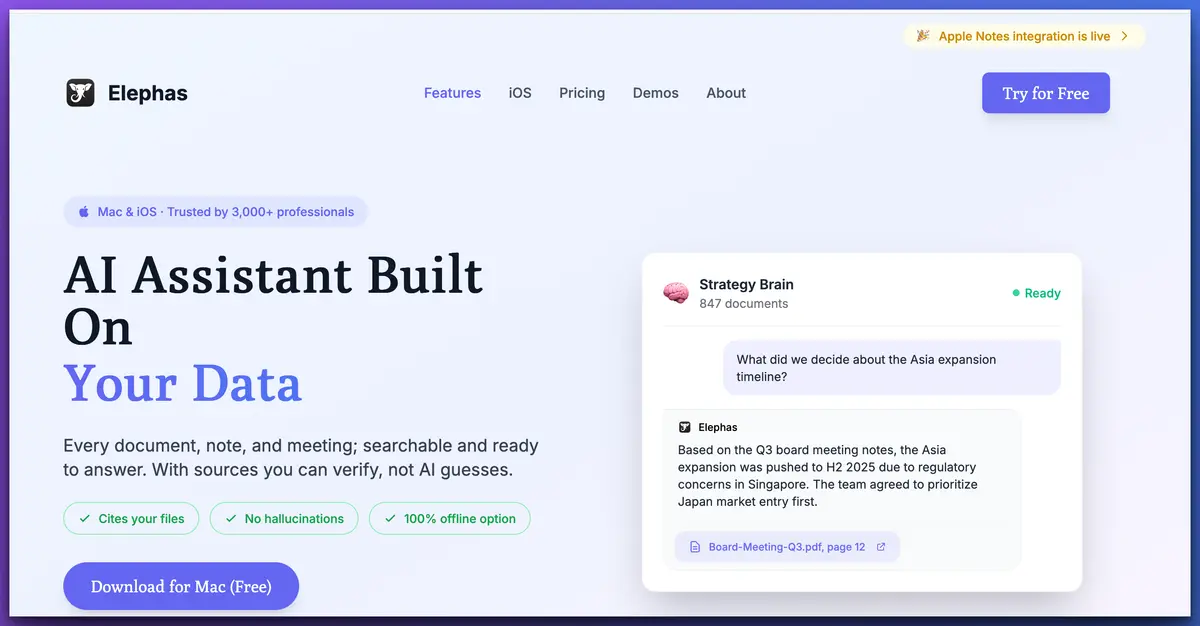
No credit card required. True offline AI included.