AI Text Watermark: What It Actually Proves for Confidential Documents
Last updated: September 7, 2026
An AI text watermark is a statistical pattern in what a model like Claude writes back, not hidden code or encryption. Claude has quietly carried one since Fable 5.1's September 2026 launch, and associates paste client drafts into it routinely without a second thought about what that means.
This article settles one question: what Claude's watermark can and cannot prove about a document your team sent through it, and what that means for privilege, disclosure, and what you tell a client before you paste anything else in.
Here is what the mark actually shows, where the real legal exposure already sits, and where a redaction habit beats waiting for a watermark to catch up.
Quick answer
- A Claude text watermark is a statistical pattern in word choice, not hidden code, encryption, or a security feature.
- It can only show Claude was "likely involved" in a document at some point, not who wrote it, whether it is accurate, or whether it leaked.
- Only two Claude models (Fable 5.1, Mythos 5.1) currently carry it; public detection is not available to ordinary users, only to eligible regulators, researchers, and enterprises.
- It does not change attorney-client privilege, GDPR duties, or ABA Formal Opinion 512 obligations. Those depend on where the data went, not on a watermark.
- Elephas redacts confidential names, emails, and identifiers before anything reaches Claude, ChatGPT, or Gemini. Plans start free, with paid tiers from $19/month, and you can try Elephas for free.
How Claude's Text Watermark Works, and What It Can (and Cannot) Prove
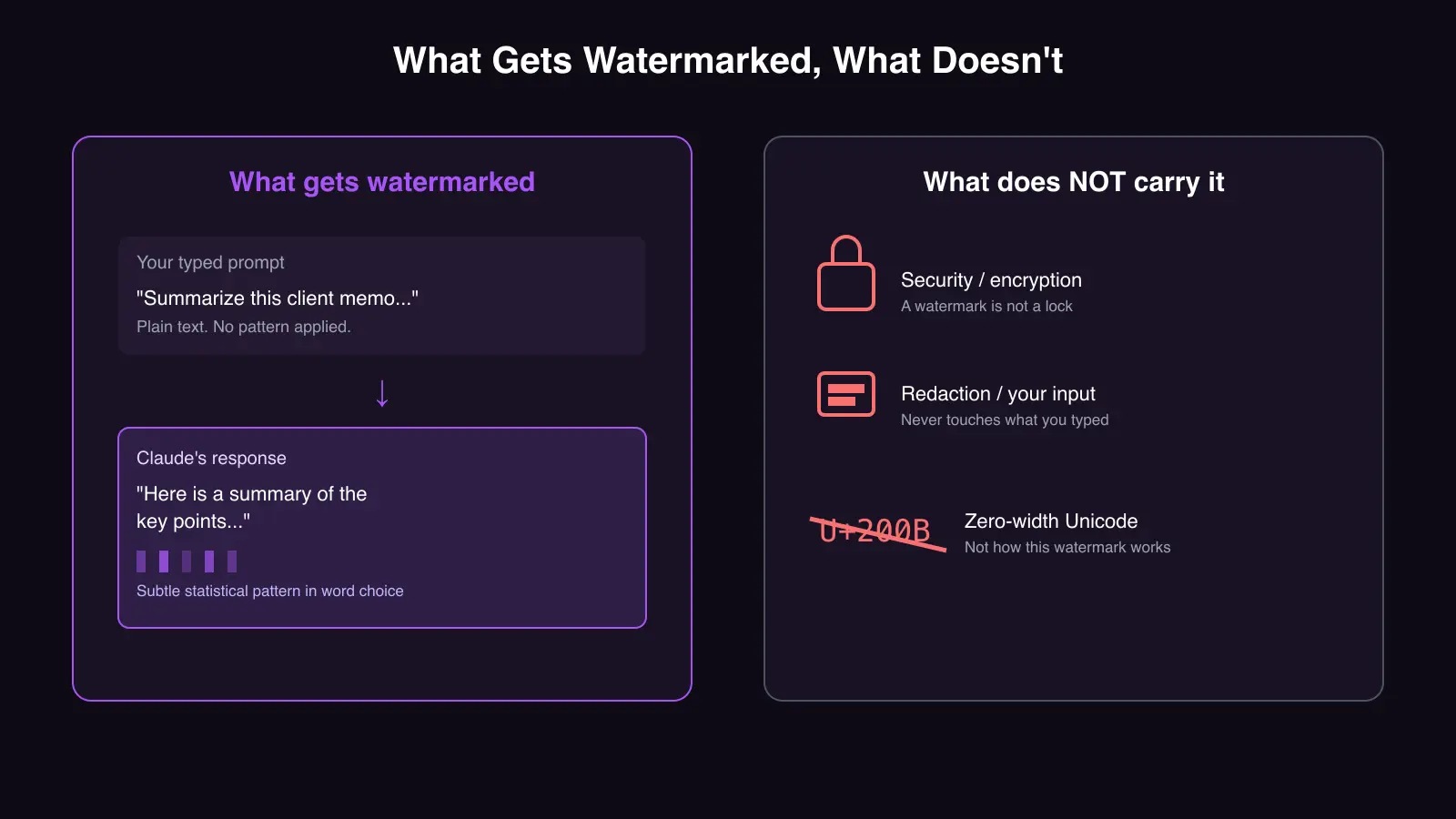
A Claude text watermark, a form of digital watermarking, is a pattern in the tokens Claude favors while writing. Anthropic says it "can only determine that Claude was likely involved," never who wrote it. The pattern is sparsest where accuracy matters most: a citation or date has one correct answer, leaving nothing to act on.
A day after the feature broke wider, r/ClaudeAI users were already asking exactly what it could prove, and legal and compliance teams keep misjudging the mark in the same three ways:
- Not a leak-prevention feature. A watermark signals provenance after the fact; it says nothing about where your data went or who else saw it.
- Doesn't cover what you typed. The pattern only lives in what Claude writes back, never in your prompt or the client language you pasted in.
- Not publicly detectable. Watermark detection stays restricted to regulators and compliance-obligated enterprises; an ordinary lawyer cannot run a document through a public detector today.
That third gap already touches a large share of the profession: 30% of lawyers use AI tools, triple the 2023 rate, per the ABA survey. r/claude users asked Claude itself what the mark could prove, and got the same "provenance signal, not proof" answer.
A federal court has already ruled on the bigger question the watermark distracts from, with a client's freedom on the line, months before Claude's watermark even existed.
The Federal Ruling That Already Turned a Claude Chat Into Discoverable Evidence
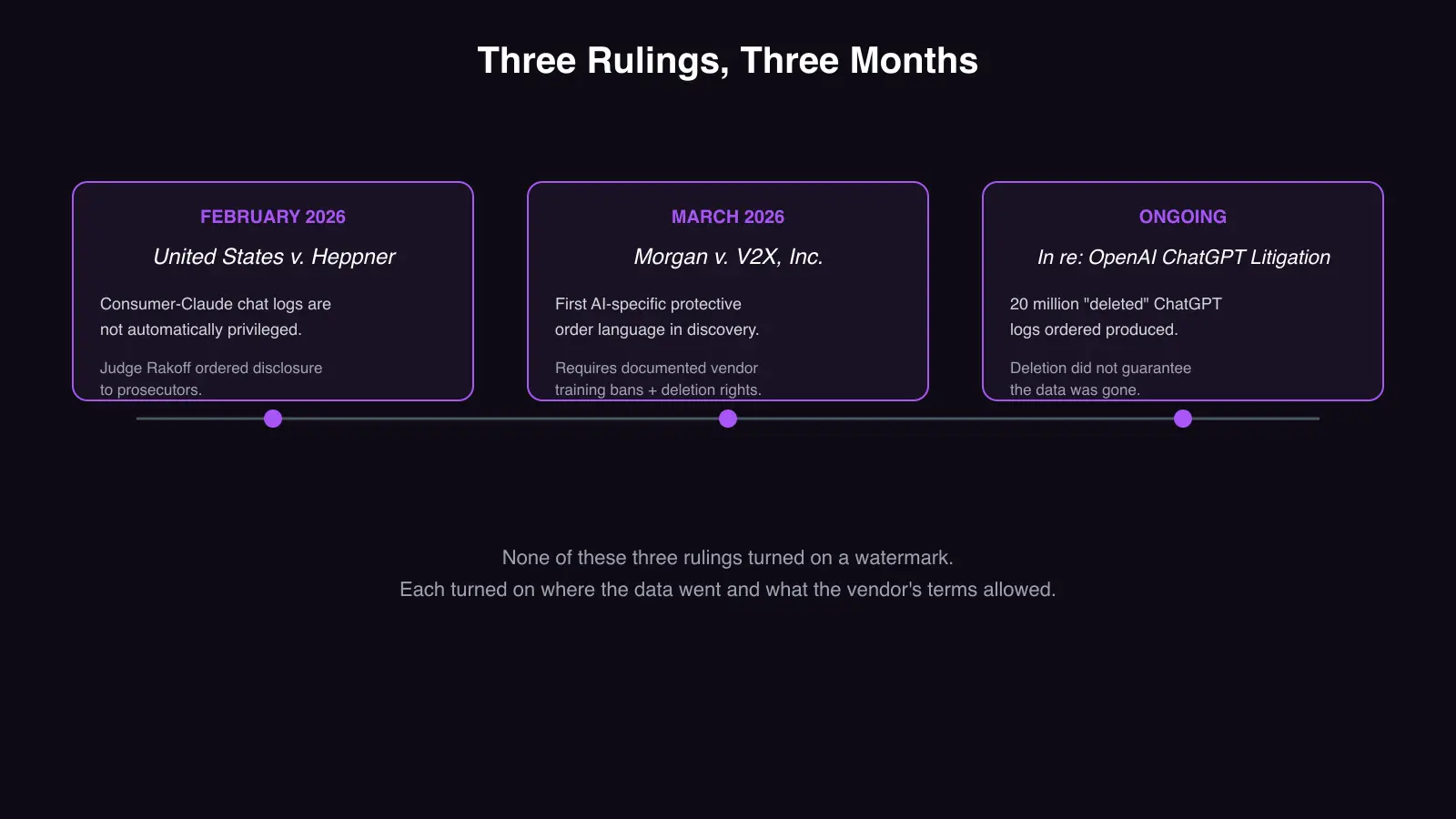
In February 2026, Judge Jed Rakoff of the Southern District of New York (Case No. 25-cr-00503-JSR) ruled for the first time that chat logs with a consumer AI tool are not automatically privileged. Agents had seized 31 documents Bradley Heppner generated with Claude while facing fraud charges; he claimed privilege, and Rakoff rejected it.
Rakoff's ruling in United States v. Heppner rested on three independent grounds, any one enough on its own:
- Claude is not an attorney and cannot form an attorney-client relationship with anyone.
- Anthropic's terms disclaim confidentiality: its privacy policy "gives Anthropic the right to disclose a user's data... to government authorities."
- No attorney directed the chats, and Claude itself disclaimed giving legal advice, so there was no legal-advice purpose to protect in the first place.
| Case | Date | What it decided |
|---|---|---|
| United States v. Heppner | February 2026 | A person's own consumer-Claude chat logs are not automatically shielded by attorney-client privilege; Judge Rakoff ordered them disclosed to prosecutors. |
| Morgan v. V2X, Inc. | March 2026 | A Colorado federal magistrate held that a litigant's AI-assisted litigation prep is work product, but wrote one of the first detailed AI-specific protective orders: confidential discovery can only go into an AI tool under a contractual ban on vendor training and a right to deletion. |
| In re: OpenAI ChatGPT Litigation | Ongoing | OpenAI was ordered to produce a 20-million-conversation sample of retained ChatGPT logs, over OpenAI's own objection, in the same litigation where a separate order forced it to preserve chats users had deleted. |
A month later, Morgan v. V2X moved from privilege to new discovery rules, and the OpenAI litigation added a retention lesson of its own: 20 million retained chat logs were ordered produced, per the table above. None of these three rulings turned on a watermark, only on where the data went.
None of that required a watermark to go wrong, and the reason it matters for a legal or compliance professional specifically is simple: privilege, disclosure, and client trust all run through your obligations, not the vendor's.
Why This Matters for Privilege, Disclosure, and What You Tell a Client
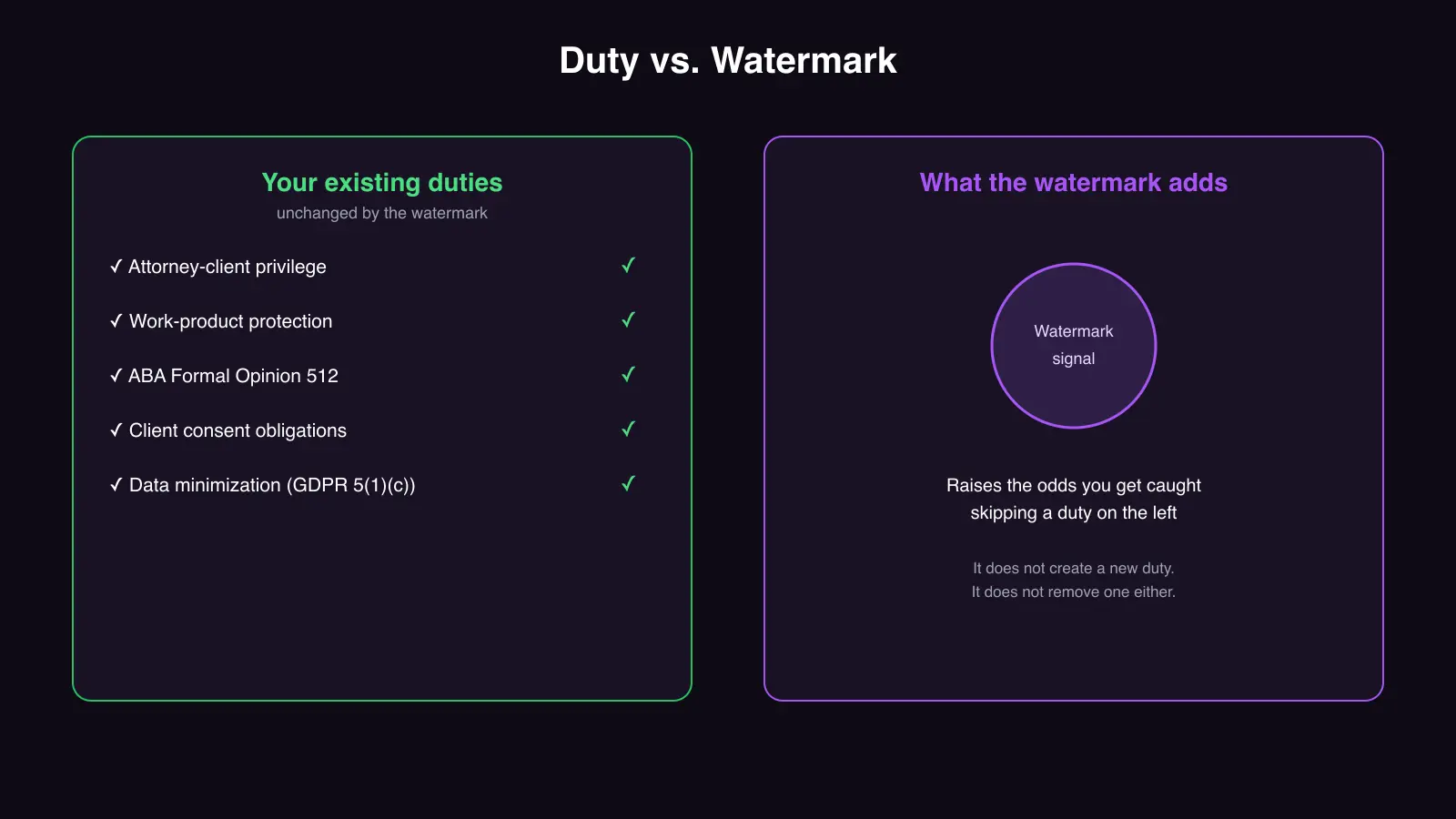
Privilege and work product both depend on a reasonable expectation of confidentiality and, for work product, direction from counsel. Heppner failed both tests, with no watermark involved. Privilege traces to Upjohn v. United States; Rule 26(b)(3)(A) protects material "prepared in anticipation of litigation... by or for a party." No attorney directed Heppner's chats.
ABA Formal Opinion 512 requires "a reasonable understanding of the capabilities and limitations of the specific GAI technology" a lawyer uses, and a watermark is now one such limitation. NYC Bar Opinion 2024-5 adds that consent to share client data with AI "must be knowing."
Before you tell a client anything about a watermark:
- Confirm what went into the tool, not just what came back
- Name the vendor and tier (consumer Claude is not enterprise Claude)
- Check the client already consented, per NYC Bar Opinion 2024-5
- Separate "was AI involved" from "is this privileged"
A watermark does not, by itself, settle privilege or disclosure. Heppner shows privilege turns on the relationship and vendor terms, not a mark in the text. That exposure runs through duties you already have, yet most people, including lawyers, have the basic facts wrong, as a r/YouShouldKnow thread shows.
Claude Watermarks, AI Watermark Detection, and the EU AI Act: What Most People Get Wrong
Many assume every Claude response now carries a watermark, a claim r/claudexplorers made the week it shipped. Only two models, Fable 5.1 and Mythos 5.1, carry it today, per Anthropic's help page. Beyond Claude, OpenAI built a similar tool for ChatGPT, never released. A Google reply first denied Gemini's API carries SynthID, then reversed.
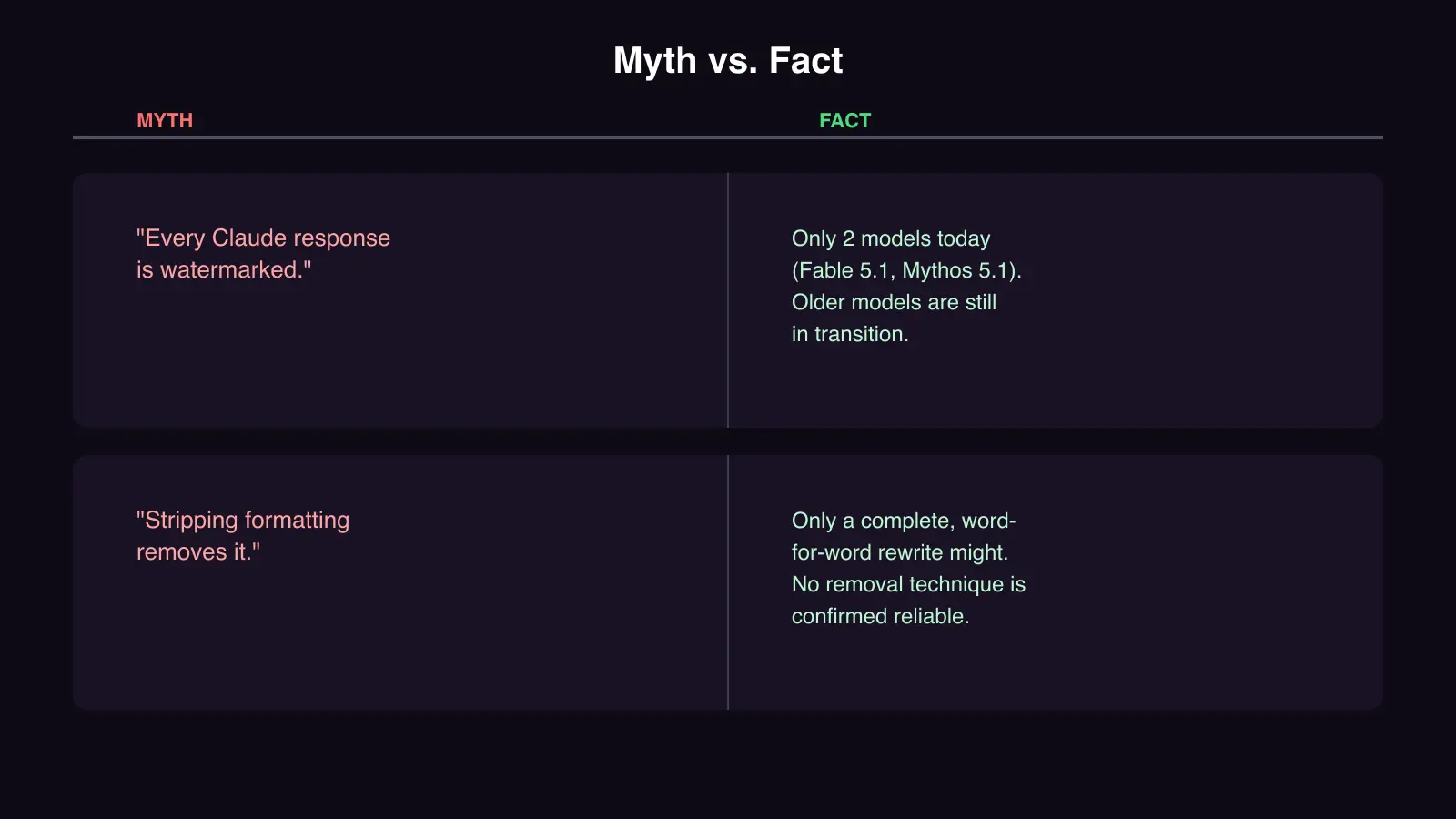
A second misconception is a "scarlet letter" fear some Claude users share online. Threads in r/ClaudeAI worry light editing, grammar fixes, or formatting could get flagged as fully AI-generated. A r/ClaudeWorkflows thread traded unverified removal workarounds, and another r/ClaudeAI thread assumed nothing generated today escapes the mark, the same overclaim Anthropic's own coverage numbers contradict.
Anthropic's own reporting contradicts most of that: light editing "probably won't remove the watermark completely," but "a complete rewrite where every word is replaced will." A 2026 study found paraphrasing defeats two of three tested watermarking schemes 100% of the time, on different, unrelated methods, not Claude's. Here's why:
- The European Union's Article 50 puts the marking duty on AI providers like Anthropic, not on the lawyers using their tools.
- That enforcement pressure, not a new disclosure rule aimed at lawyers, is the likely reason public detection access widens over time.
Providers that skip the duty face fines up to €15 million or 3% of global revenue, whichever is higher. See how Claude's watermark works mechanically; the real fix happens before your text reaches Claude.
Where Redaction Fits: Why You Shouldn't Try to Remove AI Watermarks Instead
GDPR Article 5(1)(c) already sets the right frame for any AI prompt, watermarked or not: personal data must be "adequate, relevant and limited to what is necessary." In practice, don't paste an entire client document into a cloud model when a redacted version would do. A watermark tells you something after Claude has already seen your text; redaction decides what Claude sees before that.
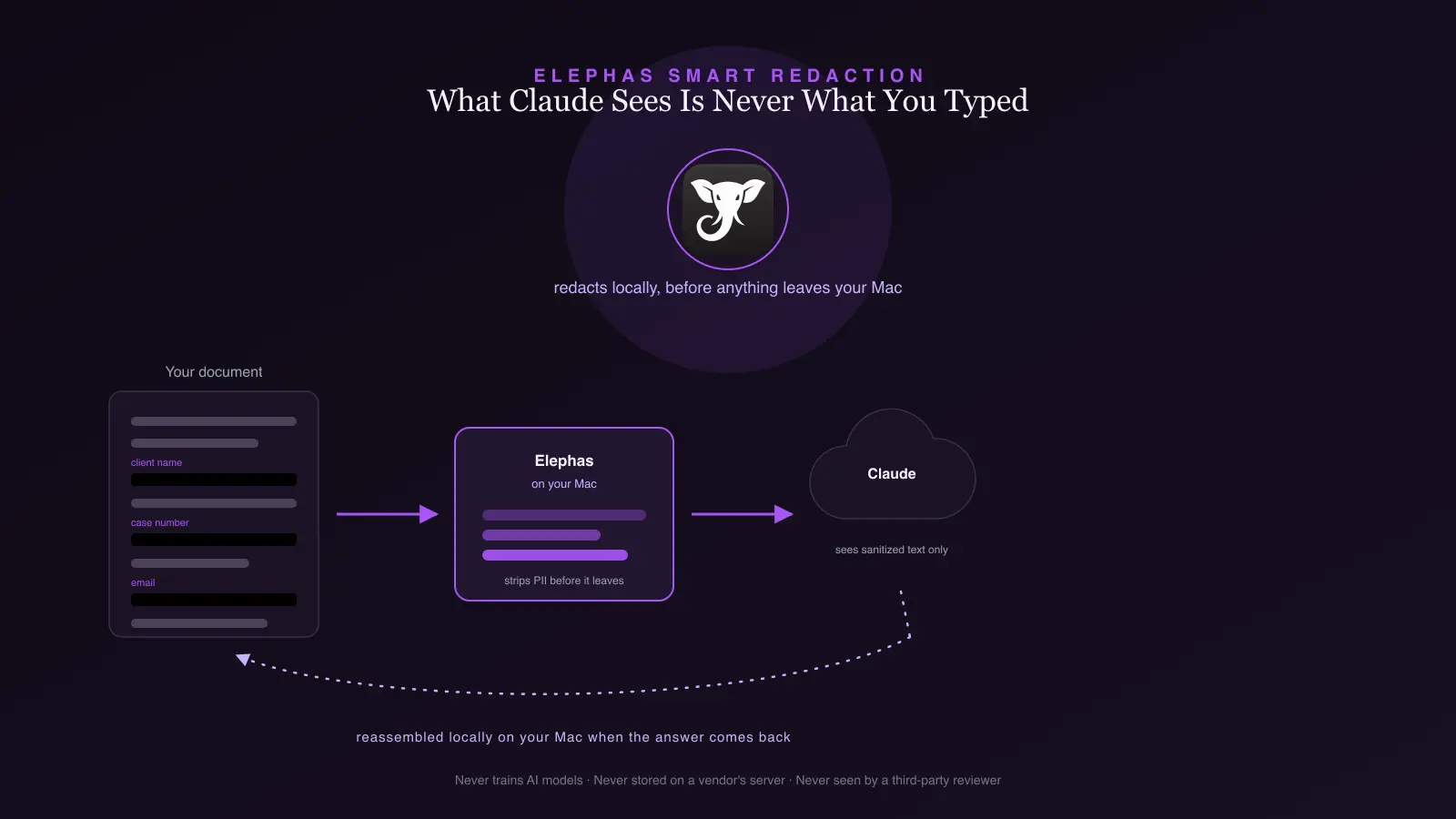
Redaction fixes exactly the sequencing problem a watermark can't touch: it decides what Claude gets to see, not what happens after Claude has already seen it. Elephas is a private AI knowledge assistant for Mac that runs that check locally, before your prompt ever leaves the machine.
Some Claude users already trade unverified removal workarounds instead, per a r/ClaudeWorkflows thread, but that solves the wrong problem: redaction controls what leaves your Mac in the first place, so it never needs Claude's watermark gone.
Client names, case numbers, emails, and identifiers get stripped on your Mac first, through automatic PII redaction, whether the destination is ChatGPT, Claude, Gemini, Grok, or Perplexity. Elephas reassembles those fields locally when the answer returns: content never trains AI models, never sits on a vendor's server, never passes through a third-party reviewer's screen.
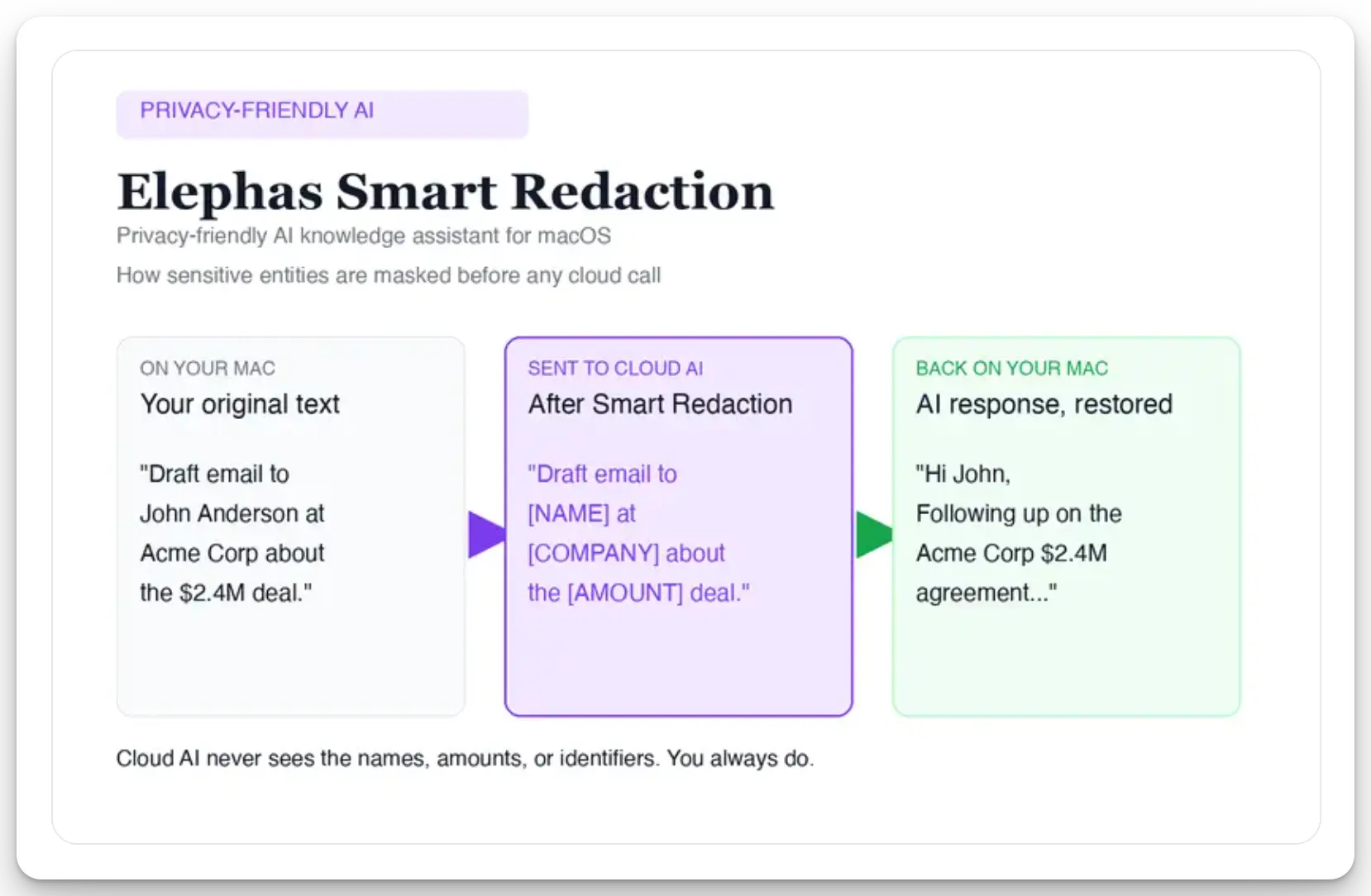
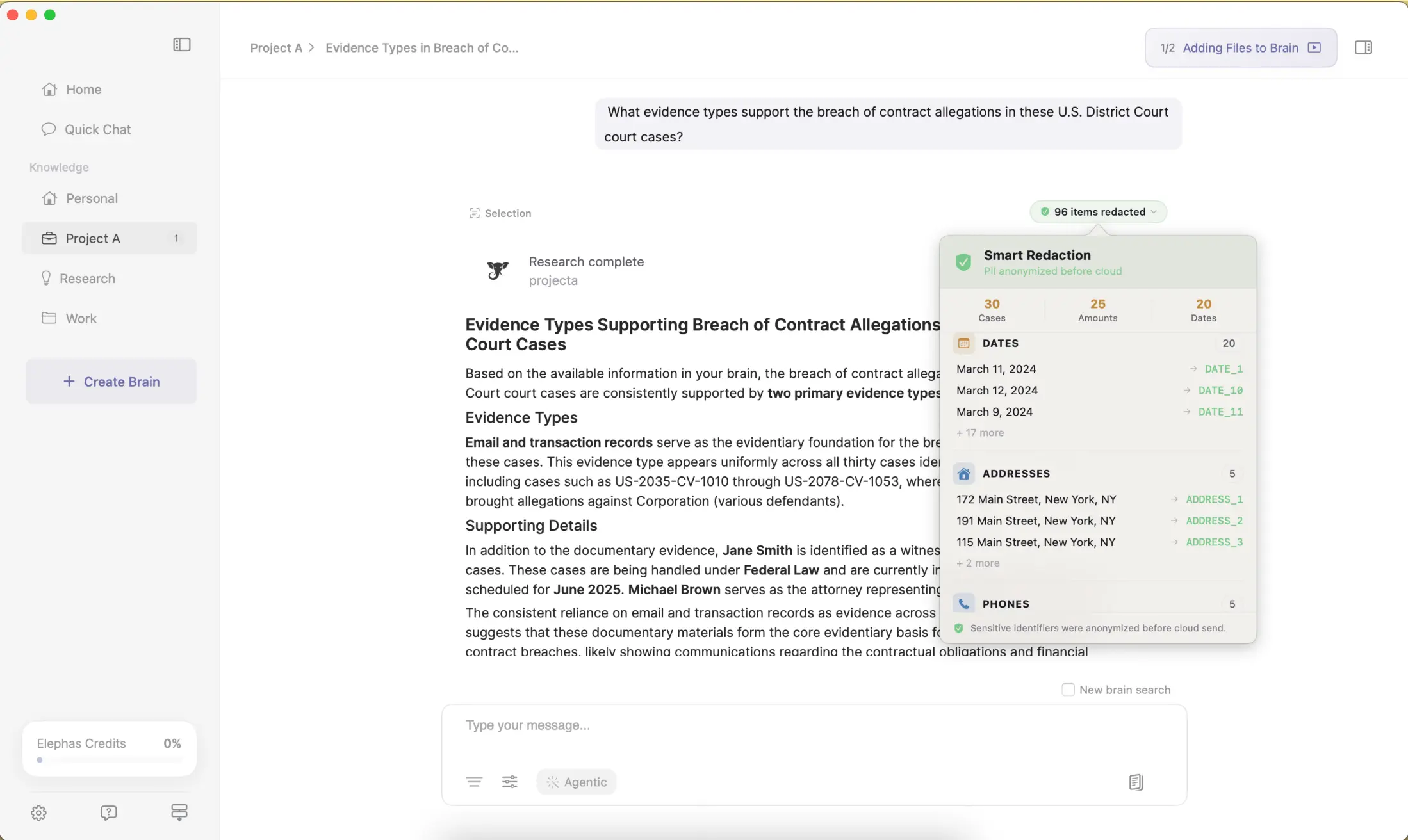
- Smart Redaction runs on every Elephas plan, including the free one
- It works alongside Elephas's own built-in local LLM models, for documents you'd rather not send anywhere at all
- Cost stays low even at scale: a 1,700-page PDF runs about $0.40 to process
- Plans start free, with paid tiers from $19/month, and you can try Elephas for free before your next confidential draft goes near a cloud model
The Real Takeaway: A Watermark Doesn't Change What You Should Already Be Doing
A watermark can't tell you who wrote a document, whether it leaked, or whether privilege survives. Only where the data went and what you told your client can answer that, and that's a decision made before you paste something into a cloud AI tool, not after a mark gets attached to what comes back.
The practical response is the same regardless of what any watermark eventually proves: adopt a redaction-first habit for confidential text before it reaches a cloud AI tool, and put that expectation in writing in your firm's or team's AI-use policy. Whether or not a document ends up watermarked, your job doesn't change. Decide what a cloud model gets to see before you send it, not after.
Frequently Asked Questions
What is an AI text watermark?
An AI watermark on ai-generated text is a statistical pattern in the tokens a language model chooses while generating text. It can only show a specific AI system was likely involved in producing that content, not who wrote it, whether it's accurate, or whether it leaked.
Does a Claude watermark prove a document was drafted with AI?
No. A watermark can only show Claude was "likely involved," according to Anthropic; it cannot prove authorship, accuracy, or that data leaked.
Does an AI watermark affect attorney-client privilege or disclosure?
No, not by itself. Privilege and disclosure turn on your relationship with the client and where the data went, as United States v. Heppner confirmed.
Does the watermark stop confidential text from leaking, or is it only a tracking signal?
It has no security function. Anthropic describes the watermark as a provenance signal showing Claude "was likely involved," not a leak-prevention feature. It says nothing about who else saw a document; only redacting sensitive data before it reaches Claude controls that.
Is the watermark embedded in the text I type into Claude, or only in what Claude writes back?
Only in Claude's output. The watermark is a statistical pattern in the words Claude chooses while writing; it never touches your own prompt or the client language you pasted in for review, before or after Claude answers.
If we used Claude on confidential documents before this watermark existed, could Anthropic tag that older work retroactively?
No. Coverage is model-specific, not retroactive: only two models, Fable 5.1 and Mythos 5.1, currently carry the watermark, and older models remain in transition. Earlier AI-assisted work has no watermark trail attached after the fact.
Could opposing counsel or a regulator run a filing through a watermark detector to catch privileged material?
Not today. Public detection stays restricted to a private preview for regulators, law enforcement, media, researchers, and compliance-obligated enterprises. EU AI Act enforcement, backed by fines up to 3% of global revenue, is one reason that access is likely to widen.