Claude Watermark vs Gemini SynthID
Last updated: September 8, 2026
On 11 August 2026, Anthropic began invisibly watermarking Claude's text output. The mark sits on every Claude model launched on or after 2 August. Google's Gemini, built by Google DeepMind, has watermarked its chat text with SynthID-Text since 14 May 2024. That is over two years earlier.
For a consultant or analyst who pastes client drafts into either tool, who marked text first is the wrong question. The live ones are whether the marks work the same way, who can check one today, and what happens to a confidential deliverable either way.
This comparison takes the mechanism, rollout, detector access, what breaks each signal, and the stakes for client work. It opens with how Claude's watermark works.
The cutoff itself is already unclear to people using Claude. A r/ClaudeAI user asked on 11 August 2026 whether models launched before the announcement carry the watermark, and called Anthropic's comments on older models cryptic (r/ClaudeAI, 11 August 2026). Coverage is not obvious from the public wording.
Quick answer
Claude and Gemini both watermark AI text with Google DeepMind's SynthID-Text, which tilts word choice in a statistical way and does not use hidden characters. Claude started watermarking on 11 August 2026 in chat, the API, and coding tools, and Gemini has applied the same mark since May 2024 and leaves its own API out. Neither company offers the public a working way to verify a passage today.
- Both watermarks use the same core method, Google DeepMind's SynthID-Text, which is a statistical bias in word choice. It is not hidden characters or inserted text.
- Claude's watermark went live on 11 August 2026 and applies to Claude.ai, the API, Claude Code, and Cowork. Gemini has watermarked app and web text since May 2024, and the Gemini API is explicitly excluded.
- Anthropic's detector is private preview only. Google's own consumer verifier accepts image, video, and audio, not text, which means neither company gives the public a working way to check a piece of text today.
- Neither mark holds up in a reliable way through heavy rewriting, translation, or very short passages.
- For confidential client work, the larger risk shows up before any watermark is applied. It is whatever leaves your device in the first place.
How to Judge an AI Text Watermark: 7 Criteria That Matter
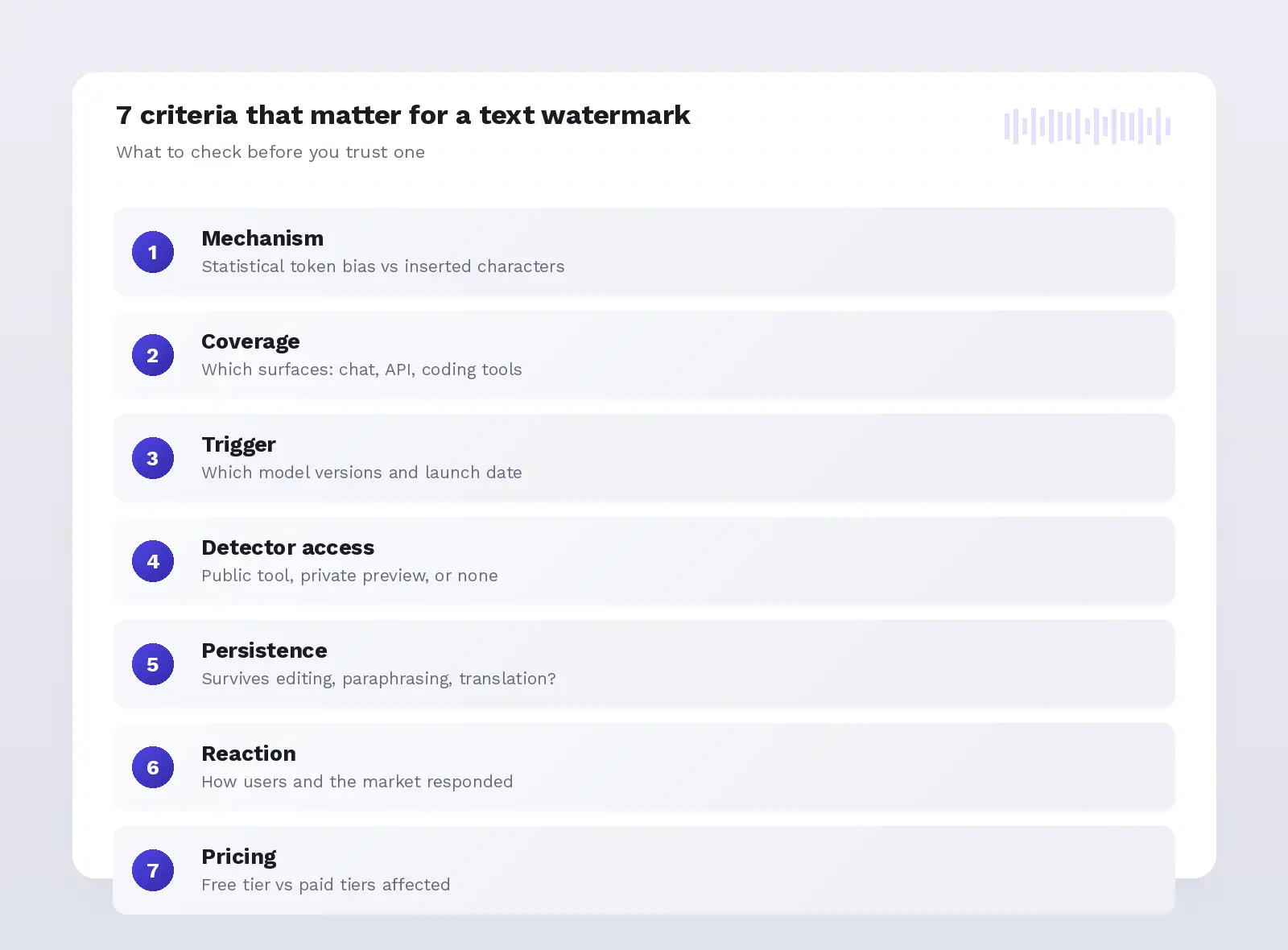
Whether a text watermark changes how you use Claude or Gemini for client work rests on seven criteria, not on which company is bigger. Digital watermarking, applied here, means a text watermark. Each criterion is a real question a consultant or analyst has to answer before pasting a client draft into either tool.
- How the mark is embedded. The embedding method decides whether normal editing can strip the mark. Start with a precise definition: it is a statistical watermark, an invisible watermark built from a bias in which words the model picks, not hidden Unicode characters or extra inserted text.
- Where the mark appears. Which models, apps, and surfaces (chat, API, coding tools) actually carry the mark today. One reader called Anthropic's own rollout language “cryptic” in a thread asking whether older Claude models are watermarked (r/ClaudeAI, 11 August 2026). That confusion is the reason this criterion needs its own answer, not an assumption that Claude now watermarks everything it has ever produced.
- What drove adoption. The driver is regulatory (Article 50 of the EU AI Act, backed by the EU's Code of Practice on Transparency) or a proactive research posture, and that split shapes how far each company is likely to expand the feature.
- Who can detect it. Who can actually check a piece of text: the public, developers only, or nobody outside the company. This is the single most consequential criterion for this audience.
- What survives, and what fails. What holds up through light proofreading, translation, heavy rewriting, or short passages and code.
- How people reacted. Documented cancellations, developer commentary, and verifier bug reports.
- What the assistant costs. Official pricing for the underlying assistant, since watermarking itself is not sold separately.
The persistence question is not theoretical. NIST research on how well text watermarks hold up found that heavy paraphrasing can push detection down to 20% for short, 225-word passages (NIST, 2024).
A separate open-source MarkLLM test of Google's SynthID-Text found paraphrasing achieved 98.3% conditional removal, a result that is not an official Claude or Gemini detector rate (Tamim and Khan, arXiv).
Claude's version of this feature is the newer one, so the comparison starts there, because it is the one most readers are asking about right now.
How Does Claude's Text Watermark Work?
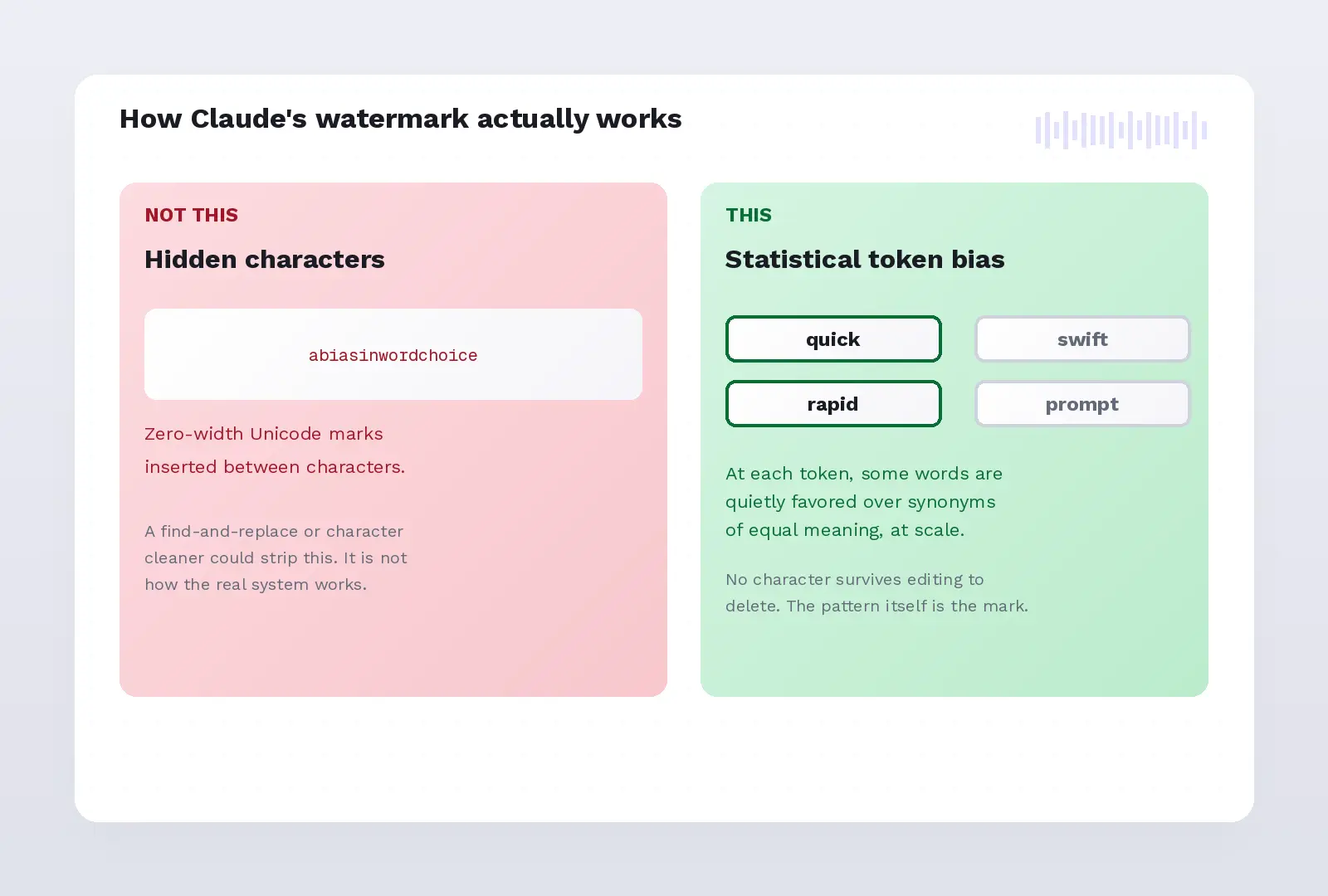
Claude's watermark applies Google DeepMind's own SynthID-Text method under Anthropic's control. It rolled out fast once the EU AI Act made text transparency mandatory.
Reaction to Claude's text watermark has been mixed. One r/ClaudeAI user pushed back, arguing the watermark only hints Claude may have been used and neither identifies the writer nor proves the draft is not theirs. (r/ClaudeAI, 12 August 2026)
What Claude's Text Watermark Actually Is
The mark is not a hidden character or inserted string. It biases the randomness Claude uses when choosing among reasonable next words, guided by a watermark key plus the text that came before it. There is no separate identifying tag, only provenance baked into the words a reader already sees.
What Rolled Out, Who Can Detect It, and How People Reacted
Here is the documented rollout, who can check a mark, and how people have reacted.
- Documented rollout: Anthropic published its technical explainer on 14 August 2026, three days after TechCrunch first reported the plan.
- Coverage: Claude.ai, API, Claude Code, Claude Cowork, and Claude Tag, for models launched on or after 2 August 2026. Earlier models still roll out over later months.
- Detector access: private preview only, for eligible organizations, not the public or an individual consultant self-checking a document.
- Persistence: survives copy-paste. Weakens or disappears under heavy editing, paraphrasing, translation, very short passages, or code.
- Pricing (unchanged by this): Claude is free. Pro $20/month or $200/year. Max $100/month or $200/month.
- Mixed reaction: Slashdot commenter praised the low-key framing: “basically a laziness badge...Only cheaters and liars should worry that it exists” (Slashdot, 17 August 2026). Claude Max subscribers Arturo Villarroya and Vladislav Rajtmajer canceled in mid-August 2026 over it (implicator.ai, citing Business Insider).
- Plenty of people don't treat it as hostile: r/ClaudeAI commenter: “What exactly is people's problem with text watermarking? A mark just signals possible Claude involvement, it doesn't identify you or prove you didn't write it” (r/ClaudeAI, 12 August 2026).
- Quality fear, still unproven: r/claude user asked if forcing the model to steer toward a keyed token pattern could make completions worse. Anthropic disputes that. Not independently demonstrated (r/claude, 11 August 2026).
- Different track for files: images and files Claude touches receive Content Authenticity Initiative (C2PA) metadata, not a text watermark.
- What it protects against: proves provenance after the fact. Flags ai-generated content a reader might assume a person wrote. Does not stop a draft being pasted into Claude.
Anthropic has not published the exact key, which means “Claude uses Google's SynthID-Text” describes the documented basis rather than a fully disclosed algorithm. The company says it has not detected a rise in cancellations tied to the watermark, though nobody outside Anthropic can verify a mark yet.
How Does Gemini's SynthID Text Watermark Work?
Even Google's own SynthID watermark detector has documented consistency problems. A user in r/GoogleGeminiAI showed that Google's checker flipped its verdict on the same upload when they ran it again (r/GoogleGeminiAI, 11 January 2026). The detector's reliability record is covered in detail further down.
How SynthID Works, and What the Nature Study Found
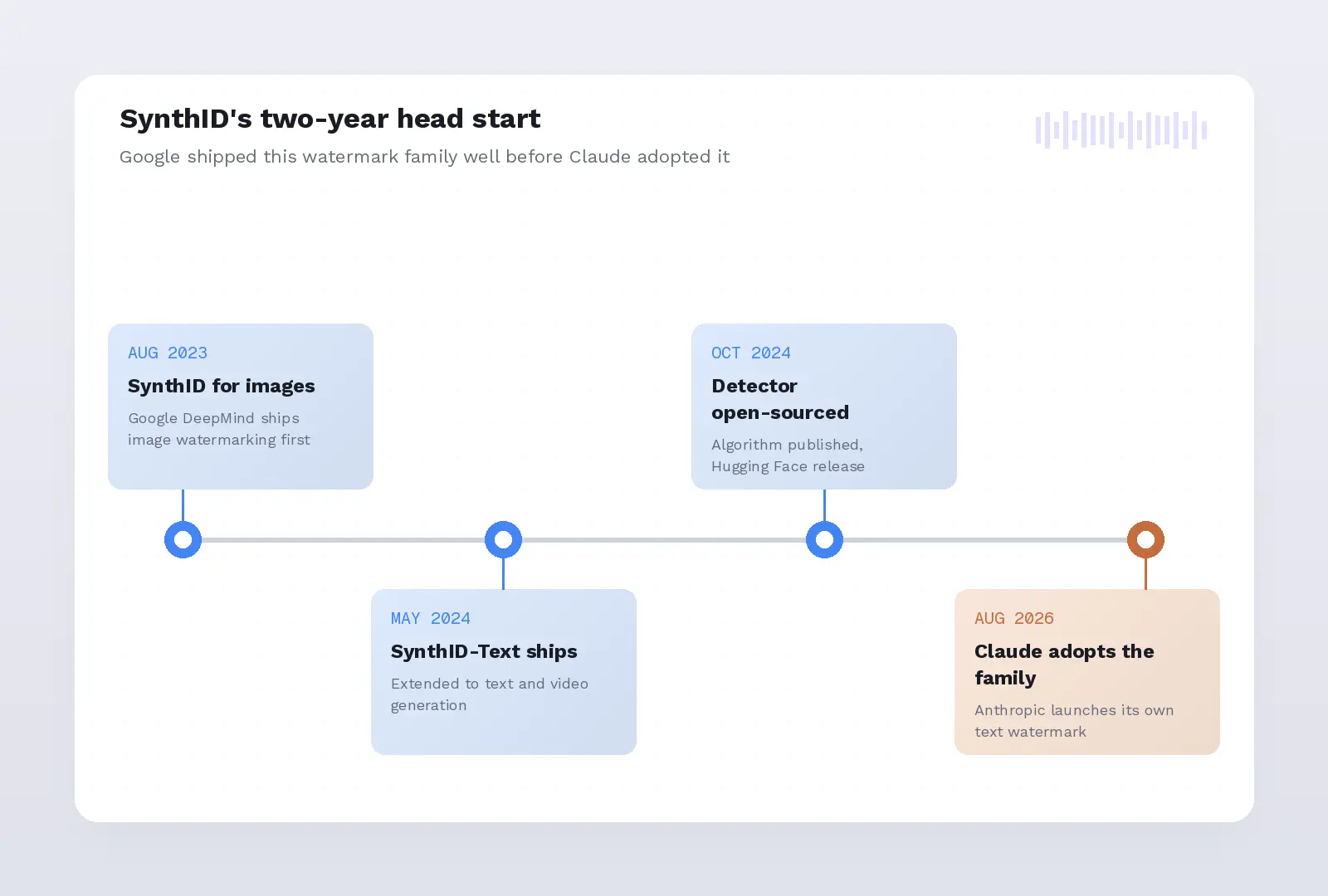
Gemini has watermarked its chat text with SynthID-Text since 14 May 2024, over two years before Claude adopted the same method. The mechanism is a modified token-sampling process that adjusts the probability of each next word during generation. Google published the algorithm and a Bayesian classifier.
A peer-reviewed Nature study used roughly 20 million real Gemini responses, watermarked and unwatermarked. It tested whether the mark degrades quality (Nature).
It found a 0.01 percentage-point difference in thumbs-up rates and a 0.02 percentage-point difference in thumbs-down rates. Both were within statistical noise (Nature).
Open Source, Pricing, and Verifier Reliability
Google published the algorithm. API coverage, consumer checking, and verifier stability still have limits.
- Open-sourced: SynthID family launched for images in August 2023, then extended to text and video that May. Text detector and algorithm went public on Hugging Face and GitHub on 23 October 2024.
- API gap: Gemini's consumer verifier accepts only image, video, and audio, not text. Google's AI Developers Forum says Gemini's API text output is explicitly not watermarked, and native API marking is “not planned at the moment” (Google AI Developers Forum, 5 August 2026). Unlike Claude's API-inclusive coverage.
- What “open” means: Public SynthID does not make output automatically detectable. A developer must run the classifier against a specific passage. Nothing surfaces alone.
- Persistence: Mark is probabilistic. Stronger on longer, more varied text, weaker after heavy rewriting or translation. Consumer verifier sometimes returns “unclear.”
- Pricing: Free for the base app, $4.99/month Google AI Plus, $19.99/month Google AI Pro, $99.99 or $199.99/month Google AI Ultra.
- Independent tests: Ars Technica put watermarked images through 300 simulated compression and resize cycles to mimic social-media degradation. Mark survived detection (Ars Technica, ~29 July 2026, paraphrased finding).
- Verifier wobble: r/isthisAI user reported Gemini's own checker refusing to return a result at all, not declining cleanly (r/isthisAI, 28 August 2026).
- Visible logo is separate: Gemini carries a separate, visible image watermark unrelated to this text watermark. Google recently made that mark removable. Some r/google users welcomed it. Others saw it as erasing a useful AI-made cue (r/google, 17 August 2026).
Openness has a limit. Third-party developers can watermark and verify their own models with their own keys. That is a different claim from anyone verifying Gemini's actual output. The consumer verifier's reliability record is less clean, covered next.
How Does the Claude Watermark Detector Compare to Gemini SynthID Detection?
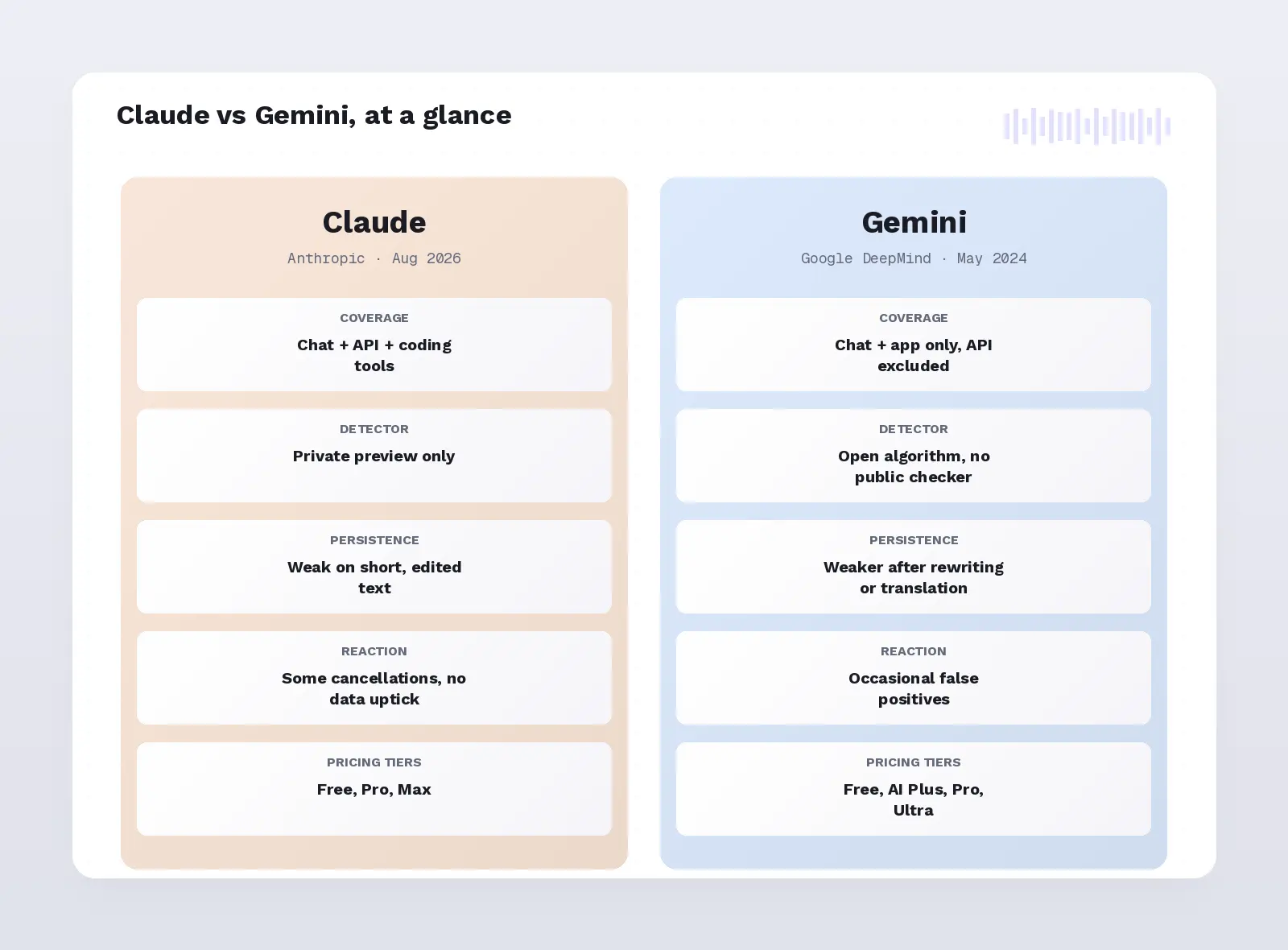
Claude and Gemini use the same watermark method. They differ in coverage, who can check a mark, and how each company rolled it out in public. Both shape how a model generates text, then leave a provenance trail a reader can't see.
This table scores both on the seven criteria that matter most for confidential client work.
| Criterion | Claude (Anthropic) | Gemini (Google DeepMind) |
|---|---|---|
| Watermarking mechanism | SynthID-Text-based statistical token bias; no hidden characters | Same SynthID-Text family (original implementation) |
| Rollout scope & coverage | Chat, API, Claude Code, Cowork, Tag; models from 2 Aug 2026, older models rolling out | App/web watermarked since May 2024; Gemini API text explicitly not watermarked |
| Trigger / rationale | Reactive: EU AI Act Article 50, applied globally | Proactive: Google DeepMind research, ~2 years ahead of the EU deadline |
| Detector / verification access | Private preview only; general public cannot self-check | Algorithm open-sourced for developers; own consumer verifier does not accept text |
| Persistence & failure boundaries | Weak on short, lightly-edited, or heavily-rewritten text and code | Same class of weakness: probabilistic, degrades with heavy rewriting/translation |
| Real-world reaction | Named-user cancellations and backlash; Anthropic reports no cancellation uptick | Documented detector bugs and inconsistent-result reports |
| Subscription pricing | Free; Pro $20/mo or $200/yr; Max $100/mo or $200/mo | Free; AI Plus $4.99/mo; Pro $19.99/mo; Ultra $99.99 or $199.99/mo |
- Where they're equal: both run the same statistical SynthID-Text approach, same blind spots on short or heavily-edited text. Neither is a hidden-character trick a removal tool could delete. Signal lives in word-choice probability, so no ai content scanner reads it.
- Where Claude leads: surface coverage. Watermark spans chat, API, and coding tools under one global policy. Gemini's covers app and web text only, not its developer surface.
- Where Gemini leads: real openness. Google open-sourced the algorithm and detector in October 2024, developer-checkable. Anthropic's stays private-preview. Gemini's consumer verifier doesn't accept text.
The Reliability of Gemini's SynthID Verifier
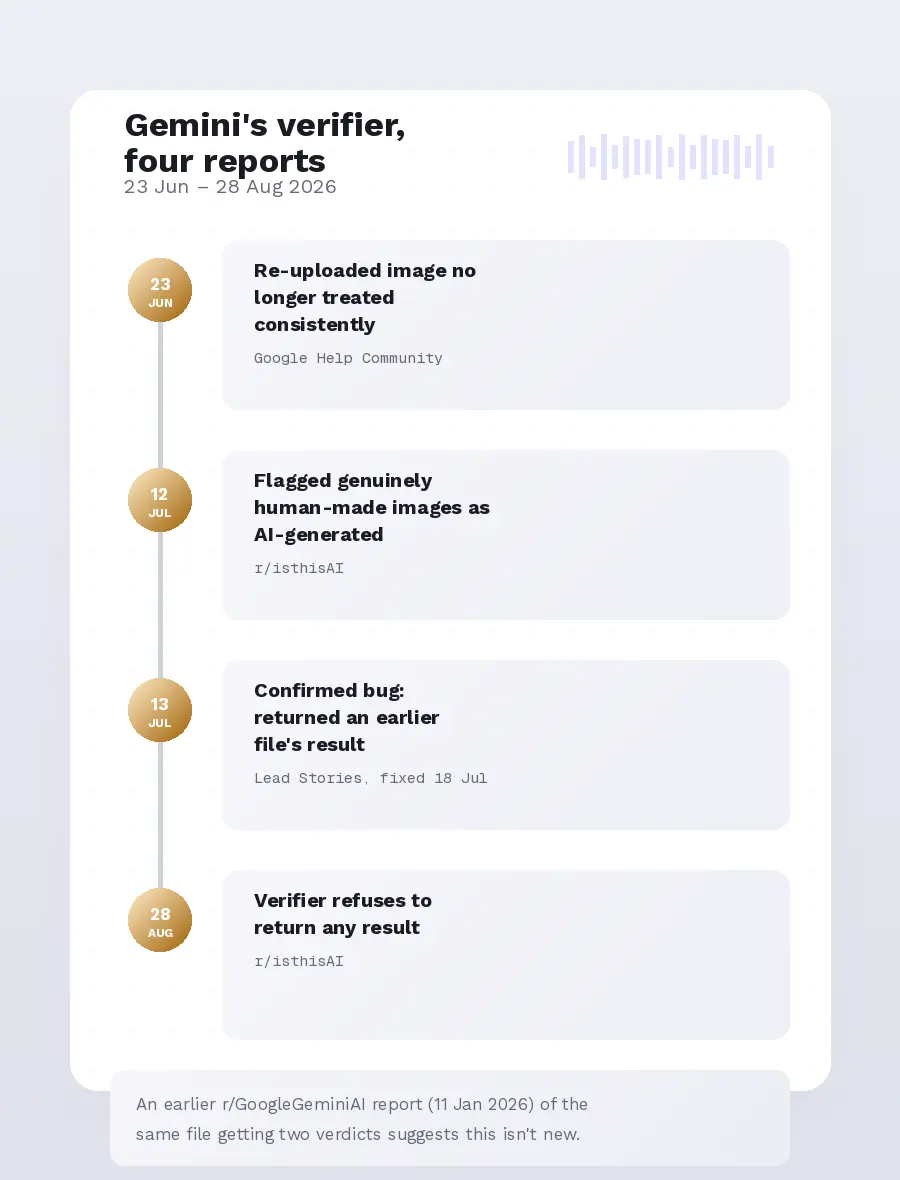
Google's consumer checker has a documented consistency problem. A Nature analysis also found that some “uncertain” answers are on purpose.
- Verifier reliability gap: Lead Stories reproduced a bug where Gemini's consumer verifier returned the first uploaded file's result for a later, different file in the same chat. Google confirmed the bug and fixed it by 18 July 2026 (Lead Stories, 13 July 2026). It's not isolated. Gemini's SynthID consumer verifier does not reliably return a correct, available, or consistent result across four independent sources spanning 23 June to 28 August 2026.
- This is a pattern, not a one-off: r/GoogleGeminiAI had an earlier report of the same file returning two different verdicts on repeat checks, which points to a longer pattern of consumer-verifier inconsistency rather than a single isolated incident (r/GoogleGeminiAI, 11 January 2026).
A separate Nature analysis found Gemini's checker is tuned to rarely cry wolf. It wrongly flags human text as watermarked only 1% of the time. When it isn't sure, it says “uncertain” on purpose rather than guess, so that answer is normal, not a glitch (Nature).
“Google is open” and “Google is easy to verify” are not the same claim. That gap is the strongest evidence for the split above. Both companies have effectively shipped half of what a consultant actually needs from a watermark today.
Should I Use Claude or Gemini If Both Watermark Text?
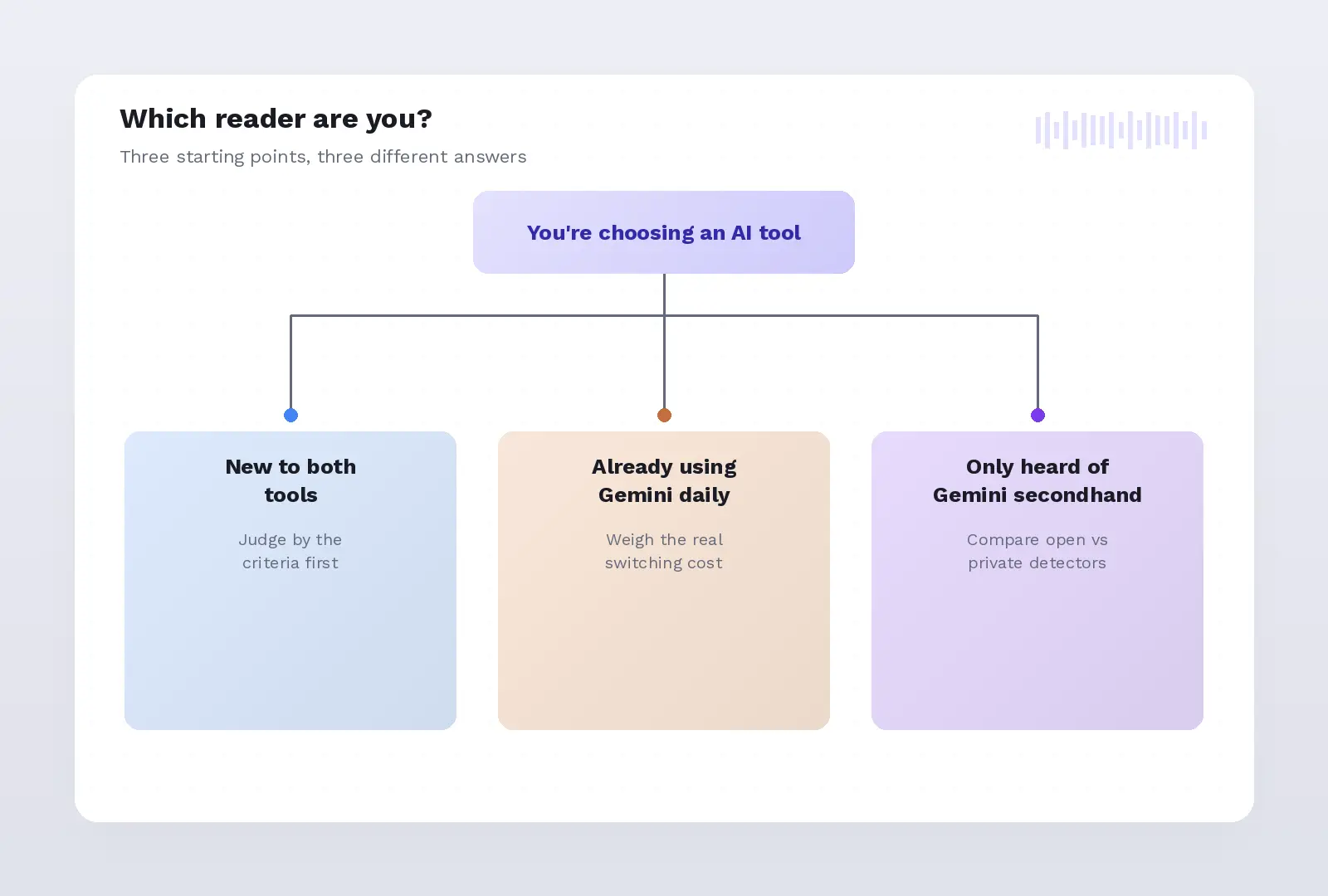
The right answer here depends less on which watermark is technically better and more on where you're starting from. A reader new to both tools has different questions than one already running Gemini day to day, and both differ from someone who has only heard of Gemini secondhand.
Even Gemini's own visible watermark option has shifted recently, with some r/GeminiAI users noticing it change or disappear on generations, a separate feature from the text watermark compared here (r/GeminiAI, August 2026).
Picking Claude or Gemini When You've Never Used Either Tool
Today, effectively no client or colleague can run your report through a checker and prove which tool wrote it. Claude's detector is private preview only. Gemini's consumer verifier doesn't check text at all. Neither watermark is something a client can independently test right now.
Pasting a confidential draft into Claude does not expose that content through the watermark. The mark is a pattern in word choices, not a data-collection mechanism. It carries no identifying information and doesn't transmit your content anywhere beyond the model itself.
- No public checker yet: a public checker does not exist yet for either tool's live output, so a watermark cannot currently be used against you or your client.
- The mark does not expose your content: it carries no identifying information and transmits nothing beyond the model.
- Pick by workflow first: if you are starting from zero, ignore watermark strength as the ranking factor. API-heavy workflows lean toward Claude on coverage; fast, research-heavy workflows lean toward Gemini's two-year head start.
- However you use AI day to day, whether Claude generates a first draft or Gemini summarizes research, the watermark question is who might check the output later, not what happens while you write.
Switching From Gemini to Claude If Your Firm Already Uses Gemini
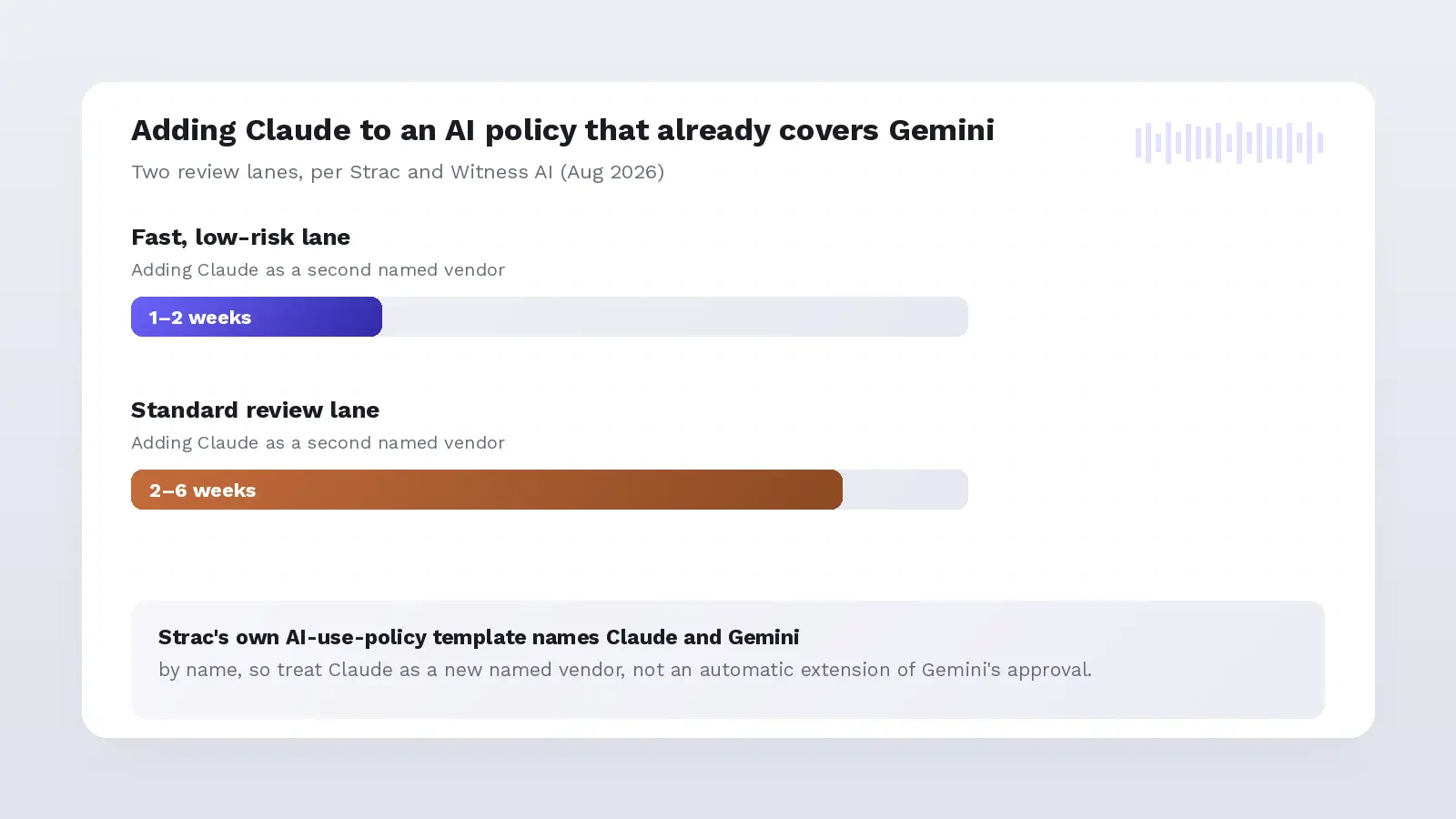
Adding Claude as a second named vendor for a firm already using Gemini typically takes 1-2 weeks on a fast, low-risk policy review, 2-6 weeks on a standard review. Budget that calendar before any team-wide switch. Gemini's existing approval excludes Claude by default, because AI-use-policy templates now list tools by name, not a generic category.
Rewriting a Gemini draft in Claude to polish wording is the kind of heavy editing both companies say weakens or erases a watermark. Bouncing a passage between the two tools is more likely to degrade both signals than to layer one on the other. Keep going and the passage stops being reliably detectable by anyone.
A firm already running Gemini still has a sourced policy question, not a formality. The current AI-use policy may name Gemini only. Claude then needs its own named-vendor review.
- Policy review takes real time: Strac's own template names Claude and Gemini as example sanctioned tools, so adding Claude as a second named vendor typically runs one to two weeks on a fast, low-risk review lane, and two to six weeks on standard review (Strac, 28 August 2026; Witness AI, 28 June 2026).
- People who use both rarely migrate wholesale: one writer described running Claude for “stress-testing arguments, identifying gaps in logic” and Gemini for fast structured research, keeping both rather than replacing one (Tom's Guide).
- The real risk to weigh: one Reddit user reported that “nothing you generate with Claude today is safe from being flagged as AI” after translation or editing (r/ClaudeAI, 16 August 2026).
- Account tier matters: Google's memory import excludes Business and Enterprise Gemini accounts, the tier a consulting firm typically issues, while Claude's memory import works on Free, Pro, Max, and Team.
- No shortcut exists either: there's no working way to remove the watermark from either company's output, so treat heavy rewriting as a way to blur the signal, not delete it.
If your policy already treats Gemini as good enough, budget a few weeks for Claude to clear the same bar rather than assume it inherits Gemini's approval.
Don't Default to Gemini Just Because You've Heard of It
If you have only heard of Gemini and never tried either tool, a client's own AI-detection check is unlikely to flag your deliverable. That check needs Anthropic's private-preview detector or Gemini's verifier, and the verifier does not check text at all.
Nothing you wrote with Claude before this announcement is retroactively watermarked. Coverage applies only to models launched on or after 2 August 2026, with older models rolling out over subsequent months. It is not applied backward to past conversations.
- Reliability cuts both ways: Google's own SynthID has flagged genuinely human-made images as AI-generated (r/isthisAI, 12 July 2026).
- Transparency, not reliability: Google shows its work publicly on the algorithm. Anthropic has not yet.
- New to AI client work: assume any AI-generated text you produce could eventually become detectable. Then pick Claude or Gemini based on where you already use AI for research and drafting, not on which watermark sounds stronger.
- Still comparing tools: a Claude alternatives roundup is worth a look before you settle on one.
Where Do You Switch If Neither Watermark Can Be Checked?
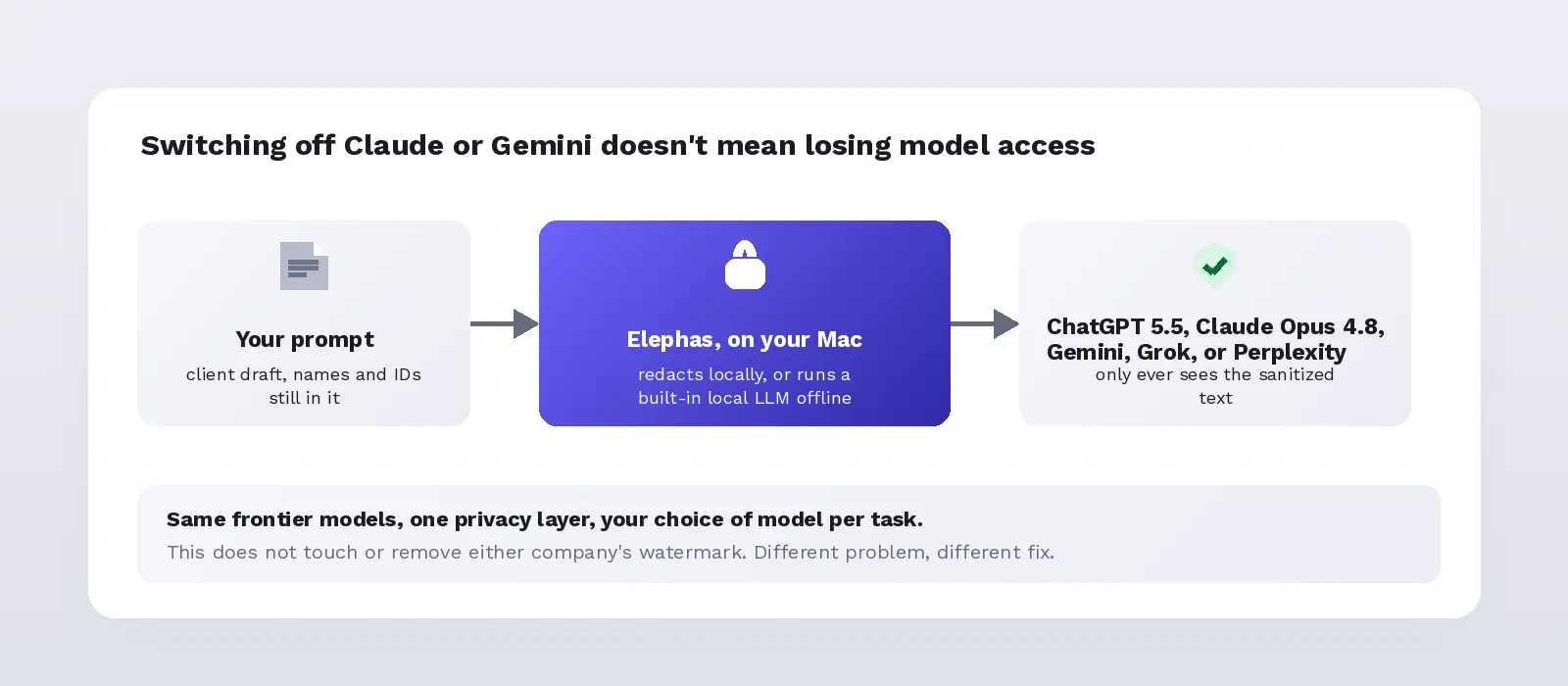
You are already deciding whether to leave Claude, Gemini, or both because of the watermark. Elephas is the product you switch to, not a redaction feature bolted onto the model you keep. Elephas is a private AI knowledge assistant for Mac that redacts sensitive data before it reaches cloud models.
You do not lose model access by switching. Elephas gives you the main frontier models in one app: ChatGPT 5.5, Claude Opus 4.8, Gemini, Grok, and Perplexity. You can still use Claude and Gemini from that same app, so this switch costs you no capability.
For the most sensitive work, Elephas has built-in local LLM models. Nothing has to leave the Mac.
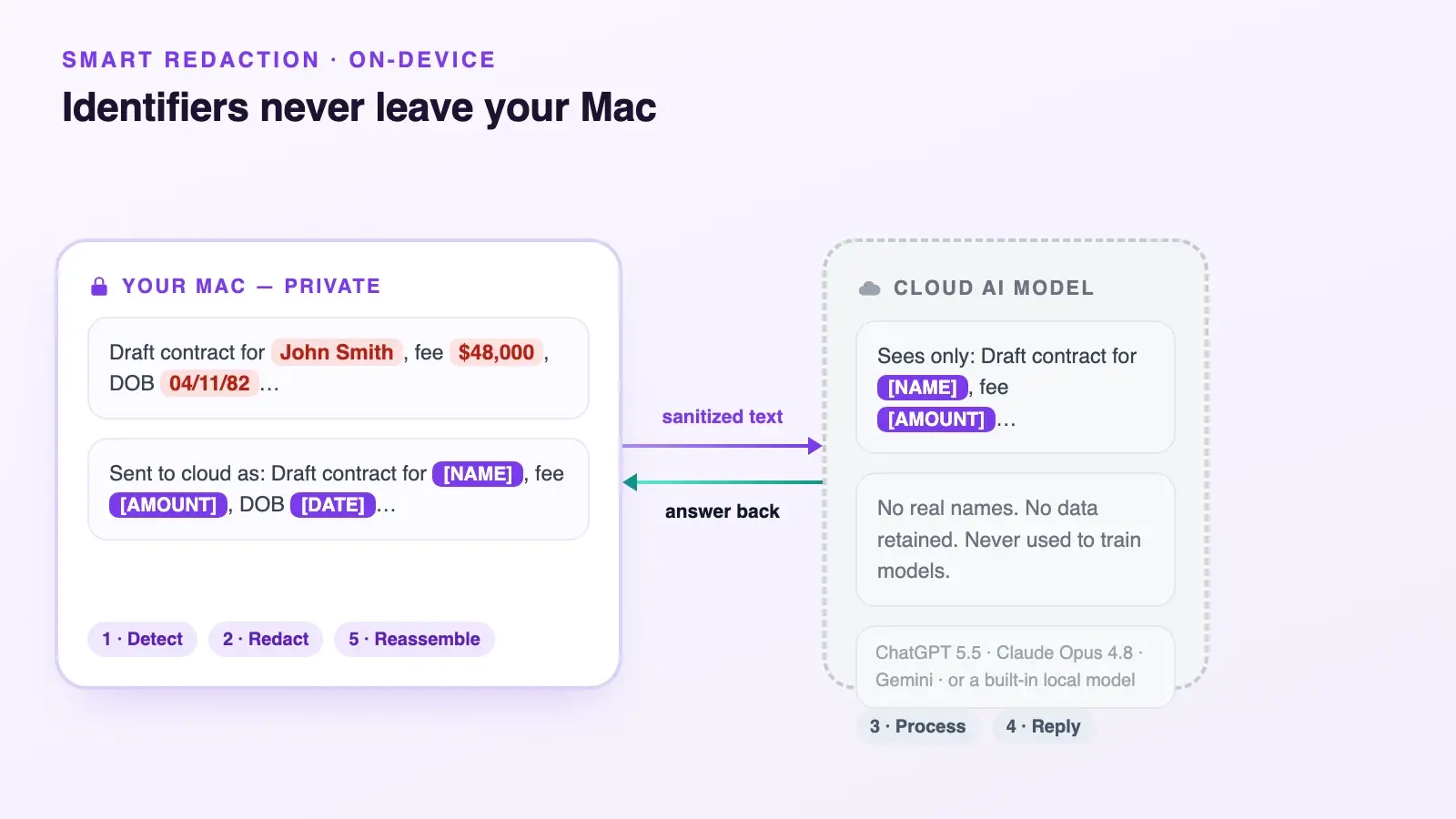
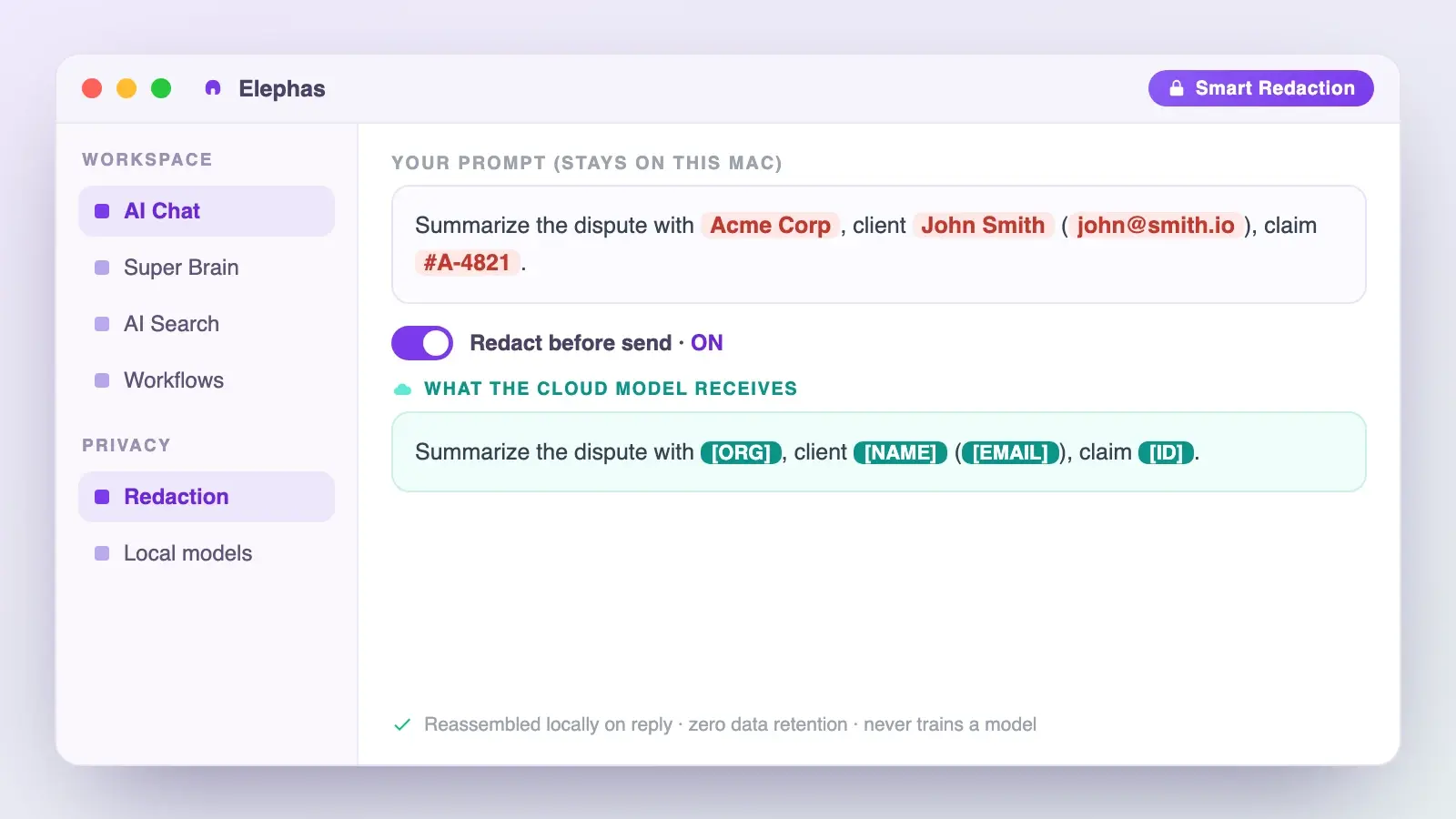
How Smart Redaction protects a prompt before it reaches the cloud
Smart Redaction then handles automatic PII redaction. It strips names, emails, phone numbers, and identifiers locally on the Mac before the prompt reaches the cloud model. The cloud model only ever sees sanitized text, and redacted fields are put back together on the Mac when the answer returns.
That text never trains AI models, never sits on a vendor's server, and never passes through a third-party reviewer's screen. Smart Redaction is on every plan, including Free.
Elephas starts at $19/month, with a free trial. It runs on Mac, iPhone, and iPad only. There is no Windows build.
Elephas is not a watermark remover. It does not make Claude's or Gemini's output undetectable. Switching to Elephas changes which model you use and what data reaches it. It does not strip a watermark from text already generated.
Frequently Asked Questions
Does Claude's watermark work the same way as Gemini's SynthID?
Yes. Claude applies the same SynthID-Text method Google DeepMind built: a statistical bias in word choice, not a hidden character. The difference is coverage and detector access, not the mechanism.
Can I remove a Claude or Gemini text watermark?
No public tool reliably removes either watermark. Heavy rewriting, translation, or short passages can weaken the signal below detector range, but that blurs the mark rather than deleting it.
Will pasting a confidential draft into Claude expose it through the watermark?
No. The mark is a pattern in word choices, not a data-collection mechanism. It carries no identifying information and transmits nothing beyond the model itself.
Is Claude's watermark applied to text written before August 2026?
No. Coverage applies only to models launched on or after 2 August 2026, with older models rolling out over later months. Nothing is retroactively watermarked.
Does Elephas remove or bypass AI watermarks?
No. Elephas doesn't compete on watermark presence or removal. It's a data-governance tool that redacts sensitive names, emails, and identifiers locally before a prompt reaches Claude or Gemini, a separate problem from watermarking.
Do I lose Claude or Gemini if I switch to a privacy tool like Elephas?
No. Switching to Elephas does not cut you off from Claude or Gemini. The app still routes to Claude Opus 4.8, Gemini, ChatGPT 5.5, Grok, and Perplexity, plus built-in local LLM models that run on your Mac. Smart Redaction strips personal details on-device before any cloud model sees the prompt.
Which company's watermark covers more of its product surface?
Claude, as of this writing. Its watermark spans chat, the API, Claude Code, Cowork, and Tag under one policy. Gemini covers chat and web text but excludes its own API.