How to Remove a Claude Watermark: 10 Methods and What Each One Actually Does
Last updated: September 7, 2026
Claude Fable 5.1 and Mythos 5.1 shipped 1 September 2026, the first Claude models with a text watermark. The mark is a statistical pattern in the words Claude picked. By 7 September, search was full of removers and paid humanizers. None can check against Anthropic's private-preview detector. Everyone selling a fix is guessing.
If you used Claude for client work, coursework or published writing, you want a remover. The article settles what each of 10 methods actually changes in your text, and which single method Anthropic itself backs.
Keep reading for what the watermark is, which Claude models carry it, the 10 removal methods people try, why none of it can be verified, whether removal is illegal, and what to do instead.
Quick answer
You cannot press a button to remove a Claude watermark. Claude Fable 5.1 and Mythos 5.1, shipped 1 September 2026, leave a pattern in the words they pick. Anthropic's watermark explainer says a complete rewrite where every word is replaced will remove the mark, and that light editing probably will not. There is no public consumer text detector as of 7 September 2026, so no method can be verified. Elephas is a private AI knowledge assistant for Mac that redacts sensitive data before it reaches cloud models, a different problem from stripping a Claude watermark.
Can You Remove a Claude Watermark?
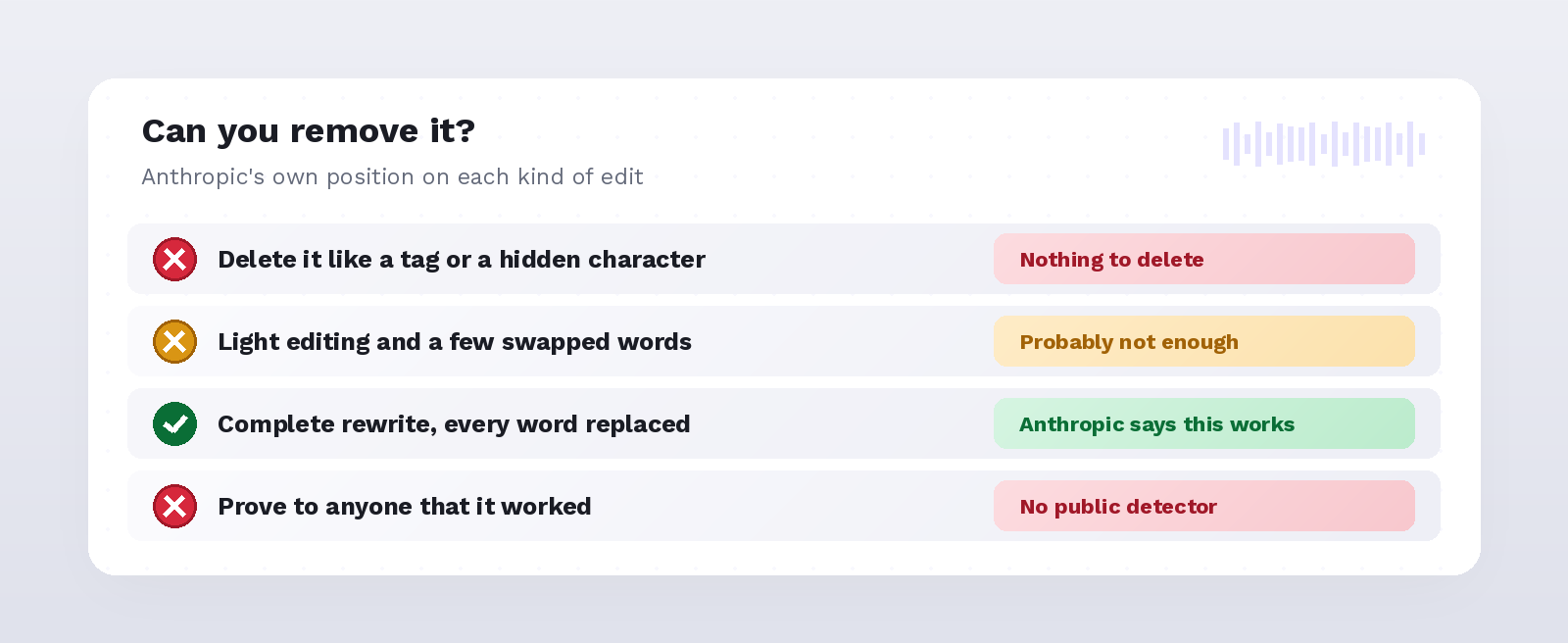
Claude watermark removal cannot work by deleting a mark, because nothing was inserted. Anthropic says light editing probably will not remove the Claude watermark completely, and a complete rewrite where every word is replaced will. No public consumer text detector exists as of 7 September 2026, so no method can be verified.
Anthropic states in its watermark explainer: "Light editing probably won't remove the watermark completely; a complete rewrite where every word is replaced will."
Removing a Claude watermark with light edits is not a real clearance. Tiny punctuation tweaks do not touch a statistical pattern, and r/ClaudeAI already called that out: "There's no way changing three commas makes it detectable". Being right about three commas is still not a clearance certificate.
What Is the Claude Watermark, Exactly?
The Claude watermark is a statistical pattern in the words the model picked. Nothing is inserted: no hidden character, no tag, and no file property. Anthropic's method is its version of Google DeepMind's SynthID-Text (Anthropic's mechanism page). The mark carries no identifying information, and detection works poorly on short passages.
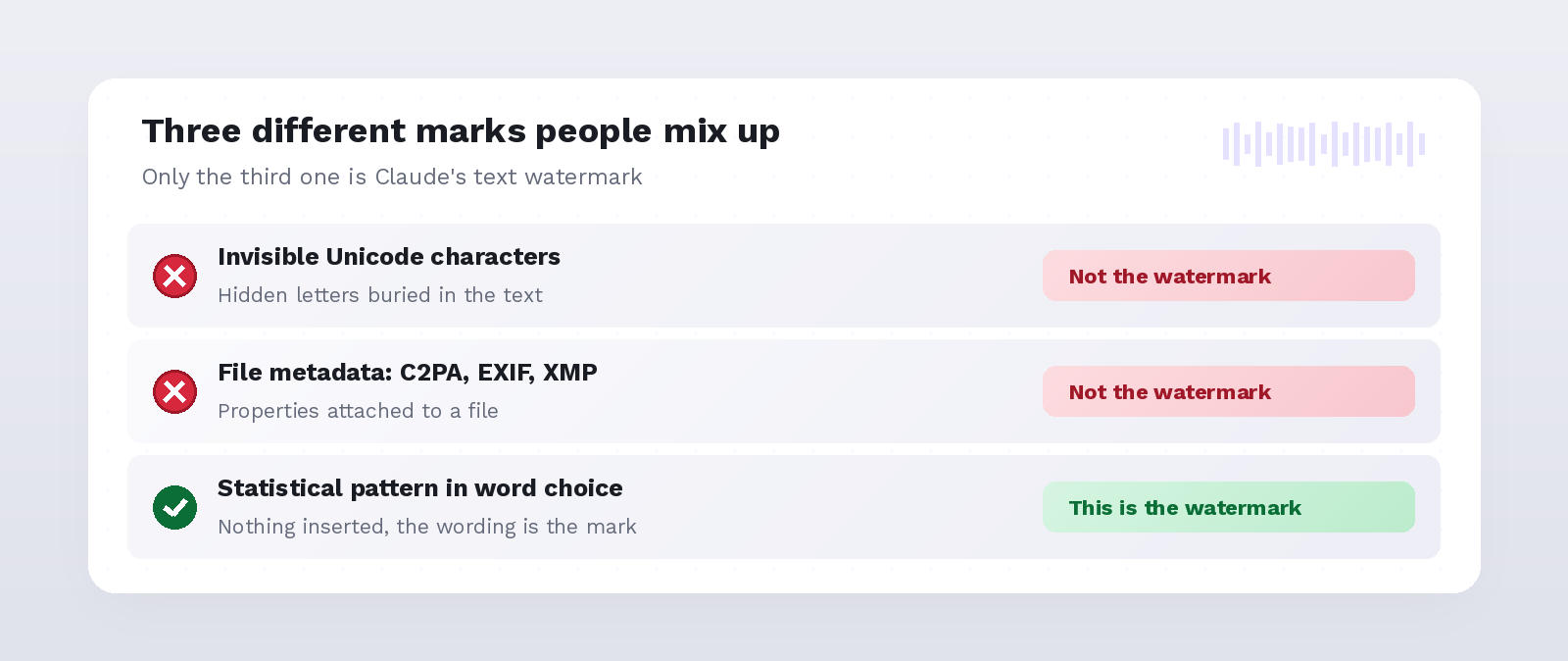
Claude often has more than one word that would fit. The watermark nudges those picks into a pattern set by a secret key. Across enough text the pattern shows up. Copy-paste keeps the mark, because the pattern is the wording itself. People mix up three different marks:
- Invisible Unicode characters (hidden letters some AI tools bury in the text). They are not the Claude watermark.
- File metadata such as C2PA, EXIF, or XMP. Claude Content Checker looks only for a Content Credential from Claude on image, video, and audio files. The tool only reads the attached credential, not the file itself, and does not check text.
- Claude's statistical watermark. Tools that clean Unicode or C2PA do not touch this.
Anthropic: "Watermarking carries no identifying information and can't be traced to a specific person, organization, or chat." Anthropic's mechanism page says detecting a watermark "doesn't work well on small samples, where there are fewer word choices and thus less information to go on." Anthropic publishes no word-count threshold.
The Claude watermark lives in word choice, not in hidden characters or metadata. r/SEO stated the mechanism in the clearest plain English anywhere: "The watermark is a statistical pattern in word choices, embedded when the model generates text. No hidden characters, no metadata." The wording is correct.
Which Claude Models Are Watermarked Right Now?
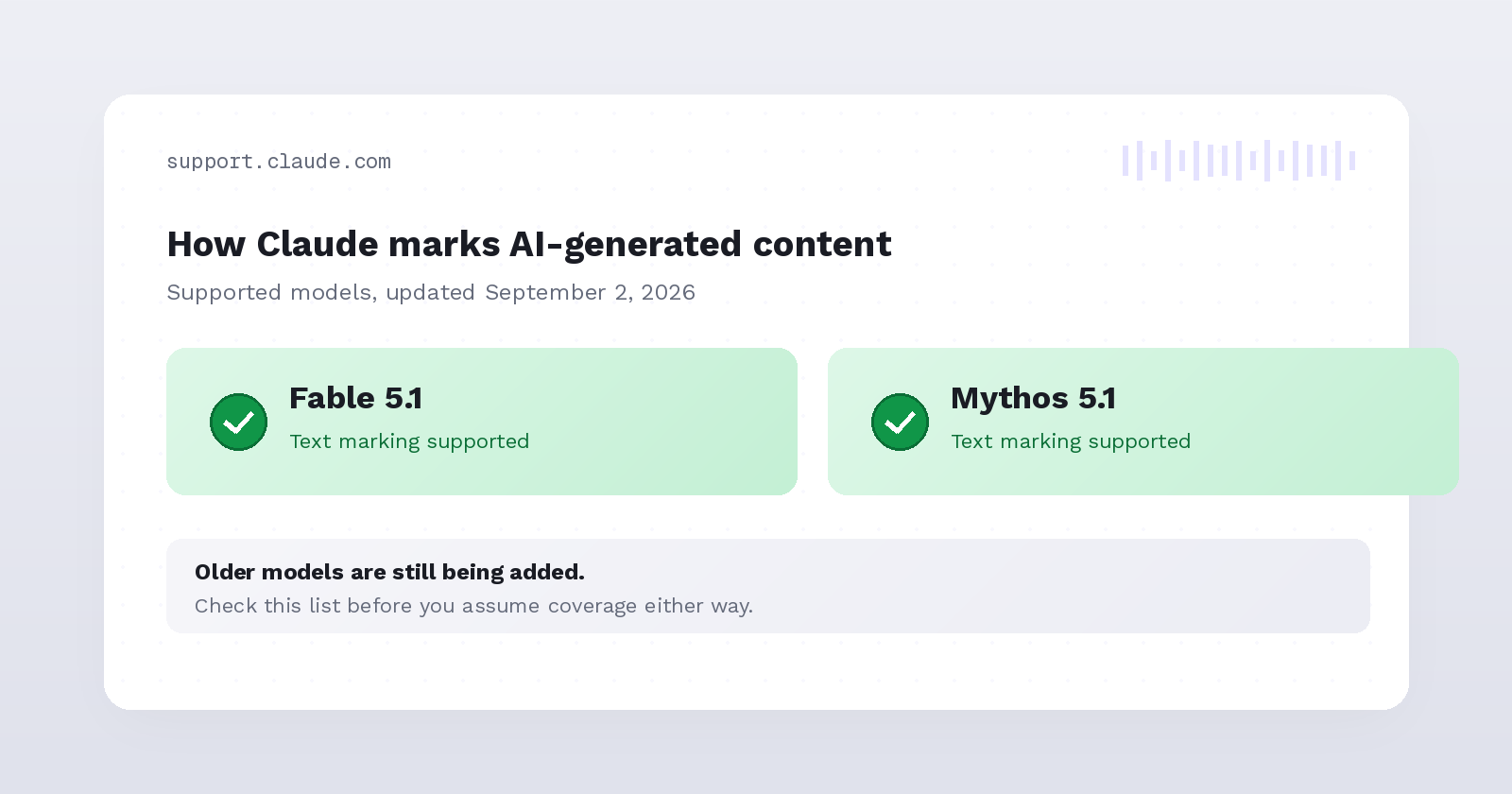
Supported Claude models watermarked right now are Fable 5.1 and Mythos 5.1, which shipped 1 September 2026. The Help Center policy says models launched on or after 2 August 2026 get a machine-readable watermark at launch. Older models are in a transition period while Anthropic adds marking support, which readers call back porting.
Anthropic's Help Center says: "Models currently supported include Fable 5.1 and Mythos 5.1." For older models it says: "The law includes a transition period for Anthropic models launched before August 2, 2026, and we're working to add marking support for those models as well." Watermarked Claude output covers:
- Claude Platform (API), Claude (web and apps), Claude Code, Claude Cowork, and Claude Tag
- AWS (Amazon Bedrock), Google Cloud, and Microsoft Foundry
Two edge cases decide how much signal your document carries:
- A Claude translation of your own writing is newly written by Claude, so it carries a mark: "A translation produced by Claude carries a watermark, because in this case every word is chosen by Claude."
- Light proofreading has very little to attach to: "When Claude proofreads text written by a person, what it gives back has generally only been lightly edited; because nearly all the words are the person's, there's very little (if anything) for the watermark to attach to."
Reddit tracked the rule and back-porting plan early. r/Anthropic: "As of Aug 2, 2026, new Claude models embed an invisible watermark into generated text." Aug 2, 2026 is the Help Center launch rule, not a ship date. Fable 5.1 and Mythos 5.1 shipped 1 September 2026. r/ClaudeAI: "They said they are working on back porting."
10 Ways People Try to Remove a Claude Watermark
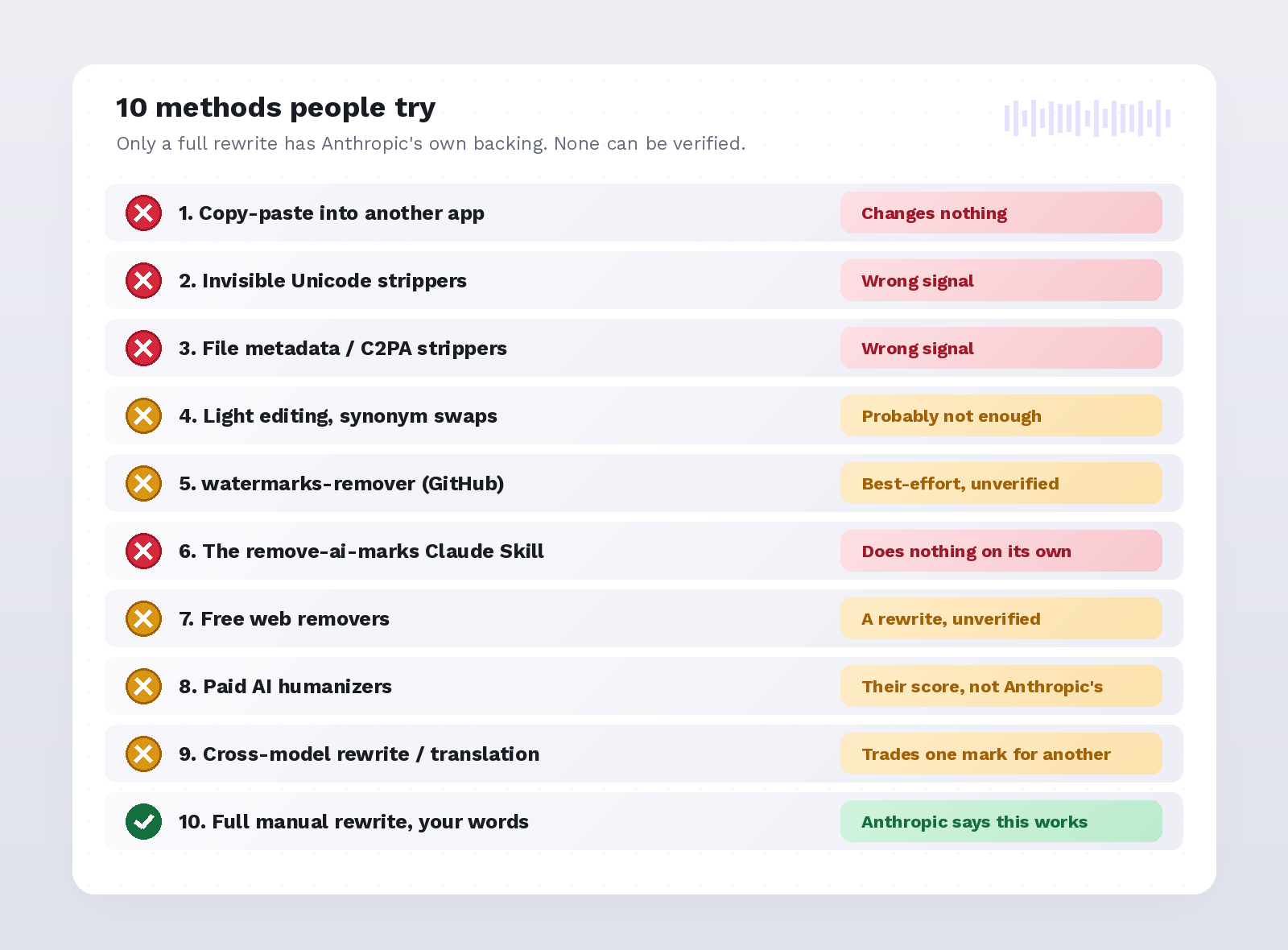
People looking to remove a Claude watermark try 10 methods. The 10 methods fall into three groups: tools that touch the wrong signal, rewrites of the wording, and things that change nothing at all. Only a full rewrite has Anthropic's own backing. Scan the table that follows for every method.
Claude watermark stripping is common because the scheme is a hard trade-off. r/Anthropic said "It is hard to design a watermark scheme that is simultaneously obvious and tamper-resistant while also not degrading the quality of the generated text." The same bind is why none of the claims can be checked.
| Method | What it actually changes | Does it touch the word-choice watermark? | Can you verify it? |
|---|---|---|---|
| Copy-paste into another app | Nothing | No | Yes, nothing changed |
| Invisible Unicode strippers | Hidden characters | No | Yes, those characters |
| File metadata and C2PA strippers | File properties | No | Yes, on files |
| Light editing and synonym swapping | Some words | Partly | No public detector |
| watermarks-remover GitHub project | Unicode plus a rewrite | Partly | Unicode yes, watermark no |
| "remove-ai-marks" Claude Skill | Nothing on its own | No | Yes: it stops |
| Free web removers | Unicode plus a rewrite | Partly | No public detector |
| Paid AI humanizers | A self-scored rewrite | Partly | No public detector |
| Cross-model rewrite / translation loop | New wording, often a new model | Partly | No public detector |
| Full manual rewrite | Every word you replace | Anthropic says yes | No public detector |
1. Copy-Paste into Another App: Changes Nothing at All
Copy-paste into another app (Notepad, Google Docs, a CMS, or paste as plain text) moves the same words into a new window. Claude's watermark is a statistical pattern in which words the model picked. Nothing is inserted, and there is no hidden character, tag, or file property (Anthropic's explainer).
Copy-paste does not touch the statistical word-choice watermark. The pattern travels with the wording. The limitation is that a "clean" paste can still be the same Claude text.
2. Invisible Unicode Strippers: Clean Text of the Wrong Kind
Invisible Unicode strippers remove zero-width and other hidden characters from text. That work is real, and you can check that those characters are gone.
Unicode strippers do not touch Claude's statistical word-choice watermark. Anthropic's mark is which words the model picked, not a hidden character sitting in the file (Anthropic's explainer).
The limitation is the mix-up: proving the Unicode is gone is not proof about Claude's watermark.
3. File Metadata and C2PA Strippers: Also the Wrong Signal
File metadata and C2PA strippers remove EXIF, XMP, C2PA credentials, and document properties from files. That is a file-property job, not a wording job.
Metadata strippers do not touch Claude's statistical word-choice watermark, which lives in the words, not in a file tag.
The remove-ai-watermarks repo is a common result when you search for a text remover:
- Apache 2.0, v0.38.0 on 7 September 2026, about 5,400 GitHub stars
- Images and video only, plus C2PA, EXIF, IPTC, and XMP
- README opening line: "Remove AI provenance marks from images and video you generated yourself."
People find it while searching for a text remover and assume it works on text. It does not.
4. Light Editing and Synonym Swapping: Probably Not Enough
Light editing of text generated by Claude changes some words and leaves most of the original wording in place. Synonym swapping of a few terms does little to weaken the watermark, because Claude's word choices still sit on the page.
Light editing does not reliably clear the statistical word-choice watermark. Anthropic's line is exact: "Light editing probably won't remove the watermark completely; a complete rewrite where every word is replaced will" (Anthropic's explainer).
The limitation is that you cannot check whatever is left. There is no public consumer text detector as of 7 September 2026, and text checking "is via our Detection API (separate tool) and in private preview" (CNET, 2 September).
5. The watermarks-remover GitHub Project: Honest, but Unverified
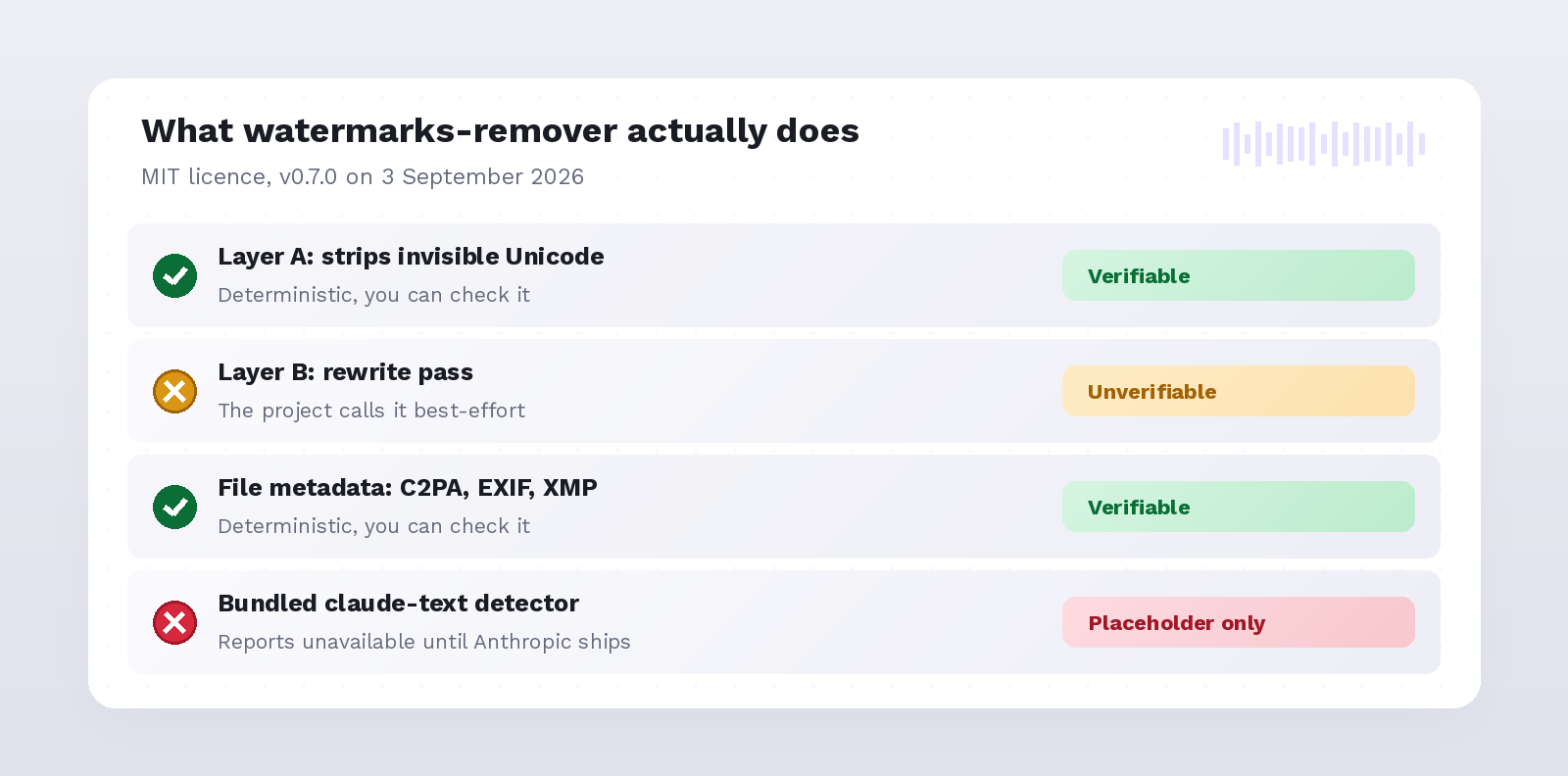
The watermarks-remover GitHub project (MIT licence, release v0.7.0 on 3 September 2026, about 21,000 GitHub stars) runs two layers on text, plus a file-metadata strip.
- Layer A is a deterministic invisible-Unicode strip. That layer is verifiable. It is not the Claude watermark.
- Layer B is a rewrite pass (paraphrase, back-translate, or masked-LM infill). The project calls Layer B "best-effort".
- The same project also strips C2PA, EXIF, and XMP file metadata.
Layer B may change wording, which is the signal Claude's statistical watermark uses, but you cannot verify the result.
The bundled claude-text detector is a placeholder that reports unavailable until Anthropic's API ships, and the project does not let you claim the output is undetectable or "proves human-written". Guillaume Meyer told Business Insider on 23 August 2026: "People are promoting it as if it's perfect. It's not."
6. The "remove-ai-marks" Claude Skill: Does Nothing on Its Own
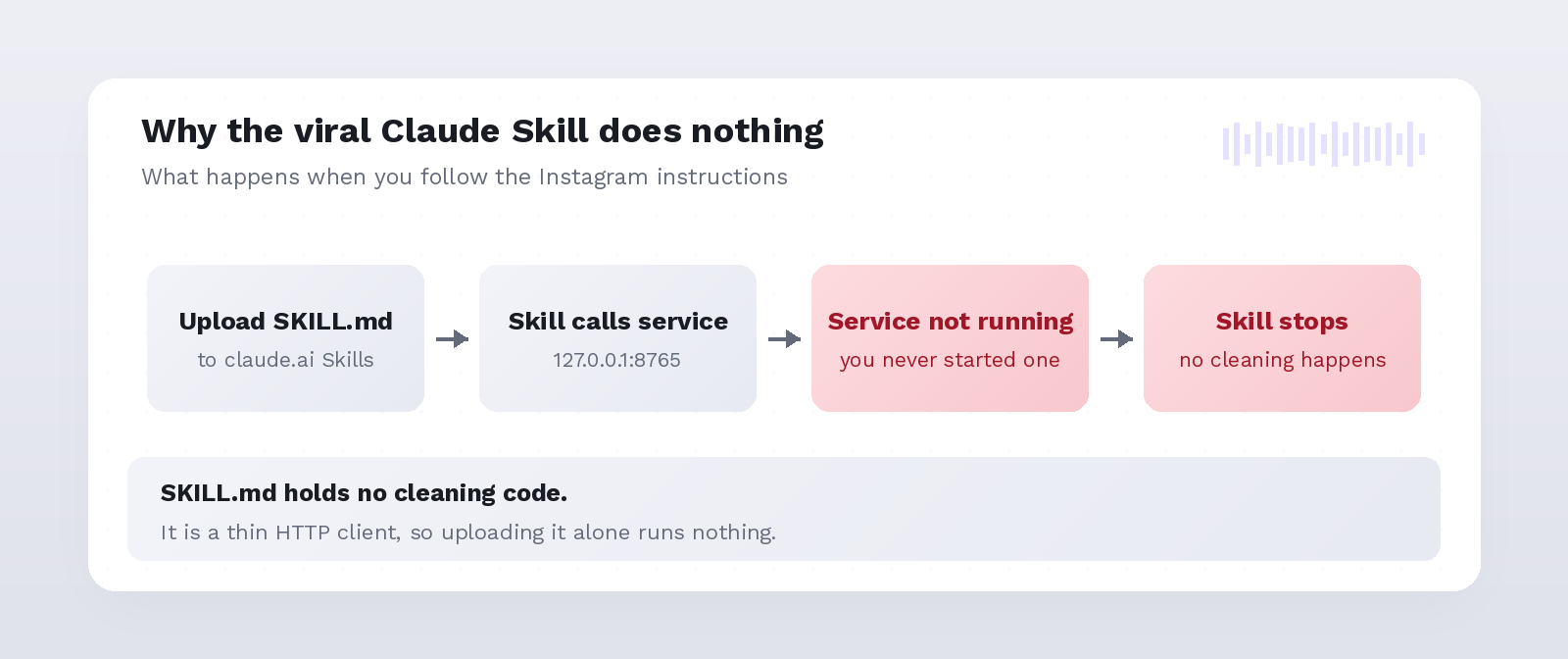
The "remove-ai-marks" Claude Skill is Guillaume Meyer's slash command /remove-ai-marks for the same project. Instagram and Threads posts tell you to download SKILL.md and upload it to claude.ai under Customize, then Skills.
The current SKILL.md file is a thin HTTP client. It contains no cleaning code. It calls WATERMARKS_SERVICE_URL (default 127.0.0.1:8765) and is instructed to stop if that service is not running, rather than clean anything locally.
Following that Instagram and Threads instruction alone runs no cleaning at all. You have only uploaded a client that talks to a local service you never started. Older August write-ups described an earlier architecture. That is not how the skill works now.
7. Free Claude Watermark Remover Sites: A Rewrite Behind a Web Form
An AI watermark remover on a free website wraps a Unicode strip and a rewrite behind a form. Sites of this kind ask you to paste your text into a box and hand back rewritten text they present as clean text, which may change wording, and they do not check Claude's statistical word-choice watermark.
Favtutor's Claude page is free, with no sign-up, and runs the pinned watermarks-remover project as a container: Unicode strip, a rewrite with a non-Claude model, and C2PA inspection. It says it cannot verify the statistical text mark, and it shows no cleaned percentage or removal score.
Ninja Humanizer's page strips invisible Unicode, removes em dashes and stock AI phrasing, then rewrites (free tier: 3 runs per 48 hours, 200-word cap; paid tiers raise the word cap).
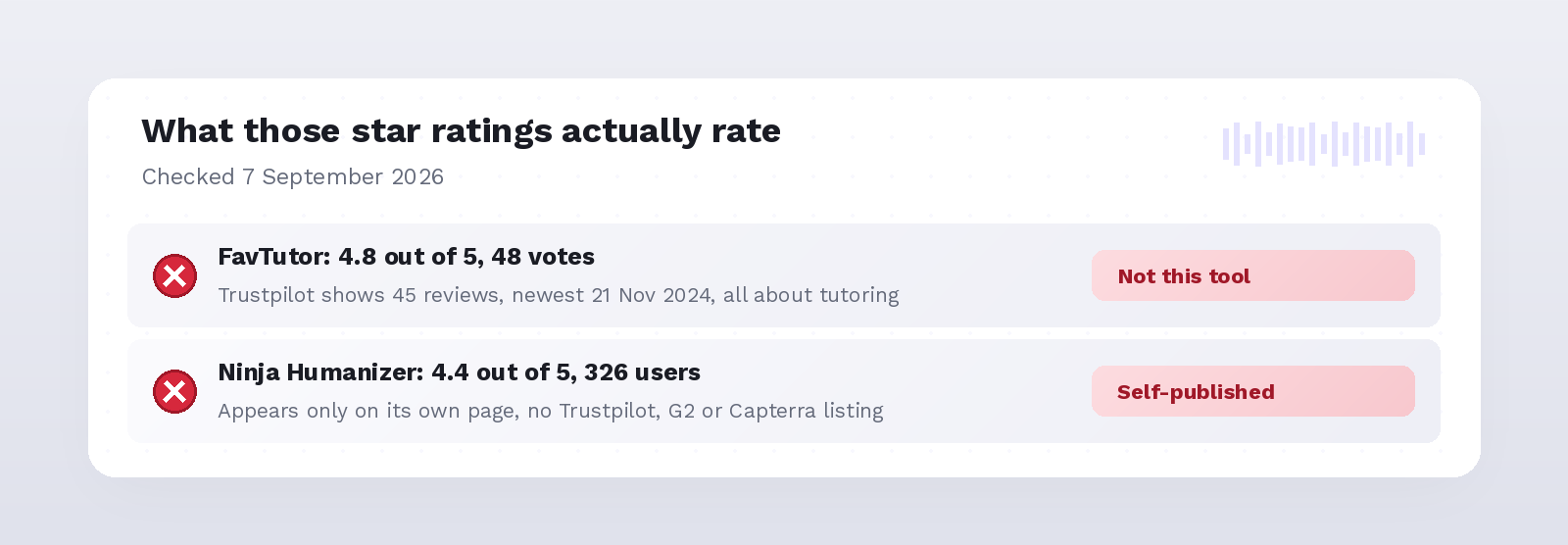
Ninja Humanizer's own page says nobody can hand you a verified zero, and "Anyone quoting you a percentage made it up." The star ratings both pages show in Google do not rate the removers at all:
- The "4.8 out of 5 (48 votes)" figure traces to favtutor's Trustpilot page, which shows 4.8 from 45 reviews, none in the last 12 months, most recent 21 November 2024, and all about its tutoring service.
- Ninja Humanizer's "Rated 4.4 out of 5 by 326 users" line appears only on its own page, with no matching Trustpilot, G2, or Capterra listing.
8. Paid AI Humanizers: You Buy a Watermark Detection Score, Not a Check
Paid AI humanizers sell a rewrite and then show you a before-and-after number. That number is not a reading from Anthropic.
Any before-and-after score a paid humanizer shows is its own estimate. None of them can reach Anthropic's Detection API. CNET, 2 September confirms it is in private preview. Anthropic's explainer lists eligibility: regulators, law enforcement, media, fact-checkers, independent researchers, educational organizations, EU civil society groups, and enterprises with their own EU AI Act verification duty.
A paid rewrite may change wording, which is the only signal Claude's statistical watermark uses. You still cannot verify the result. The free public Claude Content Checker reads C2PA credentials on files (images, audio, video) only. It does not check text.
9. Cross-Model Rewriting and the Translation Loop: Trades One Mark for Another
Cross-model rewriting pastes Claude output into ChatGPT or Gemini for a rewrite. The translation loop sends the text into another language and back. Both replace words on the page, which is the signal Claude's statistical watermark uses.
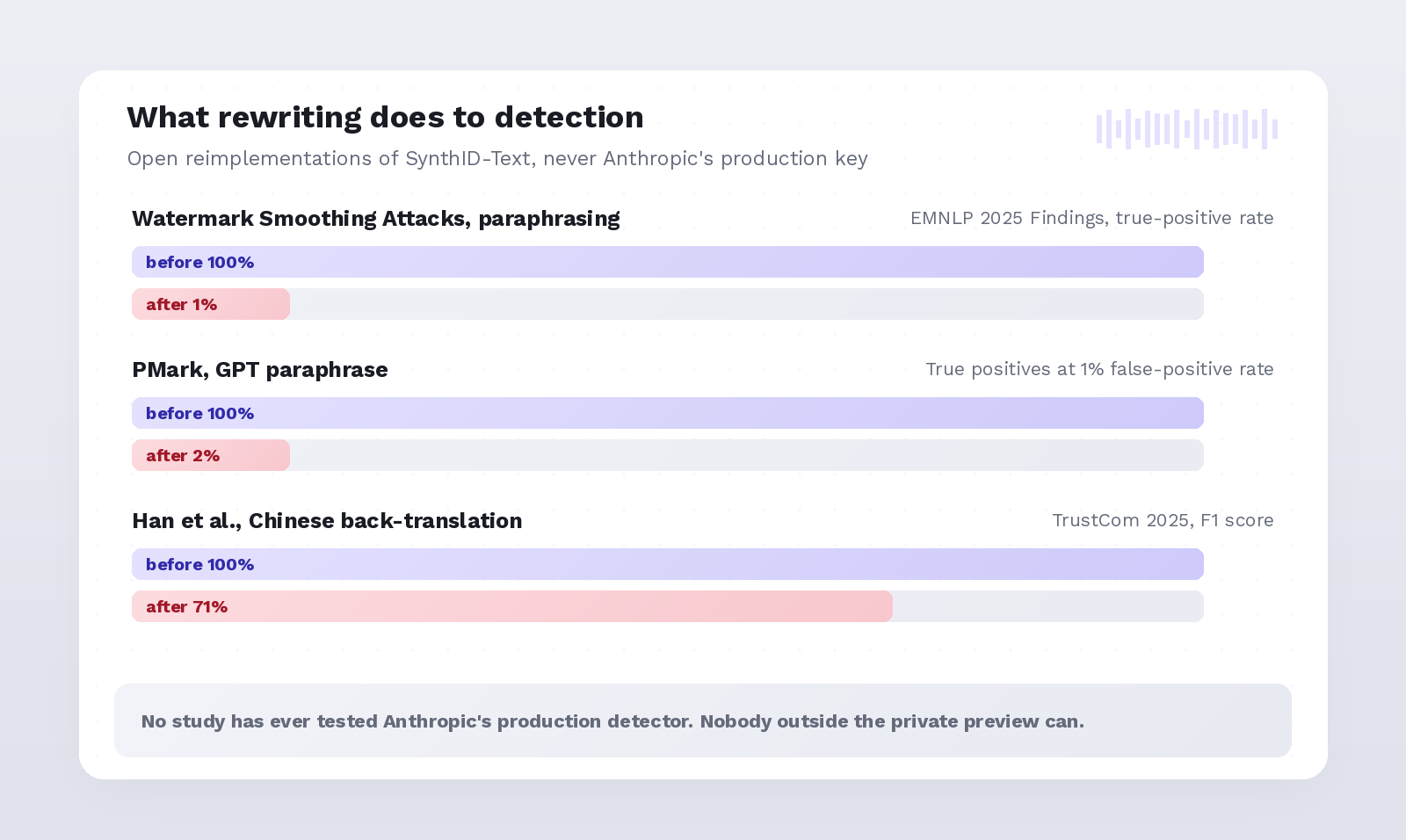
Chang, Hassani and Shokri's Watermark Smoothing Attacks (EMNLP Findings, 4 to 9 November 2025) paper found that SynthID true-positive rates on three open models fell from 100, 99 and 100 percent to 1 percent under paraphrasing and 0 percent under smoothing. The test ran on an open reimplementation of SynthID-Text, not Anthropic's production key.
The PMark study reported that under GPT paraphrase, SynthID true positives at a 1 percent false-positive rate fell from about 100 percent to 1.8 percent (arXiv:2509.21057). Han et al. at TrustCom 2025 showed F1 falling from 1.0 to 0.711 under Chinese back-translation. The test ran on an open reimplementation of SynthID-Text, not Anthropic's production key.
Google's own SynthID documentation says detector confidence "can be greatly reduced when an AI-generated text is thoroughly rewritten, or translated to another language" (Google SynthID docs).
Gemini rewrites can add Gemini's own mark, and a Claude translation "carries a watermark, because in this case every word is chosen by Claude" (Anthropic's explainer). Dathathri et al. tested SynthID-Text live on about 20 million Gemini responses (Nature, 23 October 2024). You may trade one pattern for another and still cannot run Anthropic's detector.
10. A Full Manual Rewrite in Your Own Words: The Only Method Anthropic Backs
A full manual rewrite in your own words replaces every word Claude chose. You are no longer moving Claude's wording. You are writing the passage.
Anthropic backs this as the method that clears the mark: "a complete rewrite where every word is replaced will" (Anthropic's explainer).
Two limitations remain:
- There is still no public test that proves any specific rewrite cleared Anthropic's check. Detection stays in private preview, and there is no public consumer text detector as of 7 September 2026.
- By the time you have replaced every word, you have written it yourself, which was the honest option all along.
Methods you can verify, such as Unicode stripping, C2PA and EXIF cleaning, and copy-paste, are not Claude's word-choice watermark. Methods that might touch that watermark, such as rewrites and a full rewrite in your own words, cannot be verified outside Anthropic's private Detection API.
Why Can't You Verify a Claude Watermark Was Removed?
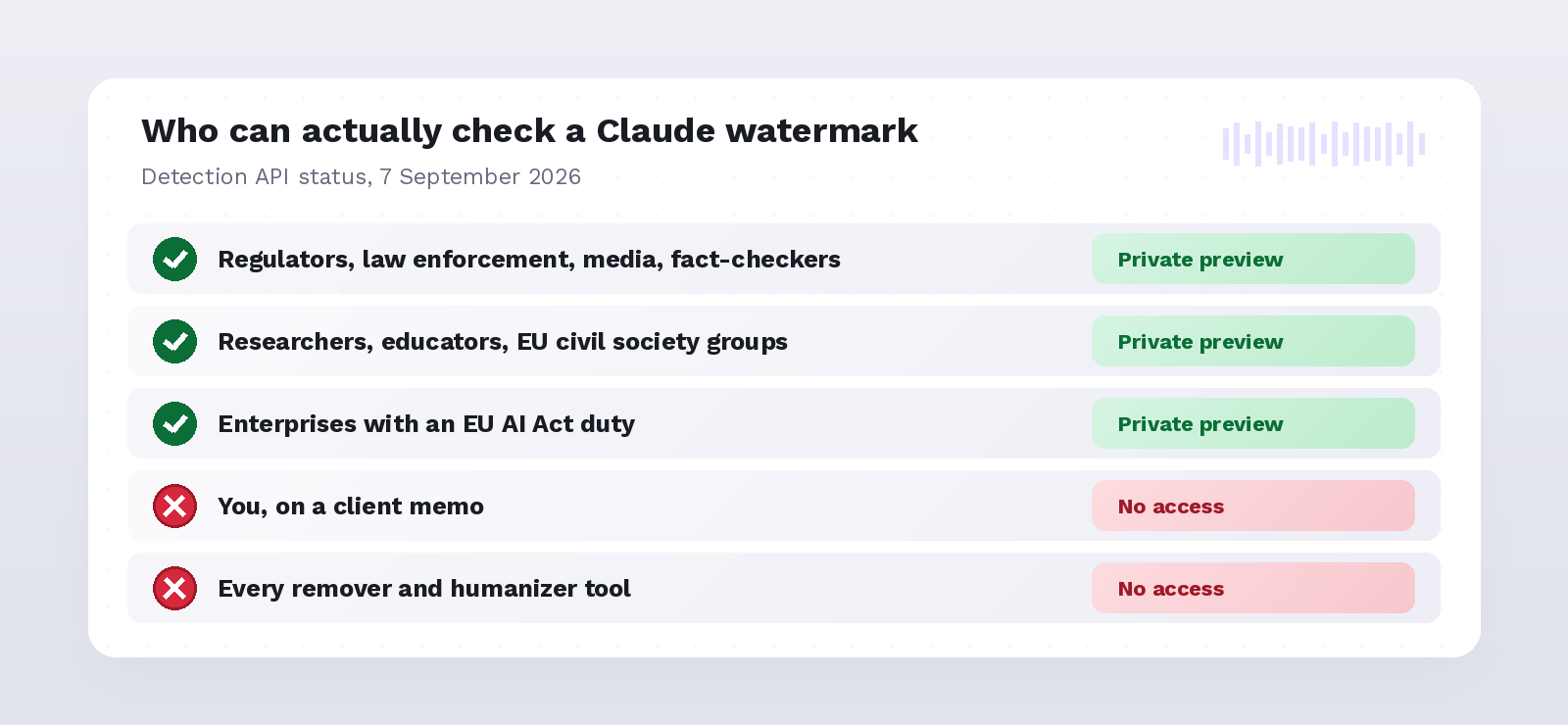
Readers cannot verify that a Claude watermark was removed because no public consumer text detector exists as of 7 September 2026. Anthropic's Detection API remains in private preview. The free Claude Content Checker reads C2PA credentials on files only and does not check the text or show what a watermark proves.
Anthropic's Detection API is in private preview for regulators, law enforcement, media, fact-checkers, independent researchers, educational organizations, EU civil society groups, and enterprises with their own EU AI Act verification duty. Anthropic plans to widen access over time, per Anthropic's explainer.
The free public tool is the Claude Content Checker, and it reads C2PA credentials on files (images, audio, and video) only. On 2 September 2026, a CNET report quoted an Anthropic spokesperson: text checking "is via our Detection API (separate tool) and in private preview".
Verifying a Claude watermark was removed cannot rest on a mid-August 2026 line from r/ClaudeAI: "Nothing you generate with Claude today is watermarked, and nobody can check for marks anyway". Fable 5.1 and Mythos 5.1 shipped on 1 September 2026, and the Detection API now exists. Out of date, never a reason to skip disclosure.
Is It Illegal to Remove a Claude Watermark?
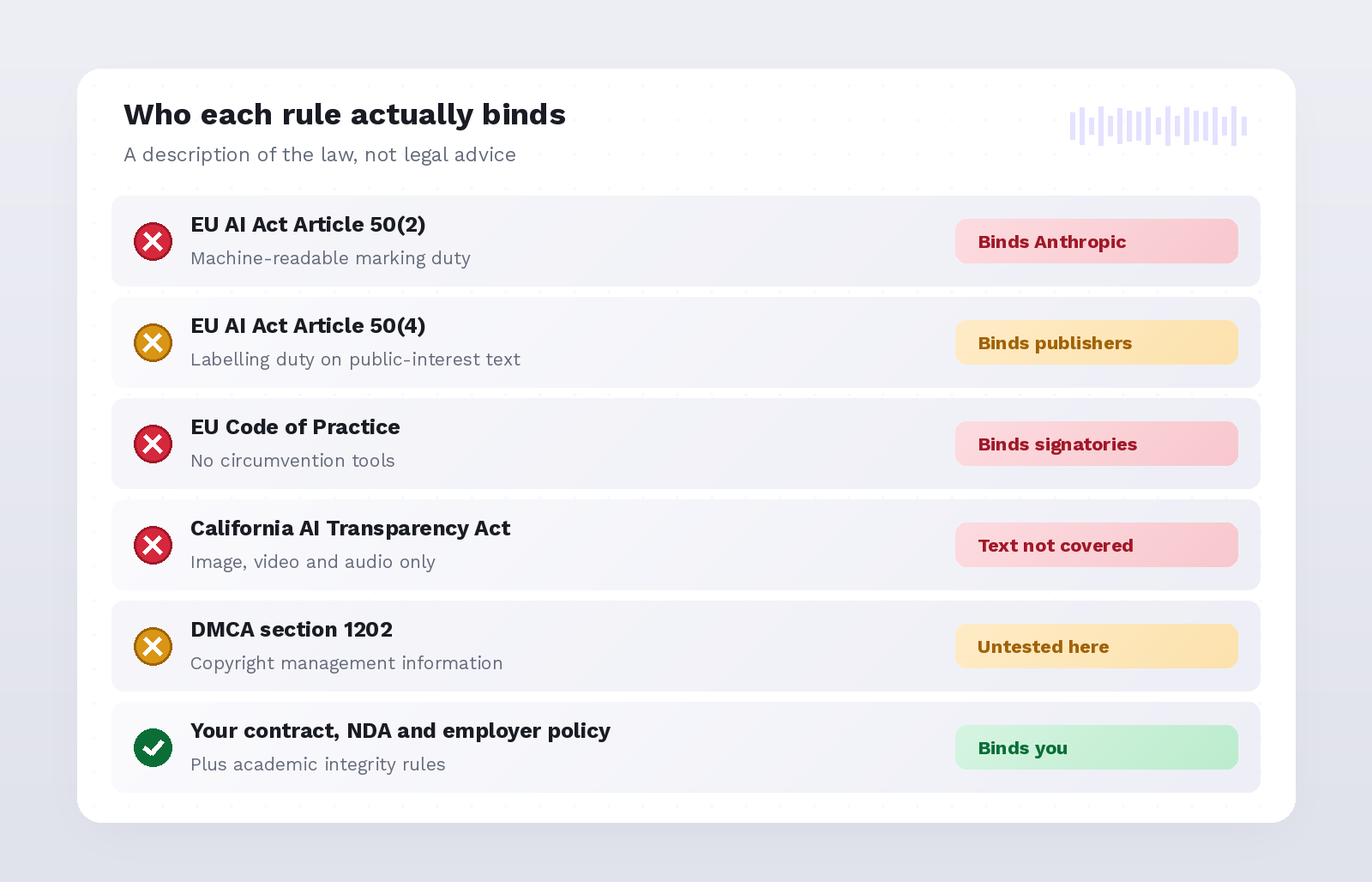
For a private person editing their own text, no law found currently makes removing a Claude watermark an offence. The notes below describe the law, they are not legal advice, so ask a lawyer for your own situation. Your contract and your professional duties are a different matter.
- EU AI Act Article 50(2) puts the machine-readable marking duty on the provider of the AI system (Anthropic), not on you. It became applicable on 2 August 2026. There is no EU AI Act offence aimed at a private person removing a watermark from their own text.
- Article 50 labelling under Article 50(4) puts a labelling duty on deployers of AI-generated text "which is published with the purpose of informing the public on matters of public interest". Article 50(4) exempts text that a human reviewed and holds editorial responsibility for. The duty is to label, not to preserve Anthropic's watermark.
- EU Code of Practice Measure 1.2 asks signatory providers to prohibit in their terms the intentional removal of, or tampering with, metadata markings specifically, and separately not to place on the market or promote tools whose purpose is to circumvent machine-readable markings. Measure 1.2 binds signatories, not every user.
- California's AI Transparency Act (BPC 22757.3, operative 2 August 2026) covers image, video and audio disclosure. BPC 22757.3 does not cover text. BPC 22757.3.1 bans large online platforms from knowingly stripping system provenance data from 1 January 2027. BPC 22757.3.1 does not apply to individuals.
- DMCA section 1202 covers removing "copyright management information". No court has held that a statistical text watermark is copyright management information. Anthropic's explainer says the mark carries no identifying information and says nothing about ownership or authorship. Untested.
Client contracts, NDAs, employer AI policies, academic integrity rules, and existing professional duties still bind you. Lawyers still have a duty to protect client information under ABA Formal Opinion 512, including when they use Claude without sending client data to the cloud. Tax preparers still sit under IRC section 7216.
What Should You Do Instead of Trying to Remove the Claude Watermark?
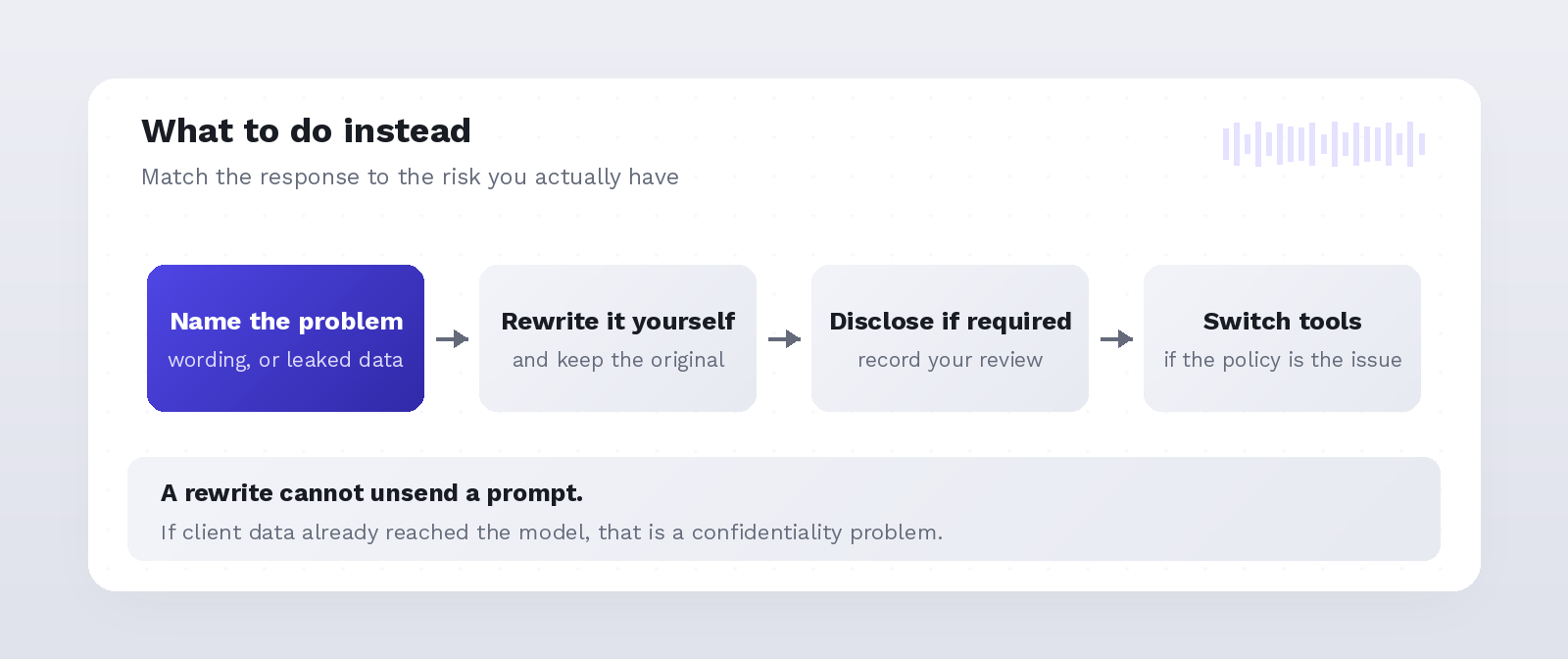
What you should do instead of shopping for an unverifiable remover is work out the real problem, rewrite or disclose when you must, and switch tools if Anthropic's marking policy is the dealbreaker. A remover's score is not evidence the mark is gone.
- Work out which problem you actually have. Being unable to stand behind the wording is a different problem from client data having gone into a cloud model.
- If the wording is the problem, rewrite it yourself and keep the original.
- If your policy or Article 50(4) needs a disclosure, disclose and record your review. Never file a remover's report as evidence the mark is gone.
- If the marking policy itself is your dealbreaker, switch tools rather than shopping for an unverifiable remover. See Claude alternatives.
A rewrite cannot unsend a prompt. Chats you chose to share can still end up in Google. If a client name already went into a cloud model, that is a confidentiality problem and paraphrasing the answer does not undo it.
Switching tools is the honest move if Claude's marking policy is a dealbreaker. r/WritingWithAI already said "Your only real option now is open-source LLM/local LLM". r/claude made the same call: "Honestly, once the watermark starts, I will switch to some other AI." People are already making the switch-not-strip call.
Leave Claude Without Losing Access to Frontier Models
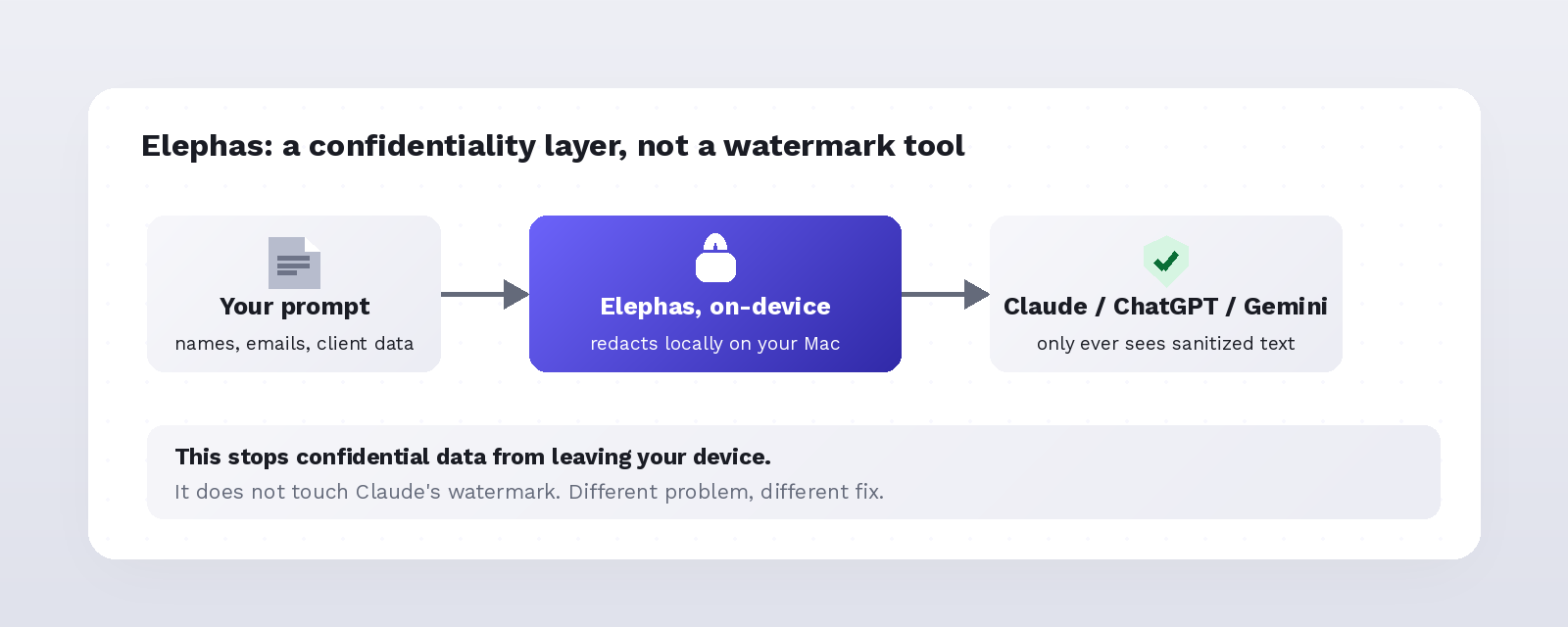
Elephas is a private AI knowledge assistant for Mac that redacts sensitive data before it reaches cloud models. Elephas is not a watermark remover and will not make Claude output undetectable.
You do not lose model access by leaving one vendor. Elephas gives you ChatGPT 5.5, Claude Opus 4.8, Gemini, Grok and Perplexity in one app, so switching does not cost you capability. Elephas has built-in local LLM models that run entirely on your own Mac, so for the most sensitive work nothing leaves the device.
The relevant feature is automatic PII redaction (Smart Redaction). Before a prompt reaches ChatGPT, Claude, Gemini, Grok, Perplexity, or any other cloud model, Elephas strips sensitive names, emails, phone numbers, and identifiers locally on your Mac. Content never trains AI models, never sits on a vendor's server, and never passes through a third-party reviewer's screen.
Smart Redaction is on every plan including the free tier. Elephas runs on Mac, iPhone and iPad, with no Windows build. Elephas starts at $19/month, with a free trial on Elephas pricing. Switching changes which model you use and what data reaches it, and does not strip a mark from text you already generated. If the switch is for privacy, start with what private AI means.
Frequently Asked Questions
Does Claude Watermark Code as Well as Prose?
Claude watermarks code less than prose. Anthropic's explainer has a "What about code?" section. Code often has to be exact, so it carries generally less watermarking than other forms of text. Where there is an arbitrary choice of words or terms in code, the watermark can still be used, for example in code comments.
Will a Free Claude Watermark Remover Work?
A free Claude watermark remover cannot be verified against Anthropic's detector, because that API is in private preview as of 7 September 2026. Tools such as FavTutor's hosted page and Ninja Humanizer strip invisible Unicode, file metadata, or rewrite the words. Those steps are not the same as proving Claude's statistical watermark is gone.
Can ChatGPT or Gemini Remove a Claude Watermark?
You cannot verify that ChatGPT or Gemini removed a Claude watermark. Anthropic's Detection API is in private preview. Open SynthID-Text reimplementations, never Anthropic's production key, saw true-positive rates fall to about 1 percent under paraphrasing in Watermark Smoothing Attacks. Google's SynthID docs say thorough rewriting or translation can greatly reduce confidence.
Does the Claude Watermark Reveal Who Wrote the Text?
The Claude watermark does not reveal who wrote the text. Anthropic's exact line in Anthropic's explainer is: "Watermarking carries no identifying information and can't be traced to a specific person, organization, or chat." The mark is a statistical pattern in word choice, not a name, account, or conversation ID.
How Long Does Text Need to Be for the Watermark to Show Up?
Anthropic publishes no word-count threshold for when the watermark shows up. Detecting a watermark "doesn't work well on small samples," Anthropic's explainer says, and confidence rises as the passage gets longer. The "150 words" figure circulating online is not Anthropic's number and is unverified.
Do AI Detectors Like GPTZero or Turnitin Detect the Claude Watermark?
GPTZero and Turnitin do not detect the Claude watermark. Those tools guess from writing style and have nothing to do with Anthropic's key. They also misfire on human writing. Anthropic's text check is a separate Detection API in private preview, as a CNET report quoted on 2 September 2026.
What Is the Claude Watermark Remover Skill on GitHub?
The Claude watermark remover skill on GitHub is Guillaume Meyer's /remove-ai-marks skill from the GitHub skill. The current SKILL.md is a thin HTTP client with no cleaning code.
The skill calls WATERMARKS_SERVICE_URL (default 127.0.0.1:8765) and is instructed to stop if that local service is not running. Uploading SKILL.md to claude.ai does not run the cleaning layers on its own.
Is There a Claude Watermark Detector I Can Use?
A public Claude watermark detector does not exist as of 7 September 2026. Anthropic's Detection API is in private preview for eligible organizations under EU law. Third-party AI detectors do not use Anthropic's key for watermark detection. Anthropic's explainer covers how the marking works.
Keep your AI chats private, on your own Mac
Elephas pairs with the AI model you already use, or runs fully offline with built-in local LLM models, and redacts sensitive data before it ever leaves your Mac.
Related Resources
Explore all AI Privacy & Security resourcesNadella Says Treat AI Models as Insider Risks: What His Essay Asks For
11 min readarticlePerplexity Computer vs Claude Cowork: Which AI Agent Should Run on Your Mac?
18 min readarticleChatGPT Business vs Plus: Which Plan Is Right for Your Firm?
15 min readarticlePerplexity Computer Review (2026): What It Actually Does, What It Costs, and Who It's For
11 min read