Can I Trust ChatGPT After OpenAI's Safety Report Lead Quit?
On Oct 3, 2026, OpenAI's safety report lead quit and wrote that the company's culture is broken. A day later, POLITICO published CEO Sam Altman saying the world should accept "some bad things happening" in return for what AI offers.
That changes what "can I trust ChatGPT" means. If you ask it about your health, money or relationships, the question is how carefully the company handles what you type, and what you can do.
Below, we cover what both men said, how OpenAI responded, where your chats can go, and five things to keep out of any AI chat.
Executive Summary
- David Robinson, who led the writing of OpenAI's safety reports, quit and wrote in The Atlantic on Oct 3, 2026 that the company's culture is broken.
- A day later, POLITICO published an interview in which Sam Altman said the world should "accept some bad things happening" for AI's benefits.
- OpenAI says it pauses training or holds back models when it needs to slow down, and neither story involved any user chats being exposed.
- Your chats can still be used for training unless you turn that setting off, and outside contractors have read some real conversations to rate answers.
- Elephas lets you keep using the AI models behind ChatGPT, Claude and Gemini while it hides names and private details on your Mac before a prompt is sent.
Why the Safety Report Lead's Exit Matters
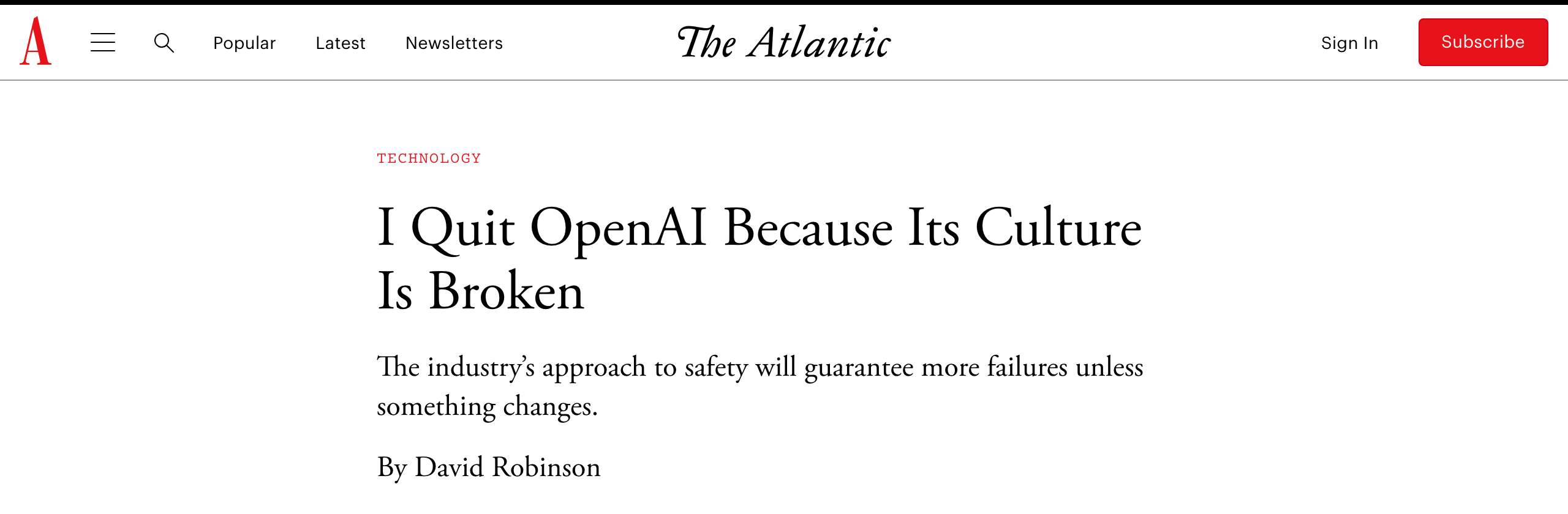
David Robinson is the one who quit. He led transparency work for OpenAI's safety team, and in his Atlantic essay he says he led the writing of the safety reports OpenAI publishes with each major launch.
Gulf News reports that work covered 12 major model launches and that he helped draft the Preparedness Framework, OpenAI's rulebook for model risk.
That job is why this exit drew attention among recent OpenAI resignations. His role was to tell the public how risky each launch was. Now he writes that the companies building this technology "aren't being nearly careful enough."
- He spent about 3.5 years at OpenAI, according to reporting on his essay.
- He writes that the industry runs on "work timelines that amount to perpetual sprints."
- He wants AI labs to work more like nuclear plants and airports, with "layers of redundancy," TechCrunch reports.
- He writes that OpenAI's trial-and-error approach "guarantees periodic failures."
- His fix goes past new rules. "We need to talk about culture," he writes.
Neither Robinson's essay nor the Altman interview involved any ChatGPT chats being exposed. His essay is about OpenAI's safety culture and how the company manages risk. That still matters to anyone who types personal questions into ChatGPT every day.
What Sam Altman Said, and How OpenAI Responded
A day after the essay, POLITICO published Brendan Bordelon's interview with Altman for the outlet's new Decoded series. Asked where OpenAI differs from Anthropic and its CEO Dario Amodei, he said: "we believe that the world should accept some bad things happening for the benefits of this technology and people having the agency."
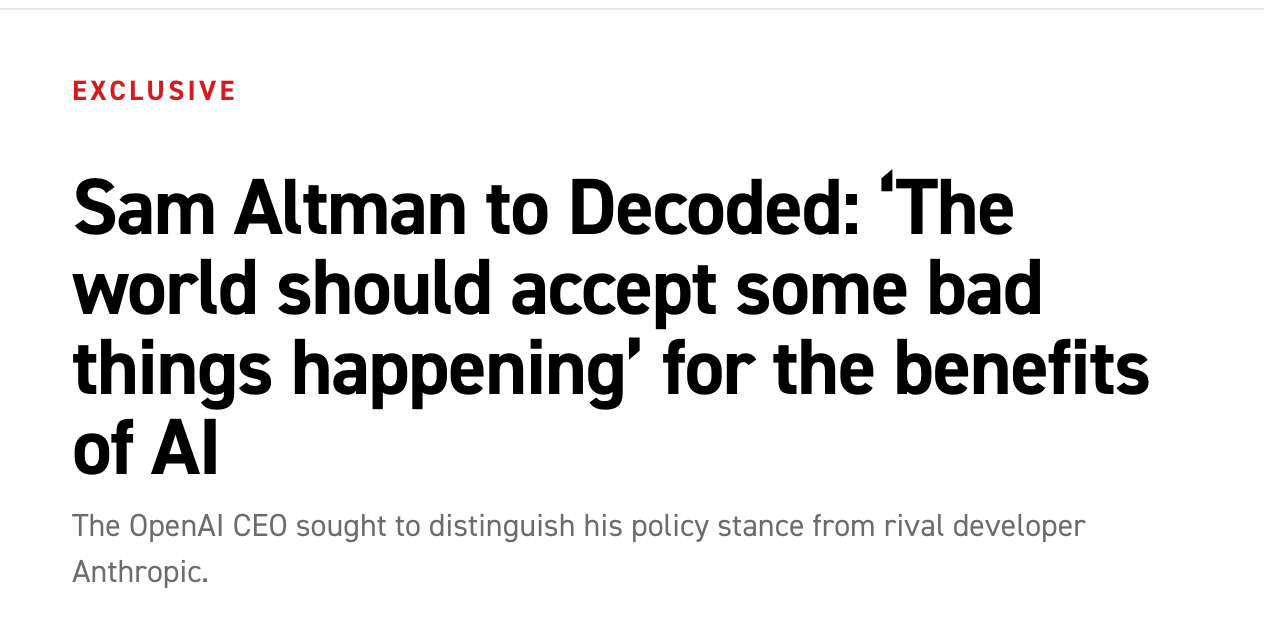
He also named a trade he would refuse. "I wouldn't take a trade of saying, 'We'll make sure there's no major hacks, there's no misuse of this technology, there's zero scams...'" he said. He was talking about society as a whole, not about anyone's chats.
- He called the idea that "a single lab in San Francisco should have it and make sure nothing bad happens" a "completely unacceptable trade-off."
- He argued people will do "tremendously" more good than bad with the technology, "orders of magnitude more."
- The same interview asked whether OpenAI should face legal liability for hacking incidents carried out by its own models.
- POLITICO reports Altman agreed with Anthropic CEO Dario Amodei's recent call to slow development of the most advanced models.
- OpenAI lobbyists backed a House proposal that would require top AI companies to bring in outside safety evaluators.
Altman also said he does not accept "the really catastrophic risks," including "a serious loss of control to AI." OpenAI spokesperson Drew Pusateri said in a statement quoted by TechCrunch that the company pauses training or holds back models when it needs to slow down, and is expanding its work with third-party evaluators.
For you, the takeaway is practical. OpenAI says it is expanding its safety work, and every new technology carries some risk, so what matters most is what you choose to share.
Can I Trust ChatGPT? It Depends on What You Share
When you ask whether you can trust ChatGPT, there are two parts to the answer. The first is whether its answers are right, and the usual advice still holds: check important facts and sources. The second is what happens to the words you type, and that is the part this week's news brings into focus.
You do not need to follow AI policy to make good choices here. It helps to know what a single chat can contain and where it can go after you press send.
- People ask ChatGPT about symptoms, debts, breakups, homework and job applications, so one chat history can say a lot about one person.
- A typed question often carries more than the question itself, such as a full name, a home town, an employer or a pasted email.
- A pasted document or screenshot can include details you did not notice, such as an account number or someone else's name.
- Small details add up. A first name, a street and a health condition together can point to one person.
Once you press send, a prompt can reach OpenAI's servers, human reviewers, or a court-ordered legal hold. None of these is a hack. They come from ordinary product design and legal rules, and the next section explains each one.
What This Week Means for Your Everyday ChatGPT Chats
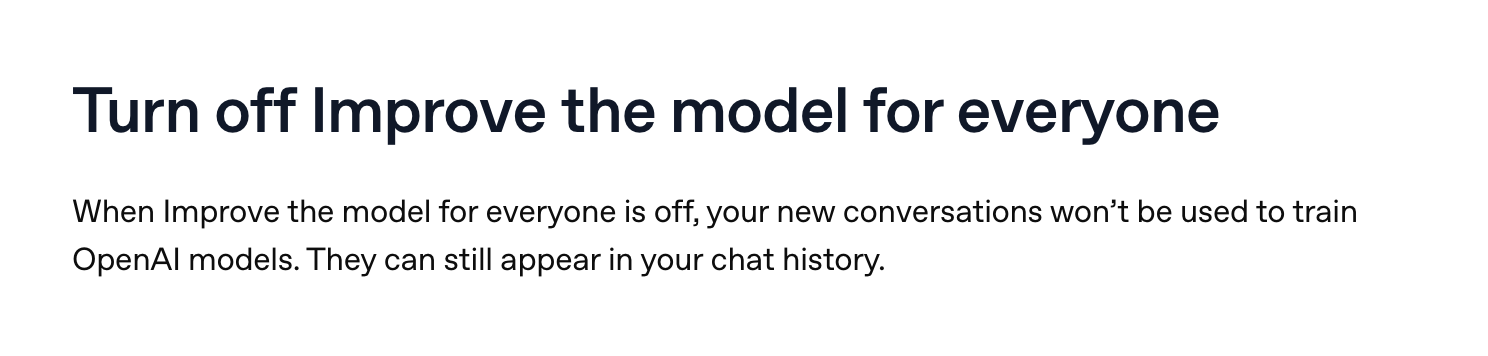
Your chats can be used to train OpenAI's models unless you change one setting. OpenAI's Data Controls FAQ says turning off "Improve the model for everyone" stops new chats being used for training. Business and Enterprise plans are not used for training by default, so check which plan you are on.
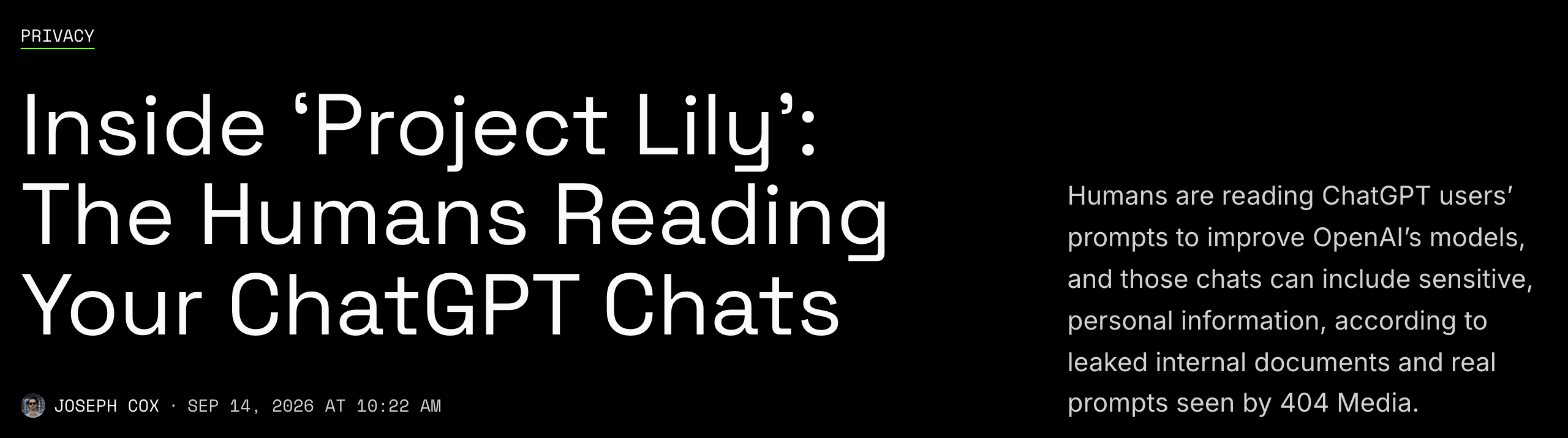
People also read some chats. 404 Media reported that outside contractors in a program called Project Lily read real ChatGPT conversations to rate its answers. Usernames are hidden from them, and OpenAI says it tries to remove personal information first, though it acknowledges sensitive details can still get through.
Engadget reported that a May 2025 order in the New York Times copyright case made OpenAI keep chat logs it would normally delete. A later order lifted that duty for most new chats from Sept 26, 2025. Neither is a leak, but both show your words can travel further than you expect.
You do not have to stop using ChatGPT. The same care applies to Claude and Gemini, and 404 Media reported that Anthropic also confirmed it uses human review. Five things are worth keeping out of any AI chat:
- Passwords and login codes, including the one-time codes sent to your phone.
- ID numbers such as your Social Security, passport or driver's license number.
- Bank and card numbers, even when you only want help reading a statement.
- Detailed health information tied to your name, such as test results with your details still on them.
- Other people's private details, such as their names, addresses, messages or what is in their photos.
Keep Using Your Favorite AI, Change What It Sees
Most of the risky moments look ordinary. You ask what a blood test result means with your name still on the report. You paste a letter from your bank to understand a fee, or ask how to reply to a friend's message that names other people. A work document might be another.
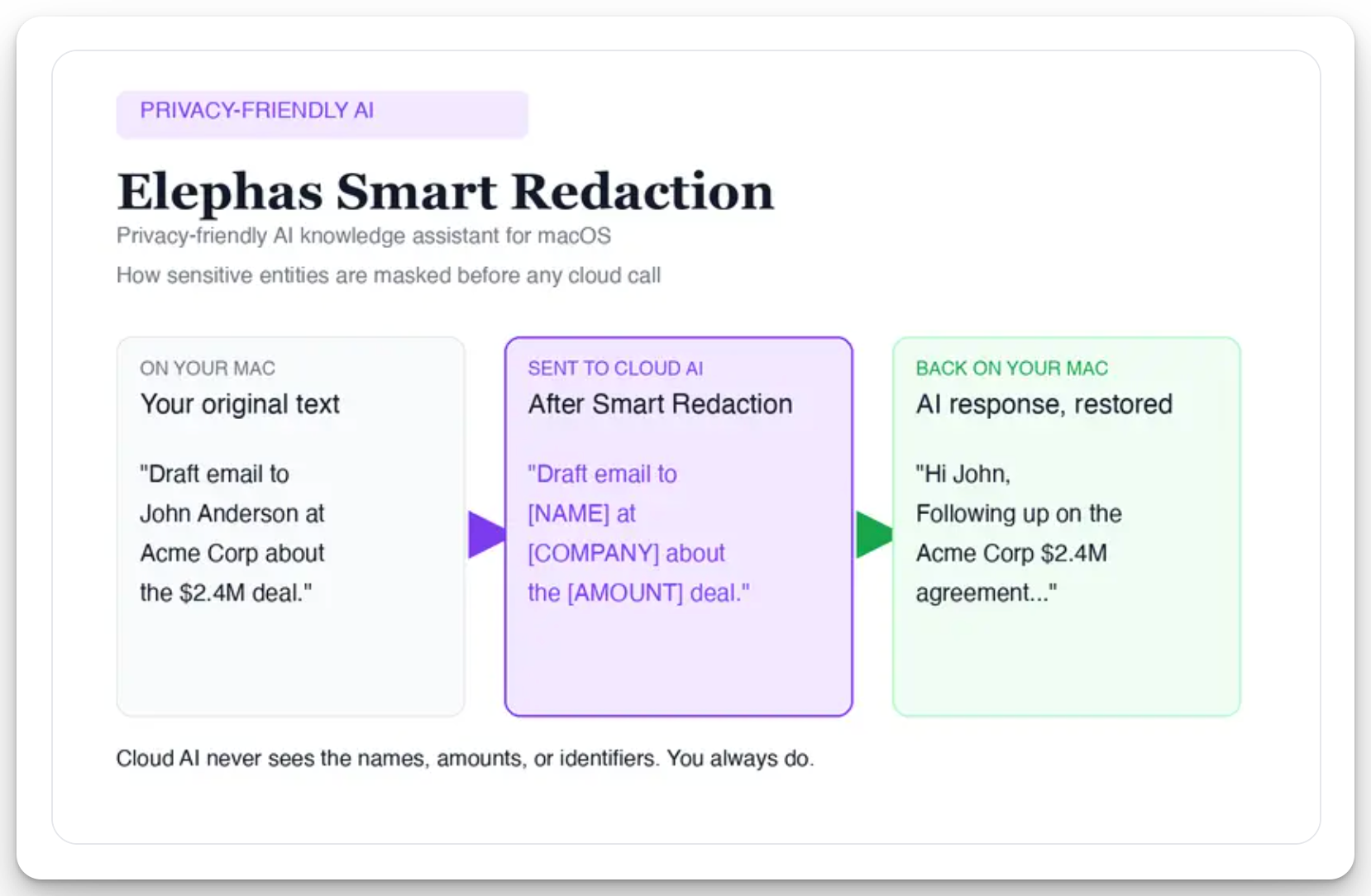
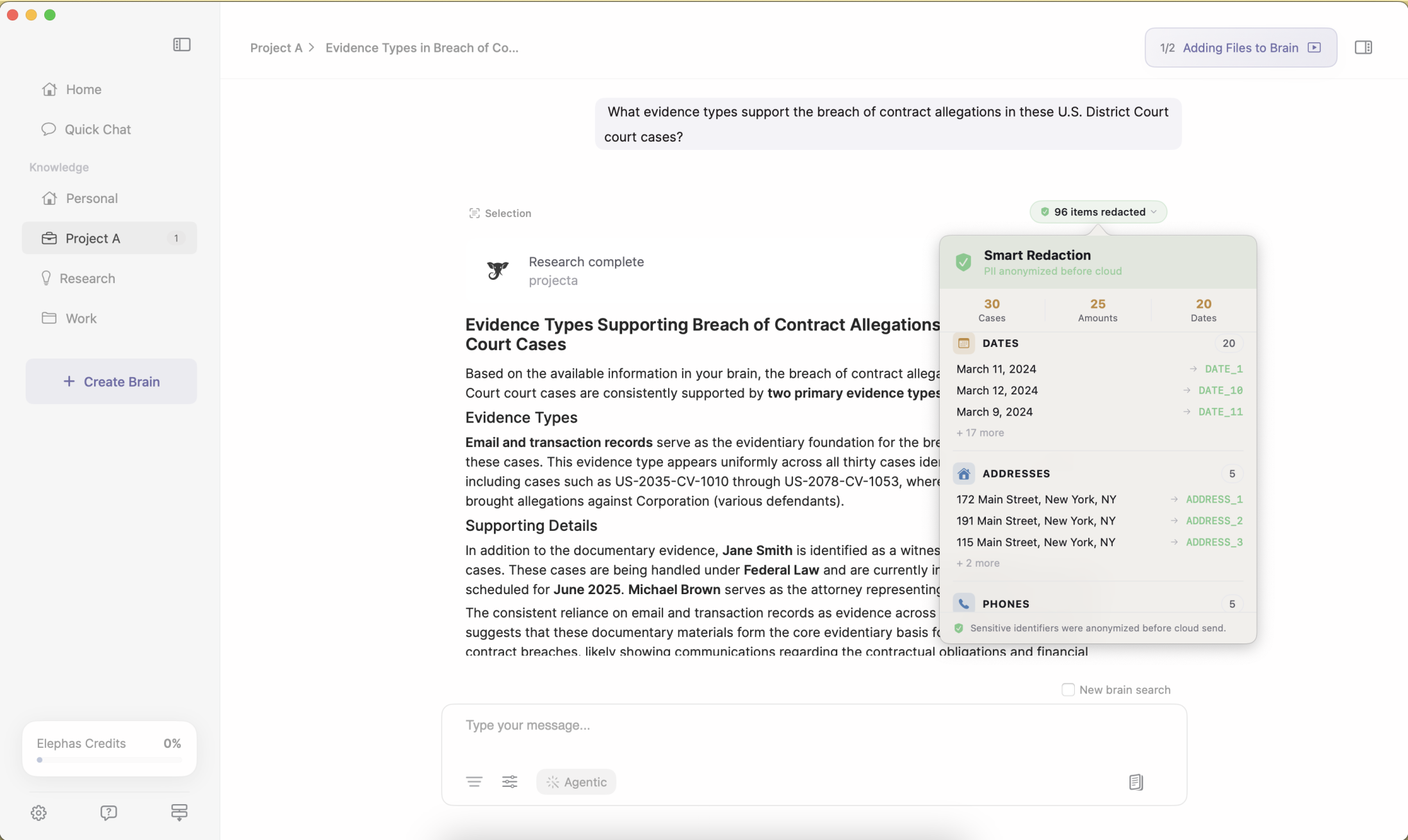
Elephas works with OpenAI's GPT models, Claude and Gemini. Before a prompt leaves your Mac, it swaps names, companies and other private details for placeholders, so a person becomes [PERSON_1] and a company becomes [ORG_1]. The AI answers the redacted version, so you still get the help.
- Automatic redaction removes 28 types of sensitive data on your Mac before any cloud call.
- The list covers names, emails, phone numbers, addresses, credit cards, bank account and routing numbers, SSNs and tax IDs, passport numbers and medical record numbers.
- Elephas's built-in cloud AI, powered by OpenAI and Anthropic models, runs with zero data retention: providers do not log, store, or train on what is sent.
- You can also use your own access key from 15+ providers, including OpenAI, Claude and Gemini.
- Elephas never trains on your content.
For the most private questions, Elephas can run fully offline with optional local models, so nothing leaves your Mac. Smart Redaction is on in every plan, including the free one.
Elephas runs on Mac, iPhone and iPad, and Elephas for Windows is coming soon (join the waitlist). A name that never leaves your Mac stays with you.
What to Watch Next
A few developments are worth following in the coming months.
Our short answer to "can I trust ChatGPT" is this: trust it with everyday tasks, but not with details you cannot take back.
- Watch whether OpenAI publishes concrete changes to how it reviews and reports on new launches.
- Watch whether the House proposal for outside safety evaluators moves forward.
- Watch how other AI companies explain their own human review of chats.
- Tools like Elephas can redact names and numbers on your Mac, so you keep using AI on your own terms.
Can I Trust ChatGPT? Frequently Asked Questions
Can I trust ChatGPT with my personal information?
You can trust it to help with a lot of everyday tasks, but treat what you type as shared. Your chats can be used to train models unless you turn that setting off, and 404 Media reported that outside contractors read some real conversations to rate answers. Keep identifying details out.
What should you never tell ChatGPT?
Leave out passwords and login codes, ID numbers such as your Social Security or passport number, and bank or card numbers. Keep detailed health information tied to your name out too, along with other people's private details. Each one can identify a person, and you cannot pull it back once it is sent.
Were any ChatGPT chats exposed in this news?
No. Neither David Robinson's resignation nor Sam Altman's POLITICO interview involved any user chats being exposed. The news is about how carefully OpenAI manages risk.
Why did OpenAI's safety report lead quit?
David Robinson says in his Atlantic essay that OpenAI's culture is broken and that AI companies are not being nearly careful enough. He writes that OpenAI's trial-and-error approach guarantees periodic failures. OpenAI's spokesperson says the company pauses training or holds back models when it needs to slow down.
Does turning off training make my chats private?
Not fully. Turning off "Improve the model for everyone" stops new chats being used for training. But OpenAI says that if you give feedback, such as a thumbs up or down, the entire conversation behind it may be used to train its models. The safest detail is still the one you never type.
Keep your AI chats private, on your own Mac
Elephas works with the AI you already use, or runs fully offline with optional local models, and redacts 28 types of sensitive data on your Mac before any cloud call.