Apple Intelligence vs Private AI Tools: Where Confidential Work Belongs
Apple Intelligence runs most tasks on your Mac in 2026, so it feels private by default. But when a task gets hard, it sends the full request to Apple's Private Cloud Compute servers, and for the hardest ones it can hand off to ChatGPT. For everyday drafting that is fine. For a contract or a patient note, it is the whole question.
This apple intelligence vs private ai comparison answers one thing, task by task: does the text leave your Mac in identifiable form? Apple Intelligence sometimes says yes with no clear signal. A private AI tool strips names and IDs on your Mac first, or keeps the work fully local, so you stay in control.
What follows is a data-path guide, not a feature tour.
Quick answer
- For most everyday tasks, Apple Intelligence keeps your text on your Mac using on-device models.
- For harder tasks it sends the full request to Apple's Private Cloud Compute servers; for the hardest it can hand off to ChatGPT with your permission.
- Neither cloud step strips names or client IDs first, so a task that escalates leaves your Mac in identifiable form.
- A private AI tool answers the question that matters: for this task, does identifiable text leave my Mac? You decide, and identifiers are removed on-device first.
- Elephas is a privacy-friendly AI knowledge assistant for Mac that redacts names and IDs before any cloud model sees your text, with redact-before-send on every plan including Free plus built-in local LLM models, from $19/month. Try Elephas for free.
What Actually Matters When the Work Is Confidential
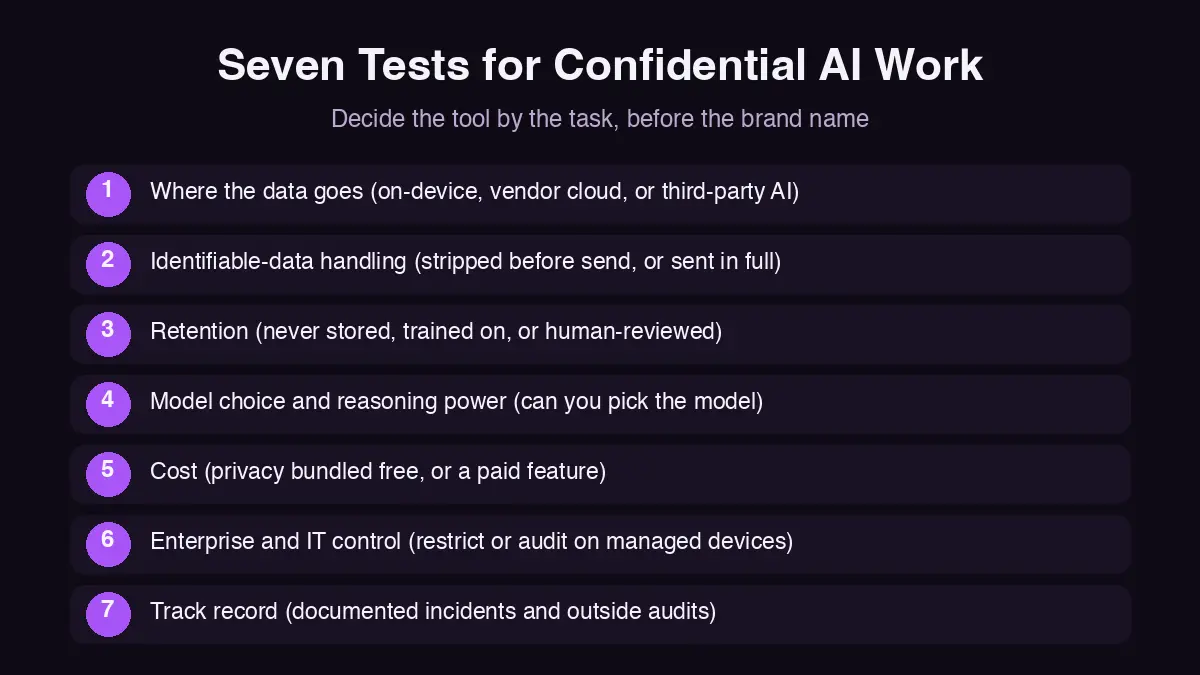
Seven tests decide whether any AI tool is safe for privileged or regulated work. They come before brand names, because the wrong tool on the right task is still a leak.
- Private AI is a spectrum, not a badge: fully local (nothing leaves), confidential cloud inference (data leaves but is protected on the server), and ordinary cloud AI (data leaves in full).
- Where the data goes: for a given task, does the text stay on-device, reach a vendor cloud server, or reach a third-party AI company. End-to-end encryption on the network does not answer this, because the model still has to read the text.
- Identifiable-data handling: whether names, emails, and IDs are stripped before any cloud model sees the text, or sent in full.
- Retention: whether data is never stored, never trained on, and never seen by a human reviewer, and how that is checked.
- Model choice and reasoning power: Apple's own models versus ChatGPT versus Claude, Gemini, or Grok, and whether you can pick. Privacy and capability are separate axes.
- Cost: whether privacy is bundled free or a paid feature.
- Enterprise and IT control: whether a firm can restrict or audit use on managed devices.
- Track record: documented incidents and outside audits, not marketing claims.
That last test earns its place. On Hacker News, commenters argued a SOC 3 report is essentially a SOC 2 with the audit details removed, so a privacy claim needs verification, not a logo.
“I don't want OpenAI to have any of my info whatsoever.”
Posted by a user on r/apple
Tests one through three matter because a mistake sticks. NPR reported that an uncaught AI-note error “is now part of the record” and can resurface under subpoena. A survey it cited found about 77% of Americans worried about how AI stores health data.
For a lawyer, doctor, or consultant handling sensitive data, rules like HIPAA, ABA Formal Opinion 512, GDPR, and IRC §7216 make these tests non-optional. With those seven in hand, here is how Apple Intelligence actually behaves.
Apple Intelligence: On-Device First, With a Cloud Fallback
Apple Intelligence is Apple's built-in AI across macOS, iPhone, and iPad, covering Writing Tools, Siri, notification summaries, and Visual Intelligence. It is free with supported Apple silicon hardware, and the complete guide covers the full feature set.
- Models: on June 8, 2026 Apple announced five third-generation foundation models, two that run on-device and three that run on servers.
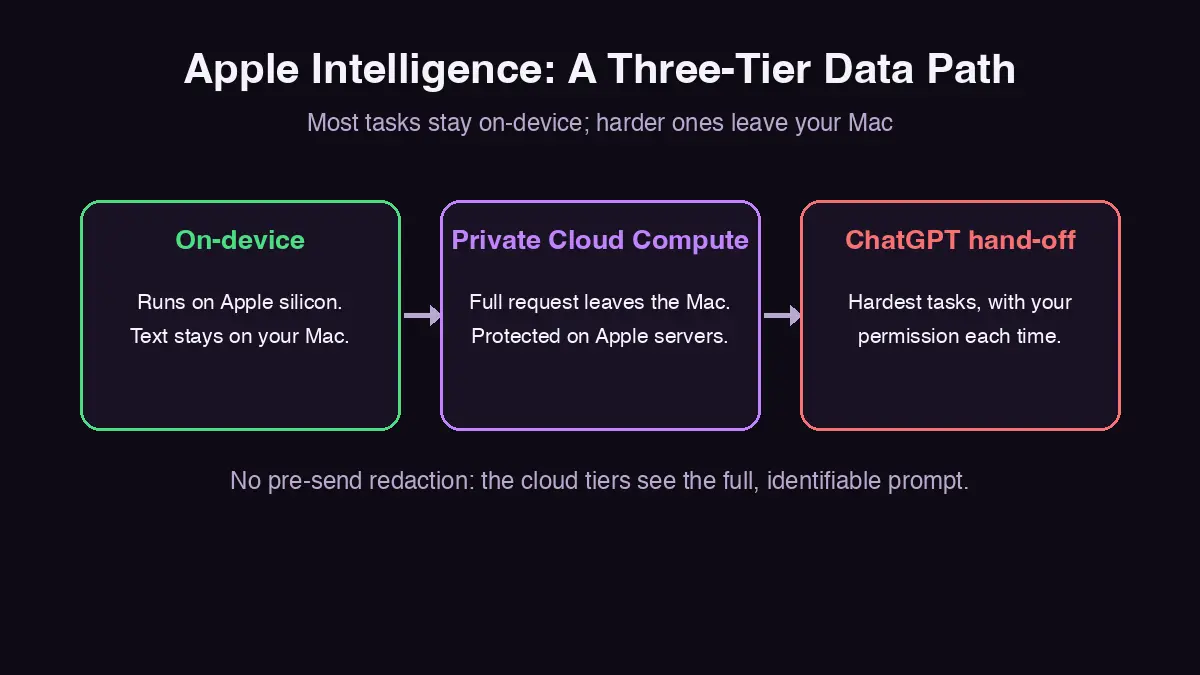
- Where data goes: a three-tier route, on-device model to Private Cloud Compute for harder tasks to optional ChatGPT for the hardest, with a confirmation prompt before the ChatGPT hand-off; the Private Cloud Compute hop happens automatically, with no prompt.
- Identifiable data: no pre-send redaction step; the cloud tier processes the full constructed prompt, so protection is server-side architecture, not stripped identifiers.
- Retention: Apple states the cloud tier deletes user data after the request and keeps nothing after the response, with no general-purpose logging.
- Model choice: Apple's own models plus optional ChatGPT only; no native Claude, Gemini, or Grok, and the best on-device reasoning needs the newest chips.
- Enterprise control: per-feature restriction keys on supervised devices only; iOS and macOS 26.4 widened org controls, but on-device-only enforcement is listed only for dictation and translation.
- Track record: Apple publishes Private Cloud Compute source images and four SOC 3 audit reports, more transparency than most cloud AI offers.
- Reach: on June 8, 2026 Apple also expanded Private Cloud Compute onto NVIDIA GPUs in Google Cloud, widening the third-party dependency a risk review must cover.
- Routing visibility: routing happened in the background, with no indicator before the send and no general local-only switch.
A 2026 WiSec study reverse-engineered Apple Intelligence on macOS and found that about half of the tasks it tested used the cloud tier, including document and email summaries, Smart Reply, lists, and tables.
Apple's record is not spotless either. It agreed to a $250 million settlement over exaggerated Siri AI marketing, a reminder that shipped features have lagged the promises.
“If you gave an excellent team a huge pile of money and told them to build the best ‘private’ cloud in the world, it would probably look like this.”
Johns Hopkins cryptographer Matthew Green
On-device processing is “one of the main selling points of Apple Intelligence,” yet it also means “the models that can be used aren't that good.”
Posted by a user on r/ChatGPT
For everyday drafting it is great, genuinely strong privacy engineering. The qualifier for confidential work is simple: on cloud-escalated tasks the full request still leaves the device, and Apple states full end-to-end encryption is not possible during server-side inference.
What Private Cloud Compute Actually Does, and What It Can't Guarantee
Private Cloud Compute rests on five stated rules: stateless processing, enforceable guarantees, no privileged runtime access, non-targetability, and verifiable transparency. Before your device releases an encryption key, it checks the server node's attestation against a public, append-only log, so the request only runs on software Apple has published for inspection.
- The honest limit is physical: a node must decrypt your request to process it, so full end-to-end encryption cannot hold during inference.
- You can only confirm routing after the fact, through the Apple Intelligence Report, which exports the last 15 minutes or 7 days of on-device and Private Cloud Compute activity.
- For Apple Intelligence privacy in regulated work, after-the-fact logging is not the same as blocking a send before it happens.
That is a hybrid system working to protect a cloud hop, not to avoid it. Which everyday tasks actually trigger it? Independent testing has now mapped that.
Which Apple Intelligence Tasks Actually Leave Your Mac?
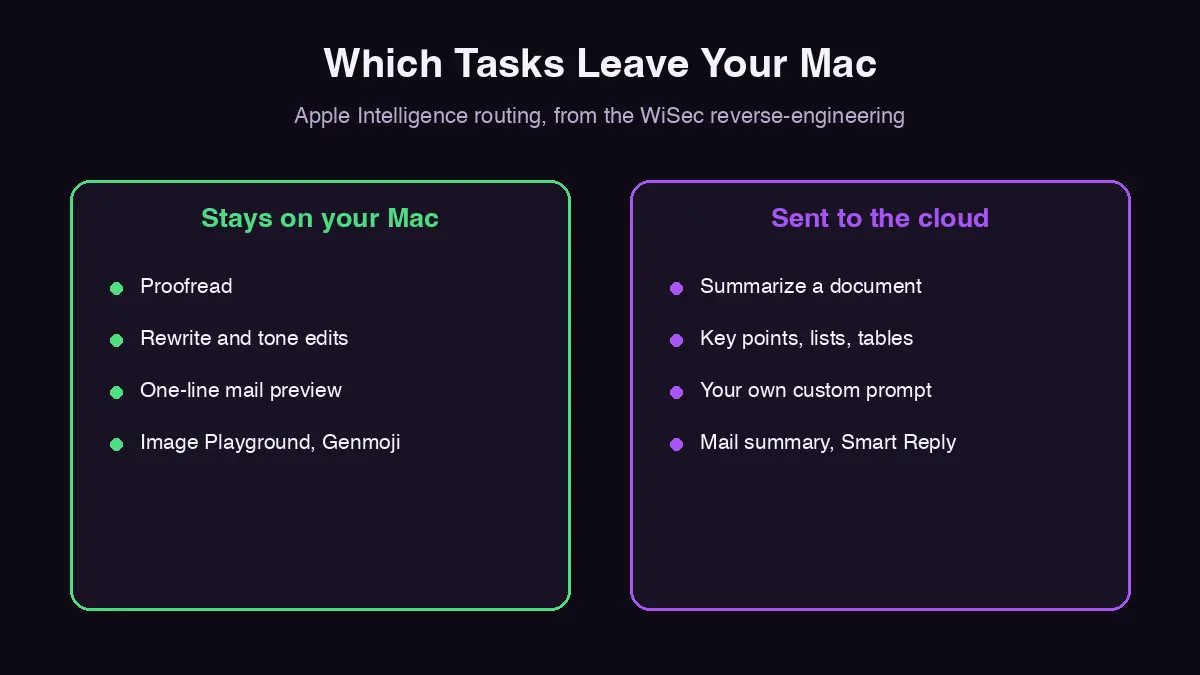
The WiSec study reverse-engineered Apple Intelligence on macOS to see which built-in tasks stay on-device and which call Private Cloud Compute. The team watched the on-device routing daemon fire per request instead of trusting Apple's labels. About half of the tasks they tested reached the cloud.
The split is not intuitive. Quick edits stay local, while anything that has to read a whole document tends to escalate.
| Task | Where it runs |
|---|---|
| Proofread | On-device |
| Rewrite, or tone edits (Friendly, Professional, Concise) | On-device |
| Mail one-line preview summary | On-device |
| Image Playground, Genmoji, Photo Cleanup | On-device |
| Summarize a document | Private Cloud Compute |
| Create Key Points | Private Cloud Compute |
| Make List | Private Cloud Compute |
| Make Table | Private Cloud Compute |
| Custom prompt (your own instruction) | Private Cloud Compute |
| Mail full Summarize and Smart Reply | Private Cloud Compute |
For confidential work the pattern matters more than any single row. The moment you ask Apple Intelligence to read and condense a real document, the full text is what leaves your Mac, with no on-screen signal before it goes.
One reason the local tier stays limited: Apple's own research shows the on-device model runs about 3 billion parameters, the smallest of its 2026 tiers, with only internal preference win-rates published, not frontier benchmarks. The heavier reasoning lives in the cloud, where a hard, confidential task gets routed.
Elephas and the Private AI Path: Redact Before Anything Leaves Your Mac
Elephas is a privacy-friendly AI knowledge assistant for Mac that turns your own documents, notes, and PDFs into a searchable AI brain and strips identifiers on your Mac before any cloud model sees your text.
On its own numbers, Elephas reports the workflow saves users 5 to 10 hours a week on information tasks, a vendor figure rather than an independent study, but a sign of the time cost it targets.
The sequence is the whole point: local Mac, then redact, then cloud AI, then the answer comes back and is reassembled locally. You choose per task whether a request stays fully local and offline on the Mac, or goes to a cloud model after redaction. There is no forced hop.
How Elephas protects a prompt before it reaches the cloud
For researchers who still want a leading cloud model, Elephas adds a second layer through automatic PII redaction. Before a prompt is sent to ChatGPT 5.5, Claude Opus 4.8, Gemini, Grok, Perplexity, or any other cloud model, Elephas strips sensitive names, emails, phone numbers, and identifiers on your Mac.
The cloud model only ever sees the sanitized text, and when the answer comes back the redacted fields are reassembled locally, so identifiable information never leaves the device. Elephas pairs this with zero data retention: content never trains AI models, never sits on a vendor's server, and never passes through a third-party reviewer's screen.
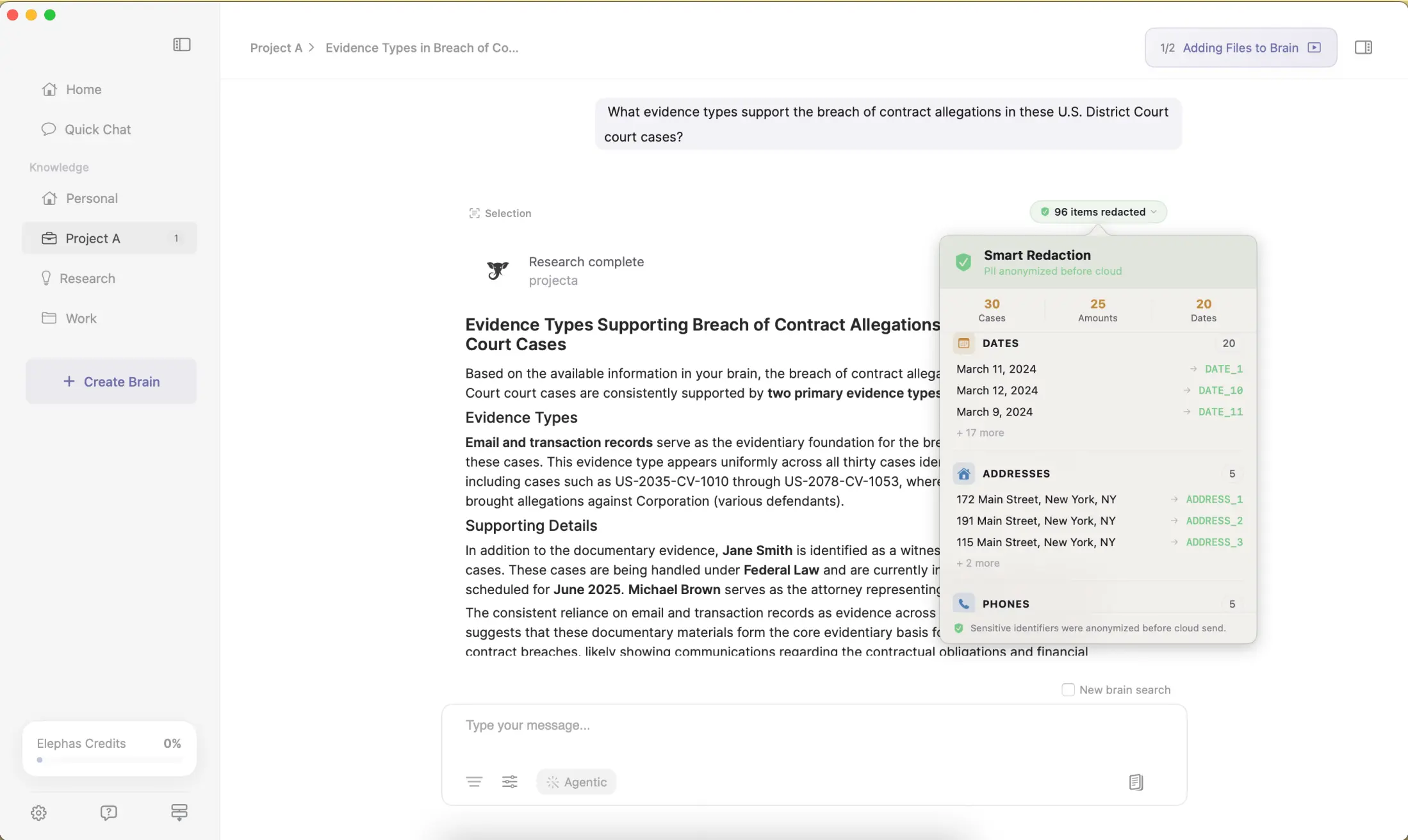
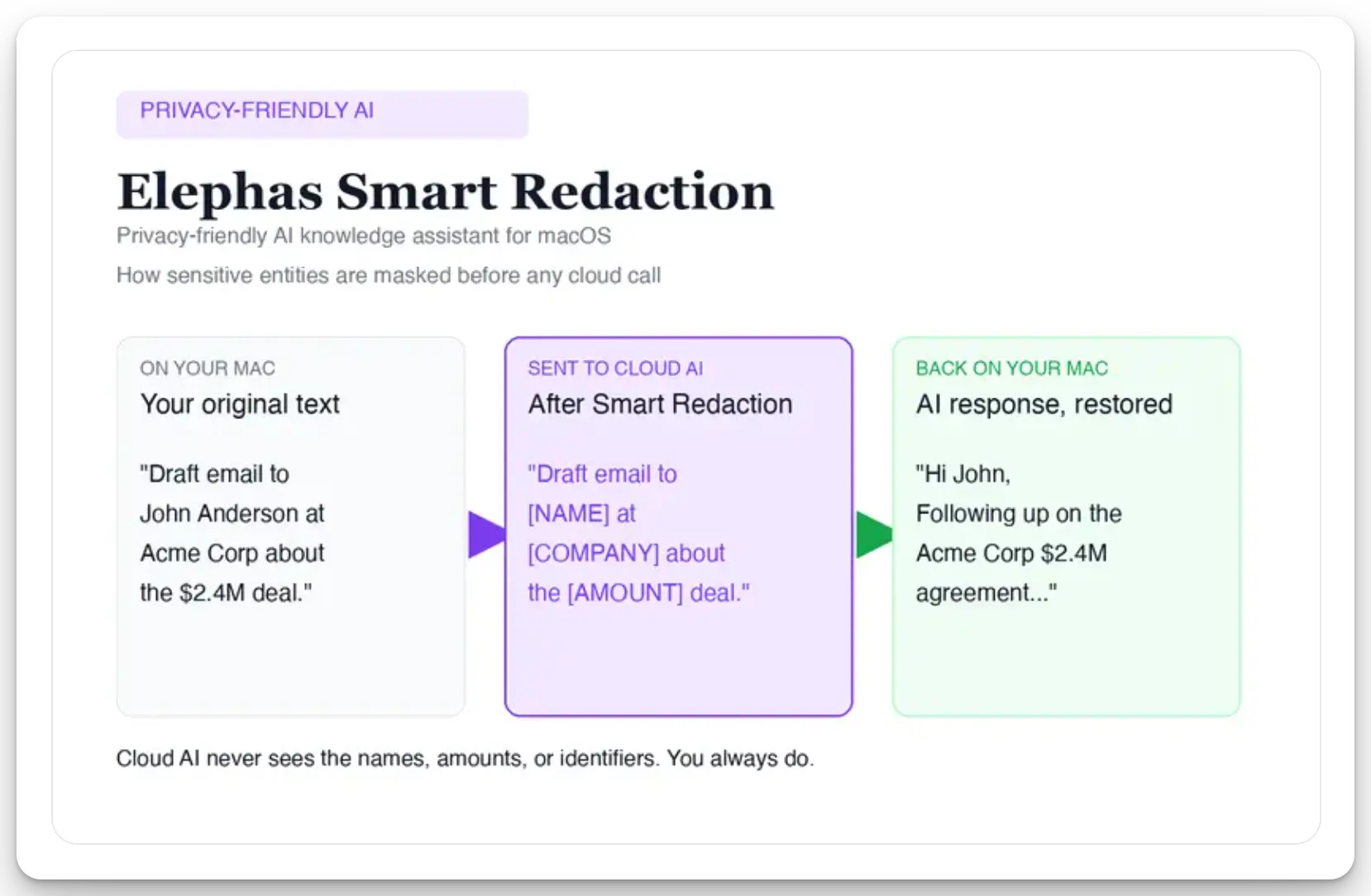
- Identifiable data: automatic PII redaction (beta) runs on every plan, including Free, so the identifiers come out before the hop, not after.
- Model choice: pick ChatGPT 5.5, Claude Opus 4.8, Gemini, Grok, Perplexity, or built-in local LLM models for fully offline work on the Mac, with no vendor lock-in.
- Retention: all three guarantees stated together, no training on your content, no vendor storage, no third-party reviewer.
- Cost: a free plan, with paid plans from $19/month.
- Honest limits: no enterprise or MDM control is documented, and the redaction engine itself has no outside audit.
- Why local matters: on-device models are best for data that cannot leave the machine at all, as one professional describes below.
- Compatibility: runs on macOS 13+, iOS 16+, and iPadOS 16+, keeps files on the Mac by default, and pairs with your existing cloud model instead of replacing it.
“I do not want to use cloud AI (claude, Chatgpt, grok) to crawl my servers and help me figure out whats going on under the hood. With an LLM on my hardware I can copy information off my local servers, tuck it in a safe location and let the local agent crawl it.”
Posted by a user on r/macbookpro
Redaction is not magic, and the honest limit is worth stating. Automatic PII detection removes names, emails, phone numbers, and IDs, but a quasi-identifier like a rare job title plus a city can still hint at a person, and a sentence's context can carry meaning after the name is gone. For the highest-stakes files, the safer setting is the fully local model, where nothing leaves at all.
- Apple does some things a dedicated app cannot: Apple Intelligence is embedded system-wide inside Mail, Notes, and Pages, and its cloud is externally checked through SOC 3 reports and published Private Cloud Compute images.
- A third-party tool cannot match that OS-level reach or that specific outside audit; put the two side by side against all seven tests and the trade-offs get concrete.
Which Tool Wins Each of the Seven Tests
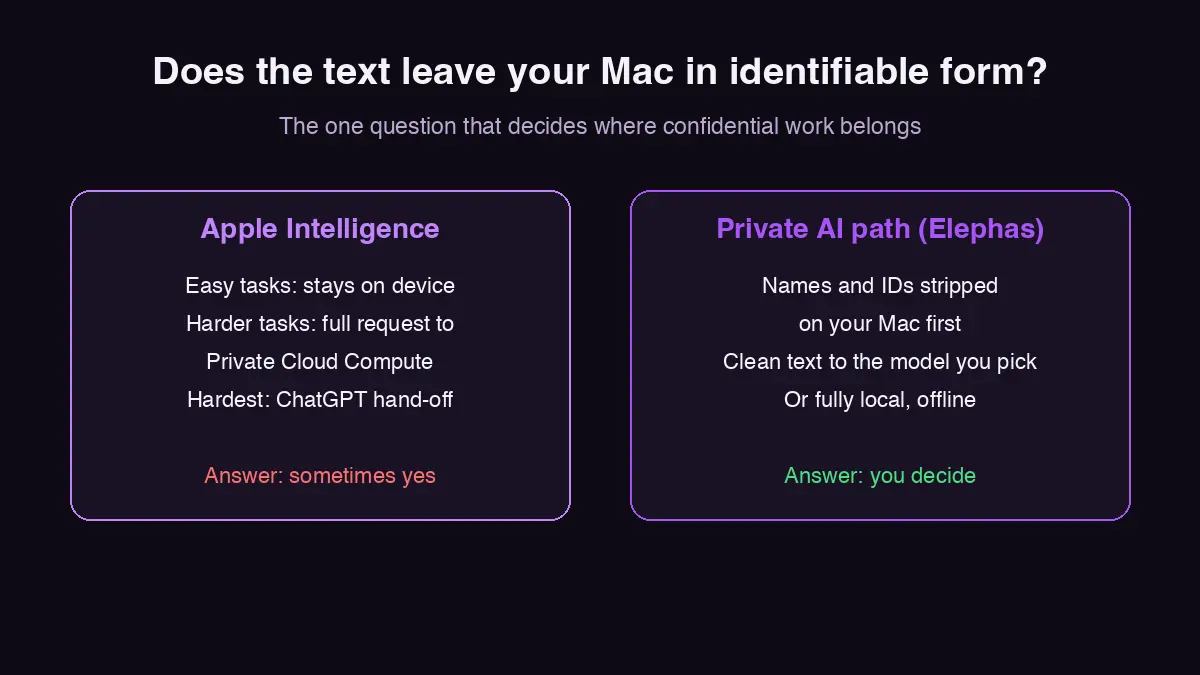
Both tools clear a bar most cloud chatbots do not. The table shows where they diverge on the tests that decide confidential work.
| Criterion | Apple Intelligence | Elephas |
|---|---|---|
| Where data goes | Mostly on-device; escalates the full request to Private Cloud Compute, then optionally to ChatGPT with permission | Local Mac, redact, cloud AI, reassemble locally, or fully offline on the Mac |
| Identifiable-data handling | No redaction step; protection is server-side architecture only | Automatic PII redaction before any cloud model sees the text, every plan including Free |
| Retention | No user data kept after the Private Cloud Compute response; no general logging | Zero retention: no training, no vendor storage, no third-party reviewer |
| Model choice | Apple's own models plus optional ChatGPT; no Claude, Gemini, or Grok | ChatGPT 5.5, Claude Opus 4.8, Gemini, Grok, Perplexity, or offline local LLM |
| Cost | Free, bundled with supported hardware and OS | Free plan; paid from $19/month |
| Enterprise/IT control | Per-feature keys on supervised devices only; no master switch | Not documented; user-level control only |
| Track record | SOC 3 audits and source transparency; also a notification-accuracy incident and a $250M Siri settlement | Mac-native app; no independent redaction audit |
Apple wins clearly on cost, zero setup, system-wide reach, and an externally audited cloud. For everyday drafting nothing is easier. Even so, its strongest tier has been probed: an RSAC lab hijacked the on-device model in 76% of prompt-injection trials before a patch.
- Weaker on enterprise control: Trio documented (2026-05-07) that several features “currently cannot be blocked via MDM,” so a firm cannot fully switch it off on managed devices.
- The optional ChatGPT hand-off draws the sharpest unease among professionals handling client data.
- The private path wins on the two tests confidential work turns on: redact-before-send and a fully local option answer the framing question with “you decide,” and you keep frontier model choice without lock-in.
“I don't trust OpenAI and I really hate that it feels like Apple is forcing me to send my requests to them through integration into the OS.”
Posted by a user on r/apple
The track record, dated
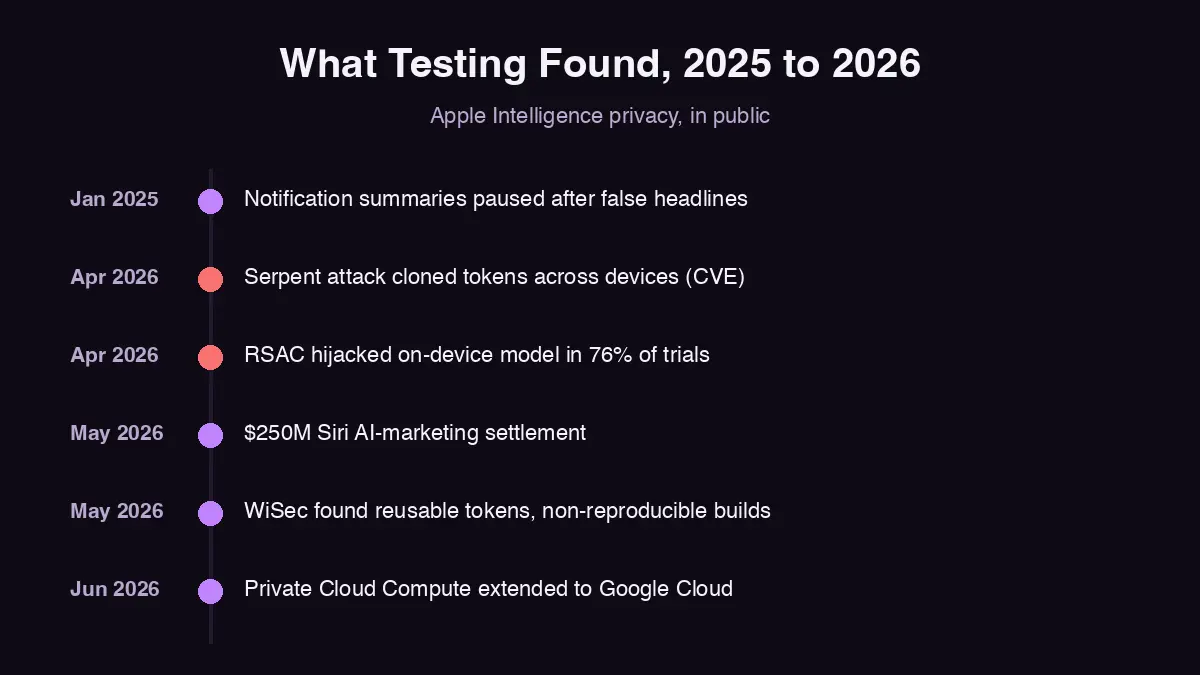
Independent research, not slogans, fills the last row. The WiSec team confirmed Private Cloud Compute is state-independent as Apple promised, then documented the softer spots. Put in order, the outside testing reads as a short, dated ledger.
| Date | What happened | Source |
|---|---|---|
| Jan 2025 | Apple paused AI notification summaries after false headlines, including a fabricated BBC alert | TechCrunch |
| Apr 2026 | The “Serpent” attack cloned Apple Intelligence tokens across devices (CVE-2025-43509); mitigated, not fully fixed, in macOS 26.2 | arXiv |
| Apr 2026 | RSAC researchers hijacked the on-device model in 76% of prompt-injection trials; patched in 26.4 | RSAC |
| May 2026 | Apple settled Siri AI-marketing claims for $250 million, up to $95 per device | TechCrunch |
| May 2026 | The WiSec team found reusable one-time tokens and non-reproducible PCC builds | arXiv |
| Jun 2026 | Apple extended Private Cloud Compute onto NVIDIA GPUs in Google Cloud | Apple |
One detail sits underneath all of it. Apple's own SOC 3 report states the audit “does not express an opinion or any other form of assurance about Apple's artificial intelligence services.”
That report covers the provisioning and protection of the compute nodes, not the model doing the work, so the strongest external check stops short of the AI itself.
None of this makes Apple Intelligence unsafe for everyday use. It shows the privacy story is still being tested in public, which is the honest reason to route only non-identifying work through it. For regulated work, that runs straight into a compliance question.
Which Rules Does Each Data Path Put at Risk?
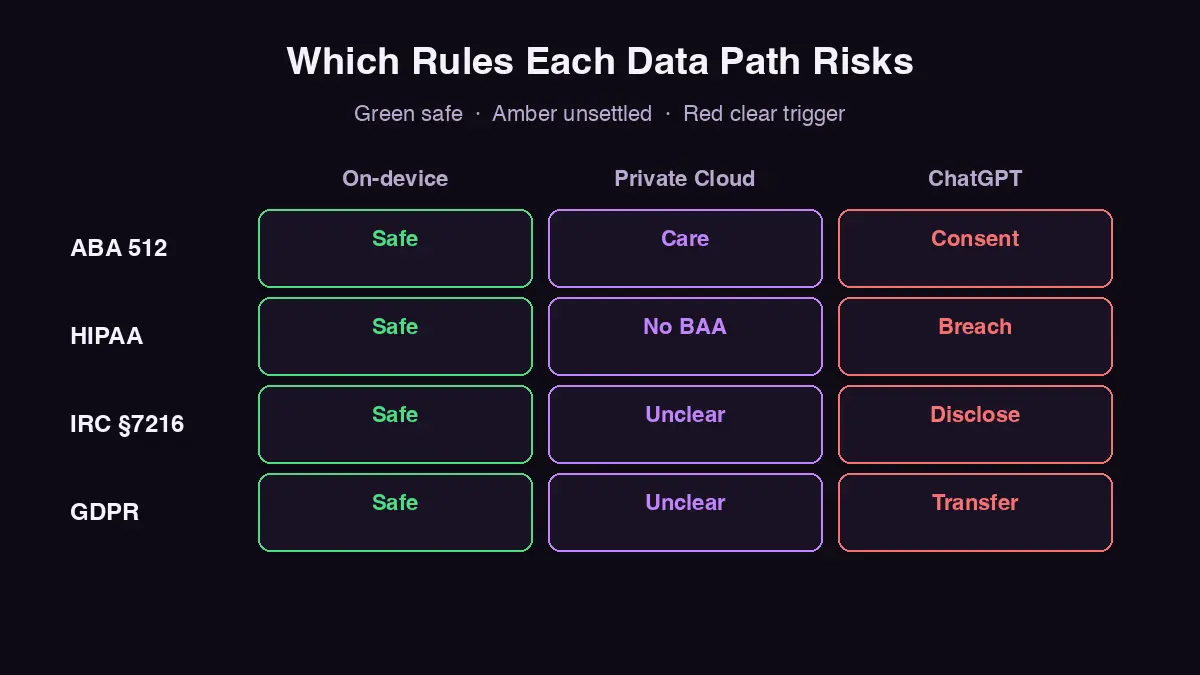
Regulated work turns the routing question into a compliance question. No regulator has named Apple Intelligence yet, so the mapping below reads each rule against the three data paths and flags where it is genuinely unsettled.
| Rule | On-device | Private Cloud Compute | ChatGPT hand-off |
|---|---|---|---|
| ABA Opinion 512, lawyers | No disclosure | Data leaves firm custody | Consent required |
| HIPAA, health | No BAA needed | No public BAA offered | Cannot get a BAA |
| IRC §7216, tax | Not a disclosure | Unsettled, no guidance | Disclosure; needs consent |
| GDPR, EU data | No transfer | Transfer basis unclear | Processor terms required |
Read it down the columns. On-device work is the safe default under every rule, the optional ChatGPT hand-off trips all four, and Private Cloud Compute is the grey column, protected by Apple but addressed by no regulator, which is exactly what a compliance officer cannot sign off.
- ABA Opinion 512 (July 2024): evaluate the disclosure risk and get informed client consent before putting client data into a self-learning third-party tool.
- HIPAA: a Business Associate Agreement is required before protected health information reaches a third party, and OpenAI does not sign one for consumer ChatGPT.
- IRC §7216: disclosing a client's tax data to a third party without specific signed consent is a criminal violation.
- GDPR: EU personal data needs a lawful transfer basis before it leaves for a service outside the EEA.
For any of these, the routing rule and the compliance rule point the same way: keep identifying work off the cloud paths.
Which Should You Pick
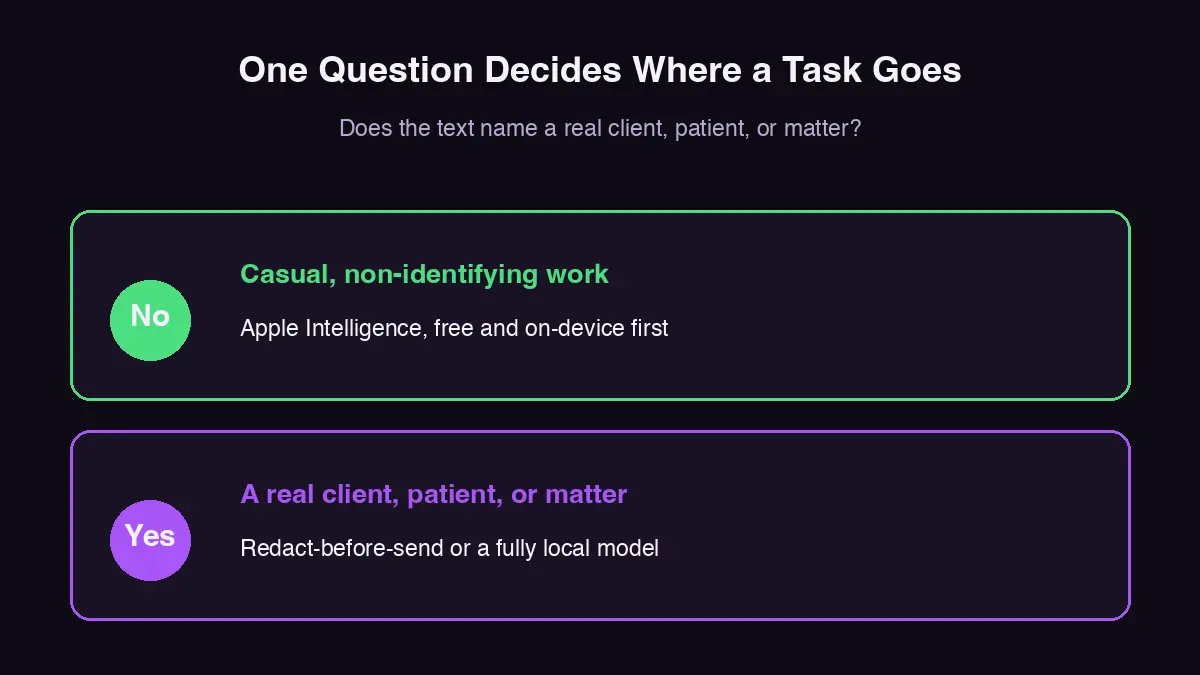
The rule is short: keep Apple Intelligence for casual, non-identifying work, and switch to a redact-before-send or fully local path the moment a task names a real client. Cost is not the deciding factor, since Apple Intelligence is free on your Mac and Elephas has a free plan too.
- Starting fresh: use both, split by task.
- Already on Apple Intelligence: add the private path for identifying work only.
- Handling privileged or regulated files: default to the private path.
One test decides between them: whether you can run a top-tier model like GPT-5.5 or Claude Opus without losing control of what leaves your machine. Apple gives you its own models plus a single ChatGPT hand-off, while a redact-before-send tool strips identifiers first, then sends clean text to the model you pick.
That gap is why “Apple can't see it” is a different promise. When Apple escalates a task to the cloud, the full request still leaves your Mac; Apple protects it on the server but does not remove the names first. Redact-before-send takes the identifiers out before the hop, so nothing identifying is left to protect.
A MacRumors user (2026-07-23) asked for exactly that: “something local and actually private.” Control is also per-request, not per-policy.
- On r/apple, one commenter noted “you have to specifically allow to send to ChatGPT each and every time it requests,” which helps a careful user but hands IT no master switch. SimpleMDM noted (2025) Apple's cloud has no enterprise audit or SIEM layer for confidentiality-bound work.
Apple still wins two honest cases. A task that runs purely on-device and never leaves beats any cloud hop, including a redacted one. Its cloud also carries an outside SOC 3 audit that Elephas's redaction engine does not, so on external verification Apple is ahead. Neither flips the rule for client-identifying work.
“Apple intelligence is ran on device. To expect remote level AI is nonsense.”
Posted by a user on r/ChatGPT
Switching is cheap and reversible: setup runs from about 15 minutes to a couple of hours, and Apple Intelligence stays installed, so backing out costs almost nothing. Keep it for everyday edits where its system-wide reach saves time, and route anything client-identifying to a redact-before-send or fully local path.
The Verdict: Route the Task, Not the Tool
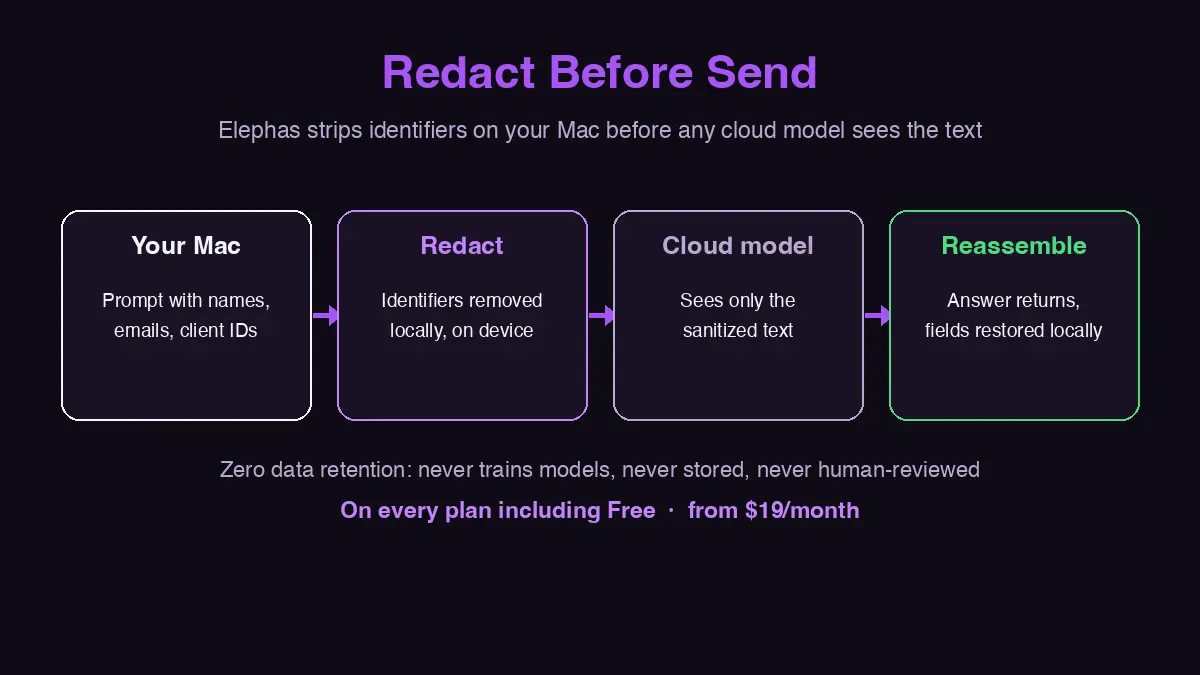
Everyday drafting is fine on Apple Intelligence; regulated, privileged, or client-identifying work belongs on a redact-before-send or fully local path. The decision is about the task in front of you, not a permanent loyalty to one tool.
It lands in the same place whatever you use today. Apple Intelligence handles casual, non-identifying work; the private path handles client files. On-device-only comes close to fully private, but cloud escalation is the gap that decides confidential tasks.
Give Apple its due. Apple Intelligence wins clearly on cost, zero setup, system-wide OS integration, and an externally audited cloud. For non-identifying, everyday work it is the better pick, and there is no need to add anything.
- The naming still confuses people about what runs where: one user on r/apple put it plainly, saying if Apple Intelligence ran “exclusively on device and no cloud computing is involved I would understand it.”
- Everyday, non-identifying drafting: Apple Intelligence, free and on-device first.
- A task that escalates to Private Cloud Compute: know the full request leaves your Mac.
- A ChatGPT hand-off: different privacy terms; opt in deliberately.
- Regulated, privileged, or client-identifying work: keep it on a redact-before-send or fully local path.
- For that confidential path, Elephas is a privacy-friendly AI knowledge assistant with redact-before-send on every plan including Free, plus built-in local LLM models, from $19/month.
Sensitive data is automatically detected and redacted before anything reaches a cloud AI model, your content is never used to train AI models, and nothing passes through a third-party reviewer's screen.
Smart Redaction runs on every Elephas plan, including the Free tier. Elephas has a free plan and starts at $19/month, with a Try Elephas free option if you want to test the redaction step on your own prompts first.
Frequently Asked Questions
Is Apple Intelligence fully private for confidential work?
Not entirely. Most tasks run on-device, but harder ones send the full request to Private Cloud Compute, and the hardest can go to ChatGPT with permission. Apple protects the cloud step well, yet the text still leaves your Mac in identifiable form on those tasks.
Does Apple's AI send my data to ChatGPT?
Only when you allow it. The ChatGPT extension is off by default and asks before each hand-off. Without an account, OpenAI must not store or train on the request except where law requires it. Once you sign in, your OpenAI account settings apply and prompts may be logged.
What is the difference between Private Cloud Compute and redact-before-send?
Private Cloud Compute sends the full, identifiable request and protects it in the cloud with attested hardware and no retention. Redact-before-send removes names, emails, and IDs on your Mac first, so the cloud model never sees who the text is about. One protects the data; the other removes the identity.
Can my IT team block Apple Intelligence on managed devices?
Not completely. Trio documented that there is no single key to disable everything, and several features cannot be blocked via MDM. Restriction keys apply to supervised devices per feature, and new features often ship switched on until a new key arrives.
Is a private AI tool like Elephas audited the way Apple's cloud is?
Not in the same way. Apple publishes Private Cloud Compute source images and four SOC 3 audit reports for its cloud. Elephas keeps data on your Mac and redacts before sending, but its redaction engine has no equivalent outside audit, which is a fair point to weigh for high-stakes work.
Which is cheaper, Apple's AI or Elephas?
Apple Intelligence is free with supported Apple hardware and needs no subscription. Elephas has a free plan too, with paid plans from $19/month. For casual work Apple costs nothing; the private tool's cost buys redact-before-send and model choice for confidential tasks.
Try Elephas free on your Mac
The Mac-native privacy-friendly AI knowledge assistant: on-device Smart Redaction, built-in local LLM models, and the flexibility to pair ChatGPT, Claude, or any cloud model with a privacy layer that runs on hardware you own.
Get Elephas →