OpenAI Election War Room Brings Hundreds of Staff Together
OpenAI has opened an election war room for the US midterms, Politico reported on 28 October. The company calls it an Election Operations Center. It opened less than a week before the 3 November general election.
This matters because a growing number of Americans now turn to chatbots for polling information. Below, we set out what the center is meant to do, what OpenAI’s published rules cover, and what the reports leave open.
We also cover the two foreign operations OpenAI removed in October, the key dates, and where to check voting information.
Executive Summary
- Reports citing Politico say that OpenAI’s Election Operations Center has staffing in the hundreds and is led by Josh Lawson.
- The center opened in the week of 28 October and is due to run until every vote is counted.
- OpenAI said on 8 October that it had banned a Russia-origin and an Iran-origin influence operation.
- Its policies ban election interference, political campaigning and activity meant to put people off voting.
- State and local election offices remain the place to check voting rules and certified results.
The OpenAI election war room brings teams together under Josh Lawson
AI Weekly, citing Politico, reports that OpenAI’s Election Operations Center brings together staff from several teams, with staffing “in the hundreds.”
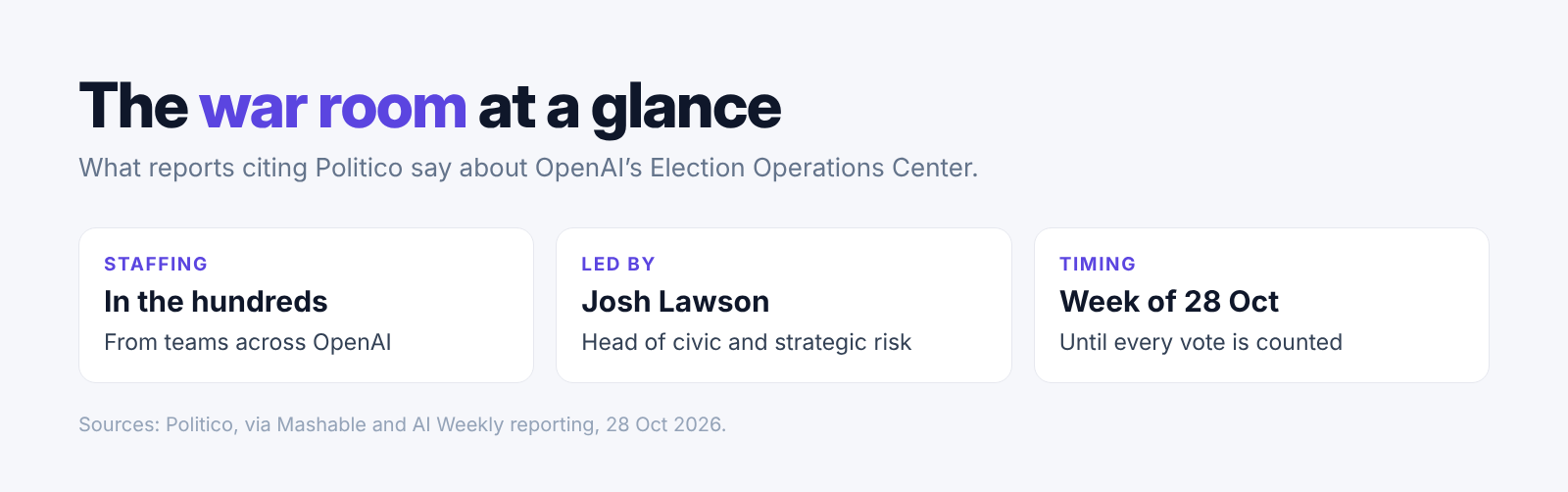
Josh Lawson, OpenAI’s head of civic and strategic risk, leads the center. Mashable’s report says its task is to watch ChatGPT’s role around the election and spot misuse of OpenAI’s AI models. AI Weekly adds that the work covers real-time abuse of ChatGPT and reports of unexpected model behavior.
Lawson told Politico the center brings “our teams together to respond quickly to emerging issues and enforce our policies as people head to the polls.” It opened in the week of 28 October. It is due to run until every vote is counted. Politico’s story was the first to report it.
Reports describe its work as watching OpenAI’s own tools. OpenAI’s election safeguards post says, “Election officials remain the authority on voting rules and certified results.”
- Mashable reports that a select group of OpenAI staff will spend election day itself in the war room.
- Mashable notes that Microsoft and Meta have also put resources into election integrity in recent years.
- During the 2024 election, a group of tech companies pledged to work together against election deepfakes [realistic fake images, audio or video], Mashable notes.
- Mashable says Lawson gave his statement to Decoded by Politico.
OpenAI says it removed Russia and Iran false fronts this month
On 8 October, OpenAI said it had banned two influence operations, one from Russia and one from Iran.
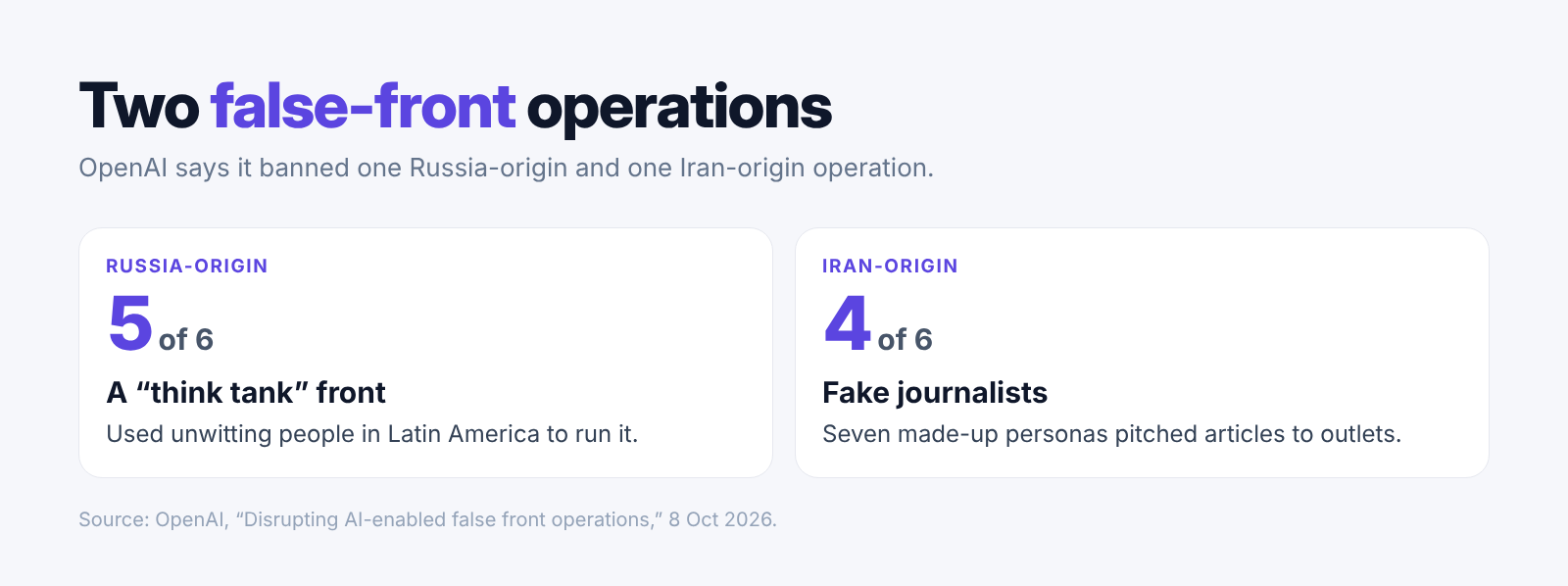
OpenAI calls both cases covert influence operations [organized efforts to sway what people think while hiding who is behind them]. Each used a false front [a group, outlet or person that looks independent but hides its real backer].
In its false-front report, OpenAI said the Russian operation appears to have used unwitting people in Latin America to run a “think tank.” The Iranian operation used seven fake journalist identities. It pitched long articles to smaller outlets around the world.
OpenAI rated the Russian operation Category 5 out of 6 and the Iranian one Category 4. It said the Russian case was the first Category 5 operation it had disrupted since it began reporting such cases. We covered an earlier OpenAI security story in our report on the ChatGPT hack.
- The rating scale is called the IO Breakout Scale, where 1 is the lowest level and 6 the highest.
- OpenAI says the operators used ChatGPT to write internal reports and to create content.
- They also used it to draft reports on a self-described research platform in Latin America called the Social Research Center.
- OpenAI says it shared information on the case with the relevant authorities.
- OpenAI’s post describes the operations’ tactics, reach and impact.
OpenAI says it watches for misuse and gives voting information
OpenAI says its 2026 election plan covers policy abuse, deception about AI-made content, and voting information in ChatGPT.
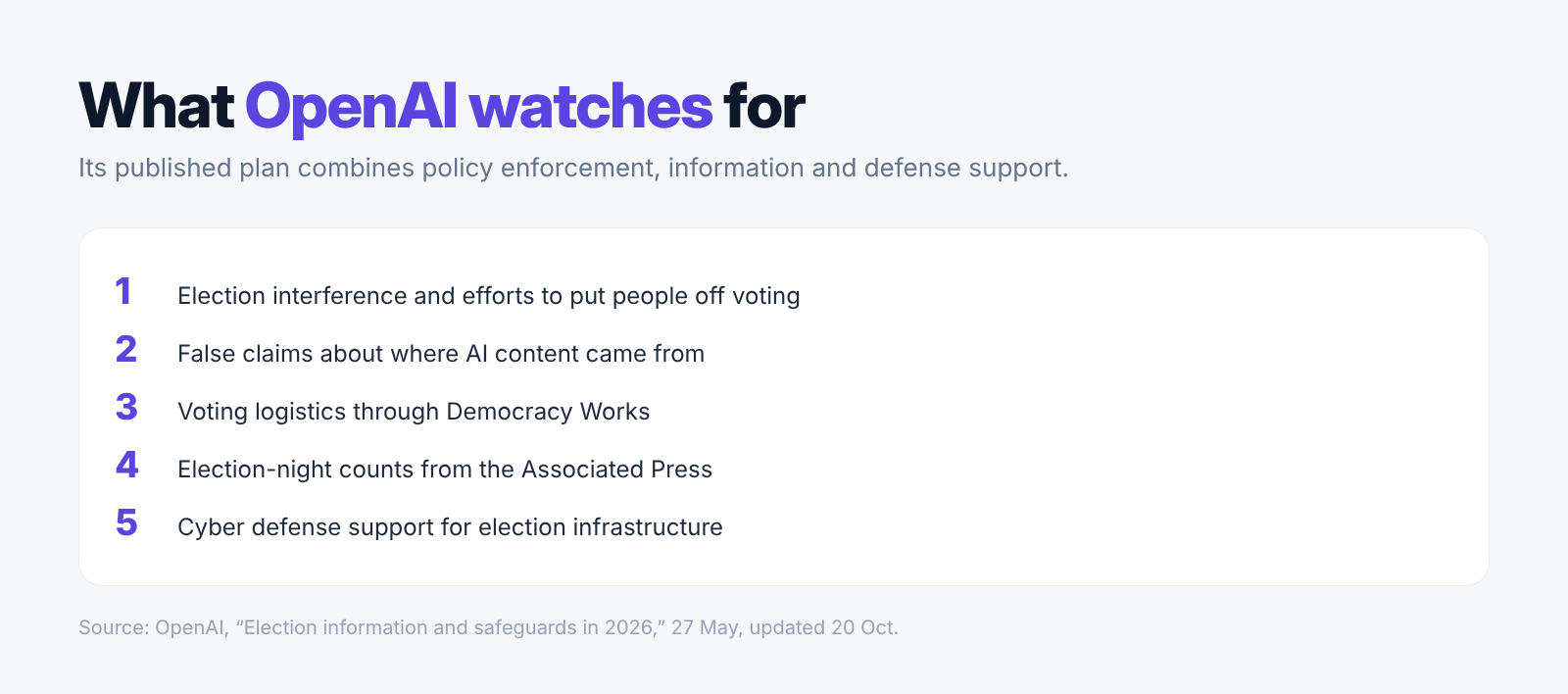
Its election safeguards post says ChatGPT shows Democracy Works information on registration, deadlines and voting locations. It also says an Associated Press link brings live vote counts into ChatGPT after polls close.
OpenAI says it enforces rules against election interference, efforts to put people off voting, and deception about where AI-made material came from. Provenance [information about where content came from or how it was changed] can help, but OpenAI says it is not a complete answer to deception.
The post also describes a program called Daybreak. It gives voting-system makers registered with the Election Assistance Commission, and state election authorities, free access to models for cyber defense.
| What OpenAI says it watches for or provides | What it says it does |
|---|---|
| Election interference and attempts to stop voting | Restricts or ends access when it finds abuse. |
| Deception about AI-made content | Uses provenance tools and policy enforcement. |
| Registration, deadlines and voting locations | Shows Democracy Works information in ChatGPT. |
| Election-night counts | Shows AP live counts after polls close. |
| Risks to voting systems | Offers some election defenders free cyber-defense model access. |
- OpenAI says political ads cannot run on its platform.
- Its usage policies ban political campaigning and lobbying.
- OpenAI’s help page defines political campaigning as mass campaign messages for or against a candidate, party or ballot measure.
- The Democracy Works information is live in the US across languages.
- AI Weekly reports that OpenAI says ChatGPT turns requests for lifelike election images into cartoon-style pictures, a step OpenAI calls cartoonification. AI Weekly says a one-step follow-up prompt got around it.
OpenAI’s election work began months before the war room
OpenAI published its 2026 election plan on 27 May, five months before Politico reported the war room.
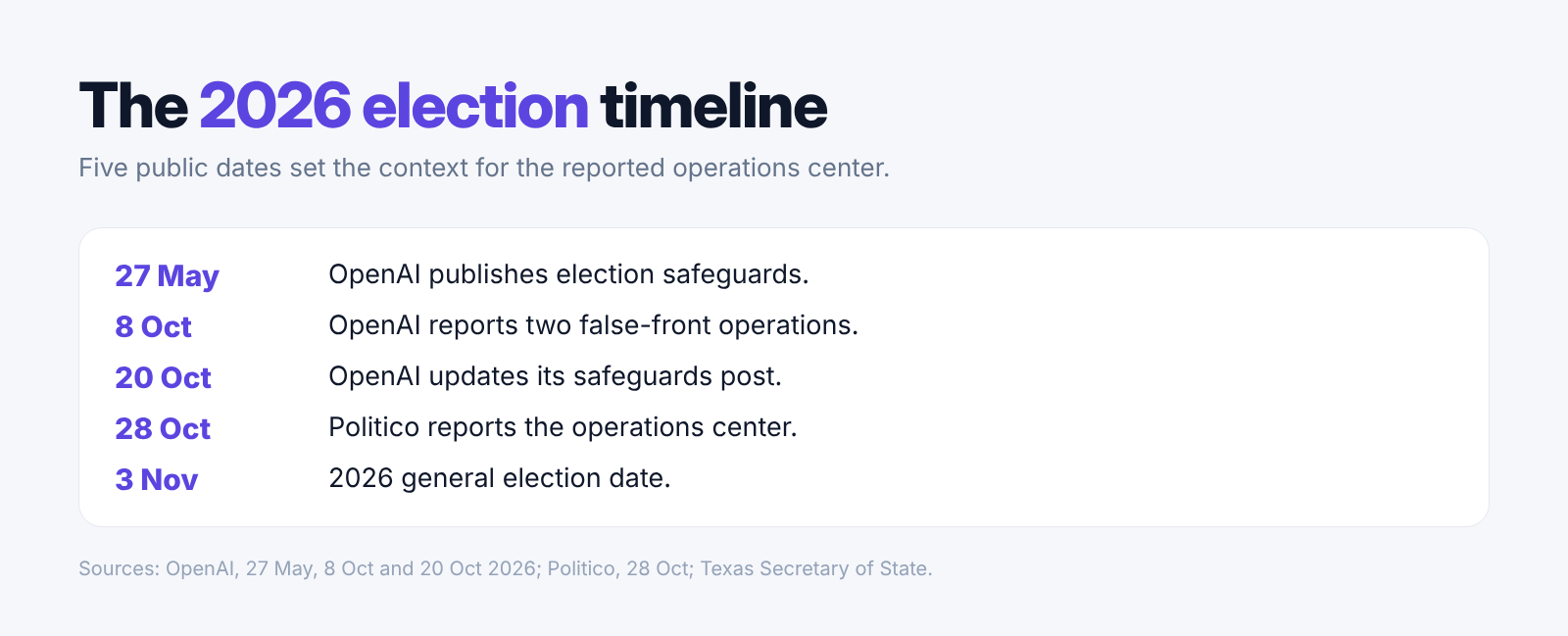
OpenAI updated that post on 20 October, 14 days before the vote. Politico’s story about the war room followed on 28 October.
OpenAI’s public reports on election misuse go back further. In October 2024, it said it had disrupted more than 20 operations and deceptive networks that year. In August 2024, it had described banning Iran-origin STORM-2035 accounts that wrote US and UK election content.
| Date | What happened |
|---|---|
| 16 August 2024 | OpenAI said it banned accounts linked to the Iran-origin STORM-2035 operation. |
| 9 October 2024 | OpenAI said it had disrupted more than 20 operations that year. |
| 27 May 2026 | OpenAI published its 2026 election safeguards post. |
| 20 October 2026 | OpenAI updated its safeguards post. |
| 3 November 2026 | US general election day. |
- In the STORM-2035 case, OpenAI said it saw no evidence the articles were widely shared on social media.
- OpenAI found that campaign’s comments posted by more than a dozen fake personas on X and one on Instagram.
- The AP vote-count feature covers elections in the US and Brazil.
- OpenAI called its October 2024 threat report a snapshot of what it understood at that time.
Official election offices remain the place to check information
State and local election offices are the first place to check a voting date, location, rule or result.
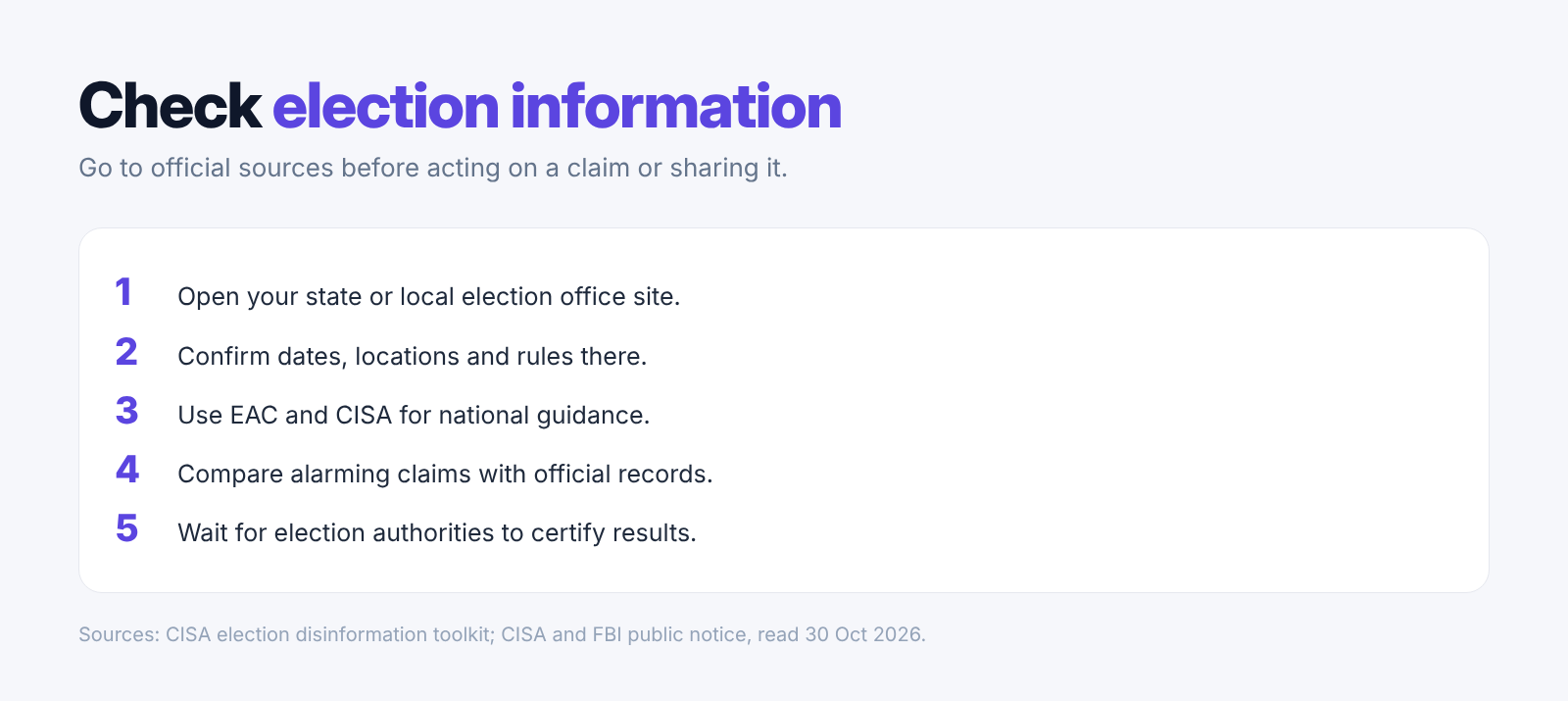
The CISA toolkit lists four reliable sources. They are state election authorities, state and local official election websites, the Election Assistance Commission, and CISA itself. CISA is the US Cybersecurity and Infrastructure Security Agency.
The same goes for voting details you see in a chatbot answer, a text message or a social post. Check them on an official site before you act on them or share them.
- Check your state or local election office first.
- Confirm your registration, location and deadlines there.
- Use the Election Assistance Commission or CISA for national guidance.
- CISA and the FBI advise relying on state and local election officials for questions about election security.
- Many official election office websites use a “.gov” address, which shows they are government sites.
- CISA and the FBI also warn people not to accept claims of election hacking at face value.
- The Election Assistance Commission’s website is eac.gov.
Outside checks give a mixed view of OpenAI’s safeguards
Outside groups have tested how well ChatGPT holds up against fake election images, and their findings point in different directions.
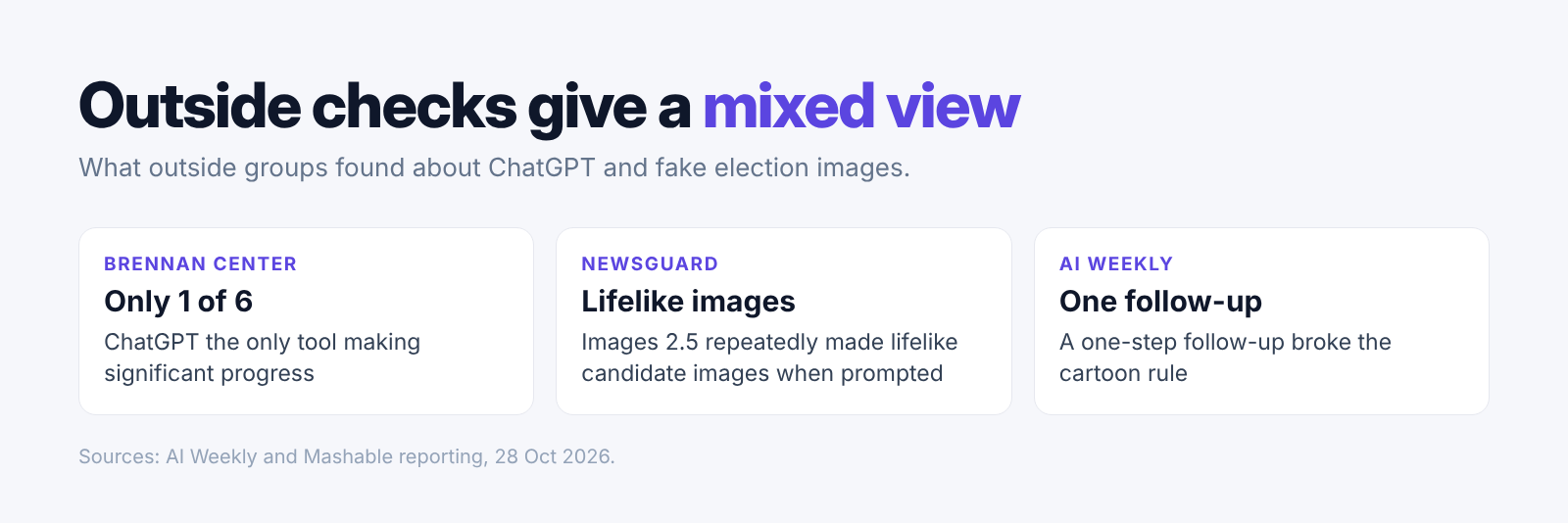
A Brennan Center report found ChatGPT was the only one of six popular AI tools making significant progress against fake election images, AI Weekly reports. Mashable reports that guardrails in Gemini and Meta AI were failing to stop fake election images in the same research.
NewsGuard’s tests found ChatGPT Images 2.5 repeatedly made lifelike images of political candidates when asked, Mashable reports.
AI Weekly argues the war room will be judged on what OpenAI discloses after 3 November, rather than on what it has announced so far.
- Lawson told CNET the cartoon rule aims to “degrade the evidentiary value of an image,” AI Weekly reports.
- NewsGuard says foreign government disinformation campaigns have increased ahead of election day, Mashable reports.
- Mashable says those campaigns were mainly spread on social media platforms like X.
- NewsGuard’s research found that X’s Community Notes failed to identify more than 93 percent of such posts, Mashable reports.
Conclusion
OpenAI’s election war room is a short-term team for the last days of the 2026 midterms. It watches for misuse of OpenAI’s own tools and builds on rules and voting features the company published in May.
Its October ban on two foreign operations shows the kind of abuse OpenAI has reported finding. AI Weekly says the effort will be judged on what OpenAI discloses after 3 November.
For voters, the practical step stays simple. Check voting dates, places and results with your state or local election office.
- The center is due to run until every vote is counted, according to reports citing Politico.
- In ChatGPT, voting information comes from Democracy Works and election-night counts from the AP.
- OpenAI says it restricts or ends access when it finds abuse.
- Outside tests of ChatGPT’s election image safeguards give mixed results.
- Election officials, not ChatGPT, certify the results.