AI Human Control Debate: Why Dario Amodei Called the Free Will Claim Absurd
The AI human control debate broke into the open on November 25, 2026. Axios reported that rival AI leaders are pushing back on a view said to be common inside Anthropic: that people should hand some decisions to superintelligent AI. The same day, CEO Dario Amodei called that reading of his views "absurd".
So who actually wants AI in charge, and who doesn't?
What follows covers the claim, the reply, what both sides leave out, and what it means for you.
Executive Summary
- Axios reported on November 25, 2026 that top AI executives are pushing back on a view, said by its sources to be common inside Anthropic, that humanity should give some decision-making power to superintelligent AI.
- Meta's Alexandr Wang, OpenAI's Sam Altman and OpenAI's Dean Ball have each spoken in November for keeping human control or agency over AI.
- Dario Amodei called the free will claim absurd, wrote that turning governance over to AI is a terrible idea, and said his views on automating specific tasks are mixed.
- Amodei says the AI companies differ little on automating tasks, and a Workday survey shows people already let AI complete whole tasks at work.
- Elephas is a private AI app for your documents that does not act on your behalf, cites the page behind every answer, and hides personal details before a question leaves your computer, and by default answers with Elephas AI, which does not store your question or use it to train AI models.
What Axios Reported in the AI Human Control Debate
The Axios scoop, by reporter Madison Mills, says top AI executives "are increasingly pushing back" against a view inside Anthropic. That view holds that humanity should give up some decision-making power to superintelligent AI. Critics say this would put us on a slippery slope to forfeiting free will.
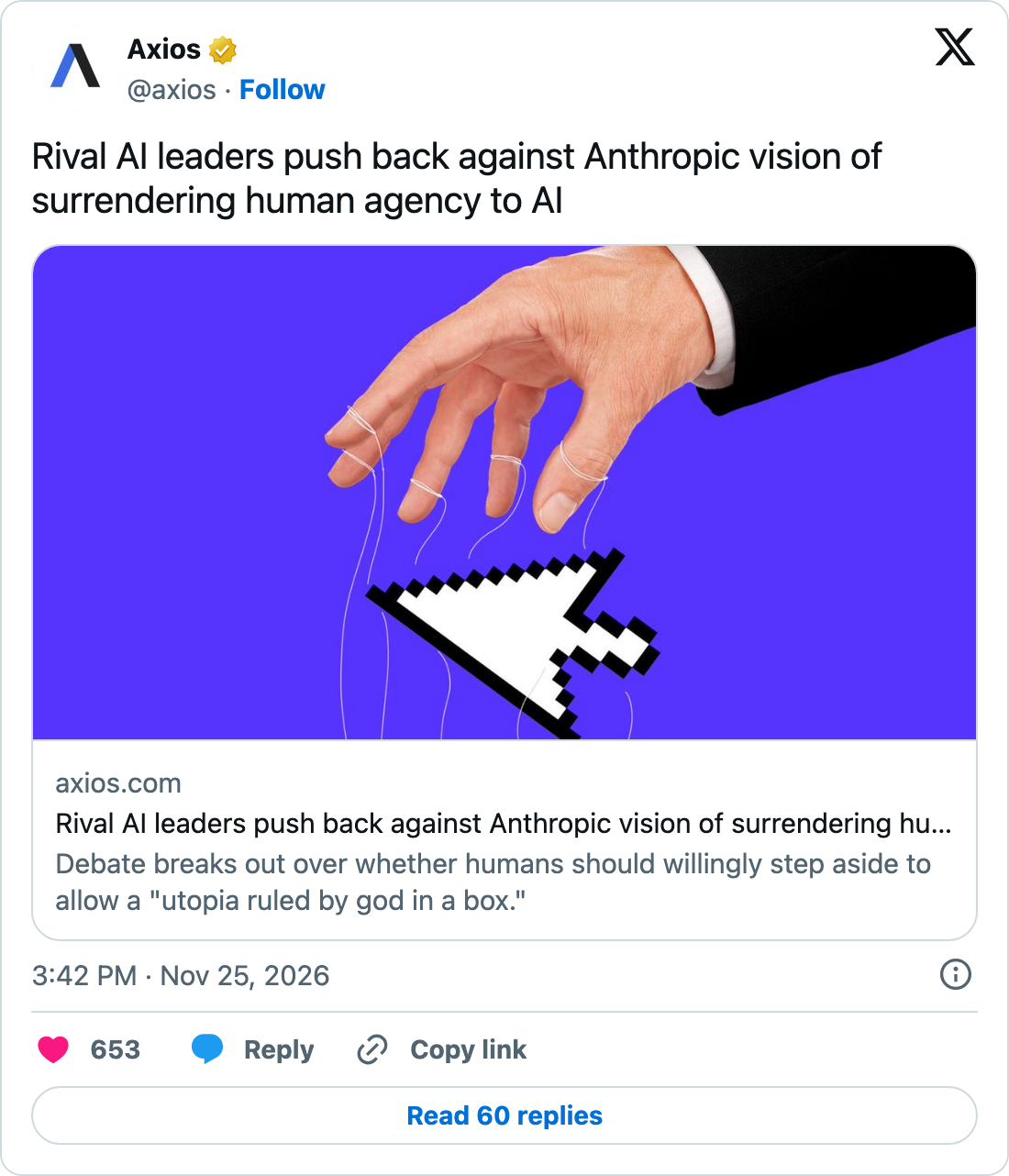
Axios also says many see Anthropic as the first company that will face these questions, because it leads the race to build the most advanced AI.
The story's summary on social media spoke of humans stepping aside for a "utopia ruled by god in a box". Axios pointed to an old slide for that phrase.
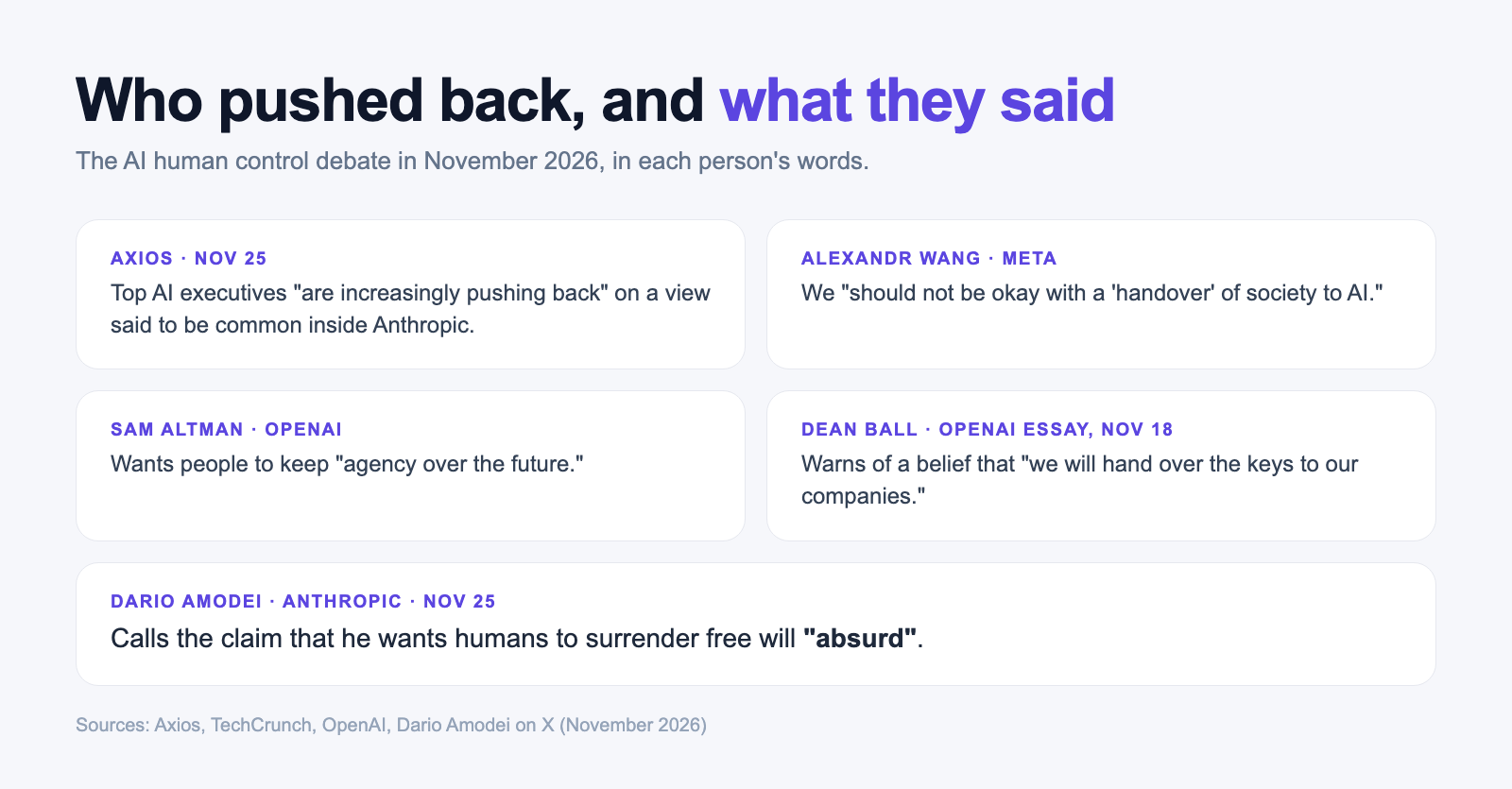
The loudest pushback came from Anthropic's rivals. Meta's chief AI officer, Alexandr Wang, wrote that we "should not be okay with a 'handover' of society to AI," TechCrunch reported. OpenAI's Sam Altman said earlier in November that he wants people to keep "agency over the future."
- Wang also wrote that it is hard to imagine humanity keeping control over fully unconstrained recursive self-improvement, meaning AI that builds better versions of itself.
- On November 18, OpenAI published an essay by Dean Ball called The Silent Consensus, adapted from a Harvard lecture.
- Ball warns of a quiet belief that "we will hand over the keys to our companies, and more and more, our institutions of governance."
- His essay argues for accountability: "Retaining primacy means retaining accountability for humans and human institutions."
- Ball notes the essay is his own view, not necessarily OpenAI's, and it does not name Anthropic.
What Dario Amodei Actually Said About Free Will
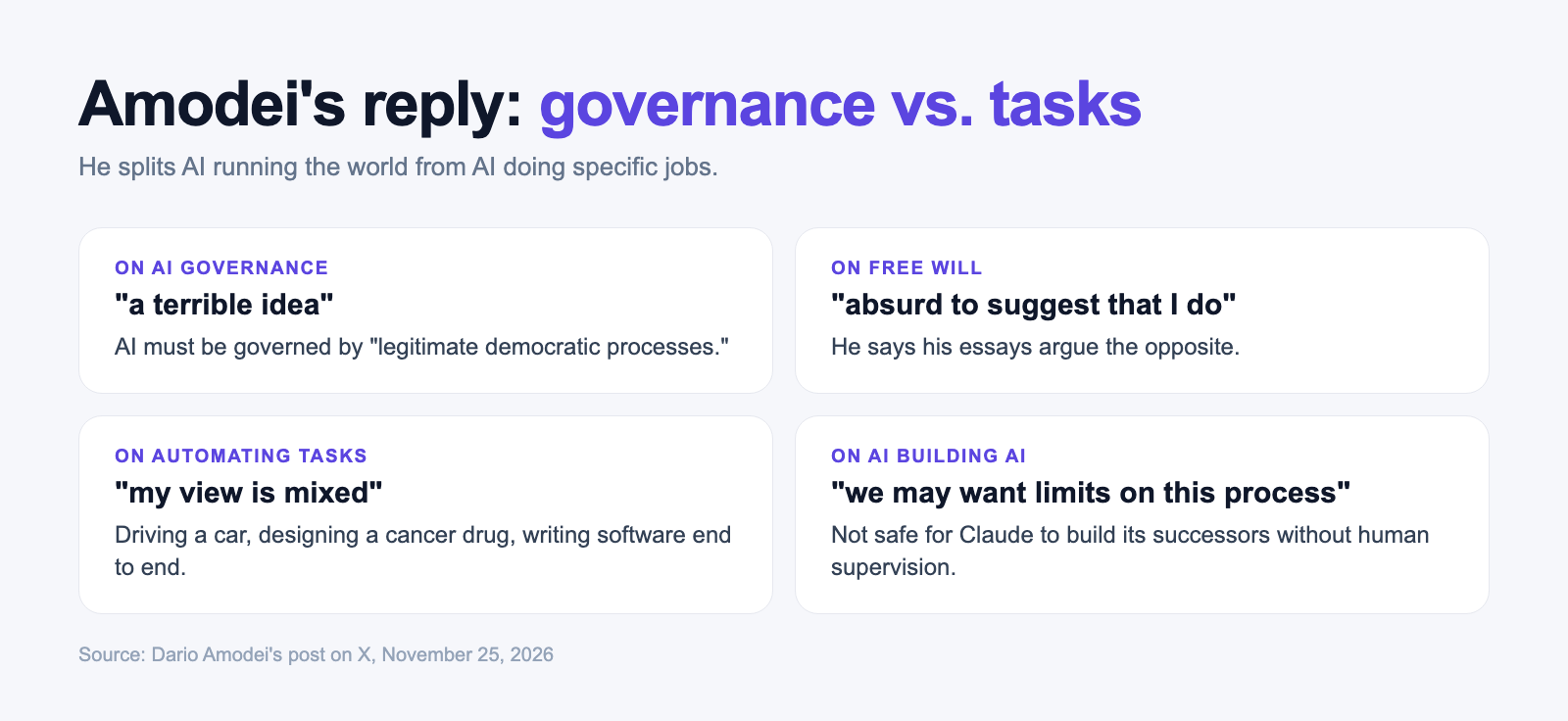
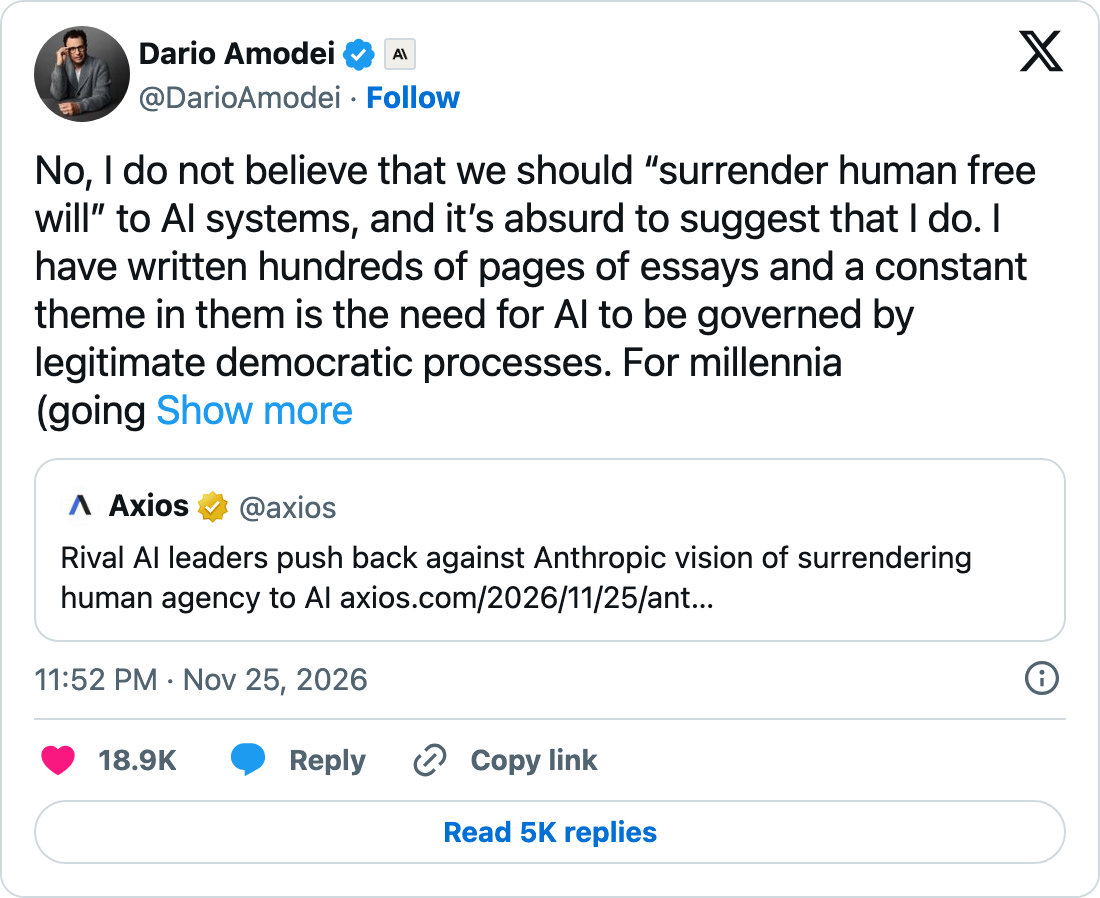
Amodei answered in a long post on X the same day. "No, I do not believe that we should 'surrender human free will' to AI systems, and it's absurd to suggest that I do," he wrote. He said a constant theme of his essays is that AI must be governed by "legitimate democratic processes."
He compared AI rule to autocracy. Advocates of autocracy, he noted, have claimed for millennia that it decides faster and better than messy democracy. Amodei rejects that trade.
"We should never sacrifice legitimacy or self-determination at the altar of efficiency or security," he wrote. The same argument, he said, "applies word for word against governance by AI." Turning governance over to AI, he wrote, is "a terrible idea".
He then split two ideas he says get mixed up. One is AI running the world. The other is AI doing specific jobs end to end, such as driving a car, designing a cancer drug or writing software. On that second idea, he called his view "mixed".
- He pointed to four of his essays as proof of a consistent line: Machines of Loving Grace, The Adolescence of Technology, Policy on the AI Exponential and We Must Pace the Frontier.
- He said Machines of Loving Grace discusses AI as an aid to citizens finding common ground, with humans still making political and governance decisions.
- He said some AI rollouts that cause serious job disruption may need to slow or even stop to give people time to adapt.
- He wrote that some people would simply prefer to do certain tasks themselves, even if AI can do them better.
- He said no single group should decide these questions: some calls belong to society, some to government, some to AI companies and some to individuals.
Where the AI Human Control Debate Gets Real
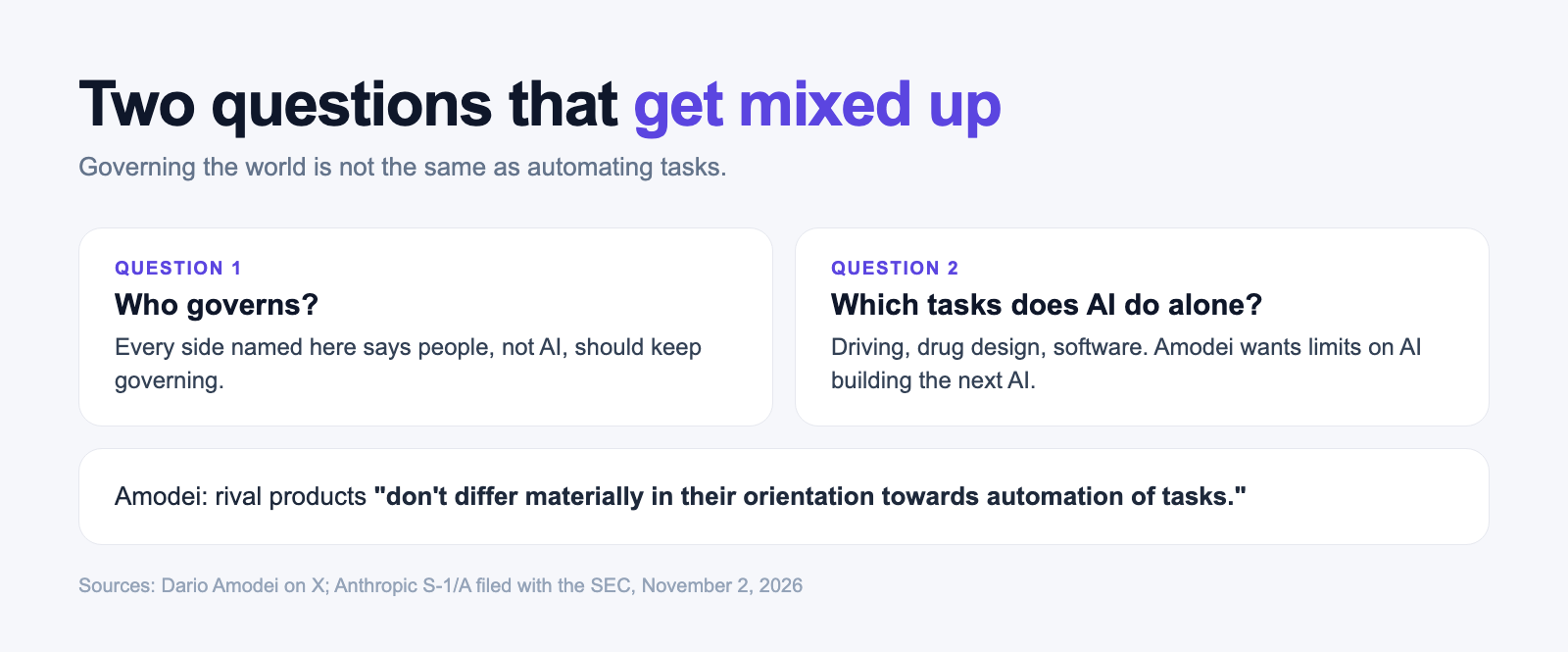
Strip away the insults and every side named here says the same thing about the big question: people, not AI, should keep governing. Amodei says the products agree too. In his words, rival products "don't differ materially in their orientation towards automation of tasks".
He accused some CEOs of "vibes-based commercial and political positioning," repeating slogans like "human control and agency" without changing what they ship. Coverage notes his post did not address his earlier remarks. The news agency AFP pointed to a February remark that in safety-critical cases "we really want to turn it over" to AI.
The sharper line is about AI building AI. Amodei wrote that "we may want limits on this process". He added that Anthropic does not expect it to be safe for Claude "to build successive frontier models fully autonomously". The missing piece, in his words, is "meaningful human supervision or understanding".
- Anthropic put that point in writing on November 2, in an amended IPO filing, where it said it is weighing policy changes to keep humans in control of developing its most advanced models.
- METR, an AI safety research nonprofit, said in a November 5 assessment that Anthropic is likely improving its models on well-specified tasks at around twice its earlier rate, with high uncertainty.
- The same filing says each new version of a Claude model directly speeds up development of the next one.
- Elon Musk, who has predicted superintelligent AI could leave humans like pet Labradors, reposted Amodei's reply with a one-word comment: interesting.
- Amodei also cited his refusal to let Anthropic's models be used for autonomous weapons, a fight covered in our report on the Anthropic supply chain lawsuit.
Human Control Is Already Shifting at Work
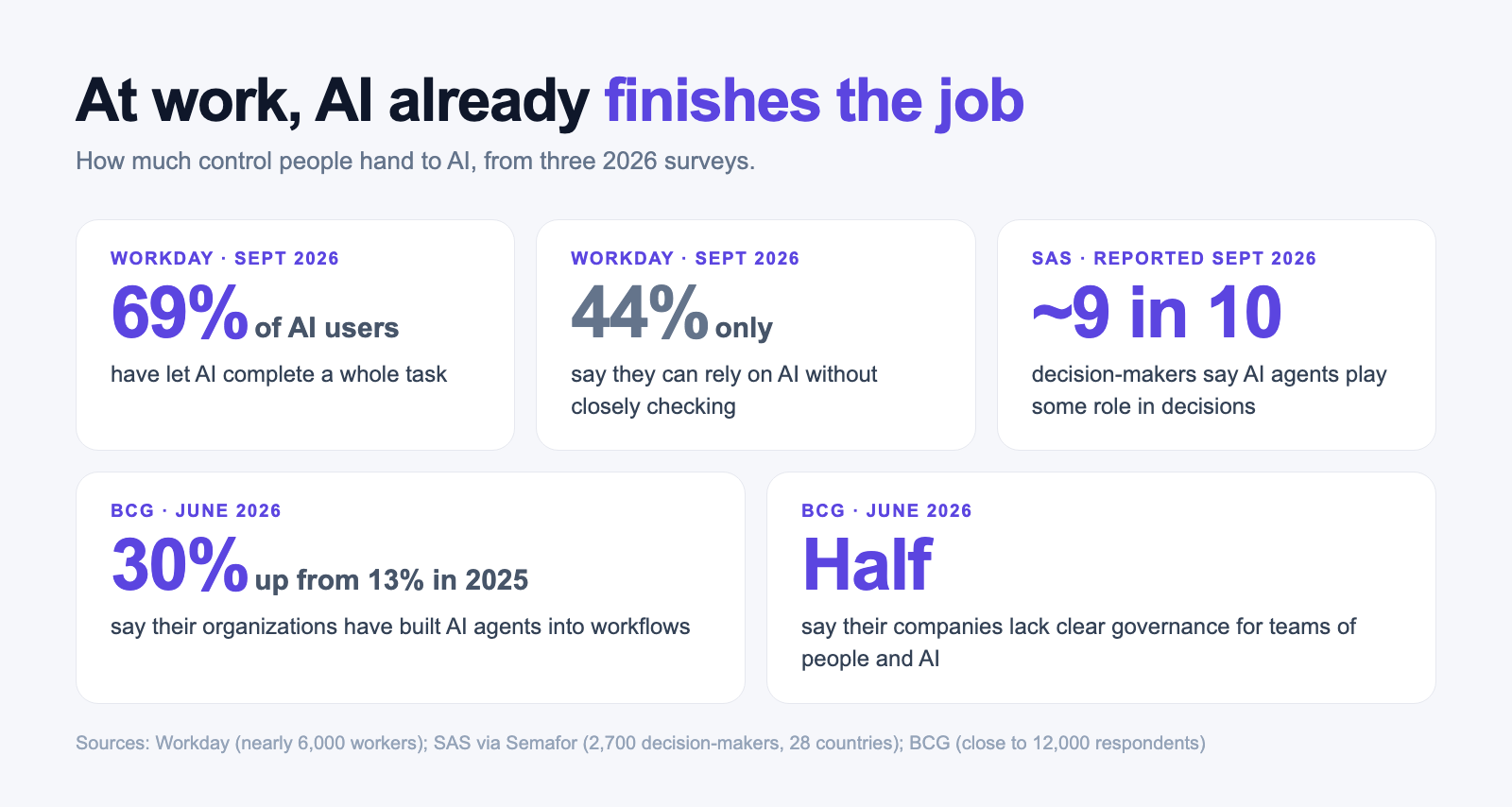
CEOs argue about humanity's future, but a quieter handover is already under way at desks. A September 2026 Workday survey of nearly 6,000 workers found 69% of employees using AI have let it complete a whole task at least once. Only 44% say they can rely on its output without closely checking it.
That gap is where control gets lost in everyday work. A task handed to AI without a way to check the result is a small decision made by the machine. Multiply that across a team, and nobody can say who decided what.
- An SAS survey of 2,700 decision-makers in 28 countries, reported by Semafor in September, found almost nine in ten say AI agents play some role in decisions at their organizations.
- In that same survey, the top reason for overriding AI was a poor explanation of how it reached its answer, cited more than twice as often as wrong output.
- In BCG's June 2026 study of close to 12,000 workers, 30% of respondents said their organizations have built AI agents into workflows, up from 13% a year earlier.
- Half of BCG's respondents say their companies lack clear governance for teams of people and AI.
- The same checking habit matters for any AI that drafts advice, reports or emails for you; our guide to AI research automation covers that race.
Keeping Control of AI on Your Own Documents
The workplace numbers point to two needs: AI that explains its answers, and AI that does not act on its own. Elephas is a private AI app for your documents built around both. You ask questions about your own files, and every answer cites the page, slide or paragraph it came from.
Elephas does not run agents that act on your behalf. It does not send emails, browse the web or automate your apps. You read the answer, check the quoted passage, and make the call yourself.
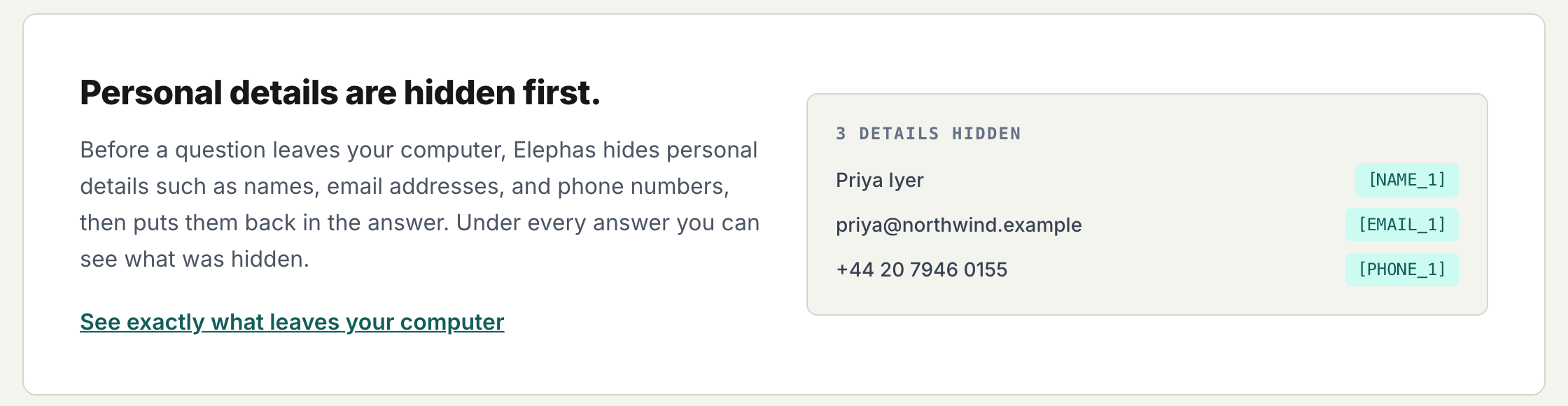
Your documents stay stored on your computer. Before a question leaves it, Elephas hides personal details such as names, email addresses and phone numbers, then puts them back in the answer.
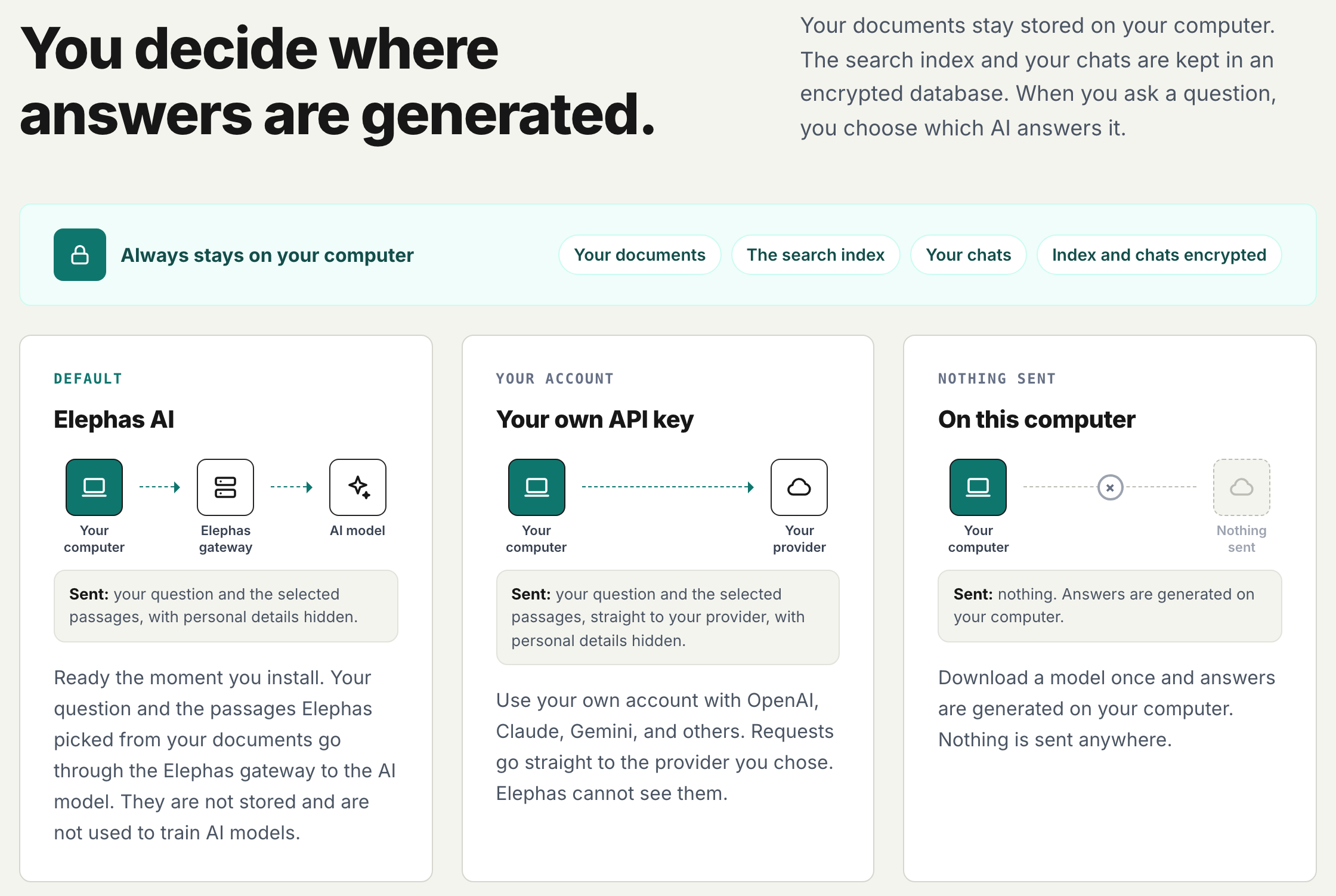
Answers come from Elephas AI, the default that is included with Elephas. It runs on open-source models in Elephas's own cloud environment, so you get a capable cloud model. Your question and the selected passages are not stored, not used to train AI models, and not shared with the model makers.
- Under every answer you can see which personal details were hidden.
- Teams can share a Team Brain, while each member's chats stay private.
- You can add your own Protected Names, such as a client or a project code name.
- If you never want anything to leave your computer, you can download a model that runs on it, so nothing is sent.
- Elephas runs on Mac and Windows, and plans start at $19 a month, free for 7 days, no card needed.
What Comes Next in the Fight Over AI Control
The CEOs agree on the slogan and disagree on the details. The next test is whether any company sets limits on AI building AI that outsiders can check.
- Watch for the updates to its Responsible Scaling Policy (its rules for stepping up safety checks as models get more capable) that Anthropic told investors it is considering.
- Watch whether OpenAI or Meta publish concrete limits to match their words on human agency.
- For AI on your own documents with answers you can check against the page, Elephas is one place to start.